Get in Touch with Mackayhairscissors Company
We use submitted details to respond to your quote request. Read our Privacy Policy.

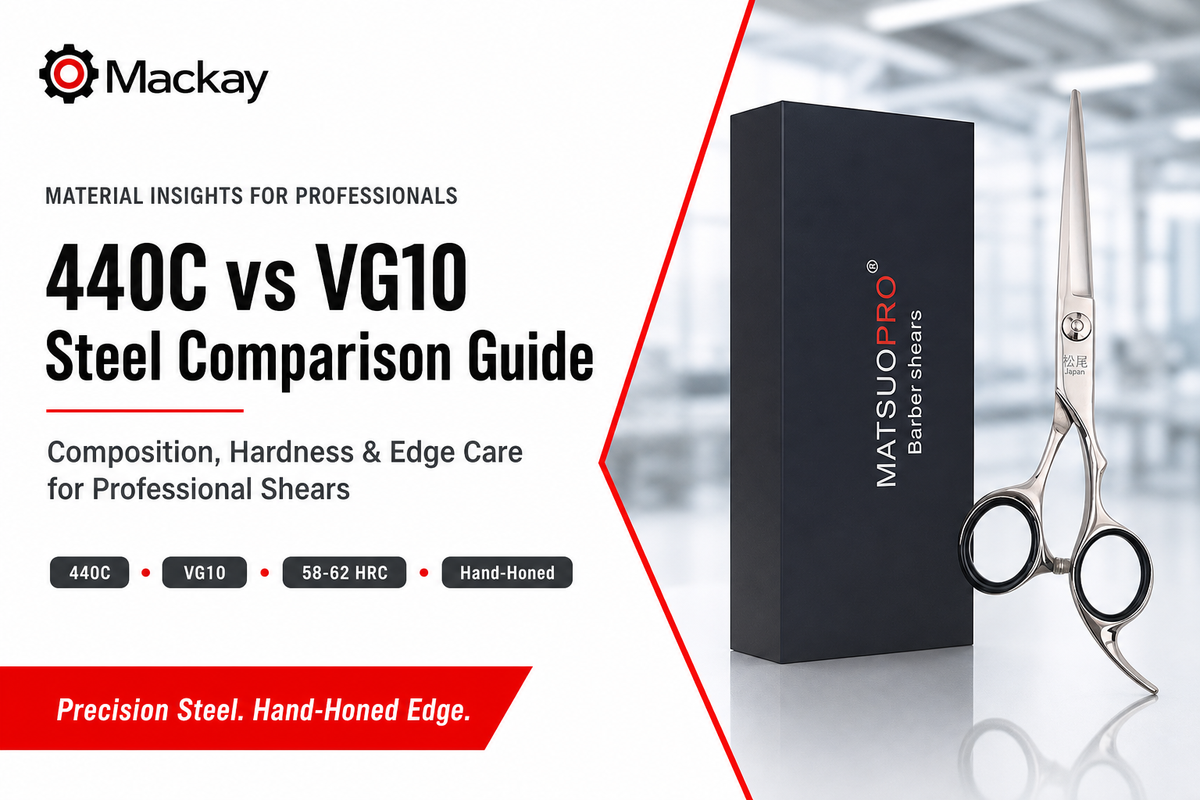
A 440C vs VG10 Steel Comparison is likely to begin and end with a spec sheet number, but a single spec sheet number alone doesn’t tell you why a particular blade can get through a full color service before needing stoning by Thursday, while another blade needs cleaning up at that time. Both steels are martensitic stainless of professional hair and pet-grooming shears, but the differences behind the spec sheet are more in the chromium, carbon and cobalt percentages than in the two or three digits you see there.
| 440C hardness | 58-60 HRC (Rockwell C) |
| VG10 hardness | 60 HRC minimum per mill spec; 58-62 HRC as commercially heat-treated |
| 440C chromium | 16.00-18.00% |
| VG10 chromium | 15.00% (mill spec) |
| Typical sharpening interval | 3-12 months, no fixed industry standard |
.440C and VG10 are both martensitic stainless steels built for professional hair and pet-grooming shears, with differing chromium, cobalt and molybdenum percentages, typical hardness (58-60 HRC in .440C versus a 60+ HRC mill spec), and wear-down-ability.
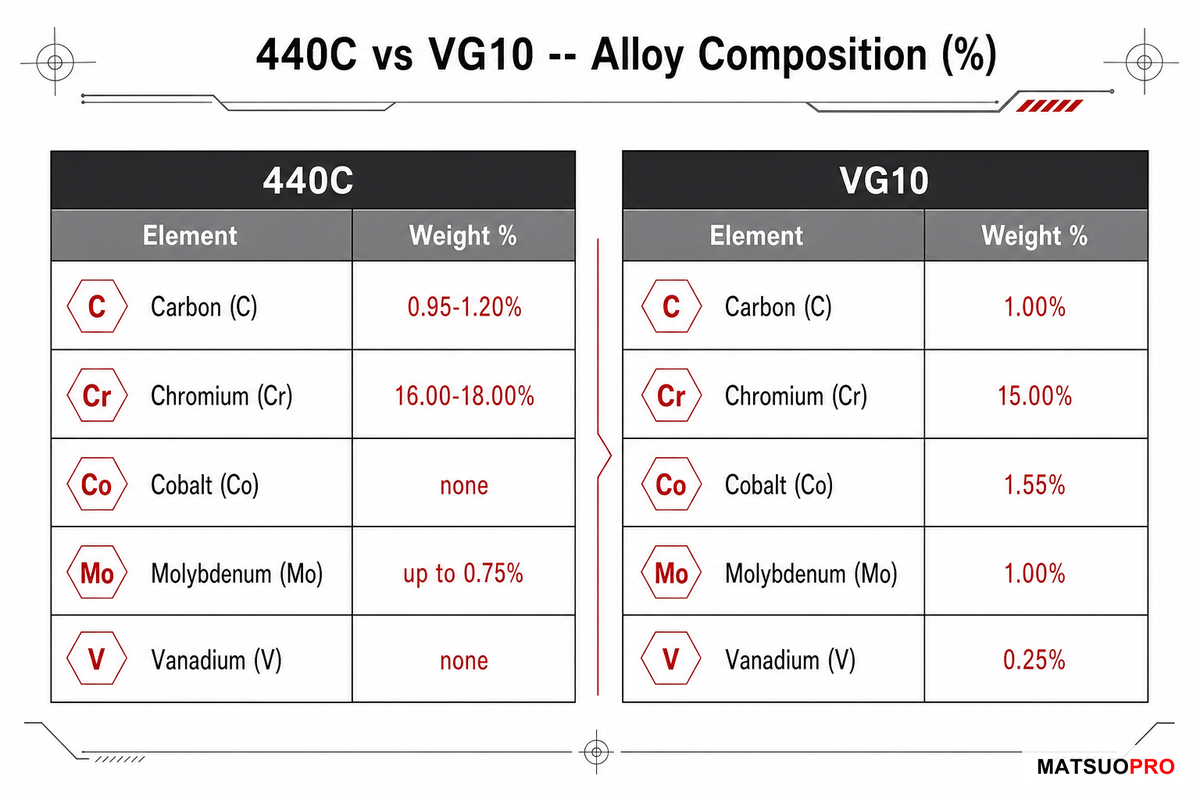
Steel is not one material. It is an iron alloyed with minute but specific percentages of other materials. Those ratios are much more important in differentiating 440C vs VG10 than either generic name is. 440C is a controlled AISI/SAE grade, governed by ASTM A276. VG10 is a proprietary Japanese formula that does not have a matching public AISI number, which is in itself one reason why side-by-side spec sheets are so hard to come by.
| Element | 440C | VG10 |
|---|---|---|
| Carbon (C) | 0.95-1.20% | 1.00% |
| Chromium (Cr) | 16.00-18.00% | 15.00% |
| Cobalt (Co) | not part of the standard spec | 1.55% |
| Molybdenum (Mo) | up to 0.75% | 1.00% |
| Vanadium (V) | not part of the standard spec | 0.25% |
| Mill-spec hardness | up to 60 HRC | 60 HRC or higher |
The information above (for 440C) is drawn from ASM International’s Alloy Digest for AISI Type 440C. Rolled Alloys’ 440C data sheet and MatWeb’s AISI 440 material property database were also used to double check the values for 440C. The values for VG10 are taken from Takefu Special Steel’s own, released specification sheet. Takefu is the grade’s creator and original producer, and as such is the closest thing there’s to a primary source for this proprietary alloy with no public AISI marker. Missing that distinction between a mill spec and a modified blend is an expensive mistake for a buyer, because a supplier can quietly substitute a cheaper composition under a familiar name, and once early resharpening and premature replacement are factored in, that kind of substitution can easily add a rough, back-of-envelope 20-30% to a shop’s real cost — an illustrative estimate, not a cited industry figure. Mackay verifies each batch’s actual composition against supplier paperwork rather than relying on the label alone.
“Professional hair-cutting shears are made of high-quality steel that is harder and has a sharper edge.”
The chromium that makes it resist corrosion is actually doing a majority of the work in both of these steels, which makes it sound as if the added 2-3% chromium of 440C would put it on top in terms of corrosion resistance. In the case of steels however, this difference in chromium is counterbalanced by the additions of cobalt and molybdenum that help refine the grain structure and improve wear resistance beyond a simple increase in the chrome percentage. Cobalt isn’t present in any appreciable amount under the standard specification for 440C, so a product description that touts itself as “cobalt 440C” implies the material has been modified or enhanced beyond the basic specification, which is exactly why comparing steel specifications between suppliers matters more than taking a product description at face value.
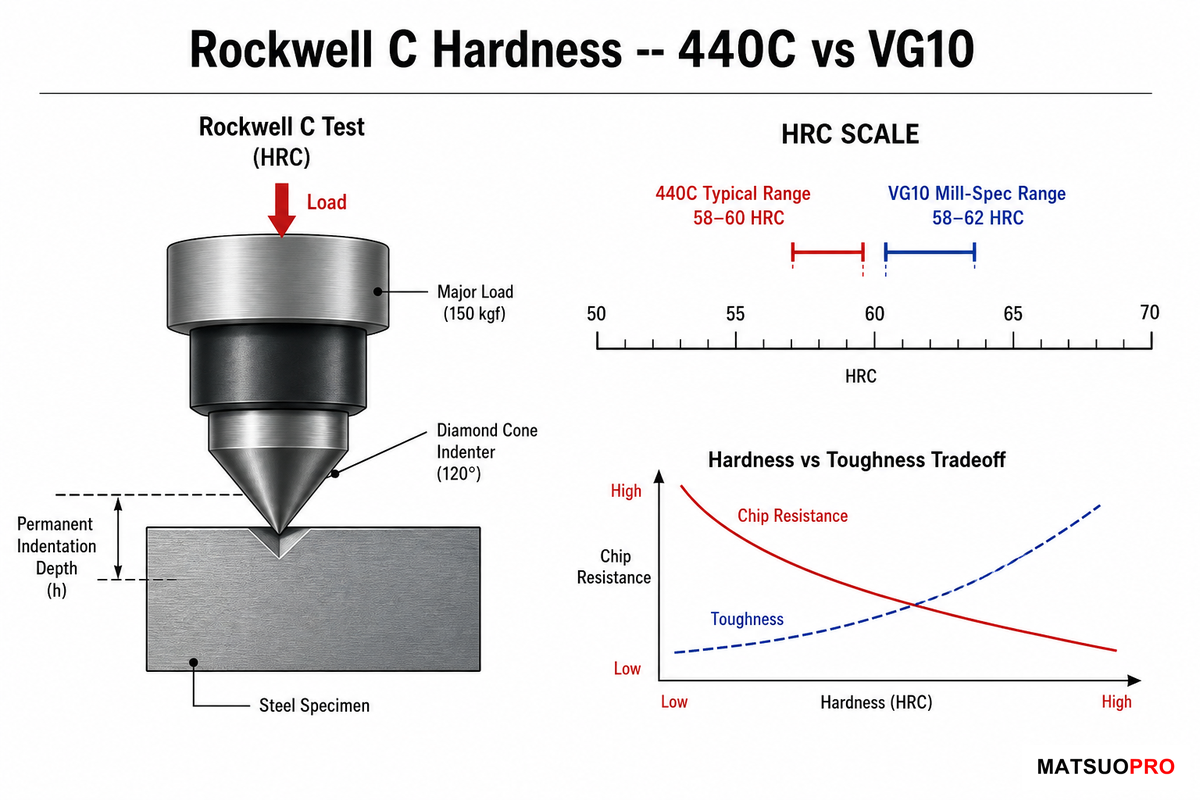
HRC, Rockwell C hardness (the Rockwell C scale used in the ASTM E18 test method referenced in federal metrology guidance) is the amount of penetration by a diamond cone indenter into the steel under a set weight. So the harder the steel the higher the HRC and the less it deforms. That is why it becomes code for “how long will the edge last.” But that code has skipped a step: the test described in E18 is performed at one spot and does not necessarily relate to how the actual ground and honed edge on your working shear will perform in the real world; it is about what the material can do under ideal test conditions, not what your actual shear will do after a year in a hair salon.
This same argument can be made against composition specifications such as the ASTM A276 that covers properties of bar and shape stock, not how well it performs when made into an actual blade.
This is where the assumption that “harder is always better” is at its breaking point. A lively debate on a cutlery forum about toughness cuts right to the chase: it isn’t just the hardness value itself but the carbide content and structure that are the critical factors that directly impact the toughness, not just the overall carbon percentage. Even if a blade has a high HRC value, it can chip under use if the underlying carbide structure is coarse and/or non-uniform- and a properly treated 440C blade may actually perform better than a poorly treated “super steel” with a higher number. Hardness, alone, describes what a steel is *capable* of, not necessarily what it’s actually doing.
440C’s principal sacrifice to the gods of sharpness and durability comes in the form of edge retention compared to VG10. Because 440C is most often offered with an HRC somewhere between 58-60, it dulls faster than a harder VG10 during heavy daily use, particularly against coarse, high-silica hair or pet coats that grind away a softer edge quickly.
It also doesn’t get the boost from vanadium, cobalt, and molybdenum that VG10’s finest carbide structure gives it, meaning a 440C edge that has been over-honed or sharpened at too steep an angle can lose its temper more easily than would an edge of VG10 under similar duress. This isn’t to say that 440C is a bad steel by any means; it’s simply one that reward more frequent, less intensive maintenance over sporadic heavy resharpening.
VG10’s generally harder nature cuts both ways: steel in the 60-62 HRC band tends to be less forgiving of sideways forces. Dropping a shear on tile, or pushing it against an exceptionally stubborn cowlick, has a statistically higher chance of chipping the blade than the same accident would with a softer 440C model.
A chipped VG10 also requires more time to restore its original cutting shape, since more material must be removed to reset the geometry at a higher hardness. Because VG10 is a proprietary Japanese formulation rather than an open standard like 440C, fewer third-party datasheets exist, making it more important to compare specs from reputable sources — this guide pulls its VG10 specification directly from Takefu Special Steel, the alloy’s originator, rather than a secondary reseller’s marketing material.
“Our quality team checks every batch of 440C and VG10 blades against third-party hardness reports before they leave the shop floor, heat-treatment consistency, not the alloy name on the spec sheet, is what actually determines how a blade performs after six months of daily cutting.”
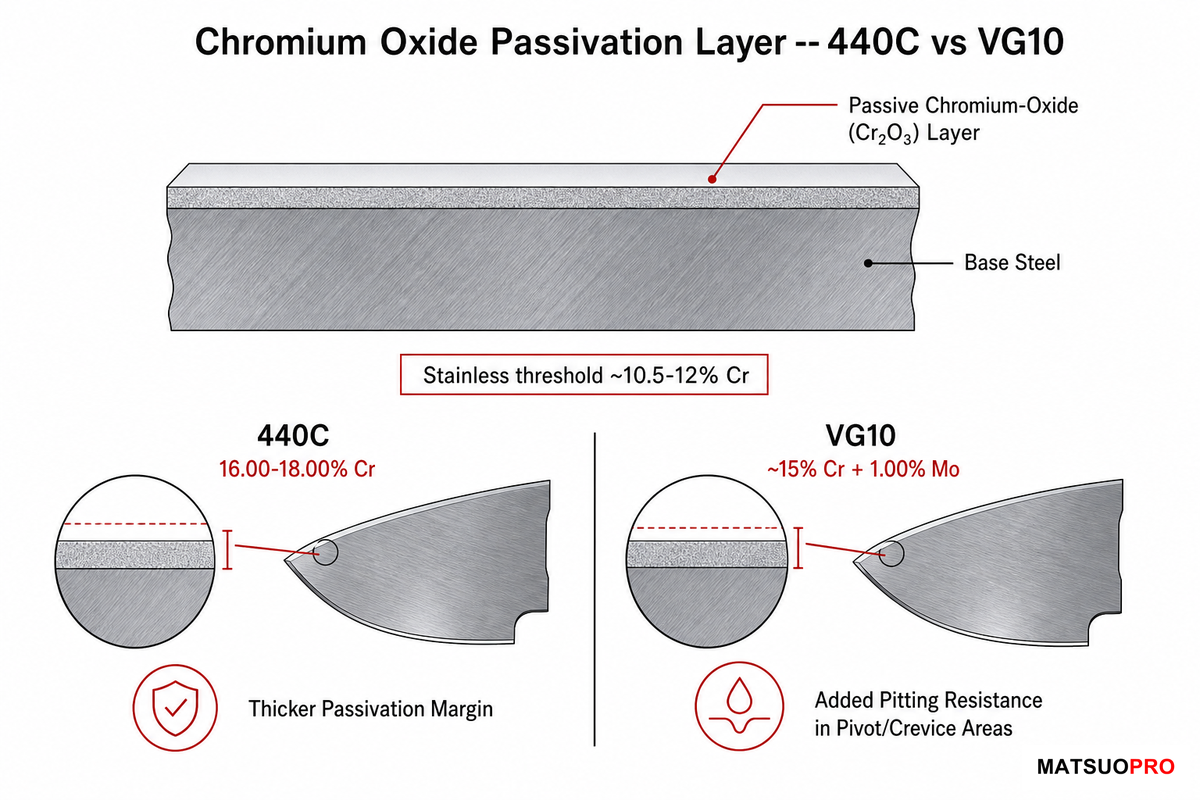
What makes a stainless steel resistant to corrosion? The answer lies in a process called passivation, during which chromium within the alloy reacts with oxygen in the air to form a very thin, protective layer of chromium oxide across the entire surface of the steel. This layer, or film, prevents the steel from further oxidation as long as chromium content is maintained at a level somewhere above roughly 10.5-12%, according to materials-passivation industry sources and computational chromium-oxide research published on ScienceDirect. Since both 440C (with 16-18% chromium) and VG10 (14-15.5% chromium) are significantly higher than this critical threshold, they’re both properly designated as stainless steels.
Now, it’s time to clear up a pervasive but misleading bit of information about these two steels. Many retail sources explain VG10’s increased resistance to corrosion by citing its higher content of vanadium. However, at approximately 0.25% by the mill specification, vanadium plays a minimal role in vg10’s corrosion resistance. Its principal purpose is fine grain refinement and improving edge stability, not providing any real protective oxide layer. In both 440C and VG10, the heavy lifting on corrosion resistance is done by the chromium, which forms the same chromium oxide passivation layer in either steel. If anything, 440C’s higher chromium content gives it a marginally thicker passivation layer on paper. That difference between the two steels isn’t generally noticeable in practice in salon or grooming applications when the blades are properly cleaned and oiled between uses.
Total chromium is far from the full rust resistance picture in the working, daily reality of a salon environment or grooming shop where products, humidity, and moisture take their daily toll. Chlorides from hair products, sanitizing solutions, and any water that seeps down into the pivot screw and crevice area will take a bite out of a passivation layer even if the total chromium percentage in the steel well exceed that of “stainless,” leading to what’s known as crevice or pitting corrosion rather than the more familiar general surface rust. A figure known as the Pitting Resistance Equivalent Number (which includes molybdenum content) quantifies that risk; VG10’s molybdenum content of about 1.00% (again per mill spec, as Molybdenum isn’t usually included in the standard 440C specs) is therefore a real (though admittedly minor) advantage in pivot area corrosion resistance apart from any supposed benefit related to vanadium, discussed in a previous section.
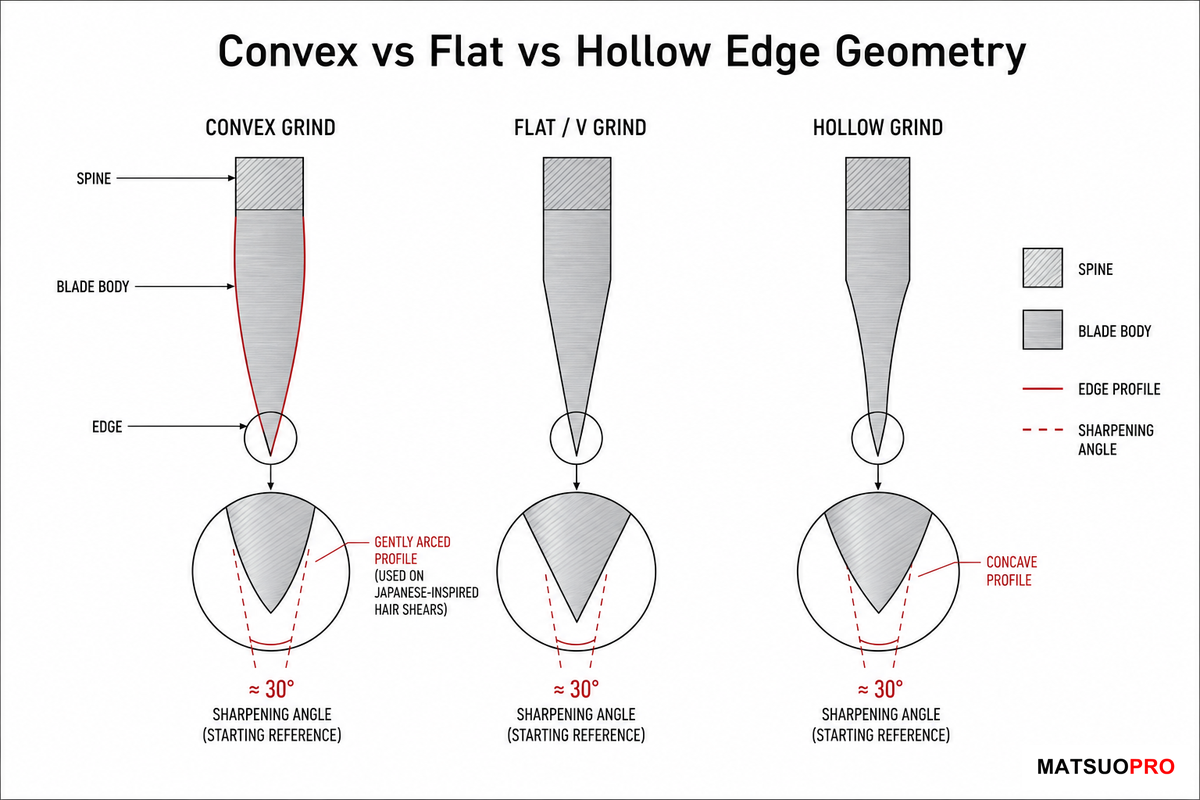
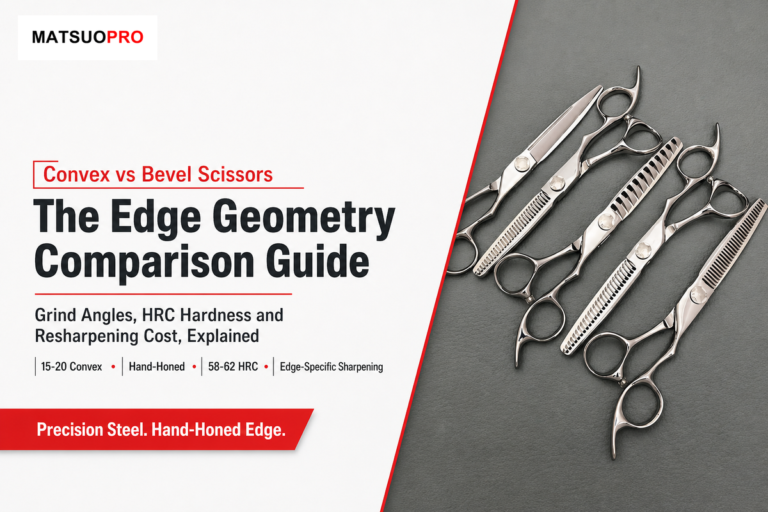
Steel grade only gets us halfway toward understanding how a pair of shears actually cut – grind is the other half of the coin. Convex grinding-the most common type for Japanese-inspired hair shears-means the blade gently arcs from spine to edge rather than being a flat angled surface. That distributes the cutting forces over a larger contact area, which gives those shears their signature smooth, gliding “cut” that professionals are looking for. Western-style shears often use a flat grind or a hollow grind that concentrates cutting force into a very fine line and can have a more aggressive feel, but is less forgiving on fine hair. The specific bevel angle where the grind meets the edge determines how much “feel” that angle create – steel grade simply determines how long it stays that way. The underlying mechanics are well documented in cutting-tool engineering research: changing a blade’s edge profile from concave to convex shifts the effective edge angle and contact geometry, per a cutting-blade geometry thesis published through Ohio State University’s engineering graduate program — the same geometric tradeoff described above, just applied to hair shears instead of an industrial cutting tool.
Of course, convex grinding complicates maintenance. A hair-shear sharpening forum post will caution that it “requires a lot of practice, a very consistent angle and specialized convex sharpening tools.” Running a convex-ground shear against a standard sharpening stone is a common mistake, because a flat abrasive cannot reproduce the compound curve a convex grind actually needs — at best it compromises the grind toward a flat edge rather than restoring the original convex shape, and fixing that trap typically means a full reprofiling — by rough estimate 15-20% more than a quick touch-up would cost, an illustrative figure rather than a cited one. Standard barber scissor-sharpening instructions will generally call for a sharpening angle of about 30 degrees as a starting point (though the angle is very specific to the manufacturer, and can vary between German-style and Japanese-style shear designs); for that reason, any factory re-sharpening service, or any shop using a convex jig, will likely perform better than a standard knife-sharpening service for a convex shear.
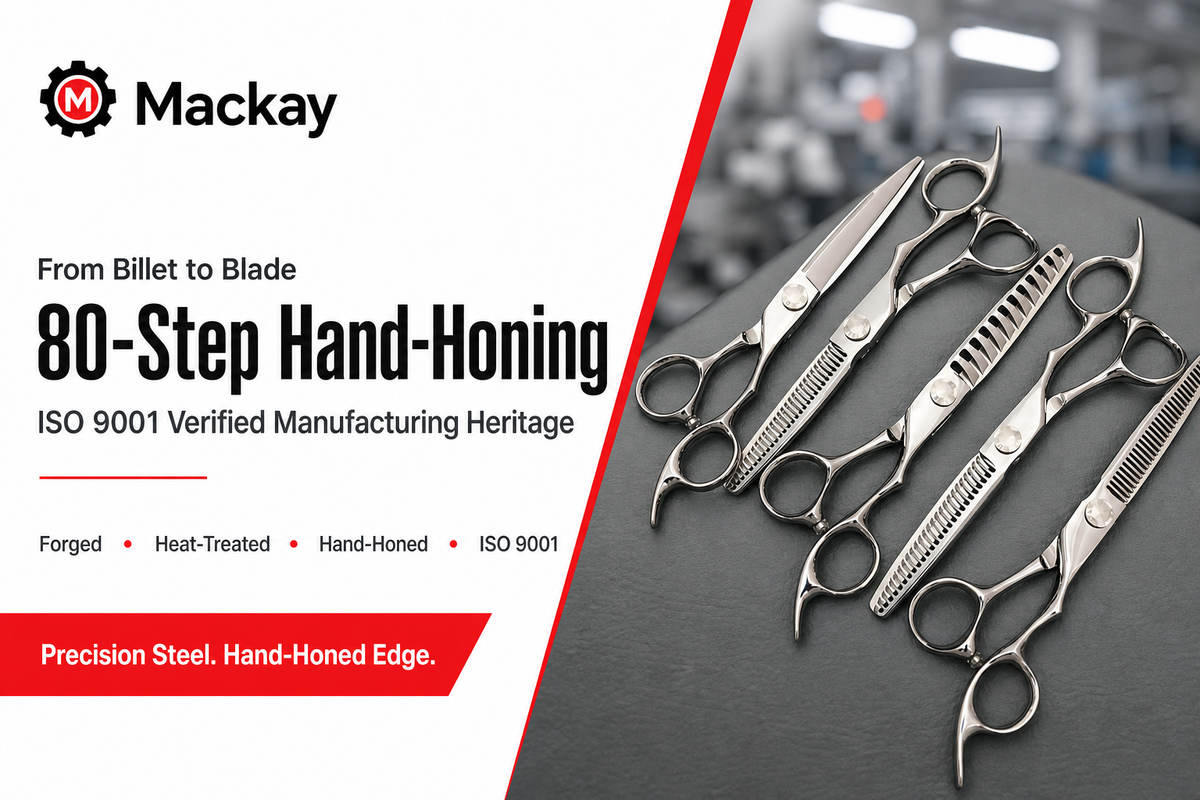
Whether it’s 440C or VG10, it begins life as forged or rolled steel billet before it remotely resembles a knife – that classic forging-and-rolling approach rather than the more exotic modern method using powder metallurgy, where atomized steel is heated and pressure-fused together, leading to more consistent distribution of carbide. Then, it’s machined into a rough blank from the billet using a stock-removal process, ground into the approximate profile, and heat-treated: heated to just above its critical temperature, quenched rapidly in oil or water to lock in a tough martensitic phase, and finally run through a tempering stage at a lower temperature to relieve brittleness while retaining its hardness. Some brands add a final cryogenic treatment step. The steel is then cooled way below freezing to ensure any remaining retained austenite transforms to martensite, an step that a cutlery forum post about 440C says “a good heat treat” accounts for why some decent “budget steel knives actually outperform a so-so” better-labeled one. Finally, a short deburring stage strips off the microscopic burr left by the grind and the blade is ready for hand-honing.
Mackay/MATSUOPRO hand grinds all convex-edge shears through 80-steps after heating, with all external material/hardness verification reports against ISO 9001 quality guide lines, BSCI and SGS audits before the blade leaves. See more on the company’s manufacturing background. It is this final hand-work that makes the convex profile described above real, and not just a selection of steel grade.
VG10 sits in the same high-quality Japanese kitchen-cutlery steel class as VG-1 and AUS-8, typically hardened higher than both thanks to its molybdenum and cobalt content, while AUS-8 runs several HRC points softer and is valued more for easy sharpening than for outright edge retention.
Most buyers shopping for a “VG10 alternative” are really looking at this same family tree, and the practical difference between grades mostly comes down to where each one lands on the hardness-versus-ease-of-maintenance curve.
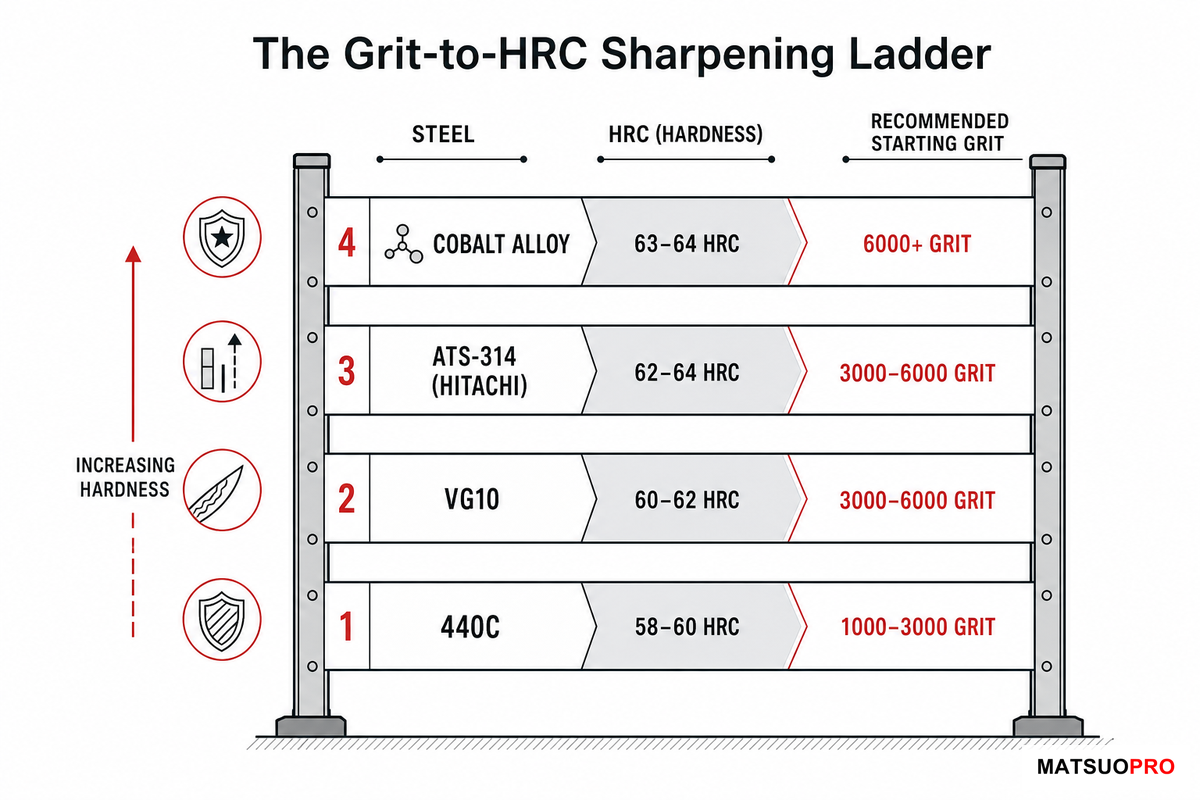
No matter which steel you put on your whetstone, you’ll generally work your way through a series of grits: the coarse (<1000 grit) to restore damaged or blunted edges; medium (1000-3000 grit) to perform basic resharpening; fine (3000-6000 grit) to achieve a refined edge; and ultra-fine (6000-8000+ grit) to give the edge a polish finish. The variable when you switch steel types is whether you’ll need to restart on the coarse stage each time or whether you’ll only need to hit the medium-and-up grits for upkeep. The general materials-science principle behind that progression is well established: NIST research on abrasive machining and surface finishing confirms that finer grit sizes progressively reduce surface roughness and material removal rate, which is exactly why a coarse-to-fine progression works on any hardened steel, not just these two.
| Steel Type | Condition | Recommended starting grit | Typical interval |
|---|---|---|---|
| 440C | Routine touch-up | 1000-3000 grit | every 3-6 months of regular use |
| 440C | Light dulling | 1000 grit, full progression up | as needed |
| 440C | Visible nicks or damage | below 1000 grit, then full progression | as needed |
| VG10 | Routine touch-up | 3000-6000 grit | every 6-12 months of regular use |
| VG10 | Light dulling | 1000-3000 grit, full progression up | as needed |
| VG10 | Visible nicks or damage | below 1000 grit, then full progression | as needed |
| ATS-314 (Hitachi) | Routine touch-up | 3000-6000 grit | estimated 8-14 months, higher hardness ceiling than VG10 |
| Cobalt alloy (63-64 HRC) | Routine touch-up | 6000 grit or finer | estimated 12+ months, longest edge life of this spectrum |
| Any steel type | Post-drop or chip damage on a convex edge | below 1000 grit, convex jig required | immediate |
The last touch is a light stropping pass after the fine-grit stage, which will clean up any remaining burrs on the wire edge and provide one last polishing step before the shear is ready to go back to work. The world of professional sharpening has no single agreed-upon sharpening frequency; providers cite anything from every three months to annually depending on your cutting volume, hair texture and your technique. Treat the chart above as a helpful guide line, not gospel-if you notice any tugging or snagging on the hair before your set date, get them sharpened immediately.
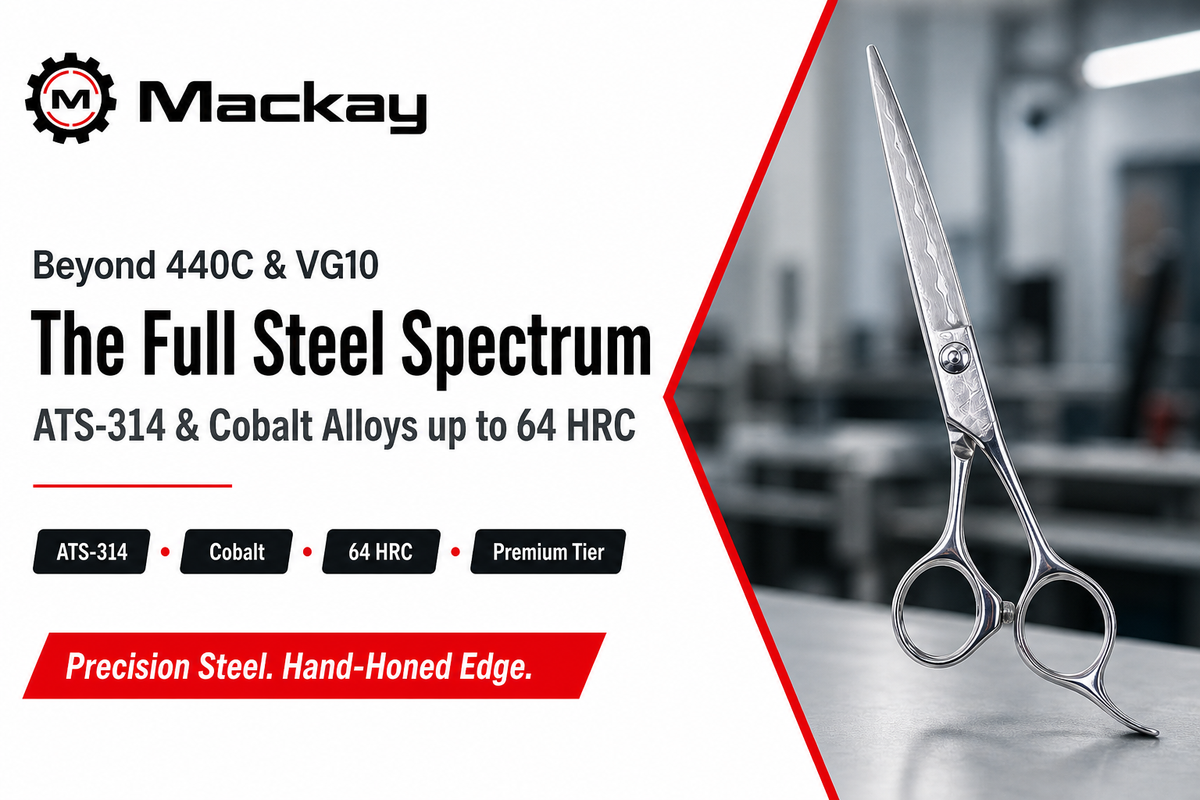
The 440C and VG10 form the upper end of the steel range that you’re likely to see in many of the professional shear choices, but it’s far from an exhaustive list. Steel such as Hitachi’s ATS-314 further expands into premium with the addition of further alloying elements for edge-retention performance. Shops demanding the absolute longest-wearing edge for the most difficult of applications will find shops with cobalt alloys reaching up to 64 HRC. However, if you’re doing six or seven cuts a day and are resharpening shears at a six-week clip regardless of steel, that may be an indication it’s time to move up the price-and-quality scale. Deciding when your own situation warrants a jump-or if the lower cost of 440C is a more sensible investment for a secondary pair of everyday shears-is something of a page-turner decision.
For a more detailed look at how 440C, VG10, ATS-314 and cobalt compare across all categories and how to make your own selection, refer to Mackay’s steel selection guide.
The habit of conducting one’s due diligence includes pushing back on the risky assumption that a higher price tag inherently translates into better shears — that is a common and expensive mistake, because in practice it doesn’t: build quality and heat-treating expertise can vary by 20% or more across the spectrum, which is precisely why this guide begins with the core elements of composition and hardness, not a price tier. Beyond steel itself, the more significant trend as we move towards 2026 is the increased vigilance expected of professionals. Barbers and stylists are being increasingly instructed to treat the phrase “Japanese steel” not as a selling point, but as an alert that a basic examination is in order, mirroring the fuzzy “cobalt 440C” marketing mentioned earlier in the article. Professionals who take the extra step to ask for actual composition percentages will be better equipped to compare shear options from various brands than those who rely solely on the marketing hype. That due-diligence habit matters more every year: employment for barbers, hairdressers, and cosmetologists is itself projected to keep growing according to the U.S. Bureau of Labor Statistics’ Occupational Outlook Handbook, which means more working professionals making steel-sourcing decisions, not fewer.
On the metallurgy side, a peer-reviewed 2025 study in Progress in Additive Manufacturing reports new post-processing techniques pushing 3D-printed 440C past 2.2 GPa ultimate tensile strength-a specialized additive-manufacturing route, not the conventional forged or rolled billet this guide otherwise describes, but still evidence that even a decades-old standard grade like 440C remains an active target for processing research rather than a frozen legacy spec. Separately, market-research estimates for the global hair scissors market vary by research house-figures in the neighborhood of high-single-digit annual growth through the early 2030s show up across more than one report-useful background context on demand direction, though the exact dollar figures and CAGR differ enough between sources that neither should be treated as a precise forecast, and neither says anything about which specific steel or sourcing practice will define that growth.
It is generally considered an entry-to-mid-tier premium steel: harder and more wear-resistant than basic 420 stainless, but softer, easier to sharpen, and less expensive than cobalt-alloyed premium grades like VG10 or ATS-314. That middle position is exactly why it remains a common choice for everyday professional shears.
It can still stain or pit if left wet, stored in a humid case, or scratched deeply enough to expose bare steel beneath the passivation layer, so routine wiping and oiling still matter.
A reasonable starting point is every 3-6 months for 440C and every 6-12 months for VG10 under regular daily cutting, adjusted sooner if you notice pulling, snagging, or visible dulling rather than waiting out a calendar schedule.
Most professional hair shears fall between 58 and 62 HRC, and within that band the “ideal” number depends more on your cutting style than a universal best answer. Stylists doing heavy daily volume with frequent dry cutting or texturizing tend to prefer the higher end of the range (60-62 HRC, typically VG10) for longer edge retention between sharpenings.
Stylists who primarily do wet blunt cutting and don’t mind more frequent light maintenance often do just as well at 58-60 HRC (440C), at a lower price point and with an edge that is faster to restore when it does dull. Very few working stylists need to chase HRC numbers above 62-beyond that range, toughness and chip-resistance start trading away faster than edge retention improves, which is why cobalt-alloy blades in the 63-64 HRC range are typically reserved for specialists rather than general daily-use shears.
Cobalt alloy blades push the hardness up into the range of 63-64 HRC, well beyond what the typical 440C or VG10 formulas can reliably reach, allowing them to retain their sharpness for noticeably longer in continuous high-volume professional use throughout a demanding workday.
However, this level of hardness compromises toughness to a greater degree than with other alloys, and the increased price makes cobalt alloys usually reserved for high-end lines catering to specialists, not general day-to-day use. (See our four-way steel comparison linked above to understand where they sit relative to 440C and VG10.)
Our discussion focuses specifically on the metallurgical and scientific principles of 440C and VG10 because most of the analyses we consulted while researching this piece jumped to the finish line with only hardness numbers and a list of marketing buzzwords. We’ve corroborated the composition data here with ASM International’s alloy digest and with multiple manufacturer data sheets, not just a single website. This review was carried out by the Mackay/MATSUOPRO technical team.
MATSUOPRO is the Mackay Hair Scissors manufacturing brand for professional hairdressing shears, barber scissors, thinning shears, and pet-grooming scissors. We support salons, distributors, academies, grooming brands, and private-label buyers that need factory-direct production with practical material guidance.
Our buying guides are written to help purchasers compare steel grades, handle styles, blade geometry, surface finishes, logo options, packaging, MOQ, and sample validation before placing an OEM or wholesale order. The goal is to make each scissors specification easier to discuss with a real production team.
Factory-direct supply since 2014, with product lines covering professional cutting shears, barber shears, thinning scissors, texturizing scissors, left-handed models, and pet grooming scissors for international B2B customers.
We focus on Japanese 440C, VG10, and ATS-314 steel choices, convex and bevel edge geometry, ergonomic handle balance, tension systems, logo engraving, private-label packaging, and sample-based OEM confirmation.