Get in Touch with Mackayhairscissors Company
We use submitted details to respond to your quote request. Read our Privacy Policy.

440C vs VG10 is the steel decision behind almost every professional hair shear, two hardenable stainless steels with different edge, corrosion, and cost trade-offs. This is a metallurgist-sourced breakdown, extended to ATS-314 and cobalt alloy, for stylists, barbers, groomers, and the salon chains and private-label brands who buy in volume. Real composition percentages, real Rockwell numbers, and the trade-offs the sales rep skips.
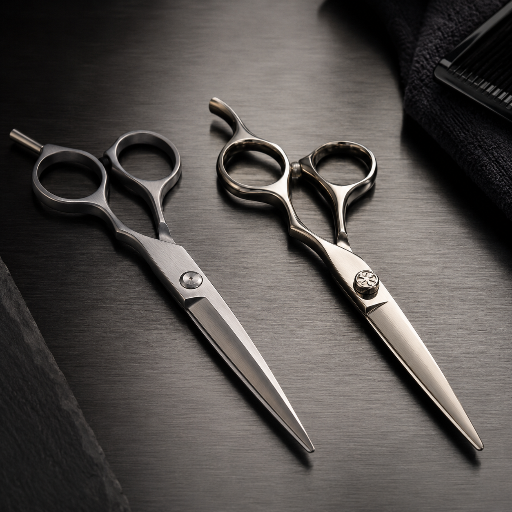
Both are hardenable stainless steels, and both land near 58–62 HRC. 440C carries more chromium, so it resists rust better and sharpens more easily; VG10 adds vanadium and cobalt for a finer edge that holds longer between hones. Neither wins outright — the right pick depends on your cutting style, climate, and sharpener.
Ask a working stylist what ruins a pair of shears and they rarely say “the steel grade.” They say the edge started folding hair instead of slicing it. They say a rough factory grind left ends frayed. They say the blades spotted with rust after a summer of sweat and hairspray, even though the box said “stainless.” And they say a dull pair forced a tighter grip that left the wrist aching by Friday.
Every one of those complaints traces back to a chain of decisions, carbon content, chromium content, how the blade was hardened, and how the edge was ground and honed. Steel choice sits at the front of that chain, which is why “440C vs VG10” is the first question serious buyers ask. But it’s only the front of the chain. What follows walks the whole thing: the four steels we work in, the honest trade-offs between them, how the edge is actually built and certified, and what it costs to own over the years a good shear should last.
Martensitic blade steels are formulated to reach at least 56 HRC after quench with balanced toughness and wear resistance (US Patent 4,353,743 – blade steel composition).
Here’s the data most shear pages leave out. This table is the Mackay 4-Steel Shear Comparison Matrix—composition, hardness, and cutting behaviour for the four steels a professional buyer actually chooses between.
Where a number comes from a metallurgist’s lab work or a published standard, it’s marked; where a figure is a trade-reported value with no independent lab test behind it, we say so rather than dress it up as fact.
| Property | 440C | VG10 | ATS-314 | Cobalt (flagship) |
|---|---|---|---|---|
| Carbon (C) | 0.95–1.20% | ~1.0% | ~1.0% (base) | high-carbon base |
| Chromium (Cr) | 16–18% (~17) | 15% | ~15% (base); trade sources cite lower | from stainless base |
| Molybdenum (Mo) | ≤0.75% (~0.4–0.5) | 1.0% | Mo-bearing | Mo-bearing |
| Vanadium (V) | none added | 0.2% | V-bearing | V-bearing |
| Cobalt (Co) | none | ~1.3–1.5% | enriched | 1–5% added |
| Hardness (HRC) | 58–60 typ; up to 62 | 60–61 typ; lab 60.7 | reported ~60–63 | up to 64 |
| Edge retention | High (above VG10 notch) | Fine edge (below 440C) | Top-tier / finest | Excellent (max) |
| Corrosion Resist | Best (highest Cr) | Very good — 7.9/10 | Very good | Good–excellent |
| Toughness | Lowest of group | 5.8 ft-lb charpy | Slightly brittle | Most brittle |
| Sharpenability | Easiest / forgiving | Easy (no V-carbide) | Needs specialist | Needs specialist |
| Best for | High-volume, DIY | Detail & slice work | Dry precision | Longest edge life |
You’ll read on some competitor pages that “VG10 resists corrosion better because it has more vanadium.” That’s wrong on two counts, and the metallurgy is settled.
First, VG10 contains only 0.2% vanadium, and vanadium’s job in that quantity is to refine the grain structure and form vanadium carbides that raise wear resistance/edge retention, not rust resistance. Corrosion resistance is governed by chromium and molybdenum held in solution. Larrin Thomas validated a PREN-style relationship on an independent dataset:
Second, 440C actually carries more chromium (16–18%) than VG10 (15%). VG10 reaches roughly the same corrosion resistance because its ~1% molybdenum counts 1.6× per unit in that relationship, and the cobalt in VG10 is close to corrosion-neutral. So the honest headline is: 440C and VG10 are both genuinely stainless, 440C edges ahead on raw chromium, and vanadium has nothing to do with it.
Trade authorities line these steels up in a consistent order of quality and price, and it maps cleanly onto how Mackay tiers its shears.
Each step up buys a finer, longer-holding edge, and asks for more careful handling and a better sharpener in return. You’ll also see Damascus steel shears advertised alongside these; a Damascus blade is usually a VG10 or cobalt core folded inside patterned cladding, so the core steel, not the pattern, still decides how it cuts.
| If your priority is… | Recommended grade | Technical logic |
|---|---|---|
| Value & durability High-volume barbering, wet cutting, humid climate | 440C | Best corrosion resistance, easiest to sharpen, lowest cost per pair |
| A keener everyday edge Mixed salon work, some slide & point cutting | VG10 | Finer edge, ~2× longer between hones in practice, still easy to service |
| Finest dry-cut precision Detail, texturizing, dry cutting; sharpener on call | ATS-314 | Finest edge and longest retention; repays a specialist sharpener |
| Maximum edge life Signature work, light hands, careful storage | Cobalt | Up to 64 HRC holds longest; least tolerant of drops and abuse |
| Low maintenance / no local sharpener You cannot easily reach a convex specialist | 440C | Standard sharpeners handle it; VG10/ATS-314 punish generalist grinders |
Match the steel to your sharpening reality, not just your ambition. A stylist without access to a convex-capable sharpener will get more life out of a 440C or VG10 pair than an ATS-314 one, because a generalist grinder using the wrong angle can devalue a hard Japanese blade in a single session. When in doubt, ask us which steel your local sharpening options can actually maintain.
REF: HARDNESS FIGURES CITED UTILIZE THE ROCKWELL C SCALE (HRC) DEFINED BY ISO 6508 / ASTM E18.
A steel grade is a promise; heat treatment and grinding are whether the promise is kept. Mackay (MATSUOPRO) has manufactured professional hair and pet-grooming shears since 2014, ships to more than 40 countries, and controls the whole build, from steel selection through the final hand-honed edge, across two production bases in Guangzhou and Zhangjiagang. Here’s what actually happens to the metal.
“The grade on the invoice tells you almost nothing on its own. What decides whether a 62-HRC edge is real all the way to the cutting surface is whether the blade was hardened without decarburizing, and whether a person, not a jig, took it to its final convex polish. We do both, and we’ll put a third-party hardness report in the box to prove it.”
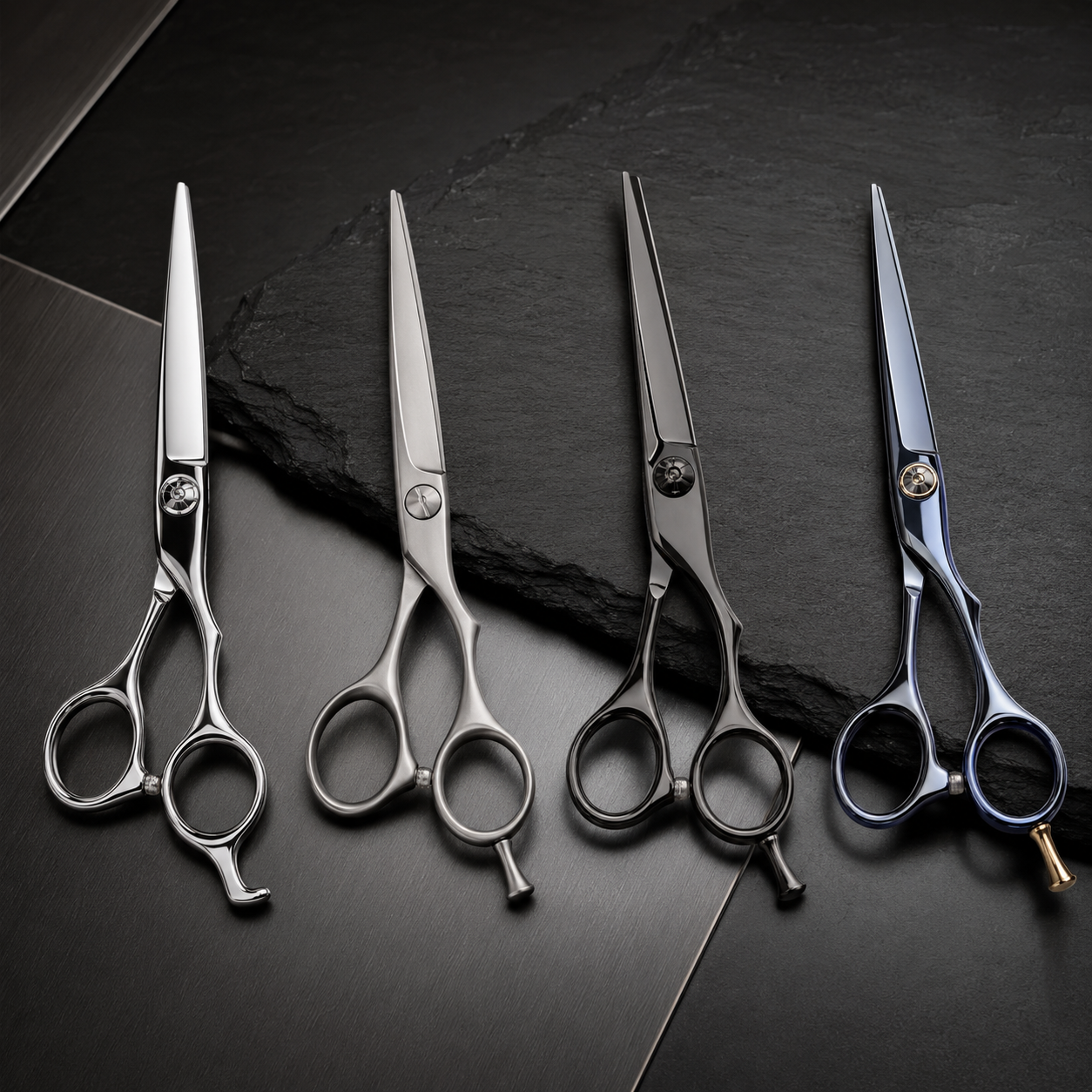
Every steel above is available across Mackay’s lines, in the sizes professionals actually reach for (typically 5.0″–7.0″ for cutting shears, plus thinning shears and blending shears).Whether you shop for them as professional hair cutting scissors, japanese stainless steel hair shears, or stainless steel hairdressing scissors, or barber shears, the four tiers below map directly onto the Shear-Steel Ladder.
Across every steel you can also specify blade length (5.0″–7.0″ for cutting work) and the handle: a straight handle, an offset handle, or a crane handle for a more ergonomic, neutral wrist position. Handle geometry decides comfort over a long day; the steel decides the edge.
Groomers cut a different material under different conditions, so the shear change even when the steel doesn’t. Dog and cat coats are coarser and dirtier than human hair, which dulls an edge faster and rewards the higher-retention steels; the work also leans heavily on curved blades for shaping legs and faces and on longer 7.0″–8.5″ lengths for body coats. Groomers in the trade are especially price-to-performance driven, the same “cheap steel costs more in the long run” logic applies, because a blade that need re-honing every few weeks eats any upfront saving. Mackay builds curved, straight, and thinning grooming shears in all four steels, with the same vacuum-hardened, hand-honed edge.
Answer four questions. The tool weighs edge retention, corrosion, and — honestly — whether you can actually sharpen a hard Japanese steel where you work.
Launch SelectorSticker price is the smallest part of what a shear costs. Enter your numbers and see the real total across the three mid-range steels, sharpening included.
Calculate TCOToggle the steels you’re weighing. Green marks the leader in each measurable row. Every composition and hardness figure is trade- or metallurgist-sourced (see notes).
Compare SpecsBoth are genuinely stainless, and 440C edges ahead. 440C carries 16–18% chromium versus VG10’s 15%, and chromium (with molybdenum) is what drives corrosion resistance. VG10 closes most of the gap through its ~1% molybdenum and rates about 7.9/10 on the metallurgist scale — very good, just a step behind 440C on raw rust resistance.
No. VG10 contains only 0.2% vanadium, and at that level vanadium refines grain and forms wear-resistant carbides — it improves edge retention, not rust resistance. Corrosion resistance comes from chromium plus molybdenum in solution; the validated relationship (Cr + 1.6×Mo + 0.8×W + 6×N) has no vanadium term at all.
In daily salon use, stylists commonly report resharpening VG10 about half as often as 440C — roughly 9–12 months versus 6–9 months at 20–25 clients a week. Interestingly, lab CATRA wear testing puts VG10 a small notch below 440C, so VG10’s real advantage is a finer, more refined edge rather than more raw wear resistance.
ATS-314 is the edge-retention champion of the mid-range group — a proprietary Hitachi-group cobalt-enriched stainless that takes the finest edge and holds it longest. The trade-offs: it is slightly more brittle at high hardness, its lower chromium asks for more rust discipline, and it demands a specialist sharpener. Its exact composition is a trade secret, and the reported hardness (~60–63 HRC) comes from the trade rather than an independent lab. For detail and dry cutting with a convex-capable sharpener on hand, that finest edge earns its keep; for high-volume wet work, VG10 or 440C is the more forgiving pick, and initial sharpness between them is near-identical anyway.
Roughly 58–64 HRC. Below about 58 the edge won’t hold up to daily professional use; 440C typically runs 58–60, VG10 around 60–62, ATS-314 around 60–63, and cobalt flagships reach 64 with vacuum and cryogenic treatment. Higher hardness buys edge life but also brittleness, so above 63 the blade needs careful handling and expert sharpening. HRC sits on the Rockwell scale, measured per ASTM E18 / ISO 6508.
Manufacturing geography is not the deciding variable — heat treatment, grinding, edge honing, and quality control are. Many premium Western brands already OEM the same Japanese steel and produce overseas; professionals reject the fake-“Japanese” rebrands sold at a markup while recommending transparently Chinese-made shears built from real Japanese steel. Verifiable specs — a stated HRC, a named steel source, and a third-party hardness report — settle the question.
Yes. Sweat, hairspray, and salon chemicals stain even stainless blades, and lower-chromium steels show it soonest. Wipe dry, sanitize with alcohol, and oil the pivot daily.
Coat is coarser and dirtier than human hair, so grooming shears favour higher edge-retention steels and re-hone more often. Geometry differs too: curved blades and longer 7.0″–8.5″ lengths for shaping legs, faces, and body coats. Steel science stays identical.