Get in Touch with Mackayhairscissors Company
We use submitted details to respond to your quote request. Read our Privacy Policy.

Hair scissor steel is where most buying decisions go wrong, not because the wrong grade gets chosen, but because grade labels and HRC numbers get treated as the whole story. They aren’t. As a vertically integrated shear factory, we forge, heat-treat and hand-hone every blade in-house, so this guide explains what actually separates a $90 pair of 440C shears from a $300 pair of the same steel, with published composition, honest provenance, and the test data most sellers won’t show you.
If you cut for a living — match the steel to your volume, technique and sharpening access, not to a marketing tier.
If you source or private-label shears — spec the right grade per product tier, and learn exactly which evidence to demand from any factory (including us).
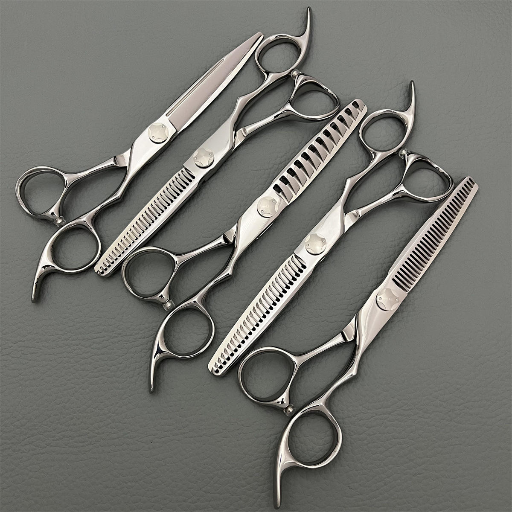
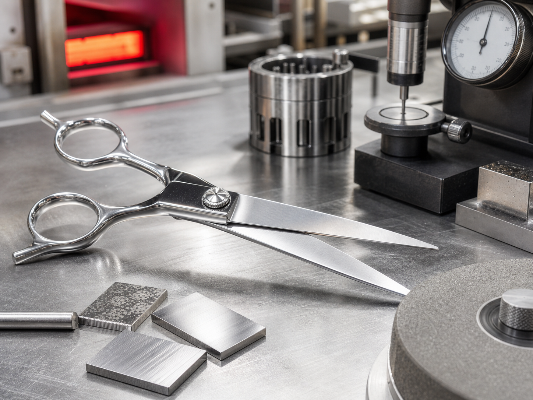
That’s the core idea of this guide, and we call it plainly. Change any one factor to zero and the blade fails, no matter how premium the other three.
A flagship alloy hardened on a sloppy furnace curve, or a perfect heat-treat ground on a worn wheel, both produce a disappointing shear.
A hair scissor blade is a stainless steel cutting edge that has to stay sharp through wet hair, product residue and daily cleaning, so it’s judged on three properties in constant tension: hardness, edge retention and corrosion resistance — the same properties that ISO 7153-1, the metals standard for cutting instruments, uses to classify surgical-grade stainless steels. Push one up and another usually gives. That trade-off is real, and it’s where the useful conversation lives.
Instead, the market’s conversation lives somewhere less useful: on the grade name stamped on the blade and the single HRC number beside it. Both matter. Neither is the whole story.
A well treated 440C can outperform a poorly treated VG-10, the better-made blade out-cuts and out-lasts the rushed premium one. 440C spent years with a mediocre reputation not because the alloy was weak, but because it was routinely under-heat-treated. Grade sets the ceiling; heat treatment and finishing decide how much of that ceiling you actually get.
Here is every steel you are likely to meet on a professional shear spec sheet, decoded by composition, hardness, edge life, corrosion and best use, all within the martensitic stainless family that ISO 7153-1 defines for cutting instruments. Hardness values are design/per-lot targets measured on the blade per ASTM E18 / ISO 6508, not a single guaranteed number for a finished shear (more on why in the next section). Composition ranges are the published grade specifications.
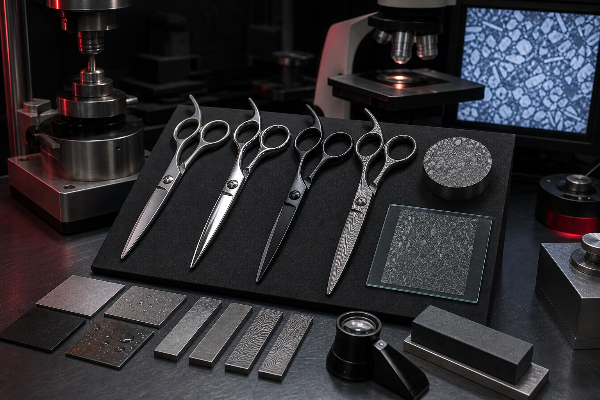
| Steel grade | Key composition | HRC band | Edge retention | Corrosion | Relative cost | Best-fit use |
|---|---|---|---|---|---|---|
| China 440C | C 0.95–1.20 / Cr 16–18 (UNS S44004) | 56–58 | Good | Excellent | $ | Value pro & apprentice lines; high corrosion margin |
| Japanese 440C | Same UNS S44004 spec | 58–60 | Good+ | Excellent | $$ | The all-round professional workhorse |
| VG10 (Takefu) | +Co 1.5 / V 0.10–0.30 / Mo 0.90–1.20 / Cr 14.5–15.5 | 60–62 | Very good | Very good | $$$ | Precision & slide cutting; longer sharpening intervals |
| ATS-314 (Proterial) | +Mo 1.00–1.30 / Co 1.0–1.5 / Cr 13–14.5 | 61–63 | Excellent | Good | $$$$ | High-volume stylists prioritising edge life |
| Cobalt alloy flagship | Higher cobalt content | 64+ | Excellent | Good | $$$$$ | Flagship blades; demand daily maintenance |
| Damascus (pattern-welded) | 8–32 folded stainless layers | 61–62 | Excellent | Very good | $$$$$ | Premium look + edge; the pattern is structural, see H2-4 |
| 420 / stainless alloy | Lower carbon than 440C | 56–58 | Fair | Very good | $ | Entry / home shears; softer edge, easy to sharpen |
| 8Cr13MoV | Chinese mid stainless | 56–58 | Fair+ | Good | $ | Budget lines; competent all-rounder when well treated |
Two rows deserve a second look. The China 440C and Japanese 440C rows carry the same grade specification, the difference in their HRC band is a heat-treatment and melt-cleanliness story, not an alloy story (we return to this under provenance). And the jump from 440C to VG10 buys you cobalt and vanadium, which refine the grain so the edge gets finer and holds longer, a genuine upgrade for slide-heavy work, and an unnecessary premium for someone doing mostly blunt cutting.
This is exactly where sourcing budgets leak. Specifying ats-314 shears or vg10 shears for a range that mostly sells to blunt-cutting barbers pays for edge-life those users will never notice, the honest spec is often Japanese 440C at roughly half the cost, or entry 440c scissors and cobalt steel scissors placed precisely where each belongs. A distributor who read this table by use rather than by prestige would cut per-unit steel cost 30–50% on the value tier while keeping a genuine flagship at the top, which is how you find the best hair scissor steel for the buyer, not the most expensive one.
HRC is the Rockwell C hardness scale, a differential-depth measurement of how far a diamond indenter sinks into the blade under a defined load. Higher HRC means a harder blade that resists edge deformation and holds sharpness longer, but also a more brittle one that chips more easily and demands a more skilled sharpener. For hair shears the useful band is narrow: below 58 HRC the edge rolls too fast under daily professional use; above 63 you’re into specialist-handling territory.
That number is measured to ASTM E18 in North America and its international equivalent ISO 6508. Here is the honest caveat the standard itself states, and that no marketing HRC badge mentions:
ASTM E18 explicitly warns that “Rockwell hardness testing at a specific location on a part may not represent the physical characteristics of the whole part or end product.” A blade is hardest at the edge and varies along its length. So a credible HRC figure is a design / per-lot value at a defined blade test point, which is exactly how we publish ours, and what you should expect any supplier to clarify.
“Rockwell hardness testing at a specific location on a part may not represent the physical characteristics of the whole part or end product.”
A credible HRC figure must be a design / per-lot value at a defined blade test point.
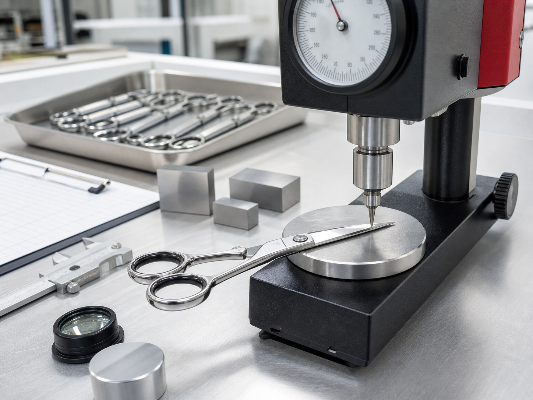
In practice, treat HRC as a band, not a badge. For a working barber or a busy hairdressing salon, that means judging a blade by its documented heat-treat and quality steel, not the number stamped on it. A shear stated at “62 HRC” tells you less than a 60 HRC shear with a per-lot report. For the full breakdown, see our HRC hardness deep-dive. Where most sellers publish a lone HRC badge, we publish the evidence.
Comparing suppliers on hardness claims for a purchase order?
Get our per-lot HRC test reports →These three names dominate every shear-buying debate among barbers and hairdressers alike. Our comparison below uses published composition and hardness plus real-world edge-life patterns reported for a stylist cutting 20–25 clients a week, not a manufacturer’s single “lasts 3× longer” claim. That same metallurgy applies whether the steel becomes a straight cutting blade or a thinning and texturizing shear that must still thin hair cleanly, because both cut hair against the identical grade, hardness and heat-treat. Each grade below sits in the martensitic stainless class defined for cutting instruments in ISO 7153-1.
| Factor | 440C | VG10 | Damascus (pattern-welded) |
|---|---|---|---|
| HRC band | 58–60 | 60–62 | 61–62 |
| Grain / edge fineness | Good | Finer (V + Co) | Fine (core edge steel) |
| Edge retention | Sharpen ~2×/yr | ~1×/yr typical | ~1×/yr typical |
| Corrosion resistance | Excellent (Cr 16–18) | Very good (Cr 14.5–15.5) | Very good |
| Sharpening | Any competent pro | Japanese-edge specialist | Damascus specialist |
| Best for | All-round, high corrosion margin | Precision / slide cutting | Premium finish + edge life |
Notice what the edge-retention rows really say: buyers report VG10 can go twice as long between sharpenings as 440C, but harder steels cost more per service, so annual sharpening spend lands surprisingly close across all three. VG10 earns its premium for stylists doing fine, slide-heavy work who value fewer sharpening trips; 440C remains the honest default for mixed cutting and humid salons. A full head-to-head with edge-life timelines lives in our dedicated 440C vs VG10 comparison.
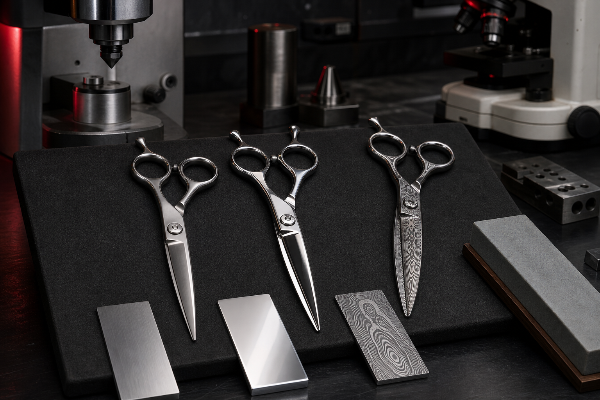
Modern hair-shear Damascus is pattern-welded: typically 8 to 32, sometimes more, alternating layers of stainless forge-welded together, with the wave pattern revealed by acid etching. It isn’t the ancient wootz (crucible) Damascus, and, contrary to the common seller line that “Damascus hasn’t been made in 300 years, it’s only a design” — it’s a genuinely different, more labor-intensive construction. But be equally clear the other way: more layers make a finer pattern after etching, not automatically a sharper cut. Cutting performance still comes from the edge steel grade, its HRC and its heat treatment. Buy Damascus for the finish and the engineering, and hold it to the same edge-evidence you would hold any other blade.
Choosing between 440c scissors and a VG10 upgrade for your line?
See the full 440C vs VG10 breakdown →This is where the grade on the spec sheet meets the factory that made the blade, the three multipliers that decide how much of a steel’s potential reaches your hand.
440C is hardened by austenitising near 1010–1065 °C, then quenched and tempered, and the tempering window matters, because tempering 440C in the wrong range measurably lowers its corrosion resistance, one reason the heat-treatment window matters as much as the alloy for the instrument steels covered by ISO 7153-1. Get the curve wrong and you get a soft, rust-prone blade from a premium bar. We vacuum heat-treat and cryogenically temper every premium blade, which stabilises the martensite and lifts hardness into the 60–62 HRC band on our standard premium lines, with cobalt flagship blades run harder; we confirm the exact per-lot figure on request rather than publish one flattering number.
Two bars of identical grade can carry different levels of inclusion and carbide segregation depending on how cleanly the steel was melted. Cleaner steel takes a finer, more uniform edge and chips less. It’s invisible on a spec sheet, which is exactly why it separates a commodity blade from a premium one at the same HRC.
A CNC-cut blade isn’t a finished edge. Our craftsmen hand-hone each premium blade to a Japanese convex (hamaguri) edge and mirror polish, then hand-tension and inspect it one pair at a time, part of the 80-plus individual steps every premium shear passes through. A convex edge glides rather than pushes through hair for a clean, sharp cutting action; a machine-only edge, on the same quality steel, doesn’t.
“We settled on vacuum heat-treatment plus a cryogenic temper because it is the only route that gave us a repeatable 60–62 HRC across a full production lot without sacrificing corrosion resistance. The alloy sets what is possible; the furnace curve and the hand-honing decide what actually ships.”
Want the heat-treat and hardness detail behind a specific grade?
Talk steel with our engineers →Origin is the most manipulated line in this market, so here’s how to read it, starting with our own. Our shears are manufactured in China from premium Japanese steel. That’s the accurate, verifiable statement: the steel is Japanese; the finished country of origin is China. We never say “Made in Japan,” because that would misstate where the product is made, and for goods imported into the United States, country-of-origin marking (19 CFR 134.11) is a legal requirement, not a slogan.
Now the metallurgy that the “Chinese steel is inferior” framing gets wrong. China 440C and Japanese 440C are the same grade, UNS S44004, one of the standardised 400-series SAE steel grades, with the same published composition. A grade is a global specification, not a nationality, and a reputable mill’s China 440C meets that same UNS S44004 spec. Where they genuinely differ in practice is downstream: melt cleanliness, heat-treatment consistency and honing quality, the three multipliers from the last section. That’s an honest, defensible reason a Japanese-finished 440C can outperform a bargain-bin one, and it’s the same reason our China-finished, Japanese-steel blades stand up: we control those multipliers in-house.
Two more origin facts sellers routinely blur, corrected here: VG10 is made by Takefu Special Steel (not Hitachi), and ATS-314 is made by Proterial, the company formerly known as Hitachi Metals, renamed in 2023. If a spec sheet still credits ATS-314 to “Hitachi Metals,” it’s quoting old copy. Precision about provenance is itself a trust signal.
If you’re building or extending a private-label range, the steel choice is a positioning decision as much as a technical one.
| Product tier | Steel we spec | HRC target | Positioned for |
|---|---|---|---|
| Value / apprentice | China 440C | 56–58 | Students, emerging barbershops, price-led ranges |
| Core professional | Japanese 440C | 58–60 | The volume seller — reliable, corrosion-safe |
| Premium | VG10 | 60–62 | Precision stylists, longer sharpening intervals |
| Flagship | ATS-314 / cobalt / Damascus | 61–64+ | Halo products, edge-life & prestige buyers |
By far the biggest gap in the steel-guide market is evidence: the popular guides rank steels on opinion, with no test data behind them. So rather than ask you to trust a number, here’s how to verify any factory’s steel claim, ours included, and what our own certifications do and don’t prove. Unlike guides that rank steels on opinion, we hand a sourcing partner a per-lot 60–62 HRC test report on request, the evidence an OEM buyer needs before committing a production run.
First, read certifications for what they actually certify. They fall into distinct categories, and conflating them is how overclaiming happens:
| What we hold | Category | What it certifies |
|---|---|---|
| ISO 9001 | Management-system | Our quality management process — not the steel grade itself |
| BSCI | Social-compliance audit | Labour & ethical-sourcing conditions in the factory |
| SGS | Inspection body | Independent inspection & verification services |
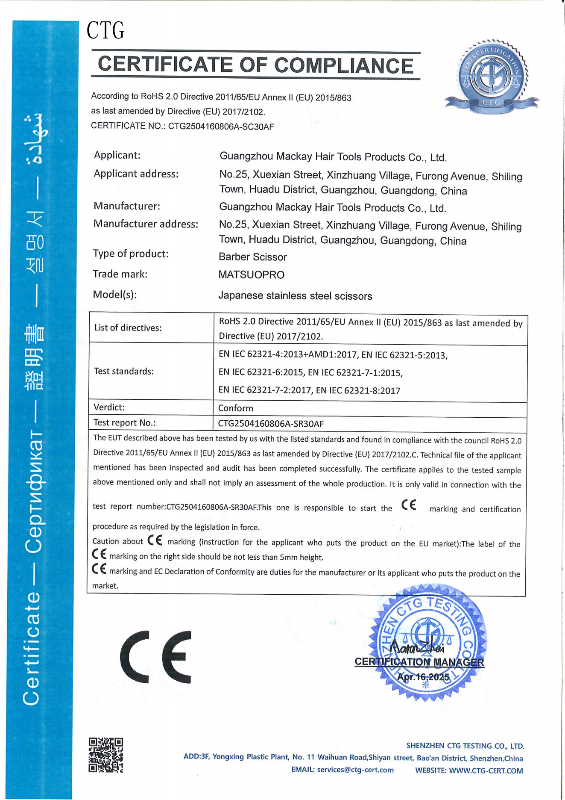
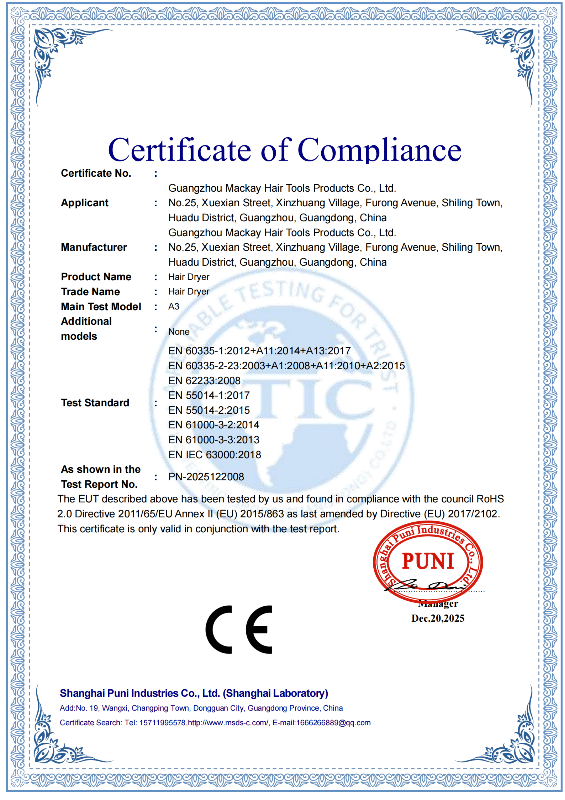
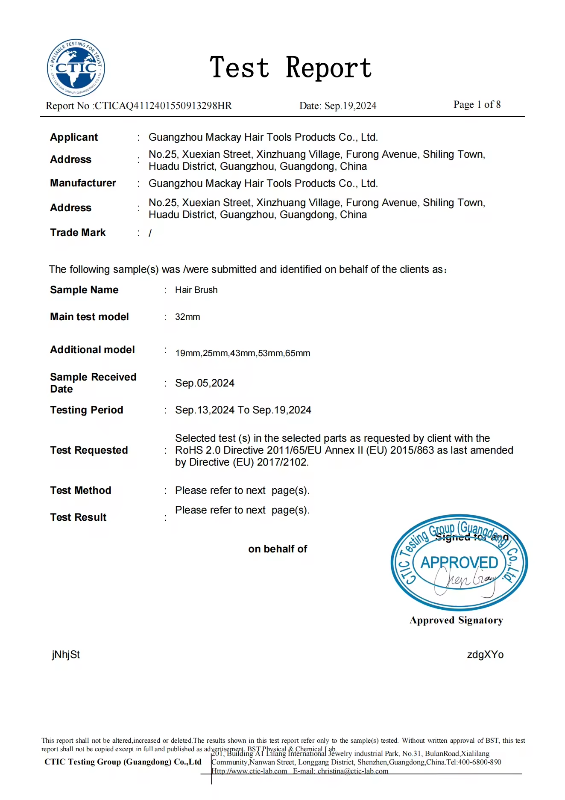
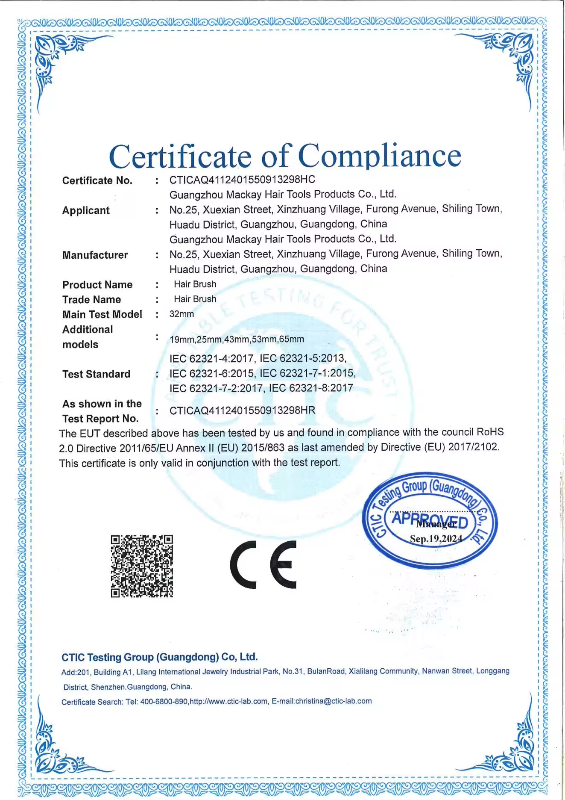
| National tools & hardware inspection center | Accredited-lab partnership | Third-party hardness & material-composition testing on request |
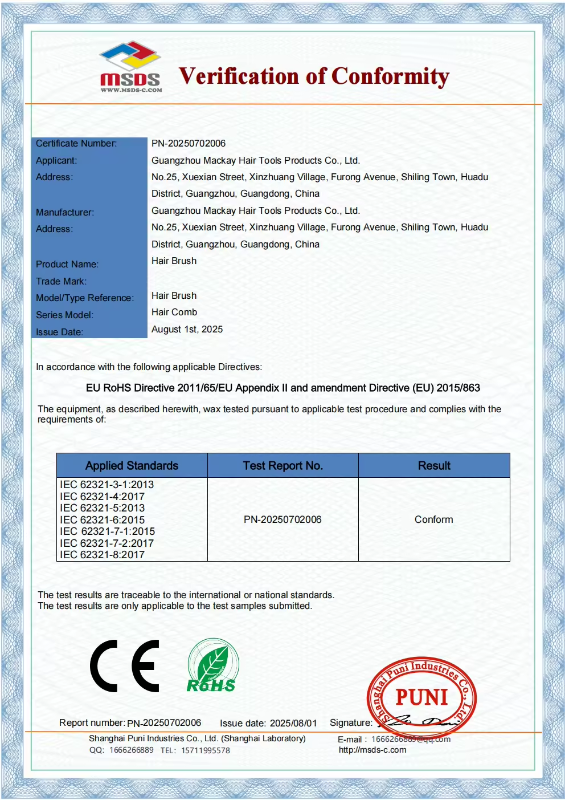
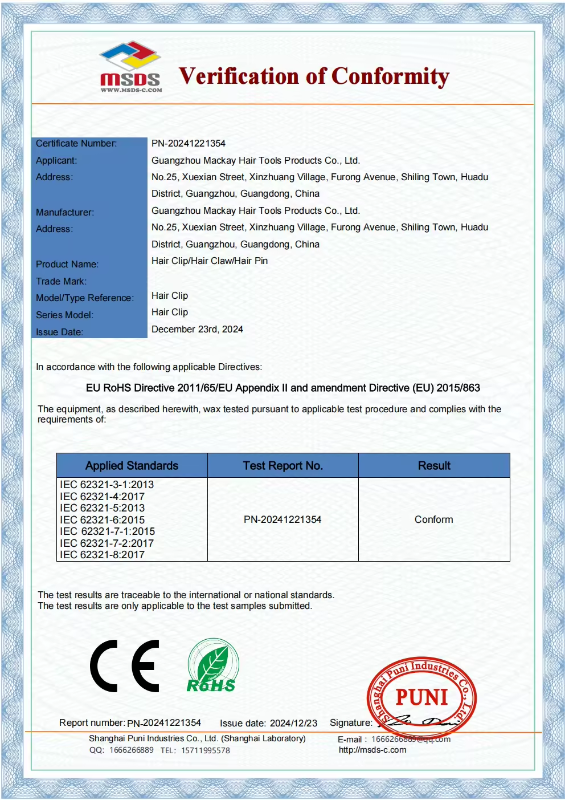
One useful distinction to carry into any negotiation: ISO itself does not issue certificates, accredited third-party bodies do, and none of the above certifies a specific blade’s hardness. That is what a material and hardness test report is for. We make third-party hardness and material reports available on request, with the sampling basis stated, rather than posting a generic badge and hoping you do not ask.
Interactive utilities for steel specification, supplier verification, and lifecycle cost analysis.
Almost all professional hair cutting shears and stainless steel hair cutting scissors are made from martensitic stainless steel. The common grades, roughly entry to flagship, are 420 and 8Cr13MoV, then 440C (the global workhorse, UNS S44004), then cobalt-and-vanadium Japanese steels VG10 and ATS-314, then cobalt-alloy and pattern-welded Damascus at the top. Stainless is used because the blade meets water, hair product and repeated cleaning every day.
Yes, 440C is the most widely used professional shear steel in the world. With 16–18% chromium it resists corrosion very well, and heat-treated to 58–60 HRC it holds a professional edge while staying easy to sharpen. Its quality varies enormously by heat treatment and finishing, so a 440C shear is only as good as the factory that made it.
HRC is Rockwell C hardness. Higher means a harder blade that holds its edge longer but is more brittle and needs a more skilled sharpener. For hair shears the useful band is about 58–63 HRC: below 58 the edge dulls too fast, above 63 it demands specialist handling. It should always be read as a per-lot design value measured to ASTM E18 / ISO 6508, not a whole-shear guarantee.
Not by grade. China 440C and Japanese 440C are the same specification, UNS S44004, so the alloy is identical. Real quality differences come from melt cleanliness, heat-treatment consistency and honing, which are factory variables, not country variables. A well-treated China-finished 440C, made on Japanese steel, can outperform a poorly-treated premium blade.
For the finish and engineering, and for buyers who value both, yes. Modern Damascus is pattern-welded from 8–32 folded stainless layers, revealed by etching. But more layers give a finer pattern, not automatically a sharper edge, cutting still depends on the edge steel, its HRC and heat treatment. Judge it on the same edge evidence as any other shear.
Among genuinely professional options, value-tier 440C (56–58 HRC) gives the best performance-per-dollar, the same 440C alloy as pricier lines, positioned for students and emerging shops. Below that, 420 and 3Cr grades are cheaper but soften faster and suit occasional or home use rather than daily professional work.
Ask five things: the exact grade by standard designation, the HRC with its test method and blade location, whether that hardness is per-lot tested or nominal, where the steel is from versus where the shear is finished, and what the heat-treatment is. Any supplier who can answer all five, and show a third-party report, is telling you the truth about the steel.