Get in Touch with Mackayhairscissors Company
We use submitted details to respond to your quote request. Read our Privacy Policy.

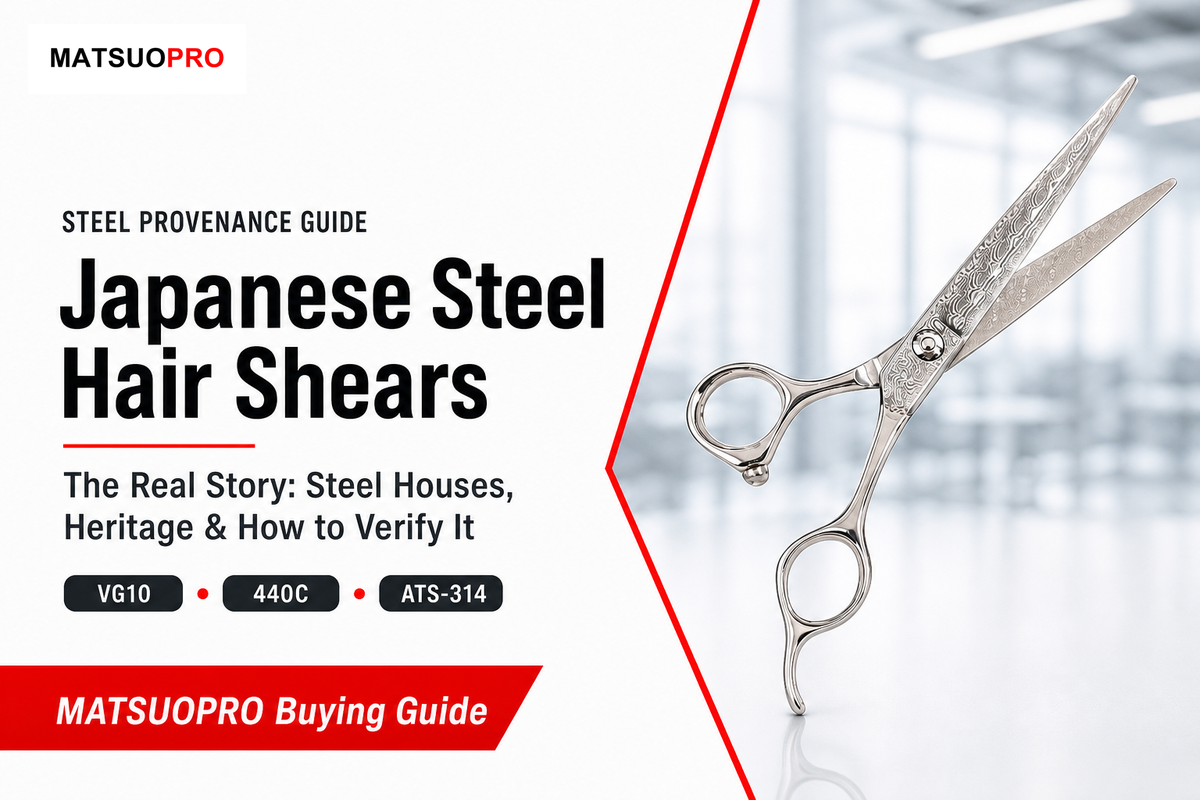
Updated August 2026
| Common grades sold as “Japanese steel” | 440C, VG10, ATS-314, cobalt alloy |
| Typical hardness range | 56–64 HRC (Rockwell C, ASTM E18 / ISO 6508) |
| Blade sizes | 5.5″ – 7.0″ |
| Edge geometry | Japanese convex (hamaguri) vs German bevel |
| Retail price range | $10–$2,000+ (Reddit-documented, Aug 2026) |
Japanese steel hair shears are professional hair-cutting scissors forged from named alloys — 440C, VG10, ATS-314, or cobalt — a category with a reputation few other tool categories match: professional stylists routinely pay well over $1,000 for a pair, according to the flagship-tier retail bands documented below, on the strength of two words on a spec sheet. Far from a manufactured claim, that fame is built on Seki City’s 700-plus-year sword-forging legacy and a handful of real, named steel houses behind alloys like VG10 and ATS-314. But “Japanese steel” has also become a buzzword used to describe something it can’t guarantee — country of manufacture — and even a competitor’s own marketing shows how easily that history flattens into a simple yes-or-no test. This guide traces the reputation to its source, names the steel makers behind it, and shows how to tell substantiated quality from marketing hype before you spend the money.
Japanese steel hair shears earn that reputation from real roots: a 700-plus-year tradition of sword-making historically centered in Seki City, and a few specific Japanese steel houses — primarily Takefu Special Steel and Hitachi Metals (now Proterial) — behind the widely recognized VG10 and ATS-314 alloys (440C, by contrast, is a generic stainless grade produced by many mills worldwide, not a single named house’s proprietary formula). However, it should be clear that the designation “Japanese steel” refers to an alloy family, not a manufacturing guarantee, and the confusion is among the most prevalent mistakes people make in buying and in selling these tools.
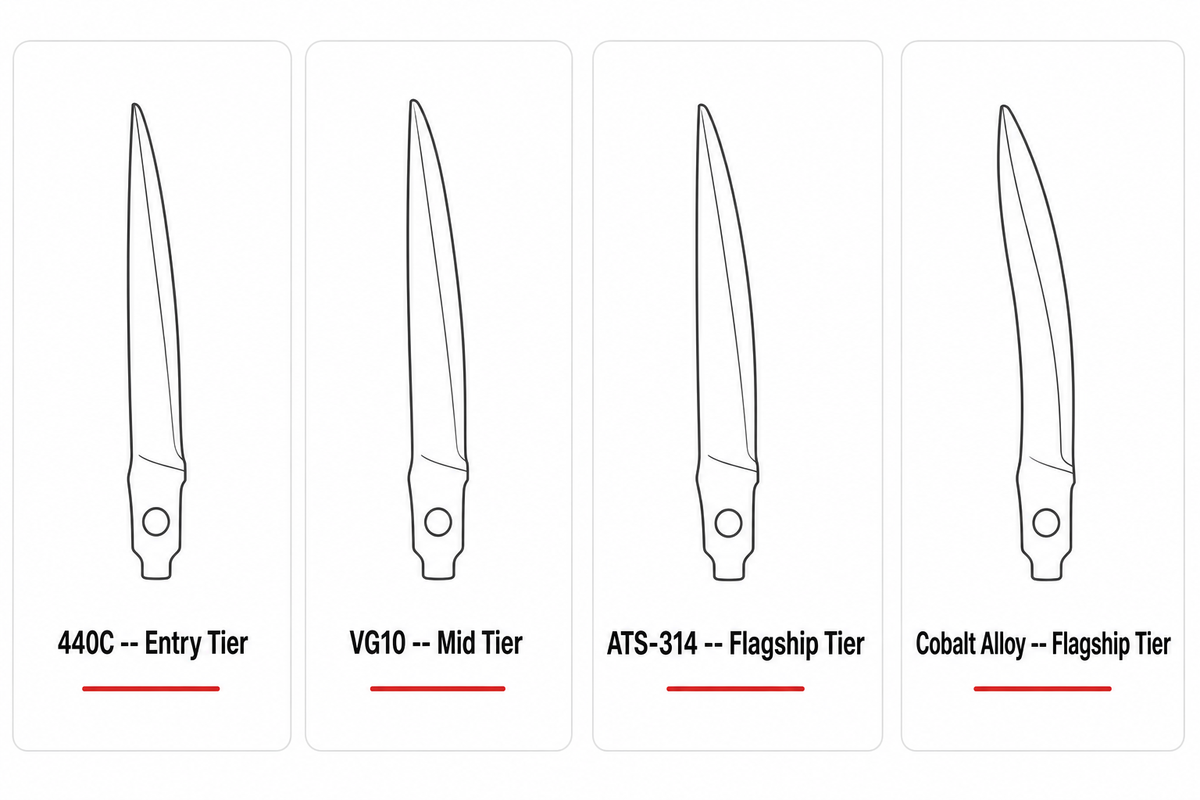
“Japanese steel” describes an alloy family, not a single grade or a country-of-manufacture guarantee. Hair-cutting shears sold under this label are almost always one of four things: 440C stainless, VG10, ATS-314, or a cobalt-flagship alloy — each with a different hardness, corrosion resistance, and price tier, detailed in the comparison matrix further down this guide.
Every one of those grades is measured on the Rockwell C hardness scale under ASTM E18 or the equivalent ISO 6508-1:2023 test method — a diamond indenter pressed into the steel under a fixed load, not a marketing adjective. You’ll also see ATS-314 written as ATS 314 shears without the hyphen, or the category written as Japanese steel hair scissors instead of shears — same alloy family either way.
Hard steel is only half the story a hair stylist actually needs. Edge geometry is the other half: a Japanese convex grind, known as hamaguri for its resemblance to a clam shell’s curve, hand-honed to a mirror finish rather than machine-beveled. When hardness and geometry are both done right, that convex edge is what gives professional barbers the smooth, gliding cut they associate with the category. But the “Japanese steel” label, suggestive as it is, doesn’t by itself guarantee either a properly heat-treated blade or a well-honed convex edge. More on blade finishes below.
That difference helps to fix another common confusion: “Japanese steel” isn’t interchangeable with the concept of high-carbon steel. While high-carbon steel can achieve a finer edge than stainless steel, it has a tendency to stain, tarnish, and rust if it’s not dried and cared for properly, whereas professional hair shears’ stainless grades forgo that edge sharpness for a measure of corrosion resistance the working stylist would otherwise not be accustomed to putting up with daily. VG10 (which may be referenced as VG-10) is in this intermediate sweet spot; it’s refined enough to come close to the edge of a high-carbon sharpness but retains its stainless qualities, and a skilled swordsmith can take years to learn just how to maintain that balance correctly.
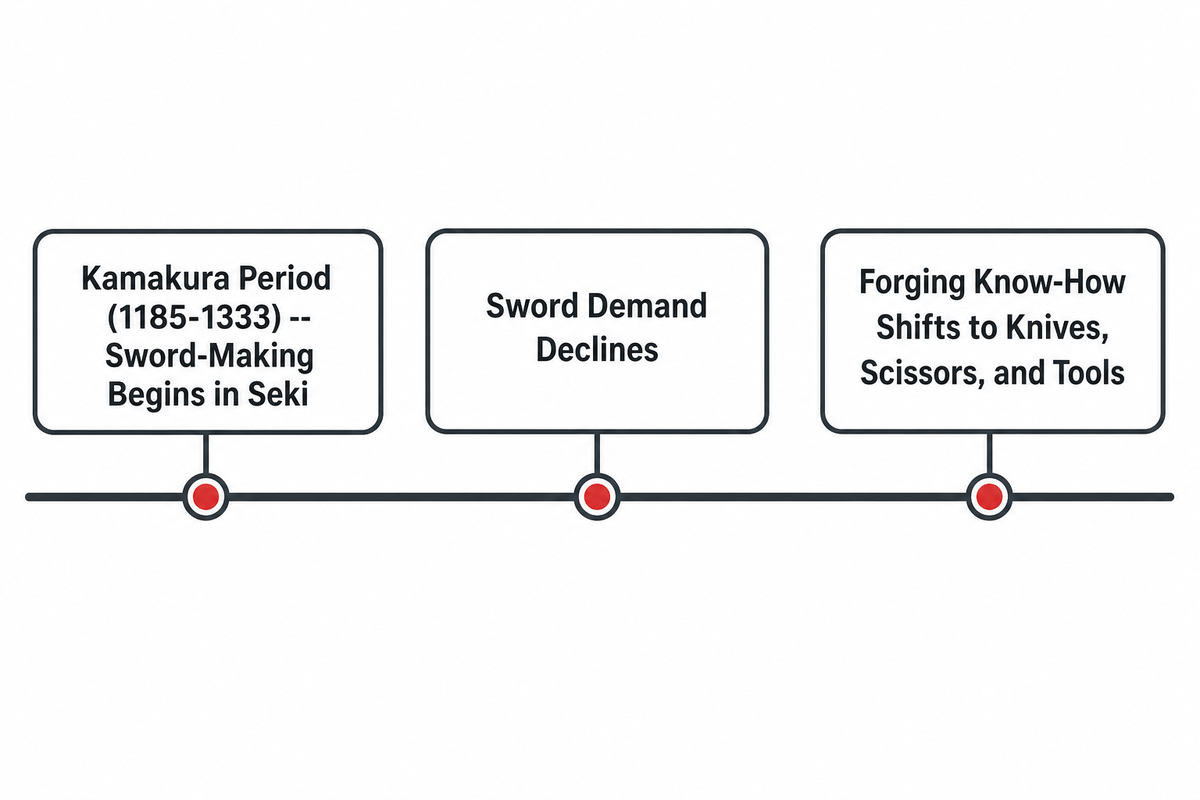
Historically speaking, Seki City in Japan’s Gifu Prefecture is the place blade-forging is most closely associated with, a tradition the city’s own tourism website traces back to Japan’s Kamakura period (1185-1333), when smiths chose the site for the excellent quality of local water from the Nagara and Tsubo rivers, suitable clay for quenching, and an abundance of pine for charcoal.
“For over 700 years, Seki has been a hub for sword-making.” — Visit Seki Official Guide, Seki City Tourism Board
Those same natural conditions that once produced swords able to cut cleanly without bending were later put to a different use: as demand for swords declined, that same forging know-how shifted toward tools people needed every day, kitchen knives, scissors, nail clippers, and razors.
This history is authentic, verifiable information and this, without a doubt, is the true source of “Japanese steel” being marketed as a symbol of quality for producing knives and other tools, although we believe it’s important for us to be very explicit about the limitations in this type of evidence; 700-plus years of tradition in a community doesn’t per se provide tangible proof that any specific shear on the shelf you’ve picked up today was actually fashioned in Seki, tested for any specific hardness, or handled by someone who studied their craft in that city. One can’t equate a city’s historic craft roots with a specific retail item’s actual country or city of manufacture; the additional details below address these concerns specifically because most marketers stop at the former.
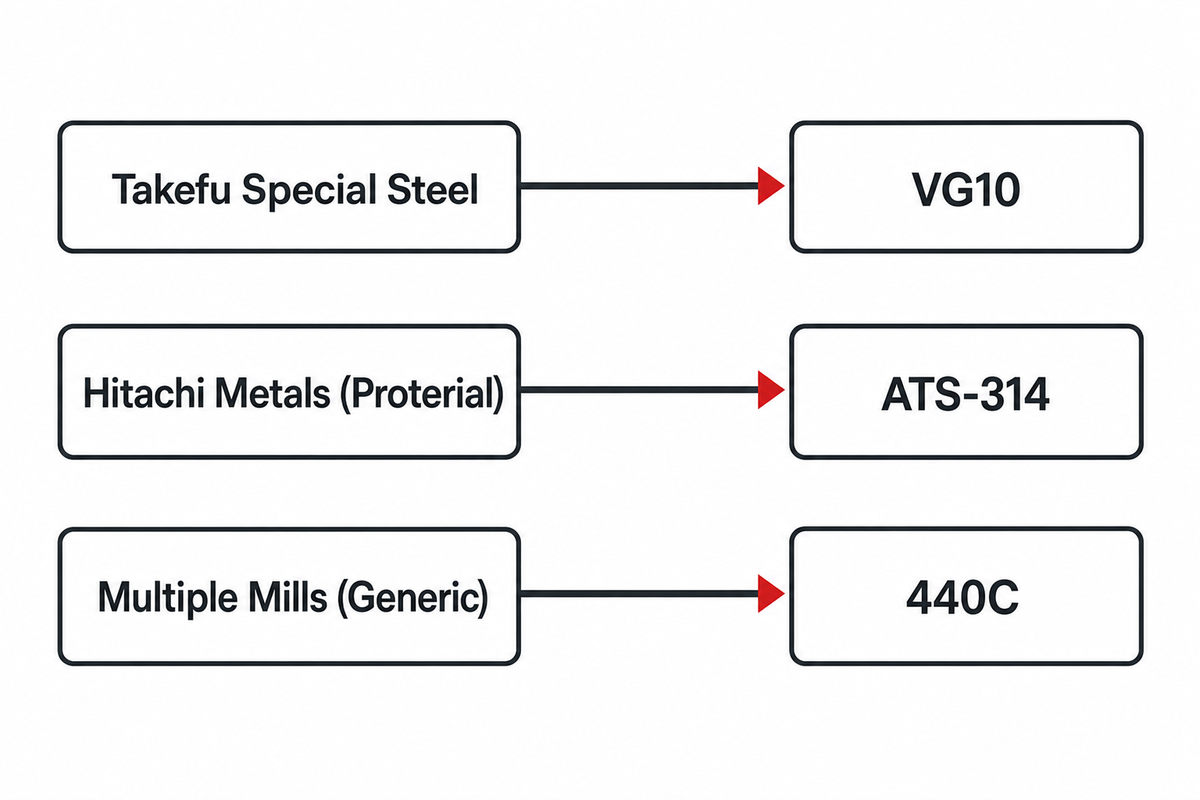
A short, incomplete list of mills associated with Japanese steel could fill in most of the more prominent blades marketed to the hair stylists: VG10 is produced from a proprietary mix developed by Takefu Special Steel (in Fukui Prefecture), generally recognized as its originator (as indicated across independent professional blade sites), whereas ATS-314 originates from Hitachi Metals — renamed Proterial in 2023 — and shear manufacturers that disclose sourcing typically state they source directly from this lineage. Takefu’s VG10 typically runs 60 to 62 HRC with roughly 14% to 15% chromium plus 1.3% to 1.5% cobalt; Hitachi/Proterial’s ATS-314 typically runs 60 to 64 HRC — a proprietary composition that, unlike VG10, isn’t independently published in detail.
Understanding that information also allows us to make clear how to convert “Japanese steel” from an opinion-based adjective into an empirical statement that should be provable. Only a vendor who can back the claim with real specifics has any business using “Japanese steel” — for example, one who lists a specified mill for its VG10 or ATS-314 steels, and ideally even provides a test result indicating hardness. In the absence of such detailed and verifiable product information, a “Japanese steel” assertion is only a verbal flag to rely on with your purchase, rather than solid factual evidence.
But the industry’s 700-plus-year tradition has a full provenance – all the way from the steel houses such as Takefu Special Steel and Hitachi Metals (Proterial) making the blanks for VG10 and ATS-314, right through the manufacturer’s private vacuum/cryogenic heat treatment and finishing process, ending with the handmade honing of the finished blade in the hands of a stylist. It is a chain which should be verifiable at every link. All any retailer is going to sell you here is the first one.
In practice, neither wins — they’re on different rungs of the same ladder, and which one you choose depends on your cutting mix. 440C has about 16-18% chromium and reaches about 56-60 HRC. It’s a low-to-mid-grade steel, relatively cheap to grind and use, and perfectly good professional-grade steel for stylists predominantly doing blunt cuts.
VG10 adds about 1.3-1.5% cobalt to the mix, plus a trace of vanadium, refining the grain structure and pushing hardness toward 60-62 HRC — a gain that starts paying off once slide-cutting and texturizing make up roughly a third of your weekly volume, because those techniques put more frictional drag on the edge per cut. Chromium, not vanadium, does the corrosion-resistance work here; VG10’s vanadium is mainly for grain refinement and edge stability, not rust protection — see our full 440C vs VG10 comparison guide for the complete metallurgy breakdown.
| Attribute | 440C (Entry Tier) | VG10 (Mid Tier) | ATS-314 (Flagship Tier) |
|---|---|---|---|
| Chromium content | 16–18% | ~14–15% | Proprietary formulation; composition not independently established |
| Cobalt / vanadium addition | none | ~1.3–1.5% cobalt + trace vanadium | Proprietary formulation; composition not independently established |
| Typical hardness | 56–60 HRC | 60–62 HRC | 60–64 HRC |
| Steel house of origin | multiple mills | Takefu Special Steel | Hitachi Metals / Proterial |
| Best-fit cutting technique | blunt cutting | slide-cutting, texturizing | daily high-volume, mixed technique |
| Corrosion resistance | very good (highest chromium) | good | not independently established (composition undisclosed) |
| Ease of sharpening | easiest | moderate | most demanding — convex-trained sharpener recommended |
| Typical entry retail price | roughly $50 to $150 | roughly $150 to $400 | roughly $400 to $2,000+ |
| Edge retention vs 440C baseline | baseline | longer between sharpenings | longest between sharpenings |
Retail price bands compiled from publicly listed pricing across the entry-to-flagship range, according to Scissorpedia’s competitor brand-price roundup and the Reddit-documented $10–$2,000+ range cited above.
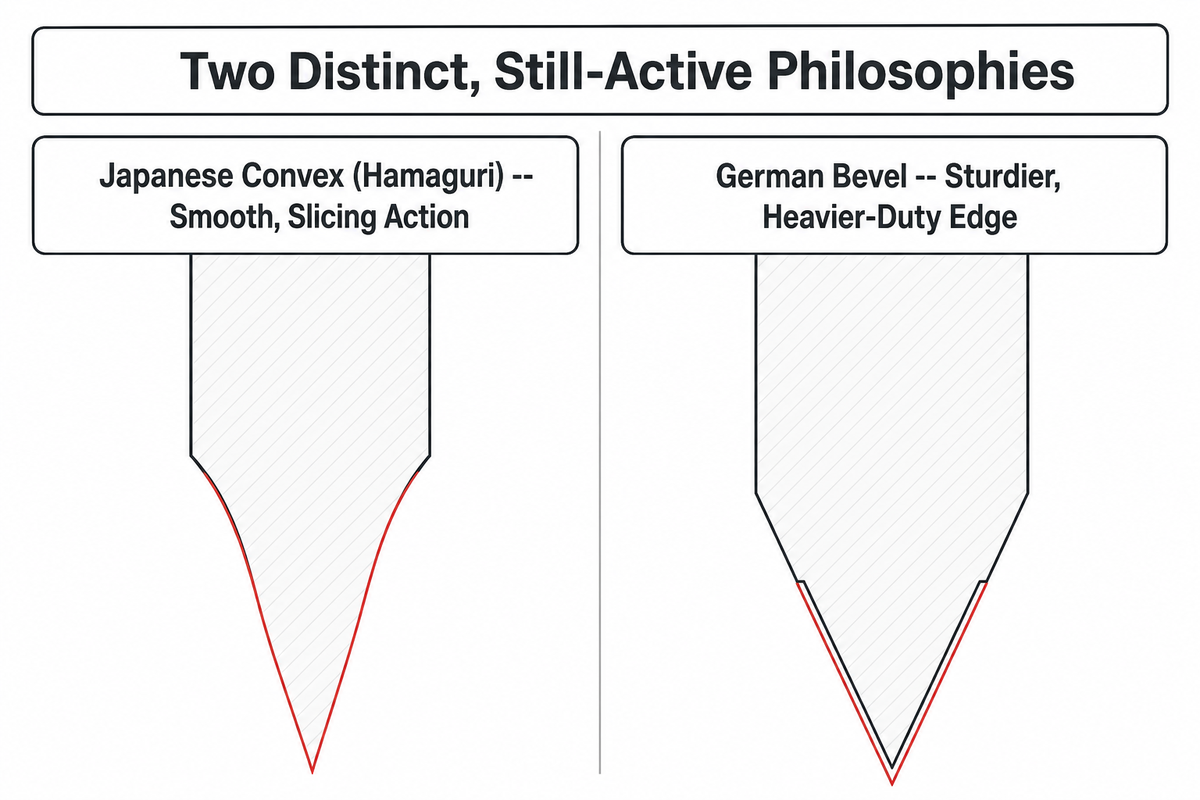
Japanese and German shear-making represent two distinct, still-active approaches to the same problem, not a simple case of one being better than the other. Japanese convex grinds arc gently from spine to edge, spreading cutting force across a larger contact area for the smooth, slicing action professionals associate with precision and dry-cutting work. German style, more common overall, uses a flatter edge bevel, which concentrates force along a narrower line for a sturdier edge, useful for heavier cutting tasks or blades that occasionally take a lateral knock. The hardness figures below for both geometries are measured the same way, on the Rockwell C scale under ISO 6508-1, so the numbers are directly comparable across grinds.
| Attribute | Japanese Convex | German Bevel |
|---|---|---|
| Edge geometry | Convex (hamaguri), mirror-polished | Flat-ground bevel facet |
| Typical hardness | Higher, 56–64 HRC depending on grade | Lower, tougher, ~56–58 HRC |
| Cut feel | Sharper, cleaner slide and slice | Sturdier, more forgiving of abuse |
| Chip resistance | Requires more careful handling | Higher — softer steel resists chipping |
| Not suitable for | Untrained flat-stone sharpening (destroys the convex profile) | Precision slide/slice-cutting workloads |
Both philosophies also run into the same straightforward point of physics: harder isn’t automatically better. Pushing hardness up generally trades away some toughness — this hardness-versus-impact-resistance trade-off applies across blade steels generally, and it’s precisely why manufacturers cap their standard, entry-level convex product lines well short of 63-64 HRC, reserving that ceiling for a dedicated flagship line — the tier a stylist would then reach for as their own daily working pair once volume justifies it.
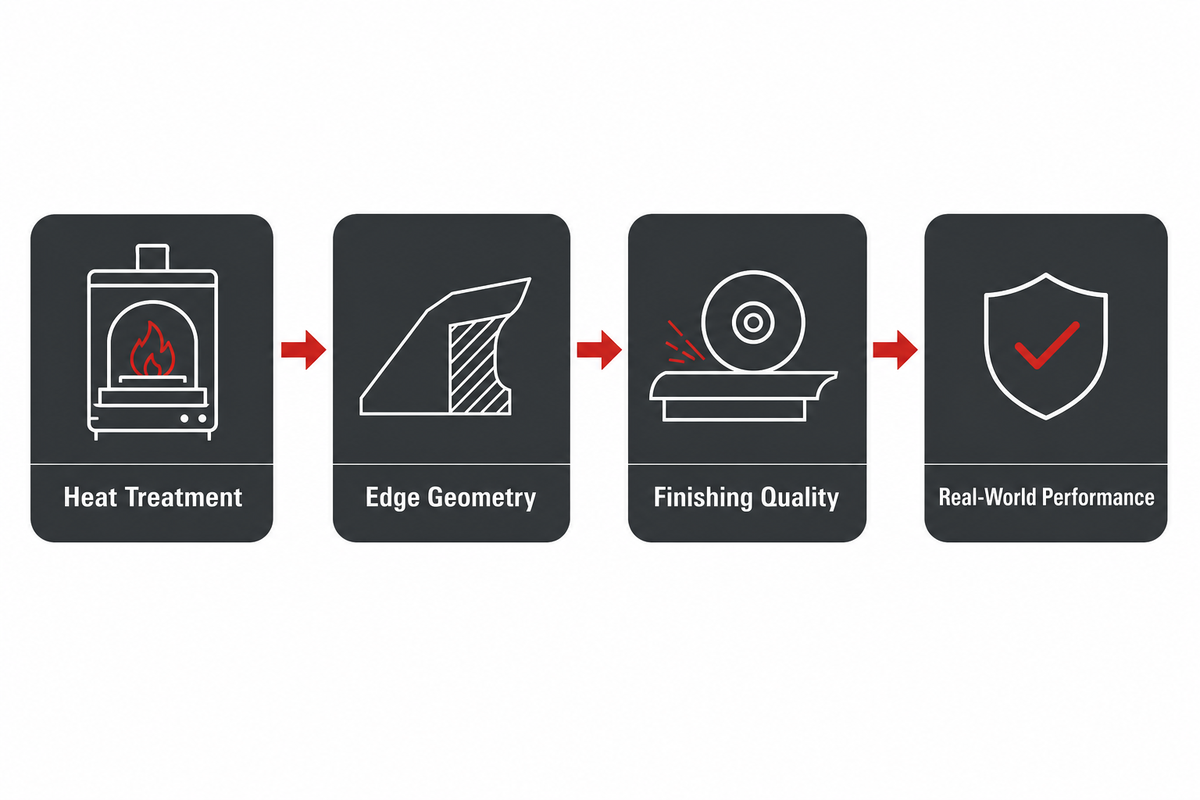
Heat treatment, edge geometry, and finishing quality are what actually define what a blade can do and how long the edge will last, more so than the grade name alone. Two knives stamped with the identical grade can cut quite differently depending on where and by whom they were heat treated and honed — a grade designation means little without that context, and steel’s true worth isn’t measured in a simple Rockwell number; harder isn’t always better.
Even a VG10 blade at roughly 14% to 15% chromium can still land noticeably softer or harder than 60 to 62 HRC depending entirely on that heat-treatment discipline — the alloy name is only the starting material, and the same logic applies across the 56 to 64 HRC range this guide covers.
Ultimately this is why manufacturer process discipline is a question you want to ask directly, “vacuum hardening with a deep cryo hold,” for example, will transform retained austenite into martensite and thereby fix in hardness and edge geometry across a thin, curved shear blade in a manner that a quick heat-treat simply can’t with even the same nominal steel. Steel name is merely the starting material. It’s the 80 or so individual operations between raw stock and hand-honed, inspected blade — CNC cut, vacuum/cryo, grinding, hand mirror-polish convex edge, hand-tensioning — that turn a steel name into reality.
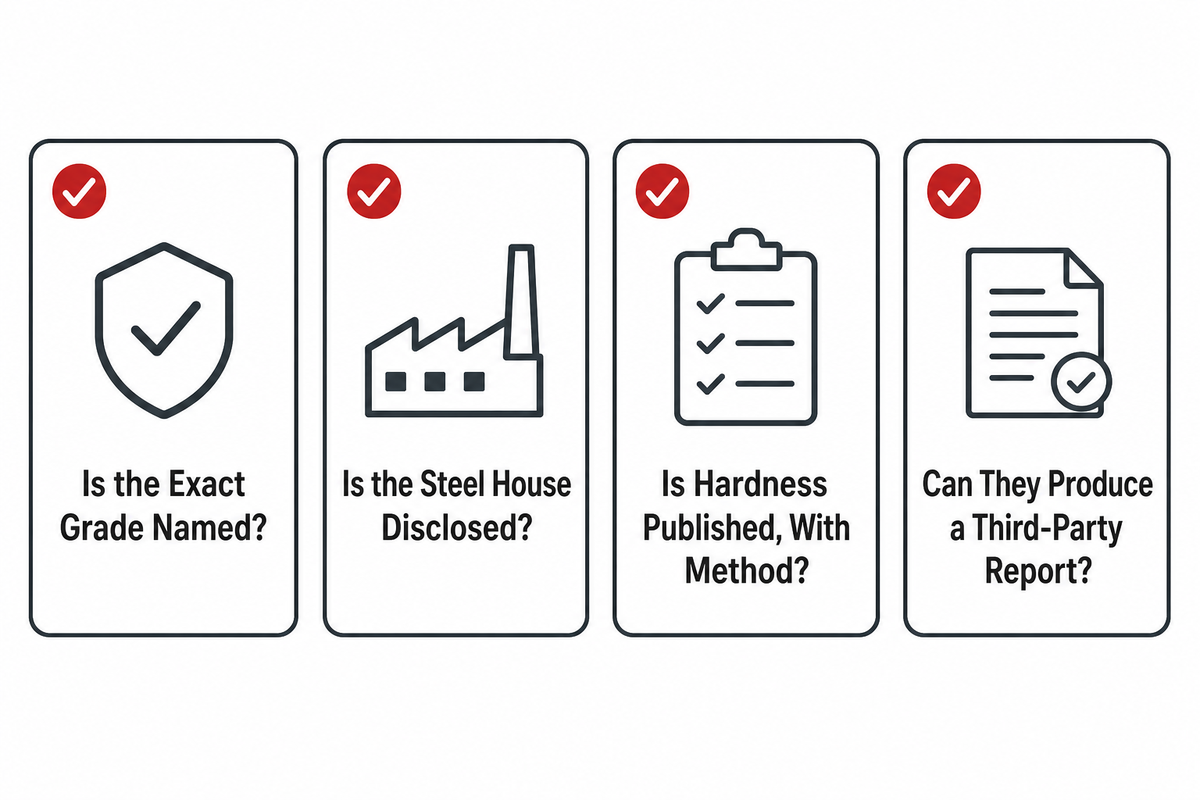
When shopping for “Japanese steel,” that labeled metal from a hair shear, make sure you ask your dealer one of each of these four questions, prior to reaching for your wallet when a price is a bit out of your usual range. If you get a written answer to all four, your claim is performing work. Otherwise, the label itself is. Even Seki City’s genuine 700-plus-year forging heritage doesn’t answer these four questions on its own — heritage and hardness are two different kinds of proof. There is no dedicated multinational performance standard for hairdressing shears at all, so far as any of these people readily let on: the closest available generalist, ISO 7741:1986, focuses on material, heat treat, hardness, corrosion, finish and cutting performance but was designed for surgical instruments, not hair tools or other salon items, which is why burden of proof lies squarely with the purchaser.
Copy these four questions into your next supplier inquiry:
| Question to ask | What a real answer looks like | Why it matters | How to verify |
|---|---|---|---|
| Is the exact grade named? | “440C,” “VG10,” or “ATS-314” — not just “Japanese steel” | A grade name is checkable against public composition data; a bare adjective is not | Cross-check the composition figures the seller gives against independently published alloy data |
| Is the steel house disclosed? | “Takefu Special Steel” (VG10) or “Hitachi Metals / Proterial” (ATS-314) | Names two real, checkable companies instead of a country adjective | Ask for the batch or purchase-order reference tying the shear to that supplier |
| Is hardness published, with method? | A specific HRC figure or range, tested to Rockwell C (ASTM E18 / ISO 6508) | A number with no test method behind it is not a verifiable spec | Ask which standard edition the lab used — a superseded edition is a legitimate red flag, not pedantry |
| Can they produce a third-party report? | An independent hardness/material report available on request | Separates a documented claim from an unverifiable one | Request the report before, not after, purchase |
Sellers who describe their product as premium Japanese steel or genuine Japanese steel should be able to back the claim the same way the checklist above demands: named grade, named mill, tested hardness. A Japanese stainless claim with no chromium figure at all, or a bare real Japanese hair shears label with no batch data behind it, is the same unverifiable pattern wearing different words — and it applies just as much to any high-grade Japanese steel pitch that never gets more specific than the adjective itself.
Run the four-question checklist above before you weigh price or country claims at all. Any seller who names the grade, names the steel house, publishes a tested hardness figure, and can produce a third-party report has given you something you can independently check.
One documented example of how this goes wrong: a direct competitor’s own published buying guide asserts that Japanese-assembled shears are automatically “authentic” and shears assembled elsewhere from the same alloy formula are automatically deceptive, without citing any source for that binary rule. Country of assembly and origin of the steel itself are genuinely separate, independently disclosable facts, not two names for the same thing, which is the subject of the next section.
Price alone doesn’t prove much on its own, but it’s a useful secondary check to run alongside the four-question checklist above. Stylists trading notes on hairdressing forums have flagged a recurring pattern: a well-known premium name that usually runs several hundred dollars showing up priced under $400, or a name that typically commands close to $800 turning up under half that, gets treated as a red flag worth a second look, not a lucky find to take at face value.
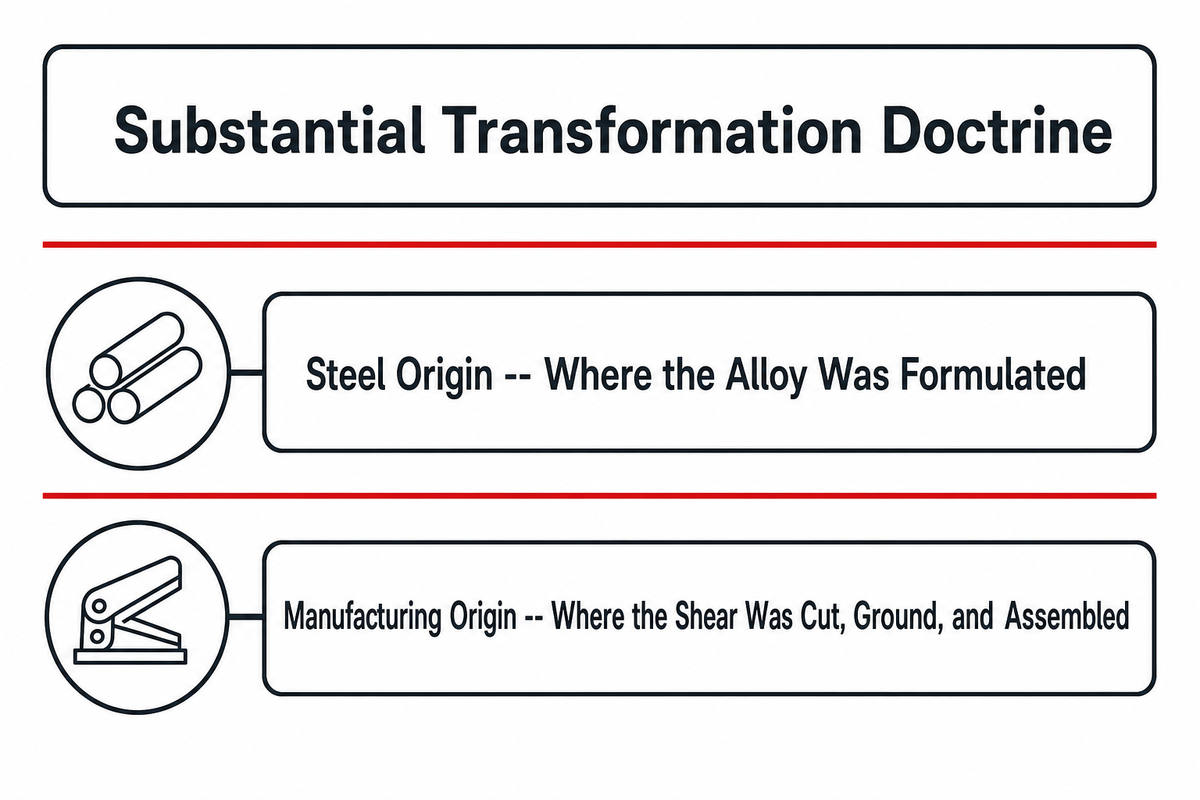
“Japanese steel” is about the alloy — the steel formulation the ingot was made to — not where the finished pair of scissors was cut, ground, and packaged. This is the most common confusion in the category: real buyers in hairdresser forums list it first on any legitimacy check, and rival suppliers have published entire articles devoted to correcting it.
Legitimately, a shear can be forged from steel sourced to that country’s formula while still being CNC-cut, heat-treated, and hand-honed to sharpness in a different country’s factory. That alone doesn’t make it a fraudulent shear.
There’s a real legal basis behind this distinction, not just an industry convention. For a product manufactured outside a free-trade partner country, like most hair shears on the market, U.S. Customs applies the “substantial transformation” doctrine to determine country of origin: whether the good underwent a fundamental change in form, appearance, nature, or character, with significant value added in the country claiming origin, rather than simply which country any single input material came from. Applied to a shear, that means the steel’s origin and the shear’s manufacturing origin are two separate, independently verifiable facts, and a factory that discloses both honestly is giving you more information than one that collapses them into a single “Made in Japan” stamp.
Very few shears at working-professional price points are actually finished in Japan — most are finished in China, which holds the bulk of global hairdressing-shear manufacturing capacity regardless of where the steel itself was formulated. That alone doesn’t determine quality.
Heat treatment, honing skill, and quality control determine the finished result far more than the country stamp does, per the same heat-treatment-beats-steel-name principle covered above. The practical question worth asking a seller isn’t “is this made in Japan,” but “which specific grade, from which mill, tested to what hardness” — the three facts the provenance checklist above is built around.
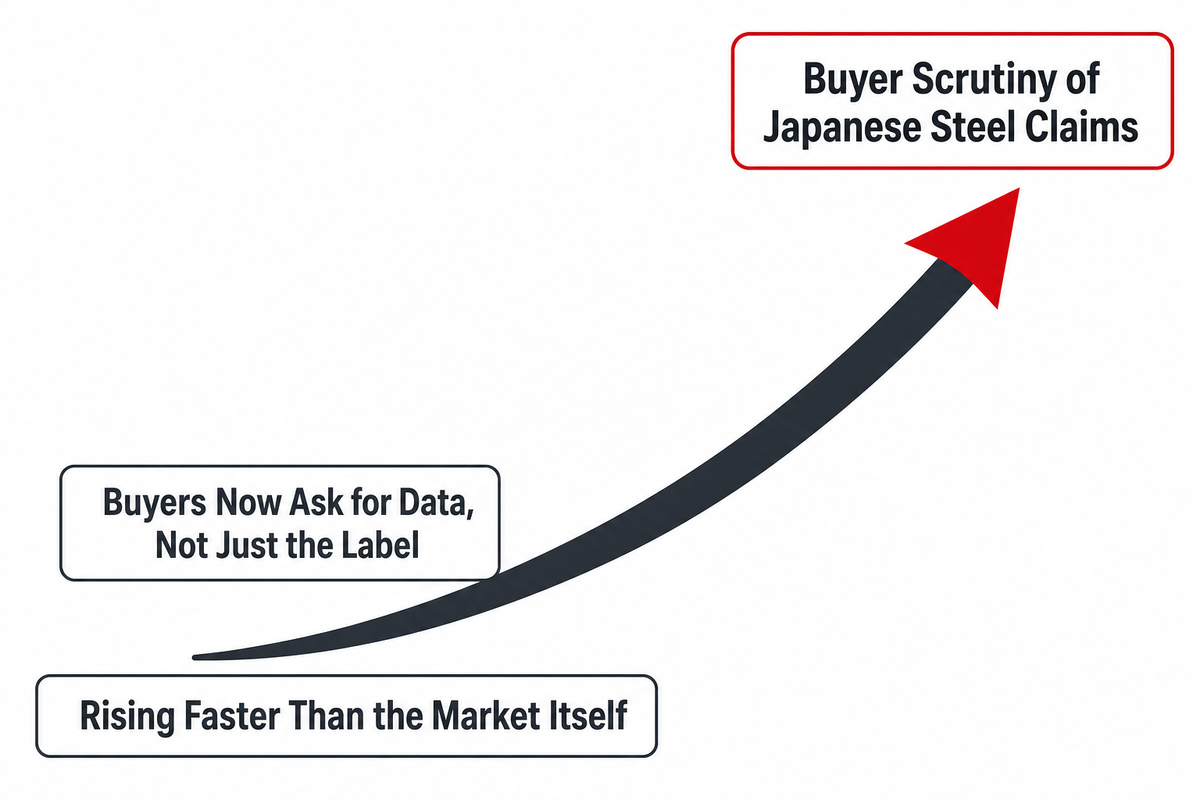
Buyer scrutiny of “Japanese steel” claims is rising faster than the market itself, and that gap is the real story. Relative search interest around Japanese-steel hair shear terms, per our own keyword-trend tracking — a directional signal, not an absolute-volume figure — has climbed roughly 19-fold over a 24-to-36-month window, a sustained multi-year trend rather than a single seasonal spike.
That tracks a documented shift in how professional buyers approach the category: they increasingly treat a bare “Japanese steel” label as a prompt to ask for composition and hardness data, not as a purchase-ready fact — a shift that shows up independently in seller-side content answering exactly those questions, and in forum threads where working stylists trade specific red-flag checklists rather than brand reputations alone.
The market-size estimates for the broader hair-scissors category are all over the place, depending on research house, and none (not a single estimate!) of the variability in market-size figures from $70 million to over $150 million ought to be taken as meaningful. Take these estimates as a very broad indicator, with a generous margin for error that will be far wider than the differences between them. More concrete is the standards side: the International Organization for Standardization (ISO) published a new edition of its Rockwell hardness test-method standard, ISO 6508-1, in December 2023 — a sign that the testing infrastructure buyers increasingly ask about is itself still evolving, not settled.
If you’re a stylist actually in the market now and looking to buy something today, one concrete aspect to consider is scheduling, more so than the arcane details of standards.
Because standards are themselves being modified now, the hardness report you get today, testing against current norms, is using a different baseline calibration as a standard than a hardness report that was issued some years ago. If two, very similar, shears each publish the claim of “62 HRC,” but the reports are 3 or more years apart, it’s worth inquiring about which edition of the standards was employed during the testing of each shear before treating these numbers as equivalent. This standards evolution explains why two “identical” hardness reports can have subtly differing meanings.
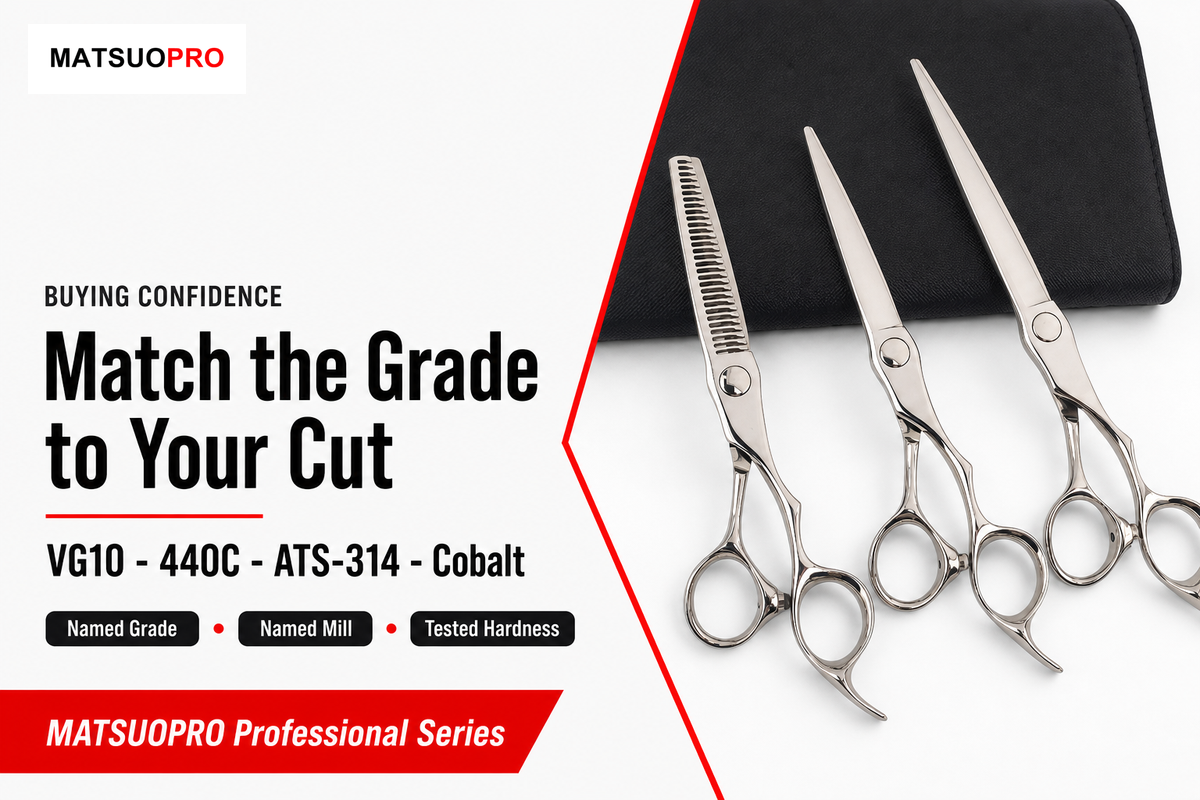
When the grade, source steel house, hardness number, and the independent, third-party report number are put together, the name-value adjective Japanese steel can transform into a measurable component specification you can trust. The table below is a consumer-priorities matrix instead of a one-size-fits-all answer, because “what to buy” always depends on your personal preferences and your specific cutting mix, as well as how much you have to spend.
As a quick reference: 440C runs 56 to 60 HRC with roughly 16% to 18% chromium, VG10 runs 60 to 62 HRC with roughly 14% to 15% chromium, and ATS-314 or a cobalt flagship runs 60 to 64 HRC — the numbers the table below turns into an actual buying decision.
| Your priority | Recommended grade | What to verify first |
|---|---|---|
| Lowest entry cost, still professional-grade | 440C | Published HRC (target 56–60) and chromium content |
| Balance of price and edge life | VG10 | Confirms cobalt/vanadium content, not just the “VG10” name |
| Longest edge life, daily high-volume work | ATS-314 or cobalt flagship | Named mill (Hitachi/Proterial) and vacuum-cryogenic treatment disclosure |
| Auditing a bulk/wholesale order | Any grade | Per-lot third-party hardness report before the shipment releases |
| Left-handed cutting | Any grade | True mirrored left-handed construction, not just a swapped handle |
| Heavy texturizing or slide-cutting workload | VG10 or ATS-314 | Sharpening-cadence guidance — full-time use often means every 3 to 4 months |
| Budget-conscious student or part-time use | 440C | At least a 1-year warranty and a clear return guarantee in writing |
| Barber-specific techniques | Any grade, barber-ground bevel | Cross-check against a dedicated barber shears line before buying |
| Wholesale or OEM sourcing | Any grade | Named steel house plus batch-level hardness reports, not just a country claim |
The honest answer depends on how many days a week you’re behind the chair, more than on how much you’re willing to spend. Full-time stylists and barbers cutting hair back-to-back, more than 6 hours a day, are the clearest fit for premium Japanese steel — the smooth cutting feel and longer edge life mean meaningfully fewer sharpening trips.
Part-time stylists, cosmetology students, and anyone giving an occasional home haircut usually do better with a mid-range or entry-level 440C pair — the kind of craftsman-grade steel that rewards daily use isn’t wasted, just underused, at that pace. By contrast, a flagship, high-hardness cobalt shear mostly adds edge life you won’t use up before your technique changes.
Whether you’re shopping for professional hair shears, a single professional shear to replace a worn 5.5-inch favorite, or a full barber shears set at 6.0 or 6.5 inches, the same principle holds: professional hair cutting scissors, like any hair cutting scissors bought for daily use, should come with a grade, a mill, and a hardness figure, not just a “shears for professional” tagline and a country name. Even a black professional handle finish is a cosmetic choice, not a substitute for that data.
Brand recognition in this category clusters around a short list of Japanese hair shears brands — Mizutani, Hikari, Kasho, Joewell, Yasaka, and a handful of others — that recur across independent buyer discussions, but brand alone isn’t a substitute for the checklist above; a well-known name that won’t disclose grade, mill, and hardness data is still asking you to trust a label. When people go searching for the best Japanese steel hair shears, there’s no single pick that fits every stylist, and no universal best Japanese scissors either — the right choice depends on your cutting mix, your hand, and your budget tier, which is exactly why the Steel-House Shortlist asks about specifications instead of brand names. One independent buyer-review roundup of recognized Japanese brands shows how wide that tier spread actually is: one widely cited maker’s line runs roughly $249 to $799, a second roughly $179 to $599, and a third roughly $95 to $299 — three legitimate, well-regarded brands occupying three different price tiers, none of them the objectively “best” one. A pair of ATS-314 shears aimed at daily high-volume work and a 440C pair aimed at occasional at-home use can both be genuine, well-made Japanese stainless steel shears at completely different price points. Whichever tier you land on, the deciding factor is whether a seller can answer the Steel-House Shortlist questions in writing before you commit, not which name sounds most premium on a product page.
Sourcing directly from a factory that already publishes per-grade HRC and offers third-party hardness reports takes the guesswork out of “how do we verify these specs.”
MATSUOPRO forges hair, barber, and pet-grooming shears from 440C, VG10, ATS-314, and cobalt alloy steel across two manufacturing bases in China, with ATS-314 plate sourced directly from the Hitachi-originated lineage now carried forward by Proterial, and every premium blade hand-honed to a Japanese convex edge through 80-plus individual steps. We wrote this guide because the history behind “Japanese steel” is more interesting, and more checkable, than the label suggests, and because a factory that publishes its own per-grade HRC has nothing to lose by explaining how the rest of the industry should be read.
Reviewed by the Guangzhou Mackay Hair Tools Products Co., Ltd. technical team (MATSUOPRO manufacturing division).
MATSUOPRO is the Mackay Hair Scissors manufacturing brand for professional hairdressing shears, barber scissors, thinning shears, and pet-grooming scissors. We support salons, distributors, academies, grooming brands, and private-label buyers that need factory-direct production with practical material guidance.
Our buying guides are written to help purchasers compare steel grades, handle styles, blade geometry, surface finishes, logo options, packaging, MOQ, and sample validation before placing an OEM or wholesale order. The goal is to make each scissors specification easier to discuss with a real production team.
Factory-direct supply since 2014, with product lines covering professional cutting shears, barber shears, thinning scissors, texturizing scissors, left-handed models, and pet grooming scissors for international B2B customers.
We focus on Japanese 440C, VG10, and ATS-314 steel choices, convex and bevel edge geometry, ergonomic handle balance, tension systems, logo engraving, private-label packaging, and sample-based OEM confirmation.