Get in Touch with Mackayhairscissors Company
We use submitted details to respond to your quote request. Read our Privacy Policy.

Updated July 2026 | Reviewed by the Mackay Group Asia Limited technical team.
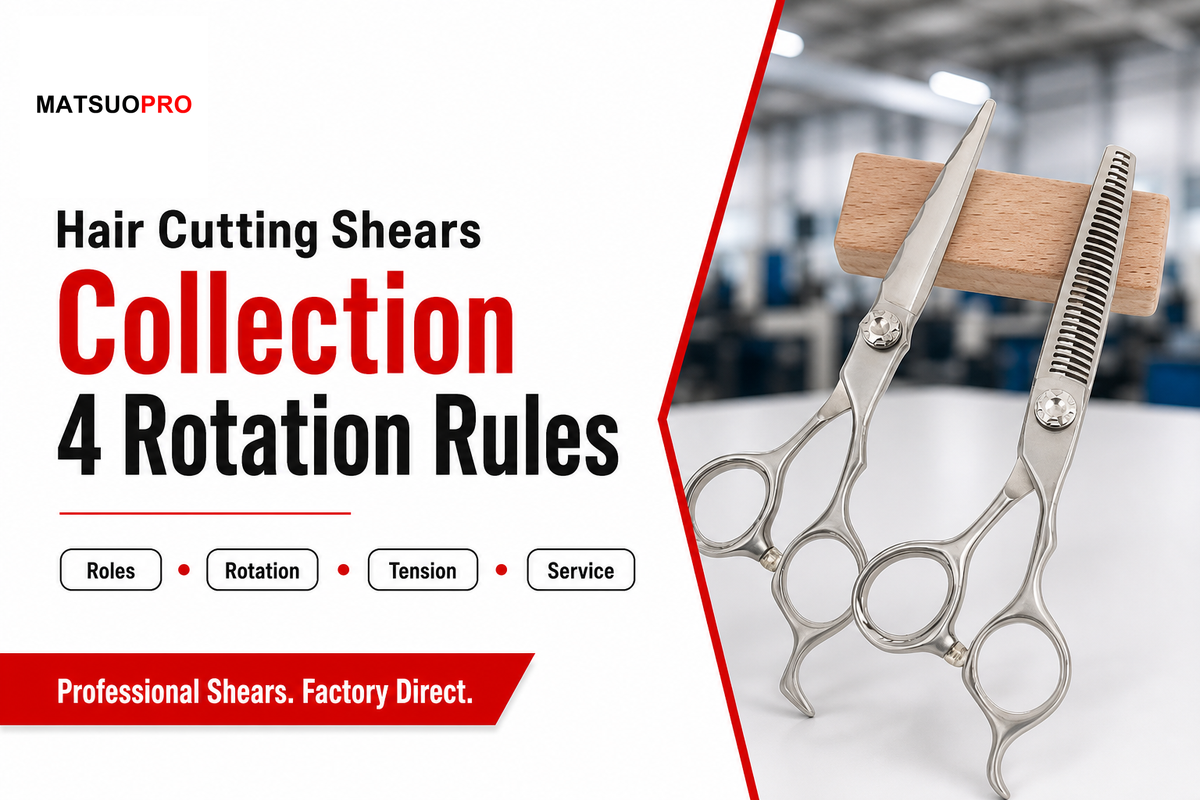
A hair cutting shears collection is a working fleet of cutting, blending, texturizing, backup and specialty shears managed across service, sanitation, tension and retirement decisions. It should not repeat the work of a product page where buyers choose steel, size, handle and finish. This guide starts after purchase: when each shear deserves a place in the kit, when it is due for service, when tension is the real problem, and when another edge honing becomes sunk cost.
Searchers may arrive through phrases such as professional hair cutting shears collection, Japanese hair cutting shears, or hair cutting shears swivel thumb options. Others ask for types of hair cutting shears and their uses, types of hair cutting scissors and their uses, or the best types of hair cutting shears. This article keeps those phrases in an ownership context and sends purchase intent back to Mackay’s product pages.
| Search label people use | How to read it without duplicating the product page |
|---|---|
| hair-cutting shears, best hair cutting scissors, best hairdressing scissors, “scissors are the best” | Treat these as quality questions about a working pair, not a new ranking for every model. |
| different types of hair cutting, different types of shears, different types of scissors, different shears, scissors used | Map each phrase to the job that shear performs in the kit. |
| pair of scissors, set of scissors, scissors you need, scissors are available | Count roles first: daily cutter, detail pair, backup pair and sanitation reserve. |
| hair thinning scissors, texturizing scissors, known as texturizing shears, thin out the hair, thinning hair | Keep tooth-count naming separate from the maintenance question; the collection still needs service rules. |
| precision cutting, slide cutting, dry cutting shear, range of cutting techniques, hair cutting techniques, hair techniques | Match the technique to edge feel, tension stability and how the tool behaves in dry or wet hair. |
| cutting shears for deep point, shears for deep point cutting, hair when cutting | Check whether the tip, pivot and balance still suit the technique after repeated service. |
| left handed scissors, swivel scissors, hair stylist | Read these as fit and posture questions, not proof that any one handle prevents injury. |
| stainless steel hair cutting scissors, best steel, best quality, quality hair shears, quality of the cutting | Use steel and finish as inputs to service planning, then verify the actual cut. |
| shears are used, shears are perfect, shears are ideal, shears are made, shears made, clean your shears | Avoid perfect-tool claims; a shear proves itself through cleaning, tension checks and reliable action. |
Quick specs for a working shear fleet

Categorize professional hair scissors by task rather than product names. A stylist may own hair shears, cutting scissors, hairdressing shears, a thinning scissor pair, texturizing shears, and wet-cutting shears. Instead of asking how many different names apply to your shears, ask what each tool does for different hair types and cutting techniques.
| Role in the kit | Job in the workflow | Typical spec | What fails first |
|---|---|---|---|
| Daily wet cutter | Most cutting hair volume | Offset or crane handle, convex edge | Edge drag, thumb fatigue |
| Dry detail pair | Point cutting and finish work | Shorter shears, light blade | Tip damage, over-sharpening |
| Long comb-work pair | Scissor-over-comb and barber scissors work | Longer shears | Tension drift |
| Blending pair | Softening lines without removing length | Toothed blade, role depends on tooth design | Dropped teeth, uneven pull |
| Texturizing pair | Weight removal and texture control | Texturizing shear or hair thinning shears | Wrong role, not always bad steel |
| Left-handed pair | Reverse-ground cutting path | left-handed shears | Using a right-hand tool backward |
| Backup pair | Covers service days and dropped tools | Same role as the daily pair | Neglect, because it is rarely used |
| Training or guest pair | Apprentice, travel, loaner use | Durable steel, simple handle | Poor cleaning habits |
| Sanitation reserve | Lets one pair dry while another is in hand | Matched daily cutter | Rust from rushed storage |
A hair cutting shears set isn’t measured only by the quantity of pairs. A set of nine pairs can be inefficient if six shears perform identical functions and the set lacks a designated shear for sanitation, a spare for backup, left-hand geometry, or fine dry detailing work. For inventory notes, record blade length in millimeters as well as inches: 5.5-inch is about 140 mm, 6.0-inch is about 152 mm, and 6.5-inch is about 165 mm. The number of teeth on a blending shear, for example, is best detailed in the Mackay guide on 40-tooth blending shears.
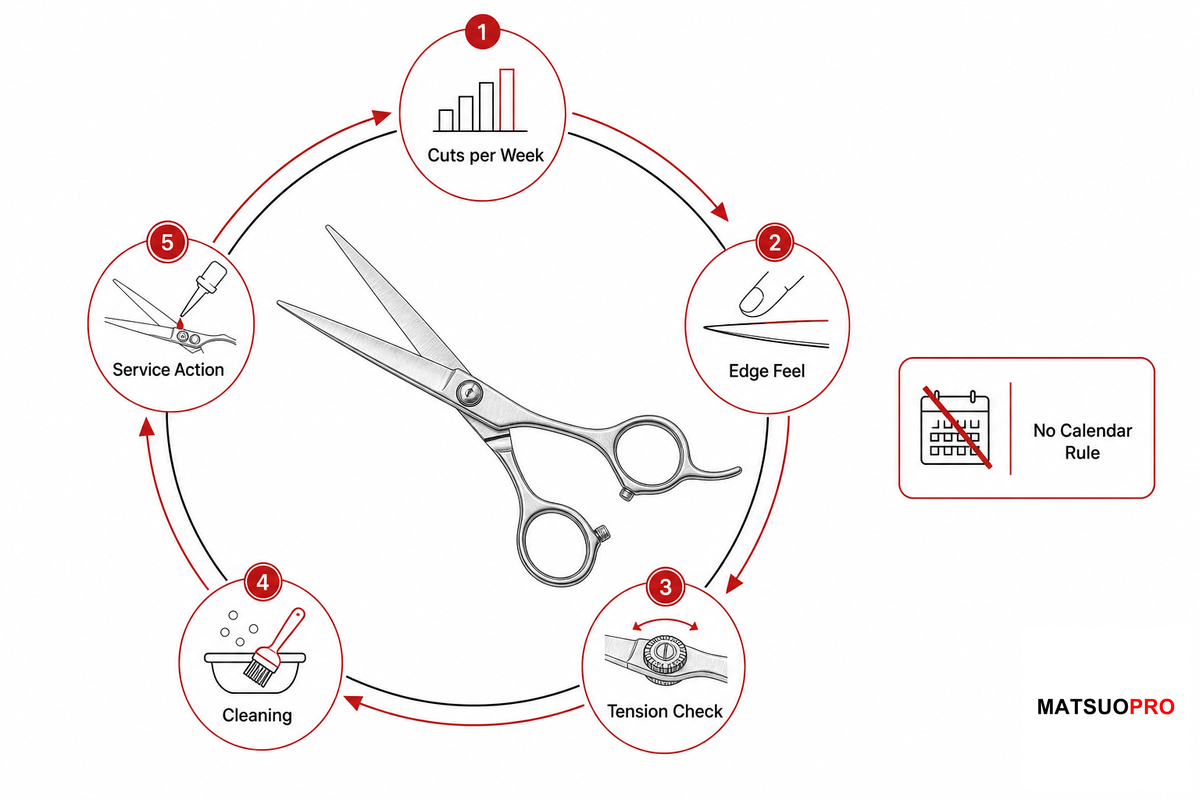
Use the Shear Service Clock as a model for professional hair shear collection maintenance. Shear service is dictated by usage (cuts per week), steel class, sanitation load, and observed failure symptoms. A calendar is a less effective benchmark. An older interview in the 2011 Modern Salon trade publication suggested sharpening only when needed. This advice serves as a useful caution but shouldn’t be viewed as a contemporary standard. Where MATSUOPRO publishes a 5 months to 8 months planning band for VG10-class edges, consider this brand-specific information, not absolute industry practice.
| Cutting load per 7 days | Steel tier input | Service reading | Tension / cleaning cadence |
|---|---|---|---|
| Under 40 cuts per 7 days | 440C / VG10 class | Use symptoms first; interval may stretch | Check every 7 days; clean after soiled use |
| 40-80 cuts per 7 days | VG10 / ATS-314 class | MATSUOPRO’s published bands can guide planning, with attribution | Check every 2 days to 3 days |
| 80-140 cuts per 7 days | ATS-314 / cobalt class | Schedule service buffer before drag appears | Check every 1 day |
| 140+ cuts per 7 days | Cobalt or backup rotation | Use two working pairs, not one heroic pair | Check every 1 day plus backup pair |
| Any load with visible debris | Any steel | Clean first; corrosion is not proof of low quality | Debris removal, soap or detergent, EPA disinfectant where applicable |
| Any load with folding hair | Any steel | Test tension before sharpening | Drop test before service decision |
| Any load with pitting or rust | Stainless steel still needs care | Stop and inspect; moisture and chloride can break passive film | Dry storage, no wet pouch |
| Any load after a drop | Any steel | Inspect tip, pivot, alignment and tension | Retire from client work until checked |
Use these log-window time intervals as service reminders, not sharpening assurances: 1 day for a high-usage tension check, 7 days for backup availability, 30 days for rust inspection, 90 days for service trend analysis, and 12 months for collection budget evaluation.
Sharp shear time isn’t scheduled by a calendar, but by workload and performance. For example: your every day shears that make 70 real cuts per week, that’s H-2010’s and they start to push hair at 18 weeks, should be sharpened about every 16 weeks, not 12, not 24. Substitute your actual number of cuts/week, not clients/day because BLS states salon work includes cutting, shampooing, coloring, drying, and styling, thus, one client = not always one cut.
Steel context for this article belongs in Mackay’s HRC Hardness guide and 440C vs VG10 guide. The role of steel is a contributing factor in service timing, not the title of a new steel page.
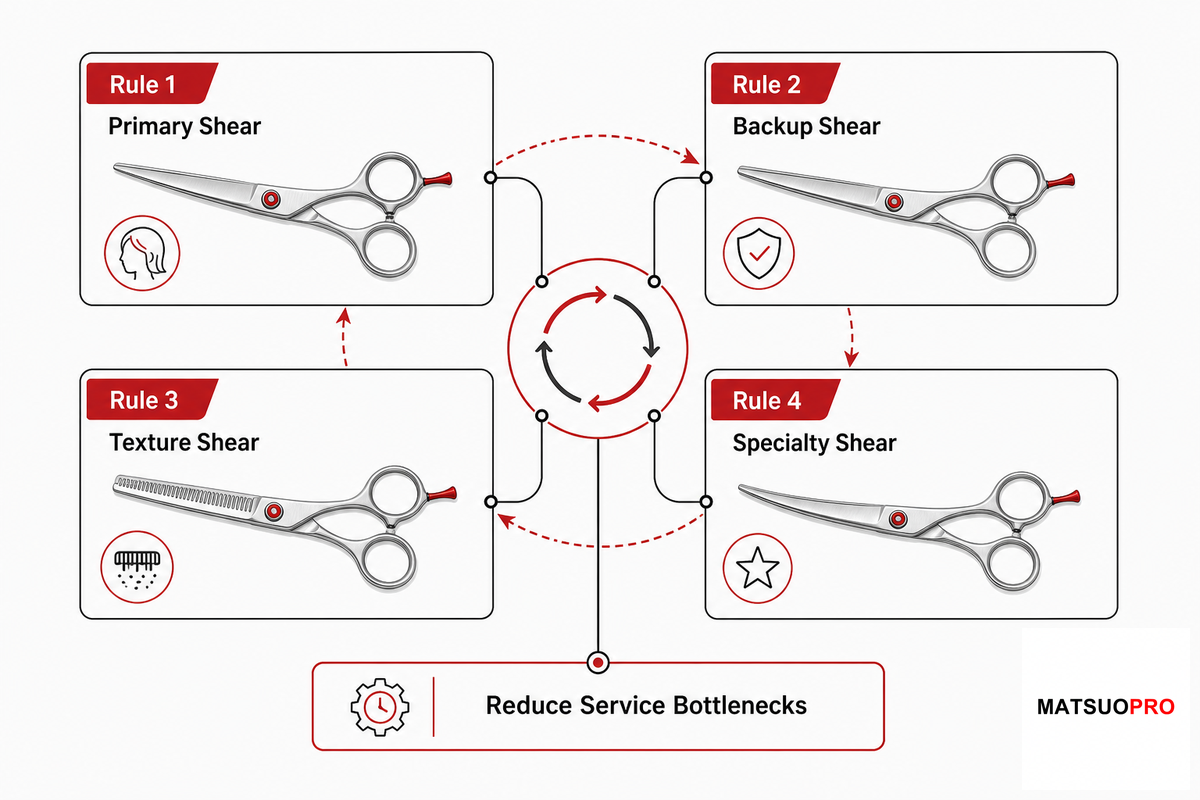
With The 4 Rotation Rules, scissors become a functional system. Experienced salon practitioners are well aware that they run multiple pairs rather than running a single pair of professional shears until they break or fail. And it’s important because the presence or absence of a spare can impact timing of service, style techniques, sanitation, and cash flow.
In practice, a salon that keeps 3 to 5 active pairs has a clearer fallback path when a pair is out for service, adjustment, or inspection. Because the U.S. Bureau of Labor Statistics lists cutting, shampooing, coloring, drying, and styling as separate duties, a working collection has to support more than one task. MATSUOPRO and Mackay can support this role-based kit logic through CNC production, precision hand finishing and OEM programs, so the rotation plan can be specified instead of guessed.
“The sharpener should only be sharpening the shear when it is necessary to sharpen, not just when you are approaching your set period of time.”
The MATSUOPRO model, offering factory-direct customization from 50 pieces (with stocked styles available starting at 1 piece) makes the role-based shear a viable option for salon and distributor private-label programs, and allows for the creation of kits tailored for specific roles instead of simply the best professional hair shears you can buy.
Advice on purchasing professional shears is better placed in the Product Category. Here, we look at what you can do to keep the ones you’ve alive.
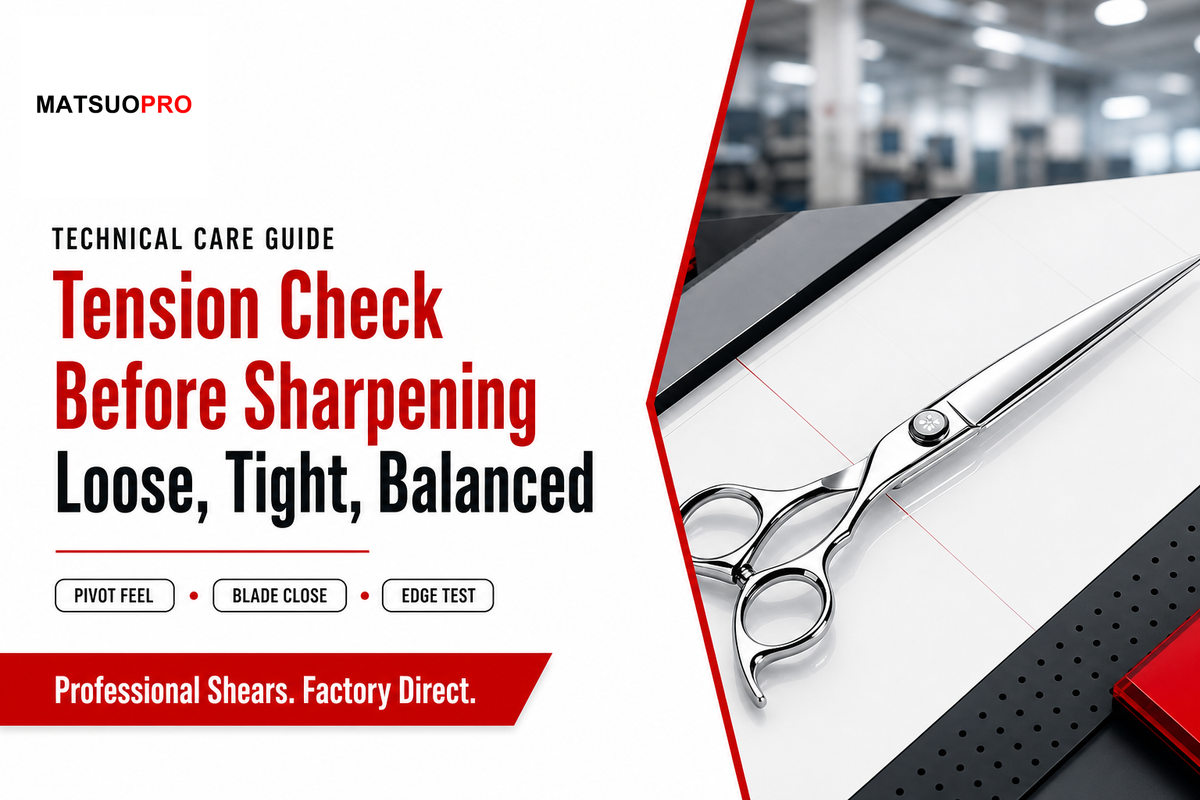
Hidden Bottleneck Map: Dullness Is Not Always the Blade. Even a sharp shear edge won’t perform properly if blade tension isn’t right. Old 2011 shear-maintenance advice from Modern Salon points to two failure modes: loose tension bends and folds hair; tight tension causes blades to bind. While that’s dated information, it serves as a practical example when combined with what the technical side suggests: one cutting-scissor patent specifies a frictional connection for hinge tension adjustment. Friction isn’t static.
That creates a hidden failure risk in daily production: the pair may look dull, but the root cause can be pivot play. Mackay hand-tensions each premium shear after CNC grinding and hand honing, which is why the field check belongs next to the sharpening decision rather than after it.
This is a minor mechanical check, but will save you time and money. A technician could be paid to sharpen a pair that simply require a tension adjustment. Or a sharp operator will cut with a tight set and reduce a sense of quality and add hand fatigue.
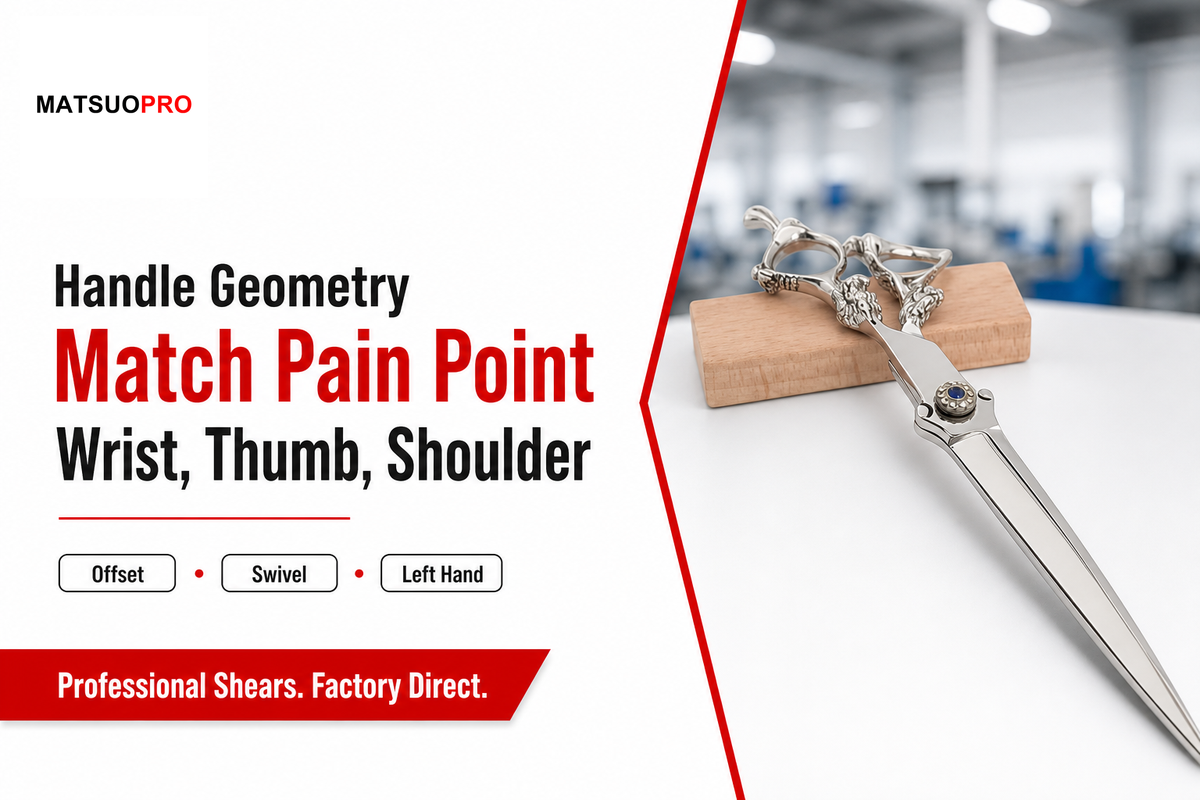
Ergonomics of shear design isn’t about comfort, it’s occupational safety. Medical research demonstrates a higher prevalence of neck, shoulder, wrist and hand disorders for cosmetologists and hairdressers. Health claims are that shear handle design can influence the positions of the wrist, hand, arm, and shoulder at work. No claim should be made without scientific proof that a specific swivel-handle design prevents carpal tunnel or RSI.
Swivel handle shears may position some hands better and reduce the need to flex the wrist, but medical evidence to show universal benefit for such models isn’t there. If a stylists wrist aches by cut 20, then one of these should be checked when buying a new pair of swivel shears: quality of the edge, the tension setting of the pair, or the way you’re rotating the hand through the stroke to achieve that cut.
| Symptom pattern | Likely tool question | Next check |
|---|---|---|
| Thumb pressure rises through the day | Edge or tension may be forcing effort | Test tension before buying a handle change |
| Wrist bends outward during scissor-over-comb | Handle geometry may not match task | Try offset, crane or swivel handle in the same length |
| Shoulder lifts on long sections | Length and posture may be mismatched | Check chair height, elbow angle and blade length |
| Pain appears only with one pair | That pair may be dull, tight or poorly balanced | Retire from rotation until checked |
For a stronger maintenance check, OSHA’s poultry-processing ergonomics eTool is not hair-shear-specific research, but it is an official hand-tool source: it lists squeezing scissors under high hand force, notes that improper hand tools require greater force, and identifies tool maintenance as a factor. Transferable point: a dull or poorly maintained cutting tool can raise force demand. That’s a stronger maintenance point than many marketing claims about the benefits of swivel shears.
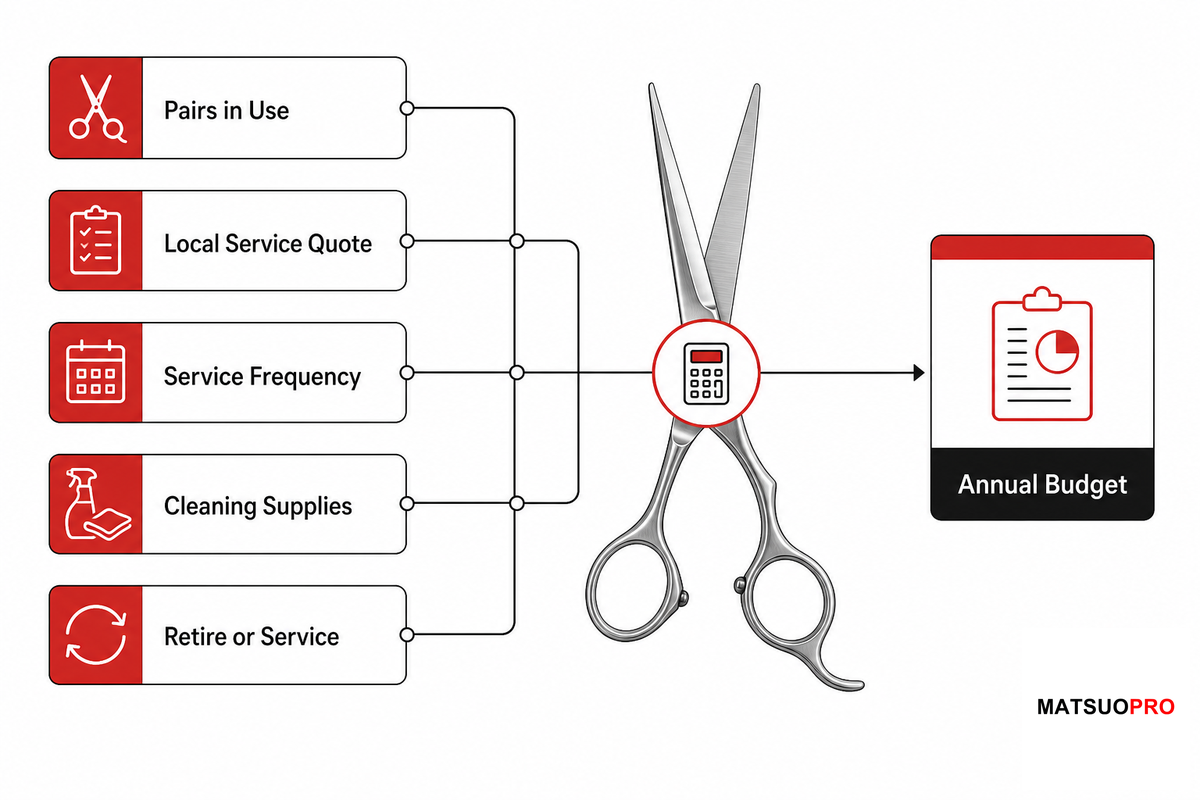
Buying top-of-the-line shears for a hair cutting professional doesn’t represent the entire cost. Maintenance cost adds up. There’s no neutral source on what’s a reasonable per-pair sharpening cost currently, so your service costs shouldn’t be built from such data. Instead use your actual per-year costs.
The mistake is treating sharpening as a one-line expense. In a salon or distributor application, the real risk is a pair failing during a busy week because the backup, tension check and service budget were never planned. Use a 30-day service log and a 12-month budget review; Mackay’s factory-direct model can then support the same role, steel and finish across replacement pairs.
Annual maintenance cost = (# of shears) x (service cost per pair) x (# services per year) + (cost to carry additional backups)
For example: (4 shears) x (your local service quote) x (2 sharpenings per year) gives the annual edge-service budget before shipping, the days a pair is out of circulation, or the cost to have a pair adjusted at the shop.
This isn’t the same as the hub-page purchase price or a per-pair 5-year total cost of ownership. Salon owners want to ensure a steady supply of their chosen quality hair scissors through the busy days of a week. Distributors will ask how private-label line shear service stories can be backed. A stylist asking the second time a pair is sharpened will be focused on what makes it a cost effective use of cash.
Mackay carries professional hair salon product assortments on its hair salon shears page. For calculating the initial investment and maintenance costs, try the shears cost of ownership tool.

A shear’s sharpness issue isn’t just blade, it’s blade’s edge at its limits. Coarse hair, thick hair, dry hair, wet and dry hair are all tests for an edge’s condition. Remove a pair that: pushes hair; folds the strand over itself; shows white pressure marks on hair strands; requires a third- or fourth-finger contribution to the cut after being adjusted correctly to its working position; or leaves a ‘burr’ on the cut end of the hair.
In practice, retirement is a quality-control decision, not an emotional one. When a pair fails the same application after tension and service checks, the safer route is to remove it from client work. MATSUOPRO’s steel, heat treatment and hand-finishing controls help new pairs start with consistent geometry, but no factory claim can rescue a damaged pivot, bent blade or chipped cutting edge.
Dull shears will smash or fold hair as they cut rather than make a sharp incision, and will likely result in a jagged finish. Practical Rule of thumb: if a blade drags, pushes, folds or results in a frayed finish after cleaning, drying, and adjustment, then take it out of service for finish work. Not all split ends are the result of your tool; it’s a combination of technique, hair type, and chemical history.
Retirement Decisions Make Hair Quality Claims Reality, Even with “Better Steel.” Misuse of premium hair cutting shears can shorten their lifespan more than any ‘cheaper’ model that has been properly cleaned, dried, tensioned and rotated in the kit. Working kits need rules of service, not simply higher-quality steel.
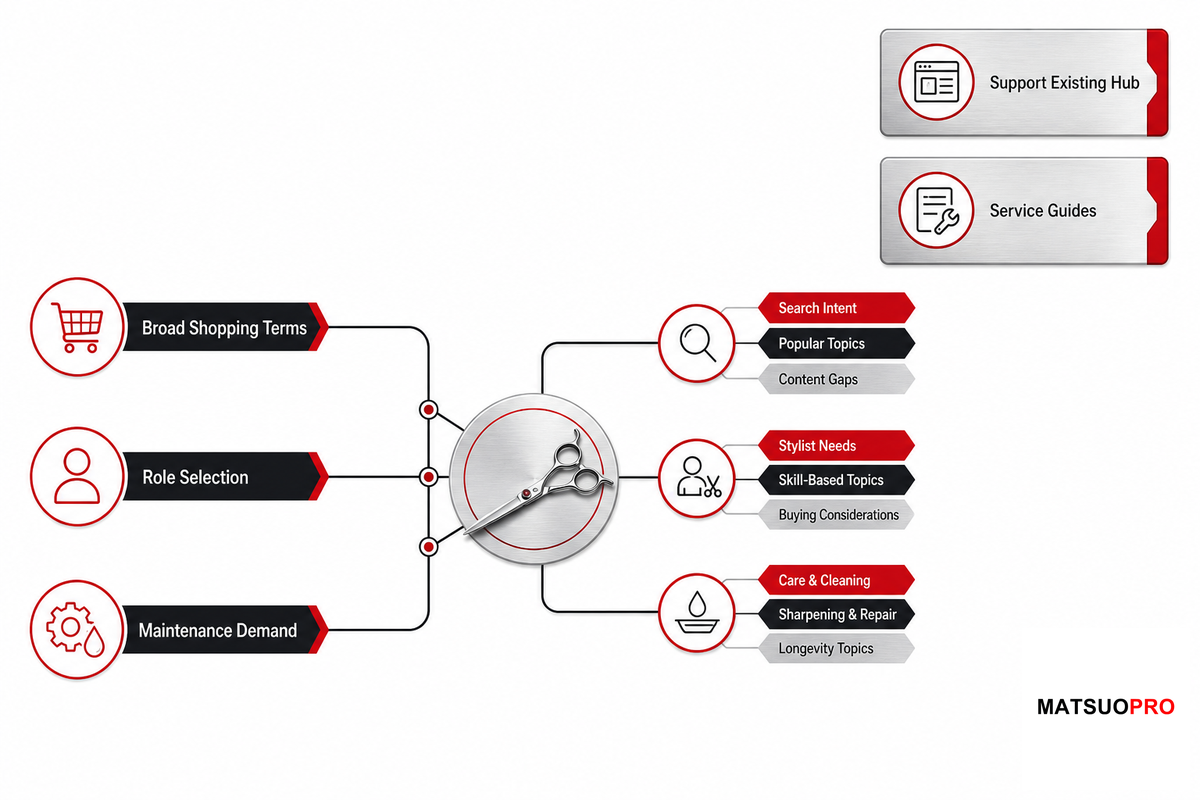
The 2026 signal isn’t the end of interest for these products. Rather, interest has become more task-based. A 12-month search-demand review ending June 2026 shows broad search queries for ‘hair cutting scissors’ and ‘hair cutting shears’ declining year-on-year. Interest in type selection has remained steady and interest in ‘thinning shears’ grew over that period.
| Query group | 12-month signal ending June 2026 | Writing decision |
|---|---|---|
| hair cutting scissors | -45% | Do not build another broad shopping page |
| hair cutting shears | -33% | Support the existing hub instead |
| best hair cutting shears | -21% | Avoid generic best-list framing |
| professional hair cutting shears | -18% | Send purchase intent to product pages |
| types of hair cutting shears | 0% | Keep guide structure |
| hairdressing scissors types | 0% | Keep role taxonomy |
| thinning shears | +22% | Link to the dedicated blending page |
| sharpening terms | 9 months of flat drift | Treat maintenance as durable support demand |
While these trends may suggest an ‘AI Overview has consumed this category’ explanation, this same dataset reveal that thinning shears have answer-engine coverage and grew in interest over this period. More useful for salon brands, and distributors: broad category page importance remains, but lasting demand is shifting to questions of use-case, application, ergonomics, steel evidence, and maintenance.
This makes the MATSUOPRO factory story highly relevant. In an effort to provide assurance that product is as good as it’s described to be, the factory story details Mackay’s management of Japanese steel, CNC blade creation, vacuum and cryo treatments, PVD coating, laser etching, hand honing, hand tensioning and 100% piece by piece quality inspection of the integrated production line. However, the true value is in the story the blog post provide for service standards around that production.
Stainless steel shears will rust if they’re exposed to moisture, salts, disinfectant residue or grime long enough to weaken the surface passive film. NASA corrosion guidance notes that chloride ions can attack the passive layer on stainless steel and promote localized corrosion. Pitting is the localized breakdown of that passive layer; a patch of rust may be the only sign. This usually points to storage or cleaning habits, such as leaving the pair damp in a pouch, drying it incompletely after cleaning, or leaving residue from strong disinfecting solutions. After cleaning, dry the blades fully, then inspect the pivot, inside face and tips under bright light. If a stain keep developing in the same place, adjust the drying routine, the disinfectant process or storage.
Begin by removing any loose hair and debris before washing your shears with soap and water, drying thoroughly, and using the disinfectant protocol recommended by your local salon board. California’s Board of Barbering and Cosmetology, for example, categorizes shears as non-electrical instruments and requires an EPA-registered disinfectant effective against bacteria, fungus, and viruses. Other regions may have different rules, so treat this as a useful example rather than a universal guide.
An adequate collection include several pairs for daily cuts, detailed work, texture and blending, backup and for specialized needs such as left-handed or barber shears. Many hairstylists find that 3 to 5 active pairs, excluding training or display items, are sufficient. The number of pairs needed can fluctuate depending on the hair types you work with, your weekly cutting volume, cleaning routine and how frequently you send shears to be serviced.
A household sharpener isn’t ideal for convex-edge shears. The precision of Japanese convex edge geometry is reliant on precise blade alignment, a specific polishing technique and careful contact. Coarse sharpeners found in homes may inadvertently flatten or nick the cutting edge, particularly with high-quality Japanese steel. The high-end MATSUOPRO shears are produced with CNC machining and are hand-honed to a mirror finish by master craftspeople-a quality finish that demands maintenance from a sharpener experienced with convex hairdressing shears rather than from an instrument meant for kitchen scissors.
It’s worthwhile to inspect it at least. Any sharpening process changes the edge, and during service, the action at the pivot may also change. If your drop test doesn’t meet expectations after sharpening, try adjusting the pivot tension before attributing the issue to the edge.
Send your shears for sharpening if the handle, pivot, alignment and edge geometry are all in good working condition. However, replace the pair if you find rust spots at the cutting edge, bent blades, significant pivot play, or if the cost of repair exceeds the shears’ practical utility in your collection. Shears designated for training might merit one more sharpening. Pairs used for daily professional haircuts require consistently fluid action because the friction associated with a poorly functioning pair ultimately costs more than a sharpening invoice.
When storing your shears, ensure they’re clean, dry, lightly protected, and kept separate from other metal instruments. Avoid sealing a damp pair in any kind of pouch. The tips should be safeguarded, the pivot kept free of debris, and backup shears checked frequently enough to be ready at a moment’s notice if your primary pair is unavailable.
Manufacturer note
MATSUOPRO is the in-house manufacturing brand of premium professional shears for Mackay Hair Scissors. Mackay is a fully integrated manufacturer supplying its products to salons, distributors, and brands in over 40 countries. Its production workflow, as reported, involves acquiring Japanese steel, using CNC machines for cutting, applying vacuum and cryogenic heat treatments, employing PVD coating and laser engraving, hand honing and hand tensioning, and performing piece-by-piece quality checks. Custom OEM/ODM services are available beginning with orders of 50 units, and readily available in-stock styles can be ordered starting from just one piece.
The information presented in this article is based on the brand-provided context and shouldn’t be interpreted as claims of first-party sharpening records, warranty data, customer service logs, or laboratory-derived service interval results, as these weren’t furnished for this report.
References & Sources
Related articles
MATSUOPRO is the Mackay Hair Scissors manufacturing brand for professional hairdressing shears, barber scissors, thinning shears, and pet-grooming scissors. We support salons, distributors, academies, grooming brands, and private-label buyers that need factory-direct production with practical material guidance.
Our buying guides are written to help purchasers compare steel grades, handle styles, blade geometry, surface finishes, logo options, packaging, MOQ, and sample validation before placing an OEM or wholesale order. The goal is to make each scissors specification easier to discuss with a real production team.
Factory-direct supply since 2014, with product lines covering professional cutting shears, barber shears, thinning scissors, texturizing scissors, left-handed models, and pet grooming scissors for international B2B customers.
We focus on Japanese 440C, VG10, and ATS-314 steel choices, convex and bevel edge geometry, ergonomic handle balance, tension systems, logo engraving, private-label packaging, and sample-based OEM confirmation.