Get in Touch with Mackayhairscissors Company
We use submitted details to respond to your quote request. Read our Privacy Policy.

July 2026 update; reviewed by the Mackay Hair Scissors manufacturing team.
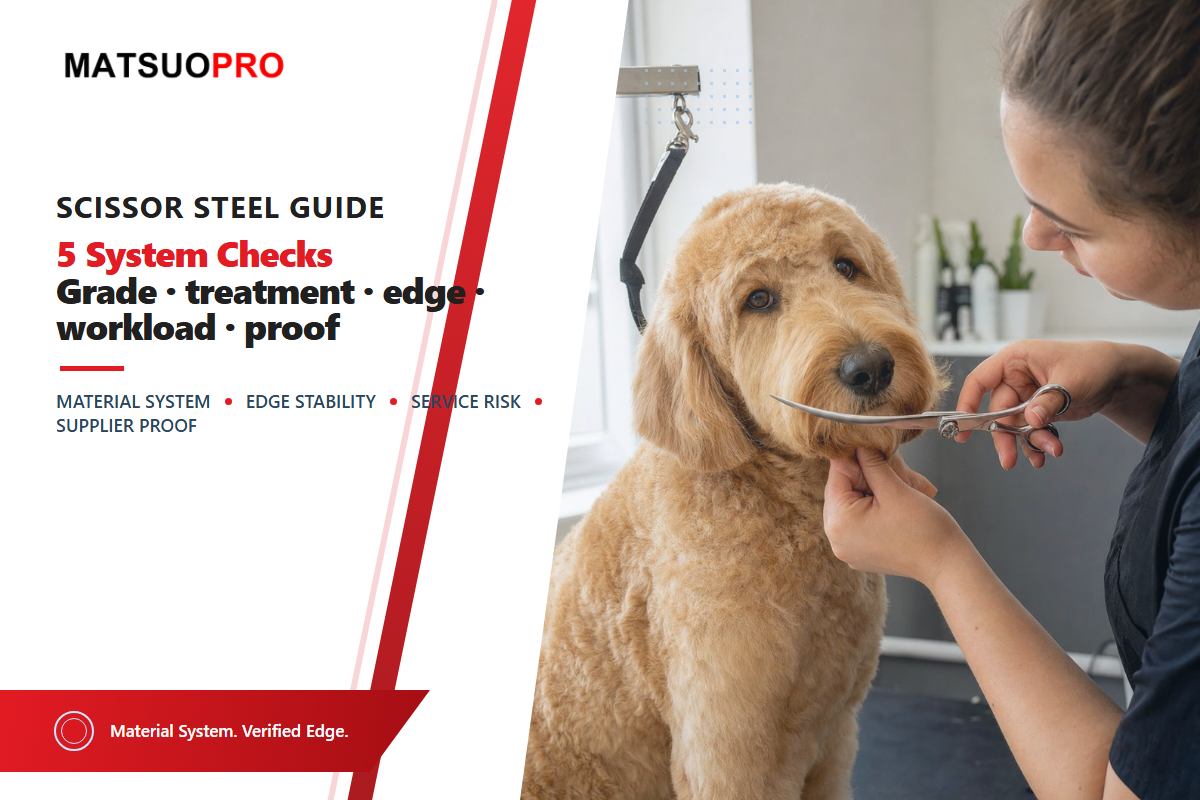
A Scissor Steel Materials Guide is a decision framework for evaluating the finished material system behind a shear, not just its grade label. Check five things together: the work the shear must do, material identity, heat-treatment result, edge and service fit, and finished-blade evidence.
Even a respected grade can’t rescue brittle treatment, unsuitable geometry, poor tension or missing traceability.
This guide covers the decision system around the steel. For grade definitions and short grade-level comparisons, use Mackay’s complete scissor steel reference.
Keeping those jobs separate matters: the reference page answers “what’s this grade?” while this article answers “what evidence and behaviour should I specify before choosing it?”
Material-system rule: a grade designation can identify a material family. It cannot tell you how the finished blade was hardened, ground, tensioned, inspected or serviced.
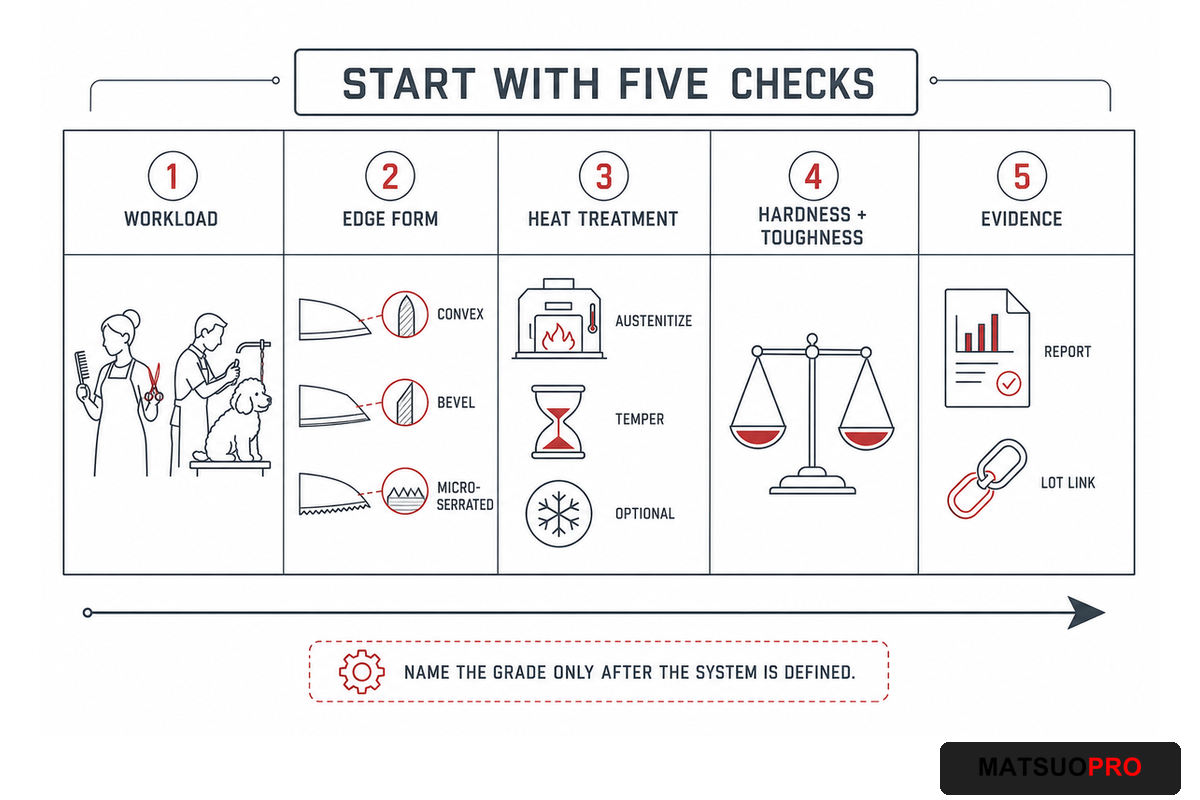
Ranked lists feel convenient, but they hide the failure points that cost a salon, grooming business or private-label buyer money.
Use this order before comparing any named steel in the complete scissor steel reference:
Handle fit and ergonomic suitability come first.
Stylists who have to bend the wrist, squeeze harder or fight an unsuitable handle won’t solve that problem with premium steel. Once the shear fits the user, the five checks above address its material side.
Buying a persuasive label can reveal the hidden mismatch too late: a fine edge that chips in rough work, a hard blade that local sharpeners can’t restore, or a corrosion-resistant alloy exposed to a cleaning routine the supplier never discussed.
Two scissors may use the same claimed grade and still behave differently because their treatment, geometry and assembly differ. Following the five checks exposes those gaps before the purchase order.
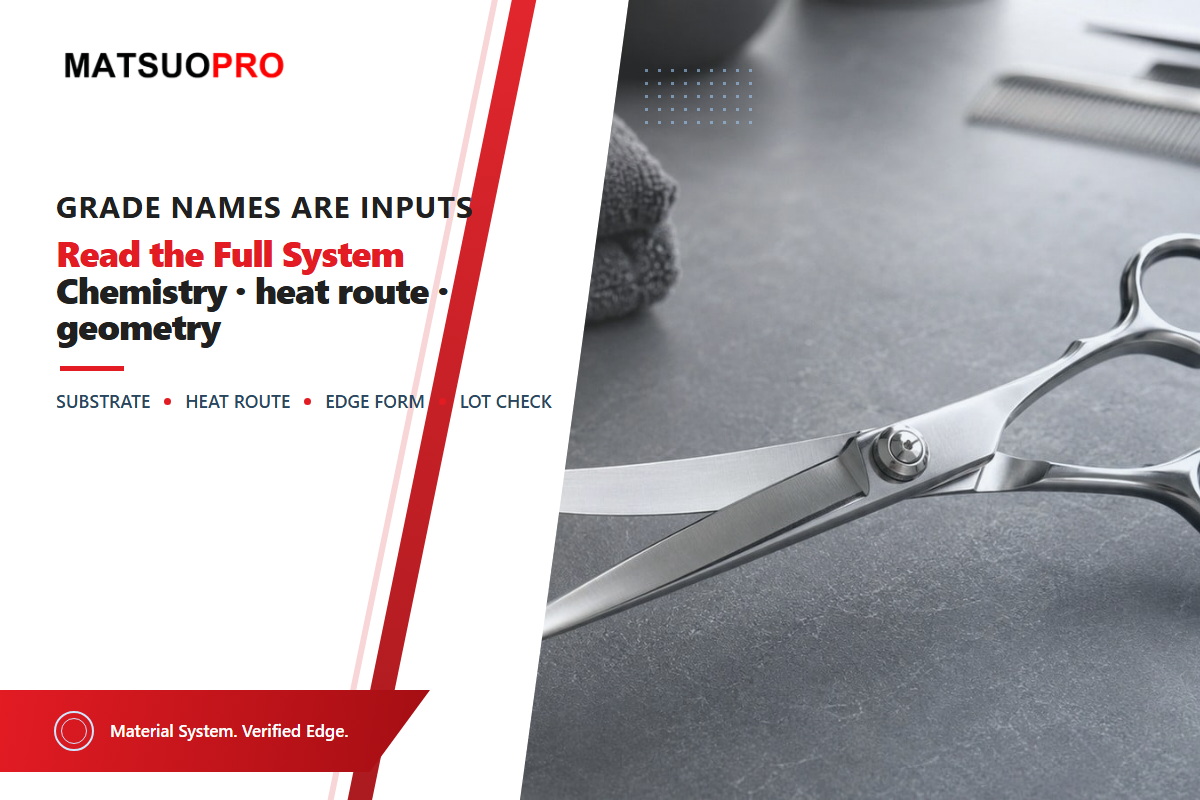
Standards-linked grade designations and loose commercial phrases aren’t the same thing.
Within its scope, a formal designation can define chemistry, product form or delivery condition. Even then, it doesn’t fully specify a finished hair scissor. From there, the chain continues through hardening, tempering, achieved structure and hardness, blade geometry, grinding, honing, assembly, tension and inspection.
Finished-shear material system
Material identity → heat-treatment route → achieved blade condition → edge geometry → grinding and honing → assembly and tension → piece-level inspection
Mackay’s five-page catalog audit illustrates why the label is incomplete. Different 440C product-family pages published 56-58 HRC on a value family and 57-59 HRC in a Japanese-440C body claim, while metadata on that reviewed page stated 58-60 HRC. Those values must not be averaged.
They belong to different family or page contexts, and one body-versus-metadata discrepancy requires correction. Here the useful lesson is narrower: “440C” alone didn’t identify the finished condition of every model.
Treat all similar tags like “japanese steel”, “chromium steel”, “cobalt steel”, “chinese steel”, “powder steel”, “titanium steel”, “v1 steel”, “s3 steel”, “10cr steel”, “damascus steel”, “takefu special steel”, “vg10 steel”, “japanese steel used”, “type of steel”, “steel types”, and “grade of stainless steel” similarly. Origin, process type (powder metallurgy vs forged steel) and added elements (vanadium) aren’t final blade specs in isolation, and surface colour does not prove the grade or finished quality. If you find yourself comparing just two specific steel options, like 440C and VG-10 (VG10), then take it to the specialized 440C/VG10 comparison article instead of re-establishing this ground again.
Marketplace language audit: which phrases need verification?
Search and seller sites use a wide variety of names and labels for steel. To maintain specificity for the searcher, this list uses the exact wording presented and doesn’t assign or promote any hierarchy for country of origin or quality.
Miscellaneous search fragments: “steel is the best”, “scissor steel should i use”, “powder scissor steel is comparable”, “corporation manufactures the ats314 steel”, “successful scissor brands”, “successful scissor brands like jaguar”, “hair scissors from japan”, “scissors from japan”, “almost every mid-level hairdressing scissors”, “high-quality stainless steel hair scissor”, “titanium coating on hairdressing scissors”, “quality hair cutting”, “cut hair”, “stainless steel products”, “every scissor into a professional”, “scissor into a professional tool”, “understand your new scissors”. These are either questions or marketing language, not material identifiers.
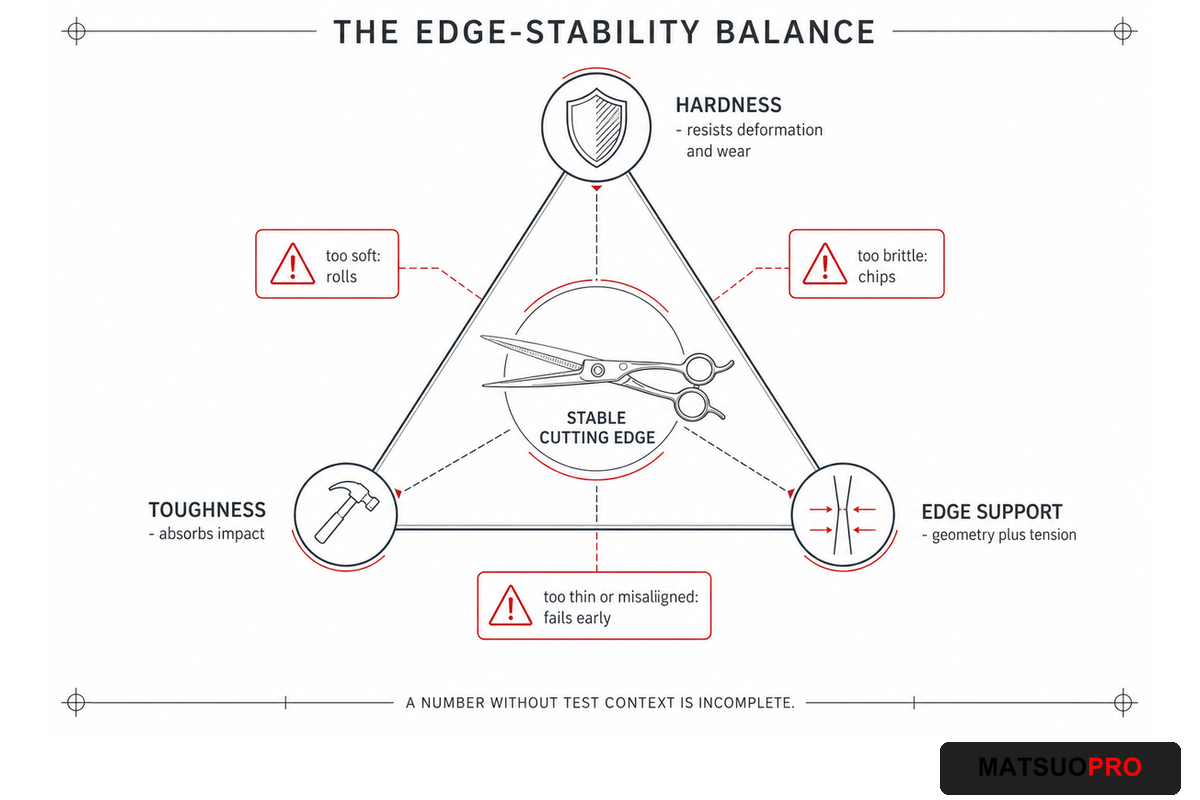
Rockwell hardness is a legitimate proof tool. It helps guide process, choose material and accept product if the measurement is correct. Problems start when a number on an HRC chart is mistaken for a certified grade or a reliable forecast of service life.
ISO 6508-1:2023 specifies current Rockwell test methods across designated scales. ASTM E18-25 characterizes Rockwell as an empirical method, and a result at one location may not represent the whole part or product. Therefore, a purchase requirement should address the HRC or other scale, finished product or coupon, test location, model or lot, and warranted range.
An NIST measurement guidance document adds a further parameter: measurement and calibration processes can help to minimize variation because reports of results possess multiple sources of error and information is most meaningful when method and context are known.
Hardness also must coexist with toughness and edge stability. Metallurgist Larrin Thomas has shown that toughness and resistance to abrasive edge wear are frequently in opposition in steel blades. A harder blade can resist greater distortion or abrasion to some extent, though a thin edge may chip when subjected to sudden impact. Treat numerical values conditionally, as ‘higher isn’t always better’. For the dedicated hardness lesson, see how Rockwell hardness affects shears.
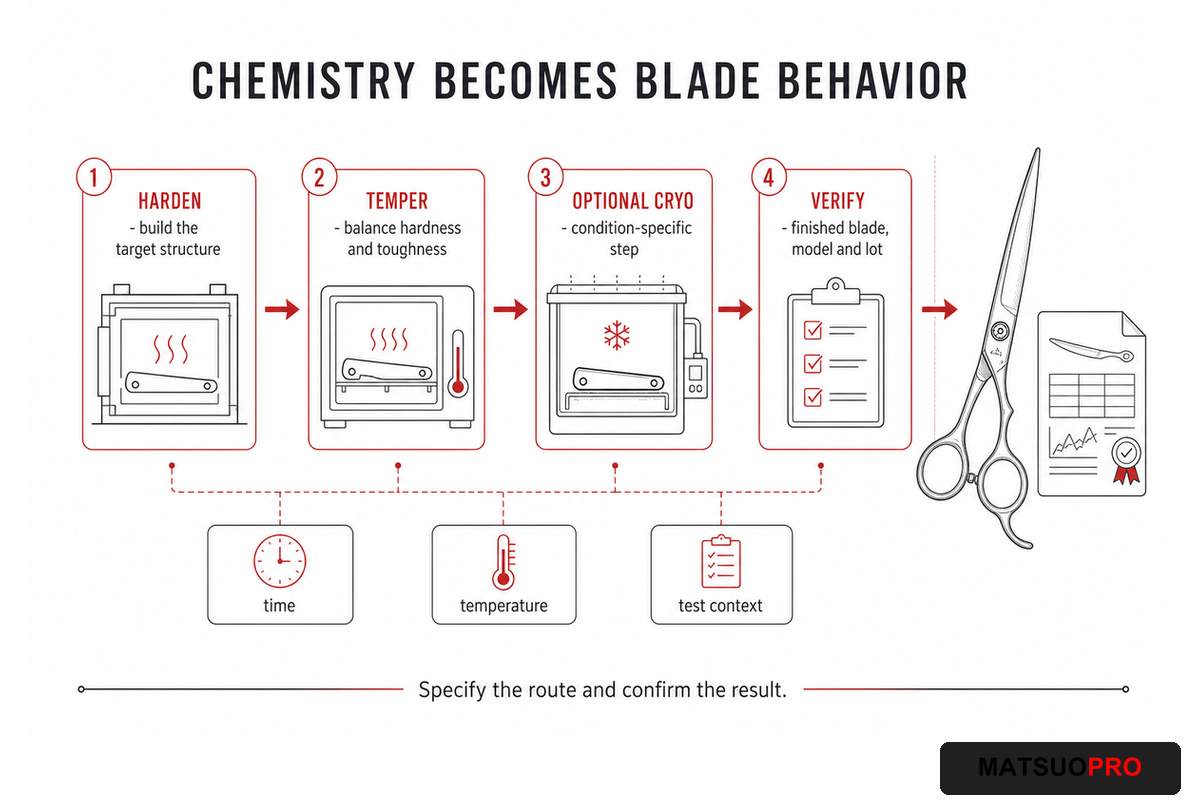
Chemistry provides the blade’s potential. Hardening, tempering and optional cryogenic treatment determine how that potential is expressed in the finished product. A buyer needs the process route and a verification point more than a long metallurgy lecture.
Mackay’s company-provided production map lists more than 80 individual operations, including vacuum and cryogenic heat treatment, CNC grinding, hand honing, tensioning and piece-level inspection. Mackay says its premium blade families are typically processed to 60-62 HRC. These are first-party process indications, not evidence of individual model or lot performance. The order documentation still needs to trace a particular model or lot to the appropriate process report.
Two scholarly tool-blade studies shed light on the role of ‘cryogenic’ treatment rather than presenting it as a miracle. In a 2025 study of DIN 1.2344 steel, changes in process-related wear were 1.34% to 13%, with changes in impact resistance only up to 2.37%. A 2023 examination of AISI M2 addressed the interdependence of austenitizing temperature, tempering temperature and cryogenic dwell time; some combinations were beneficial while others had no impact or a negative one.
These alloys and test conditions weren’t professional hair or grooming shears. Their percentage results can’t be transferred to a salon steel, pet-grooming tool or shear model in a shop environment. The bounded conclusion is to specify the entire treatment regimen and confirm the end result instead of relying on the word ‘cryogenic’.
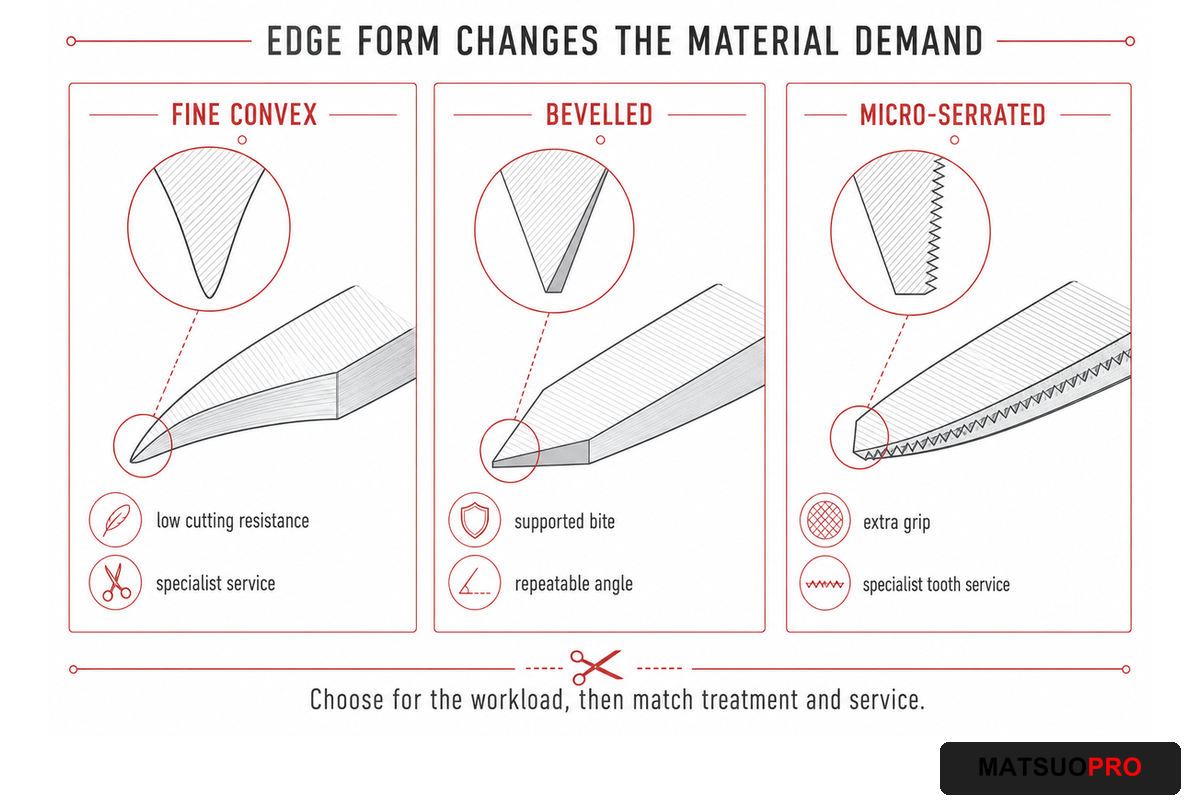
The edge of a blade is where physical conditions meet technique. Different edge types—convex, bevelled and micro-serrated—place different demands on the same steel blade, and each type has distinct tradeoffs.
| Edge form | Useful behaviour | Material-system demand | Common risk | Service question |
|---|---|---|---|---|
| Fine convex | Low cutting resistance; smooth slide or slice work | Stable treatment, supported geometry and controlled tension | Impact damage or geometry loss during poor sharpening | Can the sharpener preserve the convex profile and remove minimal steel? |
| Bevelled | Positive, supported cutting for general or heavier duty | Toughness and a repeatable bevel angle | Excess drag if finish, tension or angle is wrong | Will the service restore the factory angle rather than steepen it? |
| Micro-serrated | Extra grip on hair or coat that tends to slide | Consistent teeth, opposing blade alignment and edge support | Tooth damage or accidental removal during conventional sharpening | Does the service handle serration geometry? |
In one controlled knife test reported by Thomas, changing from a 25°-per-side edge to 10° per side produced about five times the CATRA edge-retention result for one steel, while the thinner edge suffered much more impact chipping. That’s knife data, not a forecast for professional barber scissors, salon shears or pet-grooming tools. It demonstrates the scale of geometry’s influence and the tradeoff that a steel-only measurement can miss.
An older knife-sharpening patent discusses changes to a convex grind, the damage a hollow grind can incur, micro-beveling and coating failures as engineering challenges. Although the document only suggests these problems and doesn’t verify commercial performance, it reinforces the pragmatic service question of who’s qualified to perform the required sharpening work.
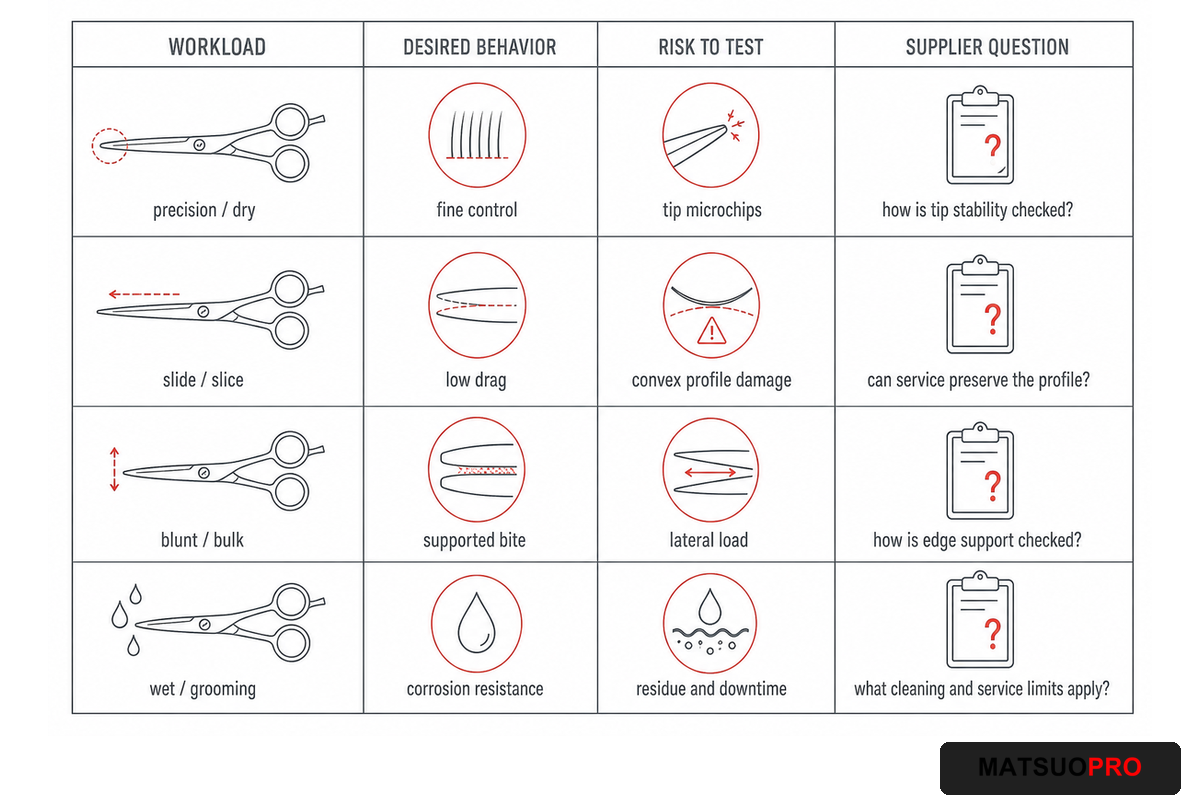
Ask “Which scissor steel should I use?” only after explaining the work. Different scissors use different combinations of geometry, tension and material condition. This is an original purchase method, not a standardized alloy comparison.
| Work type | Desired edge behaviour | Risk to test | Supplier question |
|---|---|---|---|
| Precision and dry cutting | Clean entry, fine control and stable tips | Microchipping from impact or an over-thin edge | Which geometry and finished-blade check protect the tip? |
| Slide and slice cutting | Smooth movement with low drag | Convex profile damage or residue drag | Is specialist convex service available where the stylist works? |
| Blunt cutting and bulk removal | Supported bite and resistance to rolling | Lateral load, contact damage and tension drift | How is edge support checked after heat treatment and grinding? |
| Wet or chemical-heavy salon work | Corrosion resistance with predictable cleaning | Moisture, residue and disinfectant exposure | Which care instructions and coating limits apply to this model? |
| Texturizing and thinning | Repeatable tooth entry, release and alignment | Tooth-edge damage, uneven contact and difficult specialist service | How are tooth geometry, blade contact and post-service alignment checked? |
| Dense, coarse or extension hair | Controlled bite without excess hand force | High edge load, hidden debris and accelerated contact wear | Which edge support and inspection method address this higher load? |
| Mobile or shared-tool work | Predictable cutting after transport and repeated cleaning | Impact in transit, mixed care routines and delayed specialist service | What storage, cleaning and service controls protect this geometry? |
| Pet grooming | Stable bite through varied coats with a higher cleaning burden | Coat contamination, accidental contact and service downtime | What toughness, edge and cleaning assumptions were used for the model? |
Use product and disinfectant labels for cleaning compatibility; this guide doesn’t name a single chemical acceptable for all jurisdictions and finishes. Buyers specifying pet-grooming scissors should also record coat types, contamination exposure and local repair access. Such a work record is more valuable than asking which steel is best for professional hairdressing in the abstract.
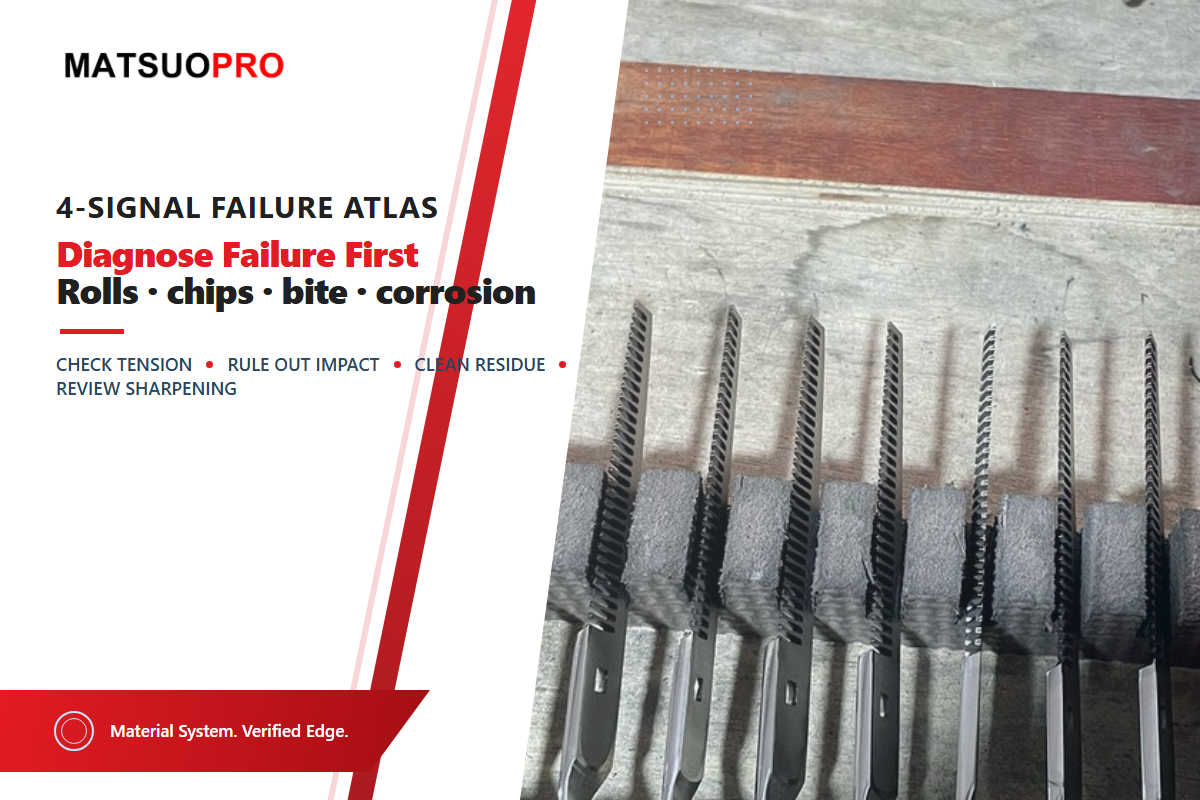
“Dull” is a symptom, not a diagnosis. Mackay’s 4-Signal Steel Failure Atlas separates a possible material or edge failure from issues of tension, impact, contamination, technique and prior sharpening.
| Signal | Possible material-system cause | Rule out first | Next inspection |
|---|---|---|---|
| Edge rolls or folds | Insufficient edge support, treatment mismatch or overload | Loose pivot, lateral thumb pressure and blade alignment | Inspect the edge under magnification and check tension through the stroke |
| Microchips or one notch | Brittle edge condition or geometry too fine for the load | Drop, hard contact or a single impact point | Map the damage location; do not grind the whole blade aggressively |
| Pushes or folds hair | Loss of bite, rounded edge or geometry damage | Residue, loose tension, dry/product-heavy hair and cutting pressure | Clean the pivot, set tension and test where the snag repeats |
| Staining or pitting | Corrosion burden beyond material, finish or coating tolerance | Moist storage, residue, incompatible cleaner and surface damage | Stop use if damage affects the edge; document exposure before repair |
Practitioner discussions repeatedly distinguish salon shears from ordinary knives and household cutting scissors. They connect bad service outcomes with altered angles, damaged tips, touching the hollow back, incomplete burr removal, blade bend and pivot tension. This is experience evidence, not controlled science, but it’s enough to justify a diagnostic sequence before blaming low-quality steel.
Aggressive sharpening isn’t a neutral test. It removes material and can erase the geometry needed to diagnose the original problem. Photograph the edge, record where the symptom occurs and ask the sharpener what will be changed.
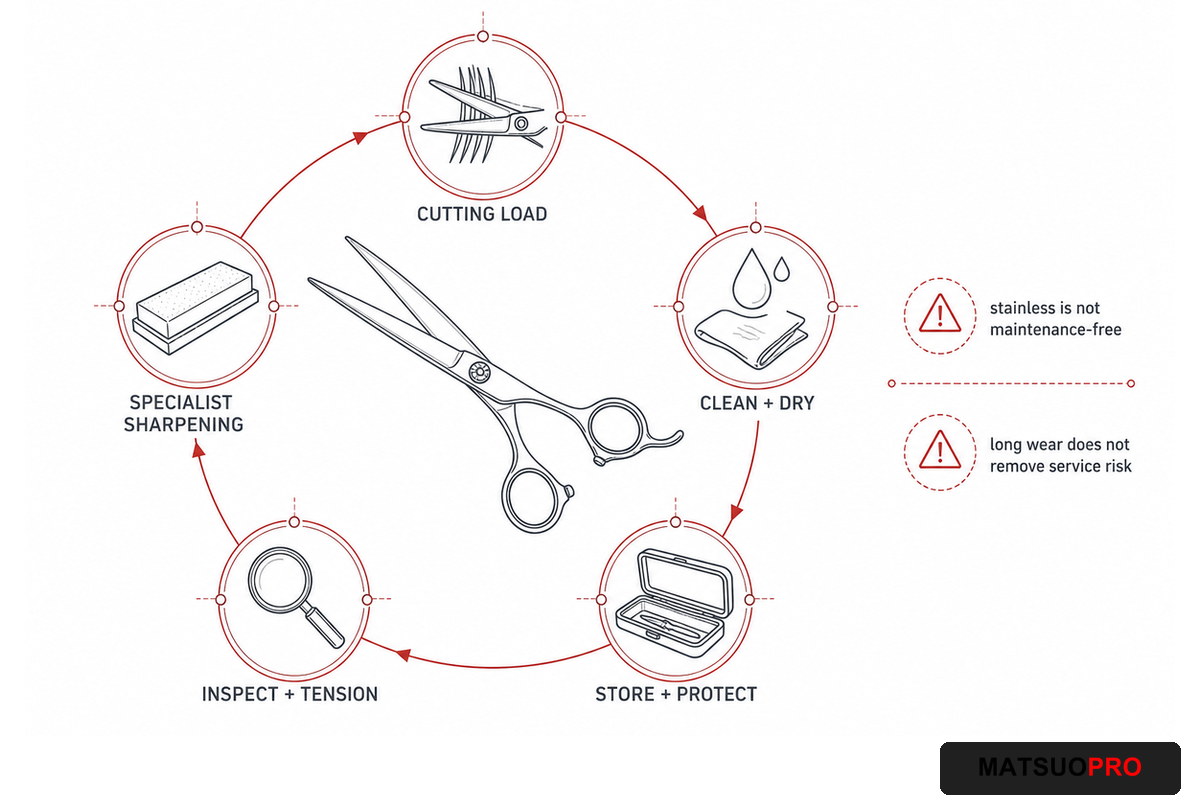
Stainless steel is corrosion-resistant, not maintenance-free. Australia’s Stainless Steel Development Association describes stainless as low maintenance rather than generally maintenance-free and explains that washing removes deposits that can cause corrosion. Its page concerns architectural and coastal stainless, so no coastal distance, chemical recipe or grade rule should be copied into shear care. What transfers is simple: deposits and moisture still matter.
Ensure hair and product residues are removed and that any care products used are compatible with the coating. Dry the tool properly, protect its edge during storage and keep the pivot in a clean, appropriately tensioned state. Factor disinfectant contact and formulation into the workload record; don’t assume all stainless can handle every cleaner.
Colour can also cause confusion. “Titanium steel shears” typically refers to a coloured coating or film on steel blades. Depending on the process, that coating may change the colour, surface feel or wear resistance without revealing the underlying blade material. Ask about both the coating and the base steel before purchasing.
Long edge life can also increase service risk if the blade is hard, thin and difficult to sharpen locally. There isn’t a universally valid recommended sharpening frequency: a slide-cutting stylist, a barber doing blunt work and a groomer working through contaminated coats impose different loads. Service skill, downtime and how much material is removed belong in the ownership cost.
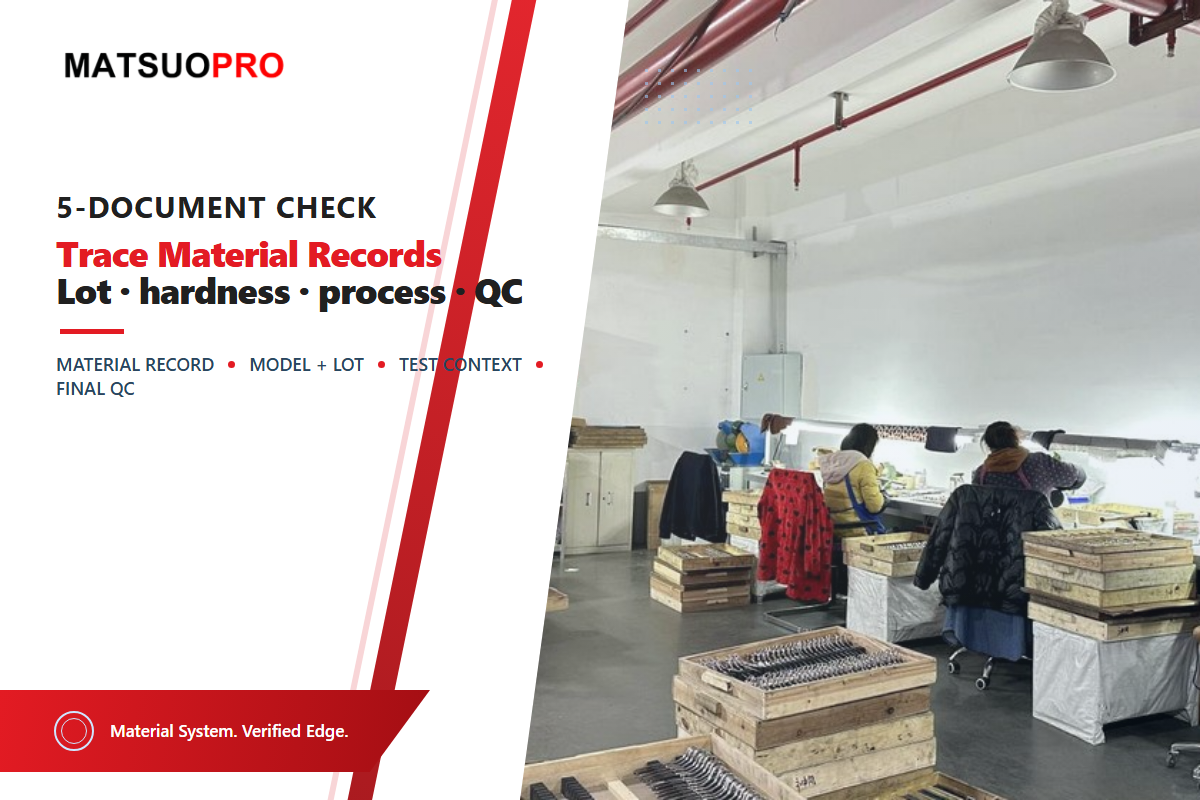
Use the 5-Document Material Evidence Check as a buyer risk-control framework. It is not an ISO or ASTM requirement, and it does not replace technical documentation or traceability duties that may apply in a regulated market.
A mill certificate addresses the first question. It cannot silently answer all five. NIST, ISO and ASTM support the need to understand the measurement method and context; they do not require this exact document chain. Model-to-lot links and final inspection records are procurement controls for the finished shear.
Mackay says its ATS-314 plates are sourced through Proterial (formerly Hitachi Metals) and that third-party hardness and material reports are available on request. Our online search confirmed the current Proterial name but did not find an independent official source connecting Proterial to ATS-314 plate. Treat the sourcing statement as a first-party claim until the material and lot documents are included in the purchasing file.
How can I avoid low-quality or fake steel?
Don’t try to authenticate steel by country, price, colour or laser signature. Request all five evidence links, ensure the names and lot numbers match, and compare the hardness report with the model ordered. A supplier that can explain and reconcile a discrepancy provides stronger evidence than one that ignores it.
For custom programs, request model-level material verification for private-label shears before approving the production sample.
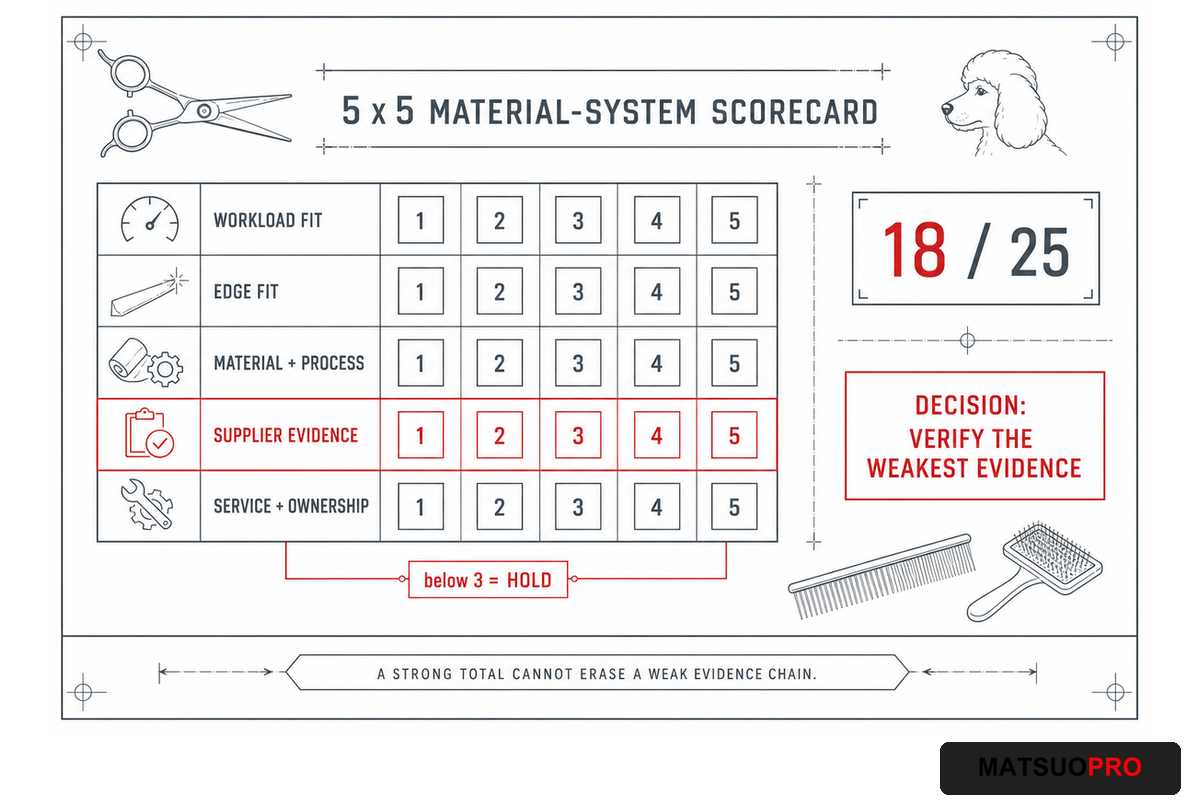
Turn the conversation into a repeatable decision using the 5×5 Shear Material-System Scorecard. Assign a 1-5 rating to each dimension, but treat evidence as a floor: if that dimension scores below 3, the decision is a hold, no matter how compelling the total may appear.
| Dimension | 1 point | 3 points | 5 points |
|---|---|---|---|
| Workload fit | Duty unknown | General fit with assumptions | Technique and exposure documented |
| Edge-design fit | Geometry conflicts with use | Usable with compromises | Geometry, tension and technique align |
| Material/process evidence | Label only | Model-level result plus partial trace | Five evidence roles linked |
| Service access | No suitable service | Mail-in or limited specialist access | Qualified local or managed service |
| Ownership tolerance | Care burden conflicts with operation | Manageable with training | Cleaning, storage and downtime fit |
Worked example: a slide-cutting stylist scores 5/5 for workload fit, 4/5 for edge fit, 2/5 for evidence, 3/5 for service access and 4/5 for ownership tolerance. The total score is 18/25. Even so, the decision remains on hold because evidence is below the minimum standard.
The low evidence score triggers the next action: request model-level hardness and traceability records so the high total does not mask the weak area.
Once behaviour, service and evidence requirements are defined, compare suitable grades in the complete scissor steel reference. That order keeps the grade page useful and stops this guide from becoming another unsupported best-steel ranking.
Professional scissors need corrosion resistance, fine-edge stability, toughness, grindability and finish quality in a workable balance. Their steel must tolerate the planned heat treatment and edge geometry, while the blades must meet under controlled tension. For more context on one measurable part of that system, see how Rockwell hardness affects shears. No single property makes the tool fit for purpose.
Begin with workload and handling fit. Define the required edge behaviour, toughness, cleaning exposure and service access, then check heat-treatment and finished-blade evidence before comparing grade details. Reject any option whose traceability can’t be linked to the model you’ll buy. Here, “best” means the documented material system that fits the work, not the most prestigious label.
Check the model specification, permanent markings and supplier documentation. Packaging that says “Japanese steel” or “premium steel” isn’t enough. Ask for material identity, the relevant material record and a batch-to-model link. If documents conflict, ask the supplier to resolve the discrepancy in writing; don’t infer composition from price, colour or country alone.
They can be, but powder production isn’t a finished-shear guarantee. Value still depends on alloy choice, heat treatment, edge geometry, grinding, service access and evidence. Well-executed conventional steel may better suit your workflow than a costly powder steel model with weak traceability or no suitable sharpener. Weigh the finished system and ownership costs, not the process label alone.
Yes, but the phrase can refer to pattern welding, cladding or decoration. Clarify what material forms the cutting edge.
Determine first whether “titanium” describes a coating or the base material. Most titanium-coloured hair scissors still have steel blades. Ask what the coating is meant to change, whether it influences sharpening, which steel forms the edge and whether the supplier can document both layers. Purchase only if the substrate, coating process, cleaning limits and workload fit your needs.
Evidence note: research into hand-held knives and tool steels is referenced solely for mechanism and scope limits. It isn’t presented as a controlled data set for professional hair and grooming shears. First-party company and process statements are marked.
MATSUOPRO is the Mackay Hair Scissors manufacturing brand for professional hairdressing shears, barber scissors, thinning shears, and pet-grooming scissors. We support salons, distributors, academies, grooming brands, and private-label buyers that need factory-direct production with practical material guidance.
Our buying guides are written to help purchasers compare steel grades, handle styles, blade geometry, surface finishes, logo options, packaging, MOQ, and sample validation before placing an OEM or wholesale order. The goal is to make each scissors specification easier to discuss with a real production team.
Factory-direct supply since 2014, with product lines covering professional cutting shears, barber shears, thinning scissors, texturizing scissors, left-handed models, and pet grooming scissors for international B2B customers.
We focus on Japanese 440C, VG10, and ATS-314 steel choices, convex and bevel edge geometry, ergonomic handle balance, tension systems, logo engraving, private-label packaging, and sample-based OEM confirmation.