Get in Touch with Mackayhairscissors Company
We use submitted details to respond to your quote request. Read our Privacy Policy.

Professional dog grooming scissors come with two prices: the shelf price, and the markup for the brand and distributors hidden inside. MATSUOPRO makes pet grooming shears from Japanese 440C stainless steel, hardens each blade to 58–60 HRC in-house, hand-hones a convex edge, then ships direct to groomers, salons, distributors and private-label brands in 40+ countries. You get the steel, the official hardness, and the factory price – with no badge tax.
Four grooming scissors handle the majority of any grooming work: one straight shear for outlines, one curved shear for faces and paws, one thinning shear or blender to erase clipper lines, and one safety-tip shear for eyes and ears. MATSUOPRO builds all four in Japanese 440C at 58–60 HRC and keep all four in stock – and available to custom order from 50 units.
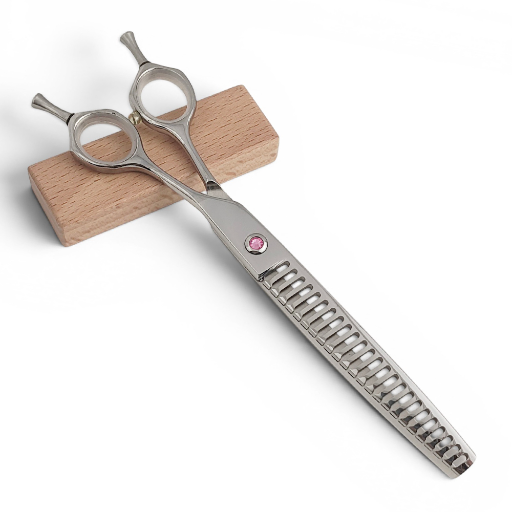
A grooming scissor is a hardened steel lever that needs to cleanly slice through thicker-than-human hair tens of thousands of times each day. That is it. And yet that single product category sells anywhere from $27 to $450 a pair, and the spec sheet rarely explains where the variance comes from.
Groomers feel this information gap keenly in their wallets. The retrospective one veteran professional named “how much money I wasted on bad shears”-the “shear graveyard” is a running inside joke- is why searching for the “best dog grooming scissors” is most often ended by a thread that recommends buying a good set of affordable grooming shears.
MATSUOPRO’s solution is procedural, not declarative. Steel grade, Rockwell hardness range and edge angle are all listed on the spec sheet of every MATSUOPRO pet grooming shear, with a third-party hardness report available on request. The decision you make for each of your team members – at $30 each – will be the same as the decision for a bulk order of 500.
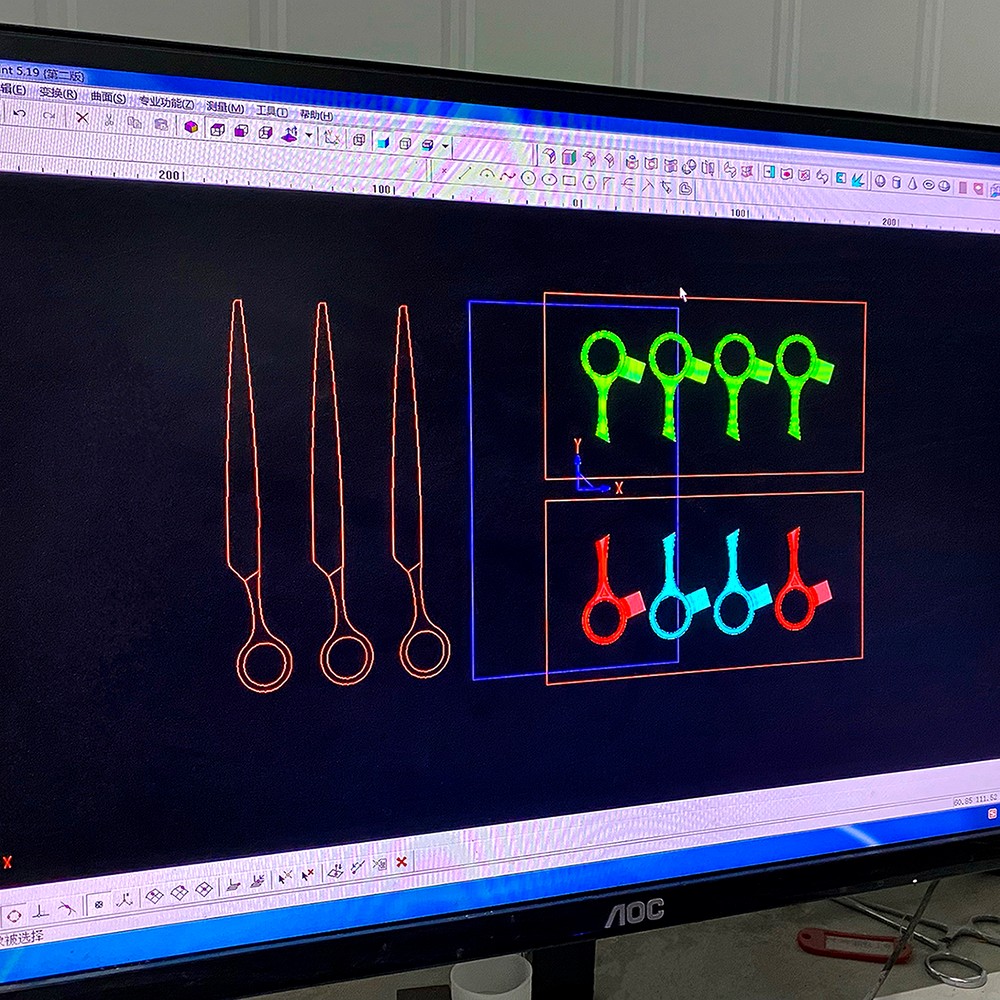
We name Japanese 440C on each line item instead of just calling it “premium stainless steel.”
We’ve included our hand-honed convex edge on a range of 15-20 degrees for every model. Our spec sheets also provide details about the tooth count and the cutting rate for each shear.
Every batch of MATSUOPRO pet grooming shears is hardened to a range of 58-60 HRC, measured on the Rockwell C scale against NIST hardness standard reference materials. We keep the hardness report for every batch on file if you would like to review it.
Premium product lines have no published steel grade or Rockwell hardness rating for their products and use vague terminology like a “proprietary Level 1-4” alloy on the product page.
An widely-read public awareness notice from a r/doggrooming user describes drop-shipped shears being resold for approximately four times their wholesale price.
Sharpening specialists warn about counterfeit grooming scissors sold through discounted marketplaces and often characterized by improperly aligned edges that cannot be fixed through sharpening.
These shortcomings do not reflect a buyer’s incompetence. Instead, it is a deficit in information when products are being purchased-when without the published steel grade, Rockwell hardness, or edge angle, price becomes the only readily visible indicator of value. In other words, a shear’s price does not accurately represent its quality, according to veteran trade members.
Our pet line covers the full grooming workflow on a single blade platform: Japanese 440C steel vacuum-hardened to 58–60 HRC, finished with a hand-honed convex edge and a hand-tuned tension screw. Dedicated collections are available for deeper selections, and this page provides a road map.
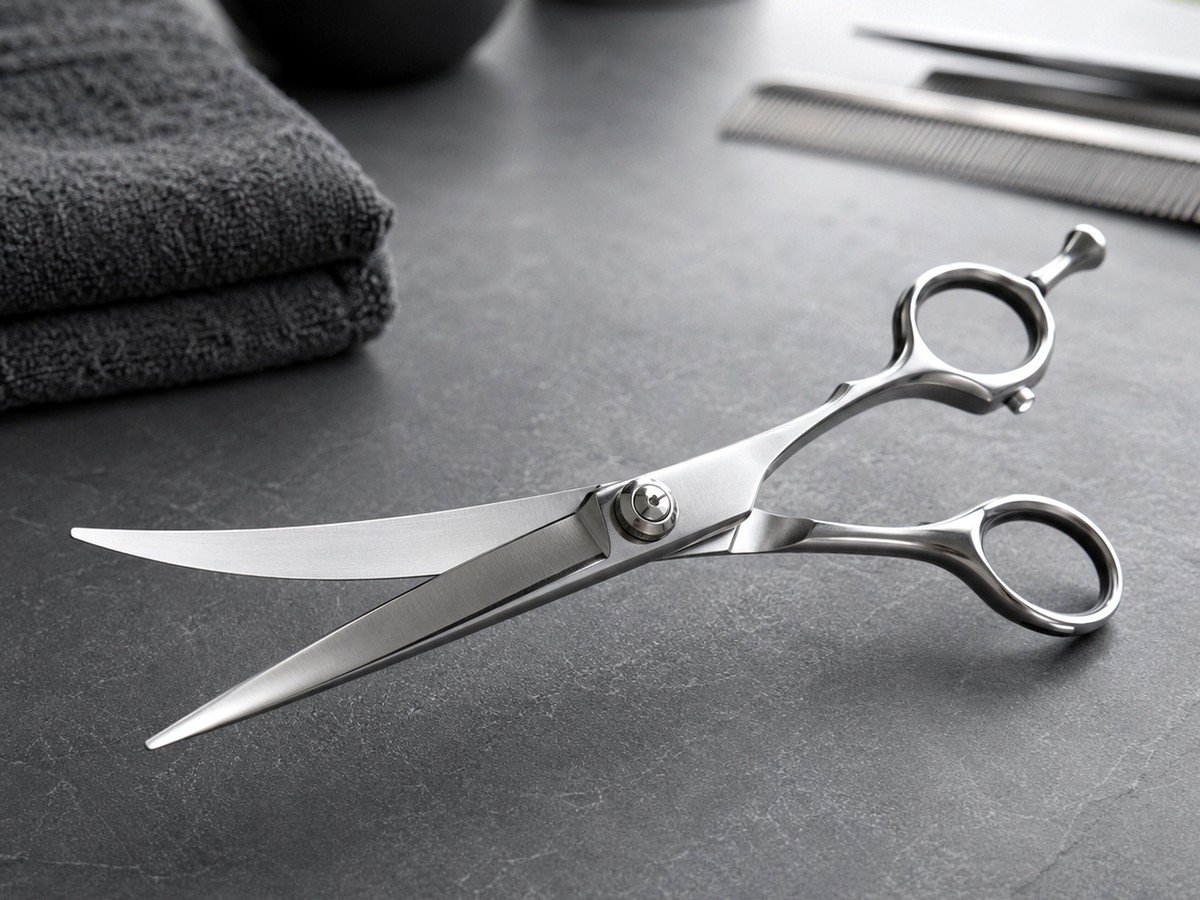
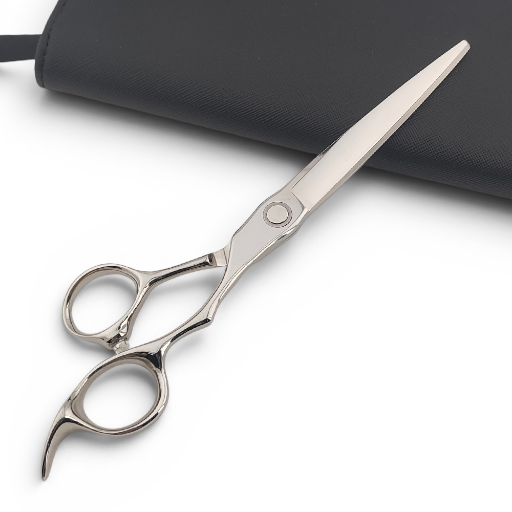
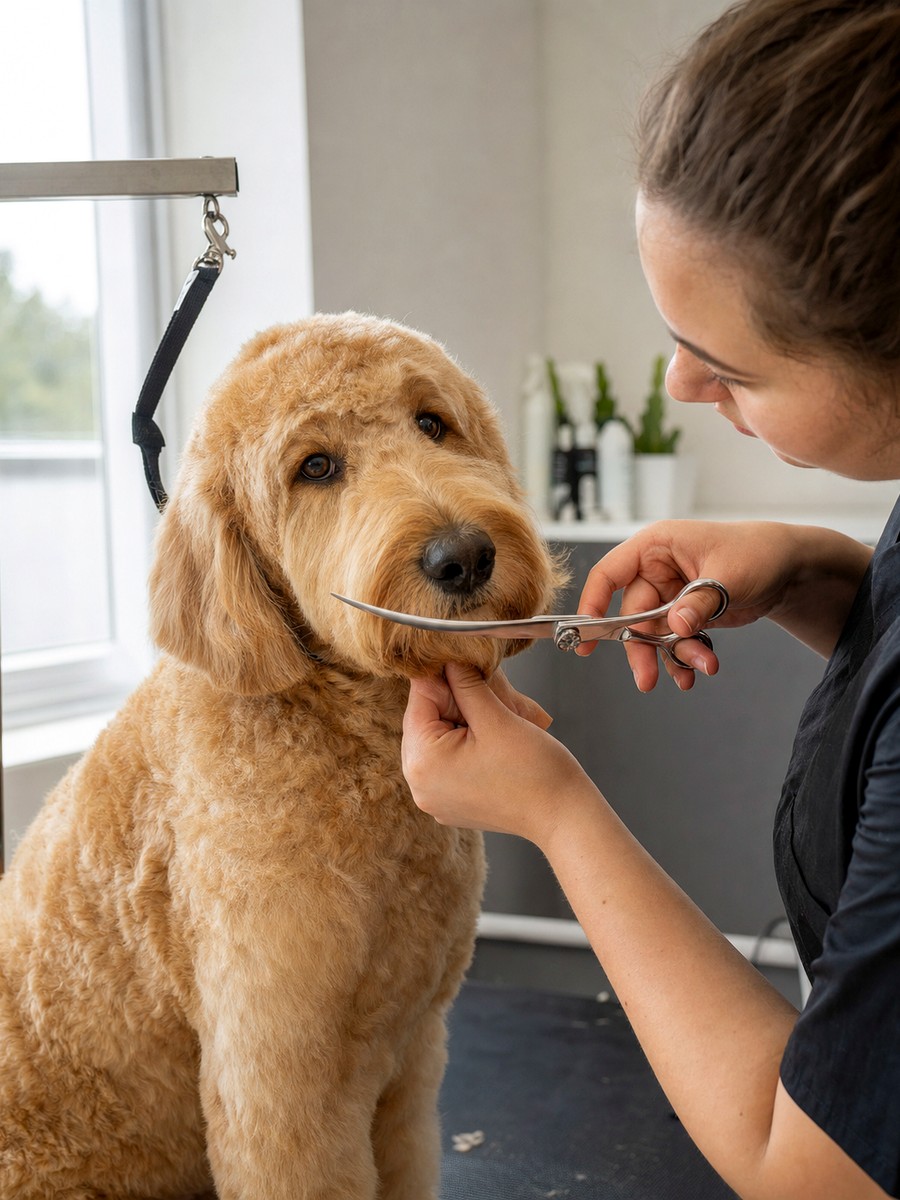
MATSUOPRO curved dog grooming shears in Japanese 440C with hand-honed convex edge.
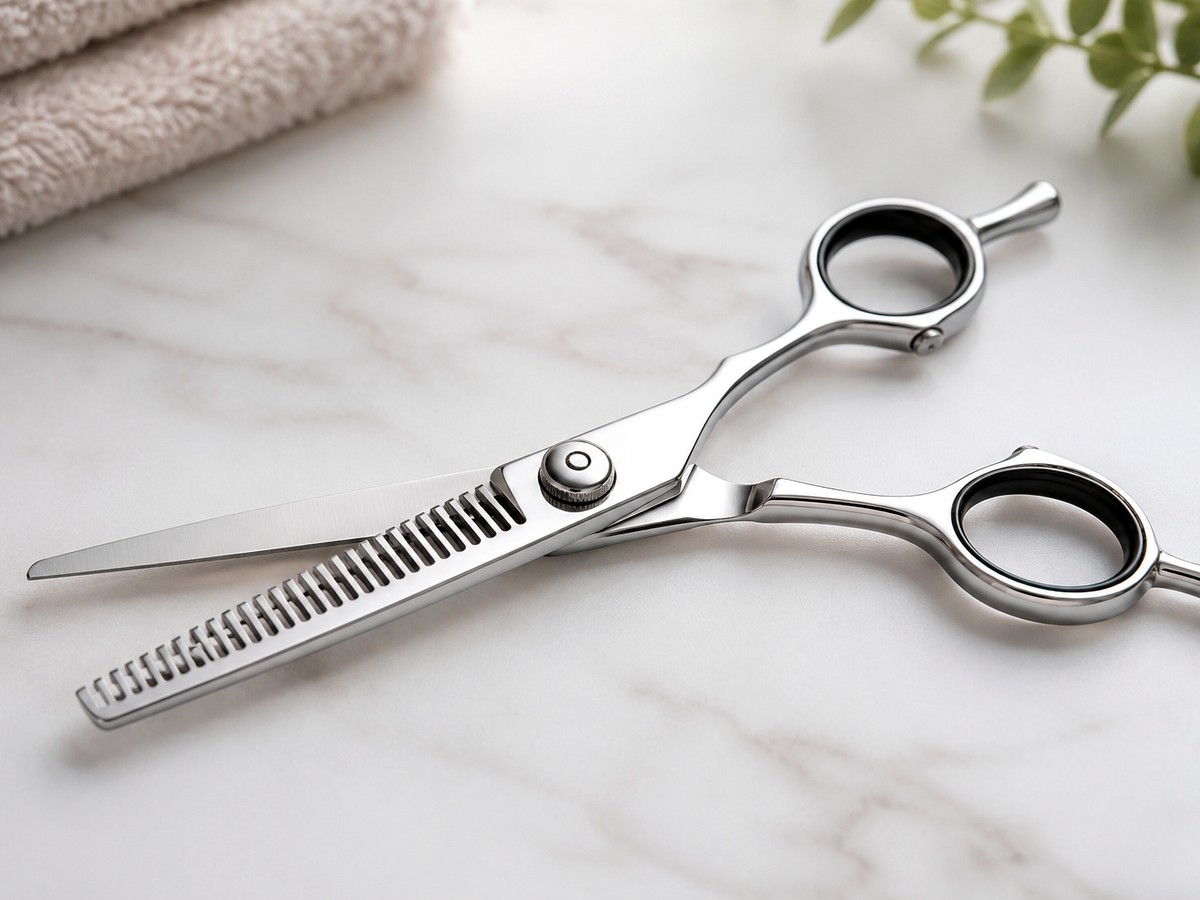
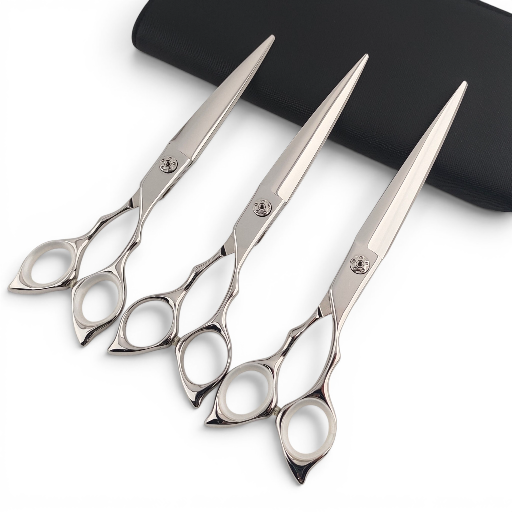
MATSUOPRO thinning shears for dogs — 24T texturizer, 28T curved thinner and 40T fine blender.
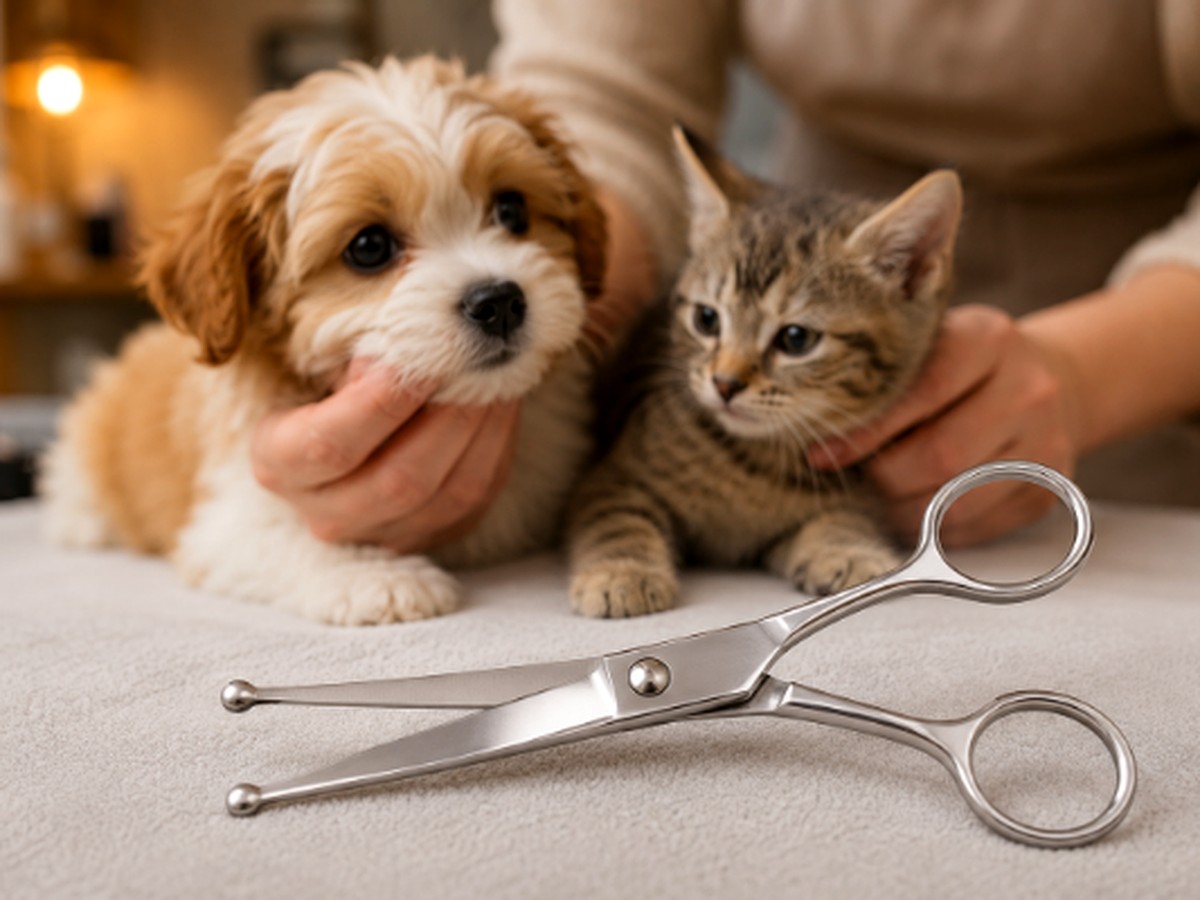
MATSUOPRO safety-tip grooming shears with rounded ball tip for puppies and kittens.
Select a tab below to view our in-stock model dimensions or review the complete grooming kit blueprint for removal rates and primary applications.
| Model | Type | Length | Teeth | Steel / HRC | Built for |
|---|---|---|---|---|---|
| MP-SC-077 | Curved finishing shear | 7.5 in | — | Japanese 440C / 58–60 | Faces, paws, rounded outlines |
| MP-SC-078 | Curved thinning shear | 7.5 in | 28T | Japanese 440C / 58–60 | Blending curved lines into coat |
| MP-SC-079 | Texturizer | 7.5 in | 24T | Japanese 440C / 58–60 | De-bulking thick double coats |
| MP-SC-080 | Fine blender | 7.5 in | 40T | Japanese 440C / 58–60 | Erasing clipper lines, finish |
| MP-SC-081/082 | Straight shears | 7.5 in | — | Japanese 440C / 58–60 | Outlines, legs, body length |
| MP-SC-083 | Safety-tip shear | 8 in | — | Japanese 440C / 58–60 | Around eyes and ears, moving dogs |
A single bad scissor is rarely the cause of groomer failure; it’s the missing scissor-either a wrong tooth count or blade shape-that throws the entire kit off. Our Blueprint below shows the removal rate of each shear type in relation to its task.
| Kit slot | Teeth | Removal / pass | Primary job | MATSUOPRO build |
|---|---|---|---|---|
| Straight shear | 0 (solid edge) | 100% in path | Outlines, legs, bulk length | MP-SC-081/082, 7.5″ |
| Curved shear | 0 (solid, curved) | 100% in path | Faces, paws, topknots | MP-SC-077, 7.5″ |
| Curved thinner | 28T | 25–35% | Contour blending on legs, chest | MP-SC-078 |
| Chunker | 7–15T | 40–50% | Breaking heavy or matted bulk | OEM-configurable |
| Texturizer | 16–24T | 25–40% | Movement and de-bulk on double coats | MP-SC-079 (24T) |
| Fine blender | 40–46T | 10–20% | Line-free polish, faces | MP-SC-080 (40T) |
| Ultra-fine finisher | 55–65T | 5–10% | Show finish, no visible lines | OEM-configurable |
| Safety-tip straight | 0, ball tip | 100% in path | Eyes, ears, sanitary zones | MP-SC-083, 8″ |
| Curved safety build | 0, ball tip | 100% in path | Small-dog and cat contours | OEM, 6–6.5″ |
| True left-handed set | any of the above | as configured | Left-handed groomers (mirrored pivot) | OEM from 50 pcs |
Work your way through the Blueprint from task to task, rather than by tool type. A 24-tooth texturizer removes more material per pass than a 40-tooth blender, as tooth count is inversely proportional to removal rate, a fact that surprises many new buyers. Detailed technical analysis is available in the specific collections: learn about the mechanics of tooth count on the thinning page, contour techniques on the curved page, and zone-specific safety guidelines on the ball-tip page.
Start with the trade’s own contrarian finding, straight from the people who sharpen these tools for a living: fit and tension decide more than the sticker does.
As for that premium price point, here’s the dirty secret. The $30 shear, when sharpened properly and properly tensioned, will outperform the badly fitted $300 one any day of the week. Price tends to track distribution channels more closely than it tracks metallurgy.
| Line (2026 listings) | Steel named? | HRC published? | Shelf price | OEM path? |
|---|---|---|---|---|
| Kenchii Happy Puppy ball-tip | “High-carbon stainless” | No | $27 | None |
| Kenchii Love / Scorpion (7.0–9.0″) | “Japanese alloy” | No | From $89–99 | None |
| Kenchii Signature (Sapphire) | “Level 2–4 alloy” | No | $119–450 | None |
| Chris Christensen (Adalynn) | 440C Japanese | No | $101–230 | None |
| Foxy Roxy singles / sets | “Premium stainless” | No | $125–149 / $550 | None |
| Geib Gator 3–4 pc kits | 440C Japan / SS alloy | No | $199–331 | None |
| Geib Crocodile 4-pc kit | SS alloy | No | $680.99 | None |
| Sensei grooming line | 440C / Moly | No | $119–309 | None |
| Groomer’s Choice Monk | Unspecified | No | ~$99 | None |
| MATSUOPRO pet line | Yes — Japanese 440C | Yes — 58–60 | Factory quote per spec | 50 pc custom / 1 pc stock |
To compare value, we collected 2026 shelf prices alongside published specifications for dozens of dog shears across the industry. Retail figures are from individual seller pages; we have not attempted to provide an artificial “you save x%” figure, since list prices and factory pricing can vary significantly.
Two patterns jump out from our research. First, of the 5 top tier brands listed in our brand pages, none publishes a hardness rating; while other brands’ product pages offer a rating, this figure is not a universal claim and therefore was excluded. Second, the money you pay above roughly $150 mostly buys the name and the distribution layer rather than different metallurgy — several of these premium lines run the same 440C-class steel our benches grind every day.
Even the secondary resale market doesn’t offer significant cost savings on shears. A widely shared buyer PSA on r/doggrooming priced the arithmetic: re-badged factory stock carrying a markup of roughly 400% still costs the same $12 sharpening visit as any other shear. While a shear’s initial price is certainly a factor, the total cost over a shear’s lifespan is primarily dictated by its steel hardness, number of times it can be sharpened, and its re-hone cost ($10 for most chain sharpeners), not a fancy logo.
Where a brand premium is real, we say so: we have exclusive pattern rights, our ergonomics are unique, and we support a local network of independent dealers who trust our name for the sell-through it brings them. Our shears have the same 440C steel as those from much higher-priced brands. They perform equally well for all dogs and breeds you see regularly, but you leave the entire retail margin in your hands.
Durability is where the arithmetic finally settles. A blade’s true cost is purchase price divided by the years it stays serviceable, and that ratio is set by heat treatment and re-hone count – not by the logo. Precision matters here in a specific, boring way: 440C steel held at 58-60 HRC takes a convex re-grind many times over, so the same pair keeps working while a soft-alloy bargain becomes drawer stock.
Buyer threads are more useful than any brochure, and they converge on four complaints that shape how we build.
Those four failures are why our stock program starts at a single piece. Test the pair that matters most to you – the curved shears for dog grooming if you shape faces, the thinning scissors for dogs if you fight double coats – before any volume decision gets made.
Working groomers standardize on 440C-class stainless steel around 58-60 HRC with a convex edge for finish work, a beveled or toothed shear for bulk work, and lengths from 6.5 to 8 inches – the same platform this line is built on. Blade geometry in this category is an actively patented field (US 12,274,344 B1; US 6,272,752 B1 covers the rounded safety tip).
Demand behind that kit is not small. Americans spent $158 billion on their pets in 2025, with $14.3 billion of it in services like grooming, boarding and training, and 95 million U.S. households own a pet. People doing the work earn a median $33,470 a year, and their occupation is projected to grow 11% through 2034 – much faster than average.
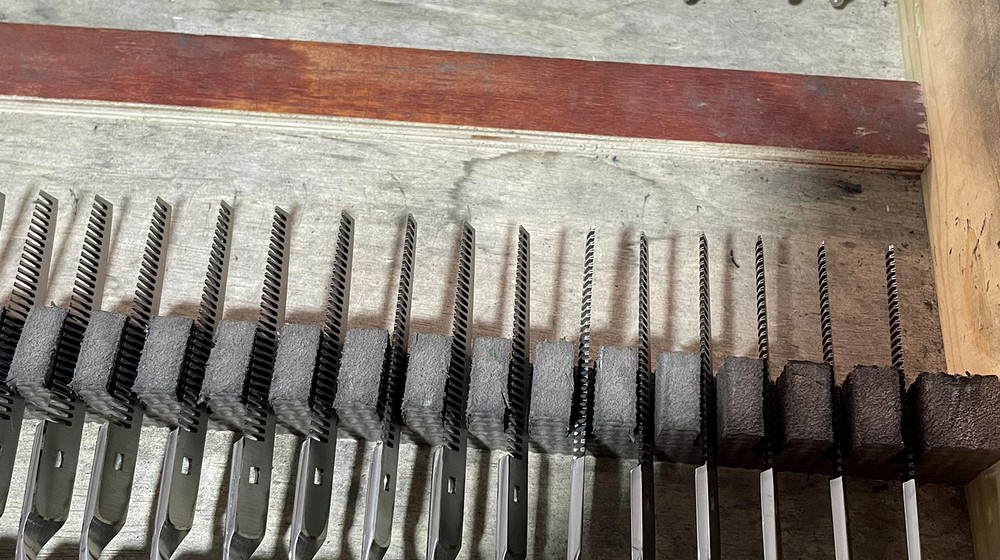
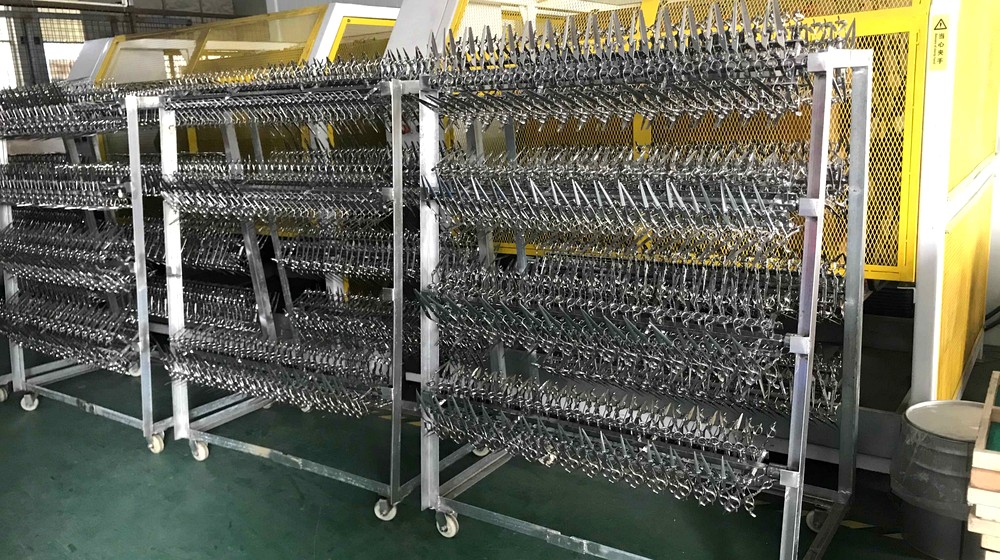
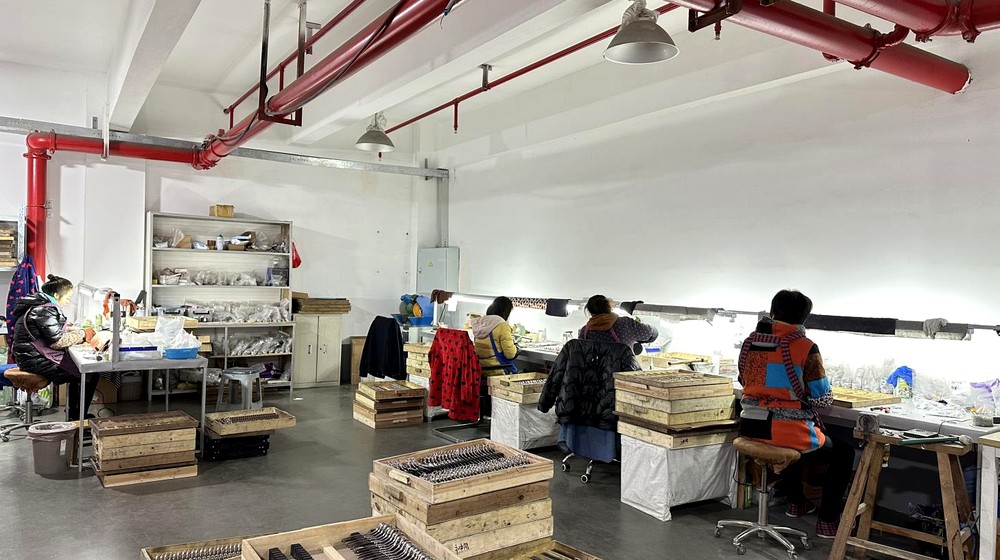
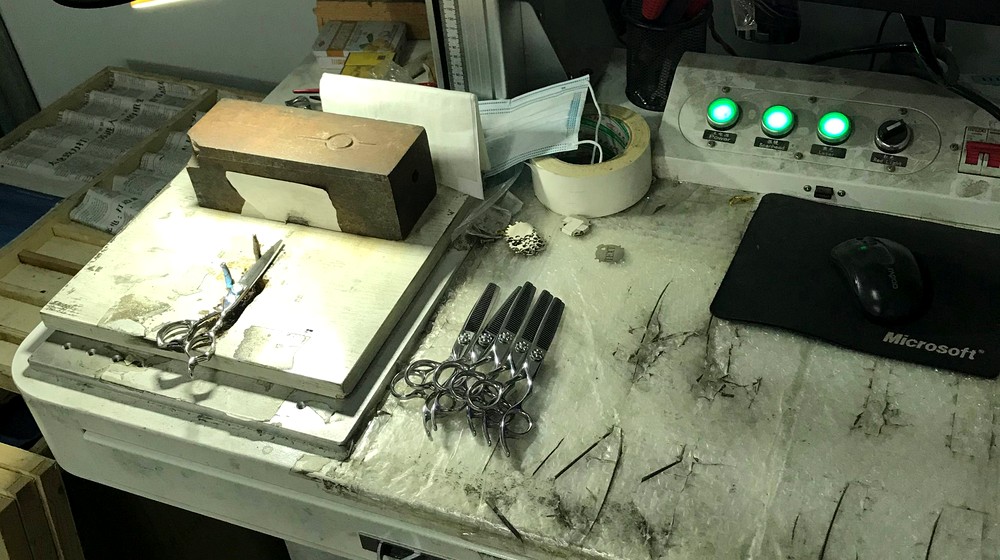
We measure hardness per pair on the Rockwell C scale (ASTM E18, traceable to NIST reference materials), run our quality system to ISO 9001:2015, test sharpness on professional media, and state origin plainly — made in China, forged from Japanese-specification steel.
Beyond 80+ discrete steps, every pair we make ends with hand finishing – convex edge honed by hand, riding line adjusted, tension balanced to touch before a single pair is individually inspected. Our artisans train at scissor workshops in Japan and Korea twice a year to keep that craft current — salon-quality grooming starts on the bench, not in a catalogue.
a precise steel grade designation, documented batch hardness, an audited factory, and an engineer who answers when a customer asks why a 40T blender left a line. This combination transforms the “cheap import” objection into a specifications discussion and it’s the difference between moving a box and standing behind professional dog grooming shears.
How long an edge lasts sparks more debate than any other number in grooming. Sharpening services tell high-volume shops to send shears in every few weeks; steel vendors quote up to a year, and both are honest for their own customer. What actually sets the interval is your daily dog count, how well each coat was combed out first, and the hardness of the steel. At 58–60 HRC our 440C blades hold a working edge a long time between roughly $10 sharpening visits, and a convex edge takes several re-grinds before the pair retires. Your shop will settle into its own service interval — budget for that cadence rather than for a universal promise.
Curved grooming work punishes neglect fastest, because a scooped blade rides the coat at an angle and drives debris into the pivot. Ten seconds of care after each dog is what separates a long-lasting tool from a one-season disappointment, and it is the cheapest upgrade any beginner can make to their grooming experience.
Left-handed teams get genuinely mirrored builds here, not a flipped marketing photo — a complaint that surfaces constantly in buyer forums. For hand-fit questions, see what actually drives scissor cost and comfort in our pricing teardown.
wipe the blades after each session, place one drop of oil at the pivot, and store the pair dry in its case.
lift a half-open shear and the blade should not swing shut on its own when tension is set correctly.
a convex edge should only be re-ground by a sharpener who works on grooming shears, or the serrations and geometry go with it.
Pick the coats you actually see and the shears you already own. The builder returns the missing kit slots, the tooth counts that fit, and the MATSUOPRO model for each.
Purchase price is one line in a shear’s cost. This tool adds sharpening frequency and service life so you can compare a $27 pair against a $269 pair on the number that actually matters.
Configure a private-label pet grooming shear and get the exact specification block to paste into your RFQ — grade, hardness, geometry, minimums and lead time, written the way our floor reads it.