Get in Touch with Mackayhairscissors Company
We use submitted details to respond to your quote request. Read our Privacy Policy.

Updated July 2026. Reviewed by the Mackay Group Asia Limited technical team.
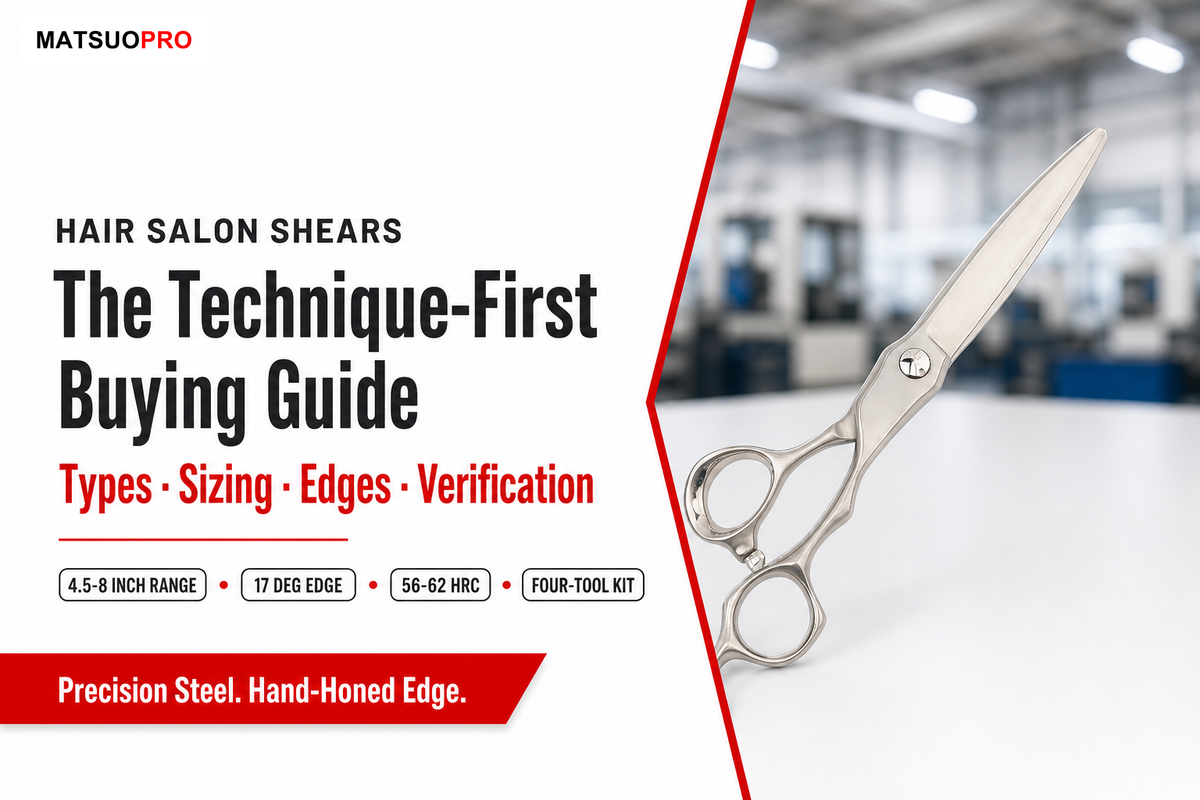
Hair salon shears are professional-grade precision instruments built to a tolerance that ordinary scissors aren’t: two ground blades whose edges meet at a controlled angle, a tensioned pivot, and a handle set placed to keep the hand near neutral through a ten-hour day. Get those four right and the tool glides. Get them wrong and no logo on the blade will save the cut, or your wrist.
This guide is deliberately vendor-neutral. It tells you when a cheaper edge geometry is the better buy, where the trade’s own published advice contradicts itself, and how to check a supplier’s claims, including ours. Everything below applies to professional hair cutting shears whoever made them, because good shears for hair come down to construction, not badge.
| Professional length range | 4.5″ – 8″ overall; most benches live in 5.5″ – 6.5″ |
| Edge types | Convex (hamaguri) · semi-convex · beveled, often micro-serrated |
| Blade included angle | 17° ±3° held constant through the stroke (per US4422240A) |
| Handle types | Opposing · offset · crane · swivel thumb |
| Tooth counts | 10T – 14T texturizing · 30T – 40T thinning / blending |
| Typical hardness band | HRC 56 – 62, measured to ISO 6508-1:2023 scale C |
| Resharpening interval | 3 – 12 months — the trade does not agree; see below |
| Service life | Commonly cited at 15 years or more with sharpening |
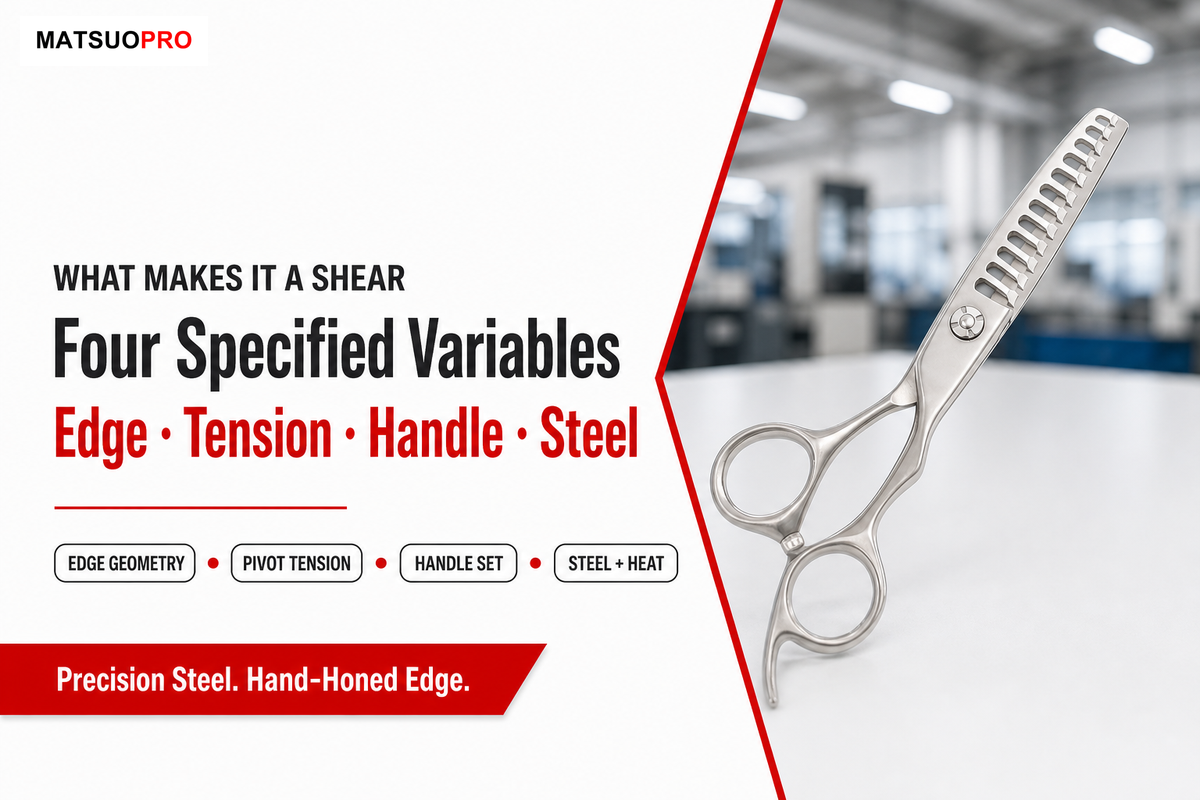
An ordinary pair of scissors and a salon shear both close two blades on a pivot, but a professional hair shear is built to a tolerance a craft-store scissor never touches. What separates them is that everything on the shear is specified: the angle the edges meet at, the tension on the pivot, the geometry of the grind, and the steel it is all cut from.
Get any one of them wrong and the tool fails in a specific, predictable way: it slips, it folds hair, or it wears your hand out by 2 p.m. Four variables decide how well a shear will cut hair, and in practice you can check all four on any pair, on shears made in Japan, in China, or anywhere else:
Regular scissors are built to sever a material. Salon shears are built to sever a fibre that actively tries to escape. Hair is slick, round in section, and under almost no tension when you cut it, so it slides along the edges rather than sitting still to be cut.
Everything unusual about a shear, the curved edges, the narrow included angle, the tension screw, exists to stop that sliding without blunting the edge in the process. Household scissors make no attempt to manage it, which is why they push and fold hair rather than cutting it cleanly. Our own professional hair salon shears are built around those four variables, and the rest of this guide is about how to judge them on any brand’s tool, not just ours.
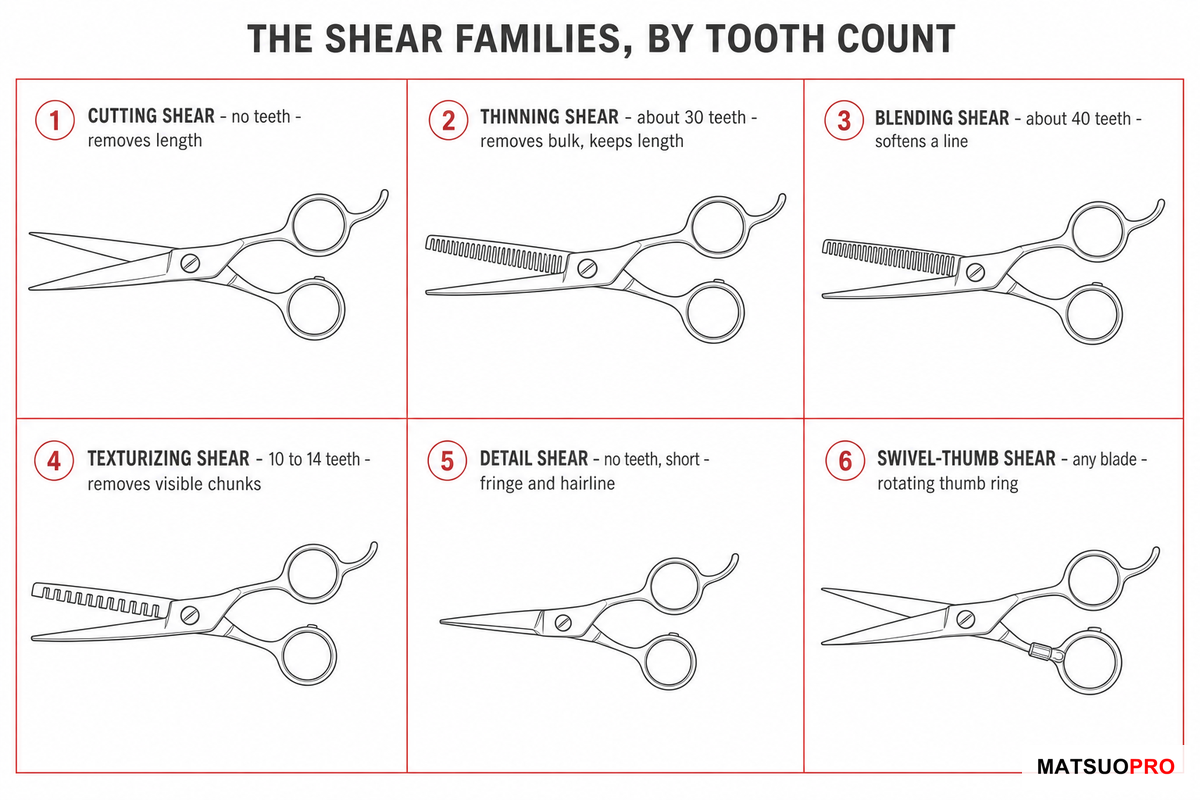
A professional kit is built from four tool families, shears that cut length, shears that remove weight, shears that add texture, and shears that blend, separated by tooth count and edge geometry rather than by brand. Everything else is a variation on these. Note that hair thinning shears and hair thinning scissors are the same tool under two names; the trade uses both interchangeably.
| Type | Teeth | What it removes | Technique served | When NOT to use it |
|---|---|---|---|---|
| Wet cutting shear | — | Length, cleanly | Blunt lines, palm-to-palm, everyday | Deep dry point work on coarse hair |
| Dry cutting shear | — | Length + weight together | Deep point cutting, dense or coarse hair | Fine detail near the hairline |
| Slide cutting shear | — | Length gradually, along the strand | Slide / motion cutting, soft edges | Any blunt line — it will not hold one |
| Detail shear | — | Very little, precisely | Fringe, ears, neckline, short shapes | Bulk removal — too slow, too short |
| Barber / over-comb shear | — | Length across wide sections | Scissor-over-comb, fades, tapering | Close detail — the blade overshoots |
| Texturizing shear | 10T – 14T | Large chunks — visible separation | Movement, deliberate texture | Fine hair — the marks show |
| Thinning shear | ~30T | Bulk, without shortening | Weight removal in dense interiors | Near the ends, or on fine hair |
| Blending shear | ~40T | Almost nothing — softens a line | Invisible transitions between lengths | Actual bulk removal — too fine |
| Swivel-thumb shear | any | Same as its blade class | Long sessions, elbow-down working | If you have never used one mid-book |
| True left-handed shear | any | Same as its blade class | Left-handed stylists, all techniques | Never a flipped-handle substitute |
Fewer than the catalogues imply. A working kit is usually one mid-length cutting shear, one longer shear if you do over-comb work, one thinning or blending shear, and a detail shear if your book runs to short shapes. Everything past that’s technique-specific. If you’re standardising a multi-chair salon, buying the same four across every bench matters more than buying an exotic fifth for one stylist.
You can see how a working family is grouped in our hair cutting shears range.
When we pulled the search demand around thinning shears in July 2026, the highest-volume queries attached to them were thick hair (2,900/month), bangs (1,900/month) and wigs (1,900/month). Those are home-user jobs. Meanwhile practitioners in professional forums report the opposite instinct, declining to reach for thinning shears at all on fine hair, and taking weight out by holding sections away from the head and cutting a taper instead. Demand for thinning shears peaks on almost exactly the job many professionals decline to perform. Tooth count, not brand, decides what the tool takes out: a 40T blender softens a line, a 10T texturizer leaves marks you’ll see on fine hair.
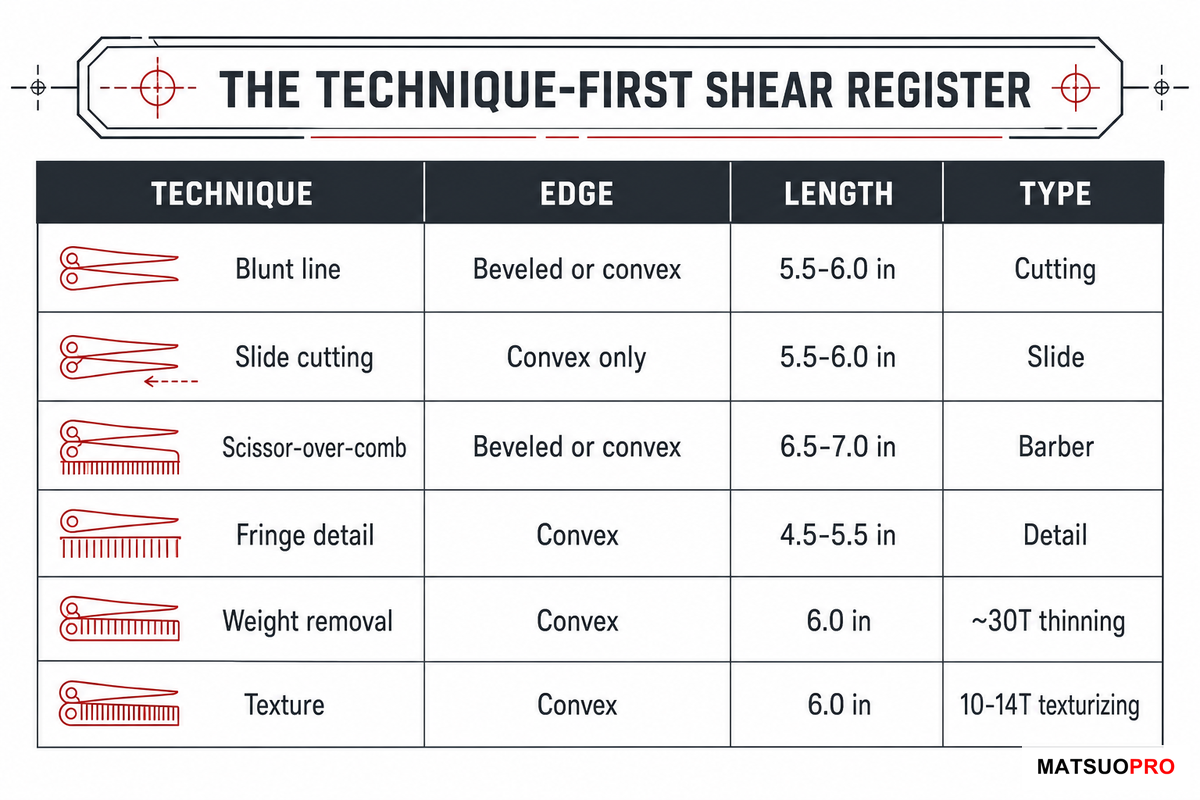
Every shear guide organises the same way: here are the products, now pick one for your technique. That’s backwards. You already know what you do behind the chair, whether that’s precision cutting, texture work, or a full day of scissor-over-comb. Reverse it, technique first, then the spec it demands, and, crucially, what actually goes wrong when the two don’t match.
| Technique | Edge | Length | Type / teeth | Failure mode if mismatched |
|---|---|---|---|---|
| Blunt line / one-length | Beveled or convex | 5.5″ – 6.0″ | Cutting | Too-sharp convex lets hair slide — the line drifts |
| Slide / slice cutting | Convex only | 5.5″ – 6.0″ | Cutting / slide | Beveled or micro-serrated catches and tugs the strand |
| Point cutting (wet) | Convex | 5.5″ – 6.0″ | Cutting | Short blade forces more passes; texture turns inconsistent |
| Deep point cutting (dry) | Convex | 6.0″ – 6.5″ | Dry cutting | Wet-cut blade pushes dry hair instead of entering it |
| Scissor-over-comb | Beveled or convex | 6.5″ – 7.0″ | Barber / cutting | Short blade cannot span the comb — ridges and steps |
| Fade / taper blending | Beveled | 6.5″ – 7.0″ | Barber | A slick convex edge slips at the comb line |
| Fringe / hairline detail | Convex | 4.5″ – 5.5″ | Detail | Long blade blocks sightline; you cut what you cannot see |
| Interior weight removal | Convex | 6.0″ | ~30T thinning | 10T texturizer here leaves holes, not weight loss |
| Softening a hard line | Convex | 6.0″ | ~40T blending | 30T removes weight you wanted to keep |
| Deliberate texture / movement | Convex | 6.0″ | 10T – 14T texturizing | 40T blender does nothing visible — wasted passes |
| Full-day mixed book | Convex | 5.5″ – 6.0″ | Cutting, crane or swivel | Opposing-grip handle drives the wrist off-neutral all day |
Every failure mode in that last column is a geometry problem, not a brand problem: the reason a too-sharp convex edge lets a blunt line drift is the same slip mechanism quantified in shear-geometry patent US4422240A. Read the register in one direction only: find the row you actually spend your day in, then buy that row. Buying a cheap shear isn’t the most expensive mistake in this market. Buying one excellent shear and forcing it across every row in the table is.
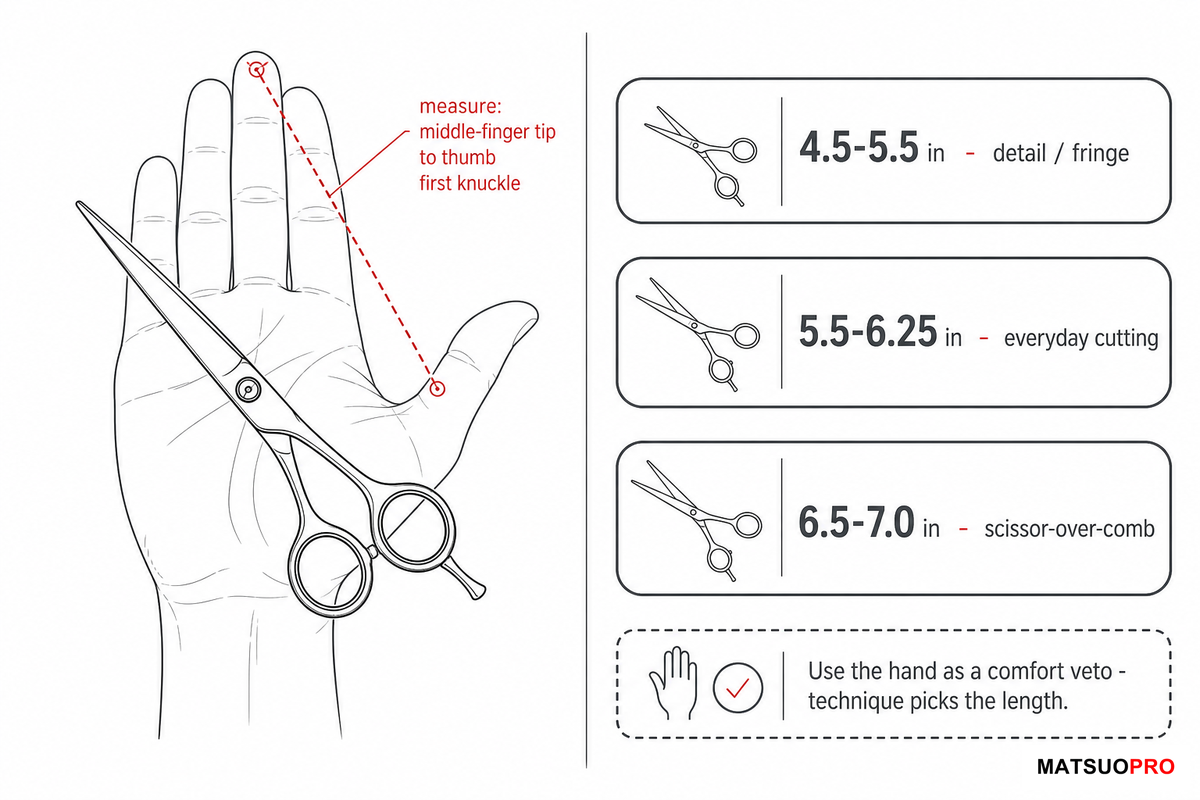
Here the trade openly disagrees with itself, and it’s worth knowing before you buy, because buying the wrong length is the most common reversible mistake in this market, and the one that quietly costs you passes on every head.
Search for shear sizing today and the most prominent advice will tell you to lay the shear flat across your palm and measure from the tip of your middle finger to the first knuckle of your thumb, size by hand. But the two most detailed professional guides in this market say the opposite, and one of them says it explicitly: blade length should be determined by your cutting technique, not your hand size. Neither of those guides mentions hand measurement at all.
The disagreement is narrower than it looks, because the bands agree even when the method doesn’t. Independent sources land within a few tenths of an inch of each other: roughly 4.5″–5.5″ for precision detail work, 5.5″–6.25″ for everyday, 6.5″+ for over-comb and bulk. So use your hand as a comfort veto, not a selector: pick the length your technique demands from the Register above, then check that the shear closes without your thumb travelling past its natural arc. If your technique says 6.5″ and your hand says the tool is unmanageable, the answer is a crane or swivel handle at 6.5″ — not a 5.5″ shear that can’t do your job. The comfort veto isn’t a nicety: the peer-reviewed evidence on hairdressing hand and wrist strain is why forcing a wrong-fit length is a health decision, not just a comfort one.
One measurement note before the example: blade length is quoted from the blade tip to the outside of the finger ring, and doesn’t include the finger rest, so two shears both sold as 6.0″ can sit differently in the hand. Worked example. Take a barber whose book is 70% fades and scissor-over-comb, and go to the Register: over-comb needs 6.5″–7.0″. Hand measurement isn’t consulted for the length. Our barber buys a 6.5″ beveled barber shear, then checks the handle: at 6.5″ the tool is nose-heavy in a small hand, so the choice becomes a 6.5″ crane-handle build rather than dropping to 6.0″. Technique set the number; the hand set the handle.
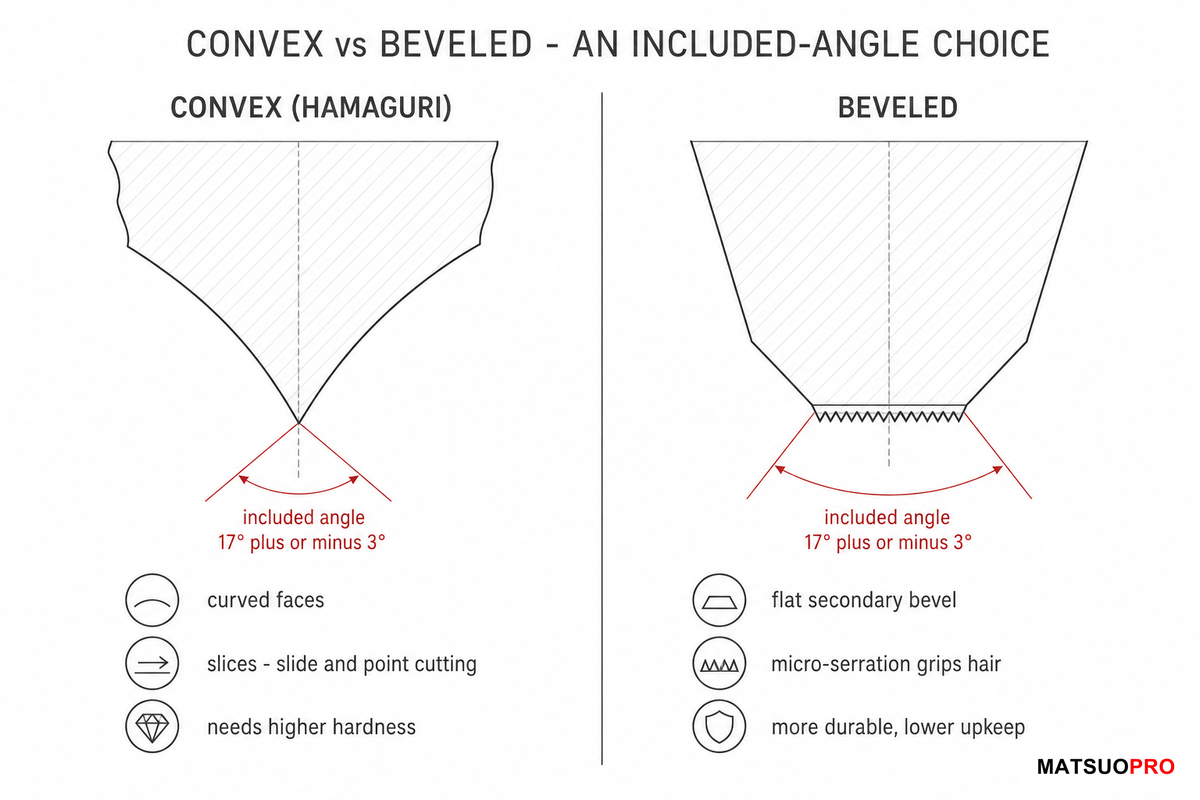
Almost every shear page sells convex the same way: sharper, therefore better. That framing is wrong, and the patent literature has said so for forty years.
What actually governs whether a shear cuts hair or pushes it’s the included angle between the two edges, and it’s a trade-off with an optimum, not a direction you push toward zero.
A 1983 shear-geometry patentUS4422240A, a hedge-shear patent whose stated principles the inventors say “may be applied with equal ease to scissors” — puts hard numbers on it. Both blades carry convex edges, and the included angle between them is held relatively constant at 17° ±3° through the entire closing stroke. It’s blunt about what happens outside that band: below 14°, “shearing performance was seen to deteriorate rapidly”; above 20°, “the tendency to extrude was seen to accelerate” — extrusion being the work sliding along the edges instead of being cut. It sets a second limit too: the two bevels together should total 80° to 120°, because under 80° “the edges tend to self destruct,” and over 120° slippage accelerates.
A hair-specific patent filed by a German shear maker in 1996KR19990014707Areaches the same shape of answer for hair, and states the trade-off outright: a very small opening angle means almost no hair slip, “however, when the opening angle is very small, there’s an adverse effect in terms of maintaining a sharp state of the cutting edge for a long time.” Push the angle the other way and “the active force component of the cutting force is very large, and the hair can be easily slipped.” Its preferred geometry runs about 24° at the blade start narrowing to 19° at the tip.
“The best opening angle of the shear blades cannot actually be determined by this method, and the ergonomic design and the conditions of the cutting edge and the strength of the hair itself should be taken into account.”
Hardy Schmidt, inventor, KR19990014707A (Jaguar Stahlwarenfabrik), 1996
The same patent gives the relationship between the force that makes hair slide along the blade (FS) and the shear force you apply (F): FS = (sin a × F) / 2, where a is the opening angle. Substitute a realistic pair of numbers. Squeeze with F = 20 N at the patent’s preferred tip angle of 19°: FS = (sin 19° × 20) / 2 = (0.326 × 20) / 2 = 3.3 N trying to push the strand out of the blades. Now open to 30° with the same squeeze: FS = (0.5 × 20) / 2 = 5.0 Nabout 52% more slip force from an 11° change. That’s why a shear that has lost its geometry starts pushing hair before it ever feels dull. Note what the inventor says next, though: the equation alone doesn’t pick the angle. Edge condition, ergonomics and the hair itself decide.
So the honest version of convex vs beveled isn’t sharper versus blunter:
Note that the trade can’t agree on the follow-on question either. One major guide states convex blades “require less frequent sharpening, and thus have a longer lifespan”; another states convex-style slice-cutting blades dull faster than micro-serrated edges. Both are probably reporting real experience from different points on the same trade-off curve. Neither is a substitute for asking a supplier what angle they grind to.
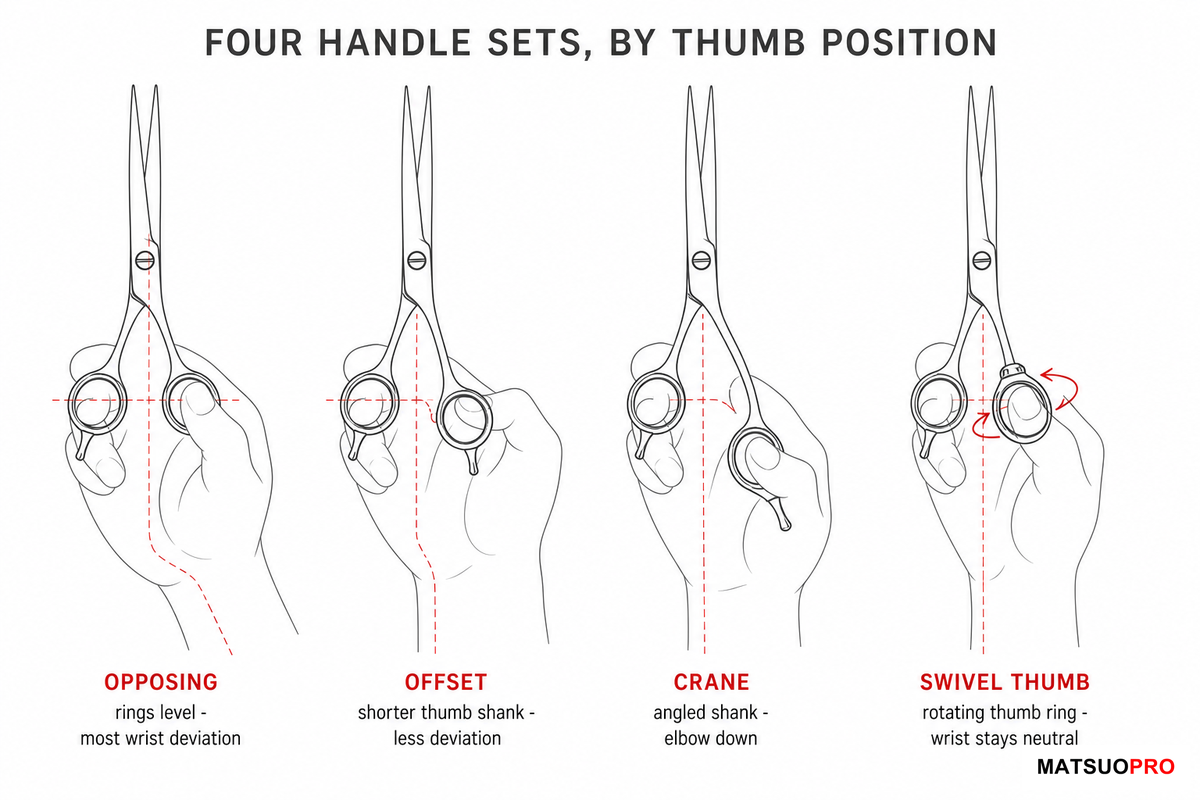
Handle choice is the one decision on this page with a peer-reviewed evidence base behind it, and it isn’t about preference.
A 2019 scoping review in the Journal of Occupational Medicine and Toxicology pulled together 44 studies of musculoskeletal health in hairdressing. Across the 19 that reported prevalence, the highest 12-month figures were lower back 13–76%, neck 9–58%, shoulder 28–60%, and hand or wrist 11–53%.
“In comparison to other occupational groups, hairdressers reported more frequent musculoskeletal disorders in all body regions or exhibited a greater risk of leaving the profession for health reasons.”
Kozak et al., Journal of Occupational Medicine and Toxicology, 2019
Those ranges are wide, and that’s the honest finding rather than a weakness we should hide. Its own authors note that “very different measurement instruments were used” and that “the comparability of the results must therefore be regarded as limited” — they declined to run a meta-analysis for exactly that reason. So the defensible statement isn’t “shears cause carpal tunnel.” It’s that hairdressing carries a measurably elevated upper-limb burden compared with other occupations, and the handle is the part of the tool that sets your wrist angle for every cut of the day.
Four handle sets, in order of how far they move the thumb off neutral:
One check no spec sheet will do for you. If you’re left-handed, hold the shear in your left hand and look at which blade is in front: on a true left-handed shear the top cutting blade is the frontmost one. If it sits behind, you’ve a flipped right-handed shear, a “lefty” in name only, and you’ll be cutting against your thumb all day. Genuine left handed scissors mirror the blade ride and the screw, not just the handle, which is why a handle change alone doesn’t fix it.
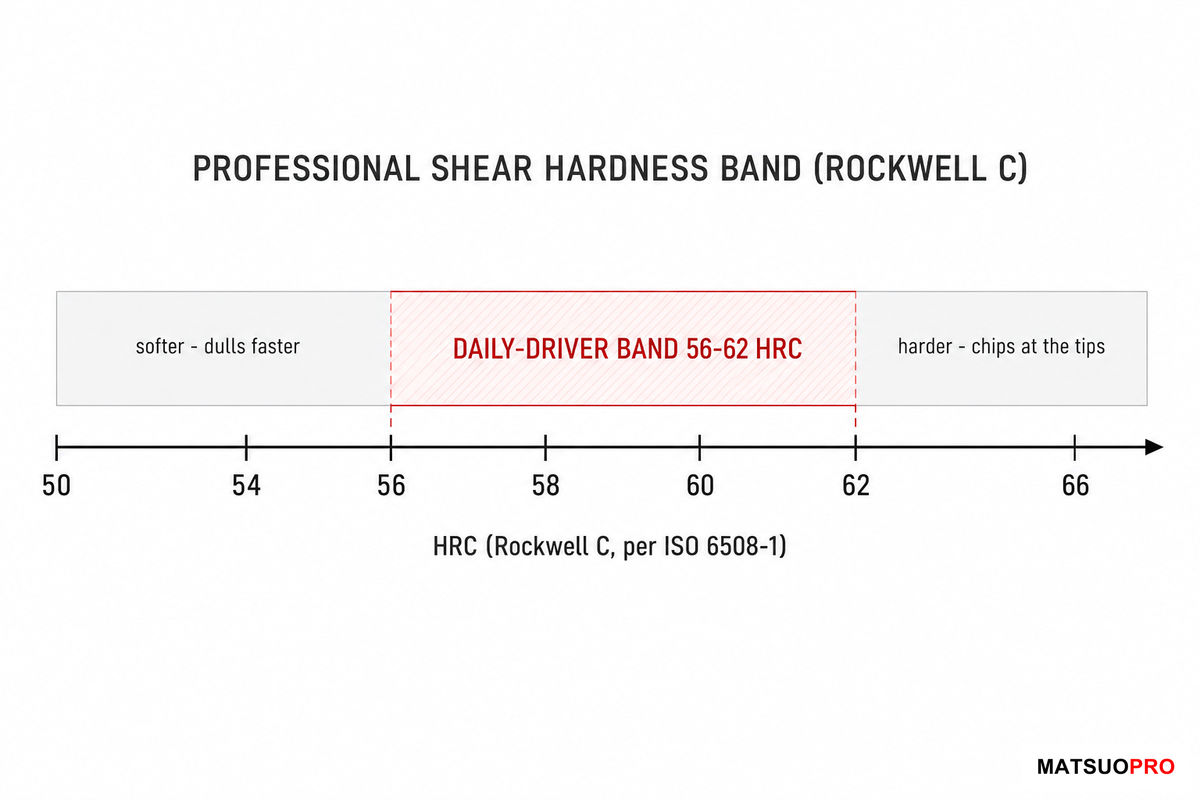
Does the steel grade on the box tell you what you’re getting? Only partly, and this is the shortest section here on purpose, because we’ve written it out properly elsewhere.
Almost every professional shear is stainless steel, and Japanese stainless steel dominates the premium tier, and Japanese hair shears dominate the premium tier because of what happens after the alloy is chosen, not because of the alloy itself. The grade is a recipe rather than an outcome. An alloy heat-treated well outperforms a nominally superior one treated badly, which is why a grade name alone predicts very little, and why heat treatment and craftsmanship decide more than the label does. Damascus steel sits at the flagship end and is a pattern layered over a core, not a separate performance class. Hardness gives you the other half: measured on the Rockwell C scale, most professional shears land between 56 HRC and 62 HRC. Higher isn’t simply better, hardness buys edge retention and pays for it in brittleness, and the trap is a blade hard enough to chip at the tips. That trade-off is the reason the daily-driver band sits where it does rather than at the top of the scale, and in practice it’s why two shears carrying the same 60 HRC on the box can wear differently.
For the full treatment, what each grade actually contains, why heat treatment dominates, and how the numbers are produced, read our HRC hardness scale explained guide, our 440C vs VG10 steel comparison, and the broader hair scissor steel guide. What matters for this page is the next section: whatever grade and hardness a supplier claims, you can ask them to prove it.

Three of the seven questions Google surfaces around this topic are questions about scissor brands, what brand do hairdressers use, what’s the best brand, what brand scissors do professionals buy. Buyers find their way around this market by name first. So it’s worth describing the market’s actual structure rather than pretending to rank it.
Professional shears reach you through four tiers, and each tier buys you a different mix of price, traceability and recourse:
There’s no defensible answer, and any page that gives you one is selling you something. Whether the box says professional hairdressing shears or barber scissors, what there’s instead is a tier that fits your situation. An apprentice buying their first pair and a distributor placing a 500-piece order aren’t solving the same problem, and the tier that serves one badly serves the other well.
Ask instead which tier’s trade-off you’re accepting, and then whether that supplier will hand over the evidence in the next section.
Our disclosure: Mackay sits in tier three. We’re a factory-direct manufacturer, which means we occupy a tier described on this page and have an obvious interest in you choosing it. That’s exactly why the rest of this guide is built around checks you can run on us rather than claims you’ve to take from us. If you’re evaluating a manufacturer for a private-label programme, our OEM and private-label shears page sets out how that side works.

The price of a professional shear is set by four things you can actually check: the steel grade and its heat treatment, the edge geometry and how it was finished, the handle design, and the distribution layer between the maker and you. Only the last one is invisible on the tool, and it is the one that varies most.
Search for the best hair cutting shears and you’ll be quoted anything from around $50 to well past $2,000 for professional hair scissors that, on paper, do the same job. Our honest answer about that spread is less satisfying than the one usually given.
You’ll read confidently that the difference is mostly branding and distribution rather than steel. We went looking for an independent source for that claim and couldn’t find one: the people asserting it are, without exception, the retailers and makers who benefit from asserting it. So we aren’t going to assert it either.
What we can tell you is what’s actually checkable, and what practitioners themselves say. Among working barbers the counterweight is put bluntly, that any shear which cuts hair cleanly is doing 100% of its job, and there isn’t much room to improve on that. That’s an opinion, not a measurement, but it’s an opinion held by people with a thousand haircuts a year behind it, and it deserves to sit next to the marketing.
One number survives that argument, and it isn’t the sticker. It’s cost per year.
Cost per year = (purchase price + sharpening cost × sharpenings per year) ÷ expected service life in years. Run it on a $400 shear at 15 years of life, with sharpening at $30 a time. Nobody agrees on the interval, one major guide says professional service every 6–12 months, another says every 3–6 — so run both ends. At 2 sharpenings a year: ($400 + $60) ÷ 15 = $30.67/year. At 4 a year: ($400 + $120) ÷ 15 = $34.67/year. Now the $150 shear that needs replacing at year 5, sharpened twice a year: ($150 + $60) ÷ 5 = $42/year. So the expensive shear is cheaper per year, but notice what moved the answer and what didn’t. Doubling the sharpening frequency changed the $400 shear by $4/year. Service life changed everything. That’s the number to interrogate a supplier about, and it’s the number nobody publishes.
Two honesty notes on that maths. Both service-life and interval figures above are industry-common estimates, not measured specifications, treat them as a method for your own numbers rather than as our claim about any product. And sharpening isn’t risk-free: practitioners report that cheaper sharpening services frequently lack the knowledge to do the job well, and a bad regrind can take more metal than it should, which quietly shortens the service life that the whole calculation rests on.
| If you are… | Minimum viable kit | Where to spend | Where NOT to spend | What to verify |
|---|---|---|---|---|
| An apprentice | One 5.5″–6.0″ convex cutting shear + one 30T thinning | The handle — it sets a habit you keep for a career | Flagship steel, Damascus, a fifth specialist shear | That it is genuinely left-handed if you are |
| A single-chair stylist | Add a dry/slide shear + a 40T blender | Edge geometry and service life — you carry the cost/year | A second brand for the same row of the Register | Sharpening path and warranty before you buy |
| A multi-chair salon owner | The same four tools, identically, on every bench | Consistency and re-order reliability across the bench | Per-stylist exotics that fragment your service path | Lot-to-lot consistency — ask for the report on a repeat order |
| A distributor / private label | A range that spans the Register, not a hero SKU | Documentation and traceability — you inherit the risk | Unverifiable origin claims you will have to defend | Hardness + material reports, per lot, before volume |
Request a factory-direct comparison against your current shear →
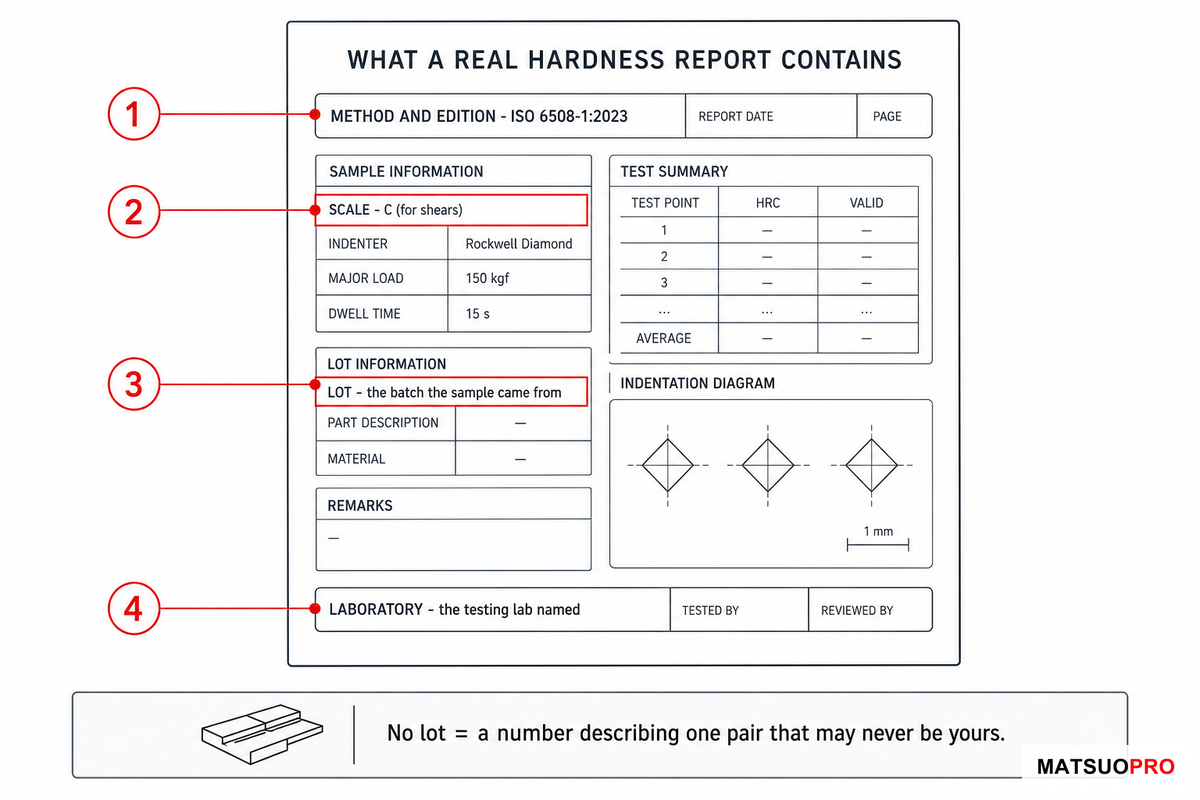
Here’s why this section exists. Two of the most widely-read shear guides on the internet both publish a “drop test” for blade tension, under the same name, and they give opposite pass criteria.
One says to lift the finger blade to 45°, release it, and keep tightening until the blade doesn’t move at all when released. Its rival says to open the shear to 90°, release, and look for the blade to fall about halfway, and states explicitly that a blade which barely moves is too tight. Any shear that passes the first test fails the second. Both pages are public, both are widely cited, and both are read by stylists as authoritative.
That isn’t a reason to distrust the trade. It’s a reason to prefer claims that come with a method attached, which brings us to the one number every supplier quotes and almost none qualify.
“HRC 60” on its own is marketing. Rockwell hardness testing is specified by ISO 6508-1:2023 (which superseded the 2016 edition), with companion parts covering verification of the testing machine and calibration of reference blocks. A report you can act on names four things: the method and edition, the scale (C, for shears), the lot the sample came from, and the laboratory. Without the lot, a number describes one pair that may never have been yours.
Three checks worth running on any supplier, ours included:
A refusal is itself information. A manufacturer that grinds its own blades can produce a hardness and material report on request; one that assembles bought-in blades often genuinely can’t, because the data was never theirs. Ours are published alongside the tools, you can see the published HRC and third-party hardness reports and hold us to exactly the checks above.

The most interesting change in the professional shear market right now isn’t a new steel, a new handle, or a new coating. It’s a shift in who is still searching for these tools at all, and it separates the professional buyer from the home user more sharply every quarter.
When we pulled US search demand across this category on 16 July 2026, DataForSEO’s keyword_overview endpoint, United States, English, reading the provider’s own year-over-year trend field rather than arithmetic of our own, the decline wasn’t uniform. It split, and anyone can re-run the pull against the historical search-volume API that produced it. Generic, consumer-shaped phrasing is falling hard: searches for “hair cutting scissors” (22,200/month) are down about 45% year on year, and “hair salon shears” and “hair cutting shears” (12,100/month each) are down about 33%. Over the same period, professional-qualified phrasing held or grew: “professional hair shears” up about 14%, and “hair shears” up about 22%. This category isn’t shrinking evenly. Its amateur-facing half is.
What this means if you buy or stock these tools. The risk in reading a 33% decline as a shrinking market is that you stock down for the wrong buyer. Through the next twelve months, expect the person typing these queries to be increasingly the professional rather than the home user, fewer enquiries, better informed, higher intent, and far less tolerant of a spec sheet that won’t answer a direct question. If you’re a distributor planning range or content for 2027, that argues for depth over breadth: the buyer who’s left already knows what a 40T blender does and wants to know what your heat treatment is.
Honest bounds on that reading, and they matter. These are one provider’s modelled figures on one date, not an audited census: re-pull them and you may not land on the same numbers, which is why every figure above is given as “about”. Google Ads volumes are bucketed, so small movements aren’t resolvable. We discounted “salon scissors” (+21%) despite it fitting the story, because its long-tail is dominated by salon business names rather than tool demand. “Professional salon shears” is up sharply but sits on a 70/month base, so it’s directional only. And one year of movement is a signal, not a trend line. This is our reading of data we pulled ourselves on a stated date from a stated endpoint, not an established industry finding, we’ve named the source and the date precisely so you can go and check it rather than take our word for it.
We manufacture hair salon shears, which makes us an interested party in almost every question above, so this guide is built out of things you can check rather than things you’ve to believe. Included-angle figures come from published shear patents, the ergonomics range from a peer-reviewed review of 44 studies, and the demand analysis from search data we pulled ourselves in July 2026 and have shown the limits of.
Where we couldn’t find independent evidence, as with the price-versus-badge question, we’ve said so instead of filling the gap. Reviewed by the Mackay Group Asia Limited technical team.
MATSUOPRO is the Mackay Hair Scissors manufacturing brand for professional hairdressing shears, barber scissors, thinning shears, and pet-grooming scissors. We support salons, distributors, academies, grooming brands, and private-label buyers that need factory-direct production with practical material guidance.
Our buying guides are written to help purchasers compare steel grades, handle styles, blade geometry, surface finishes, logo options, packaging, MOQ, and sample validation before placing an OEM or wholesale order. The goal is to make each scissors specification easier to discuss with a real production team.
Factory-direct supply since 2014, with product lines covering professional cutting shears, barber shears, thinning scissors, texturizing scissors, left-handed models, and pet grooming scissors for international B2B customers.
We focus on Japanese 440C, VG10, and ATS-314 steel choices, convex and bevel edge geometry, ergonomic handle balance, tension systems, logo engraving, private-label packaging, and sample-based OEM confirmation.