Get in Touch with Mackayhairscissors Company
We use submitted details to respond to your quote request. Read our Privacy Policy.

The working guide to what really makes a shear sharp and keep it sharp – the steel grade, the rockwell hardness, and the heat treatment behind them – from a manufacturer that publishes the numbers, not the adjectives.
“premium japanese steel” shears that dull quickly, leave distinctive white dots on hair tips, or feel ‘grabby’ during a wet cut. While user error can play a role, more often than not, the culprit is a softer or inadequately treated blade. A simple designation like “Japanese steel” offers no specific information on the grade used or the tempering process. Consequently, two sets of shears, despite wearing identical labels, may perform vastly differently. As a trusted buyer’s guide explains, a steel designation lacking a supporting treatment story conveys very little substantive information.
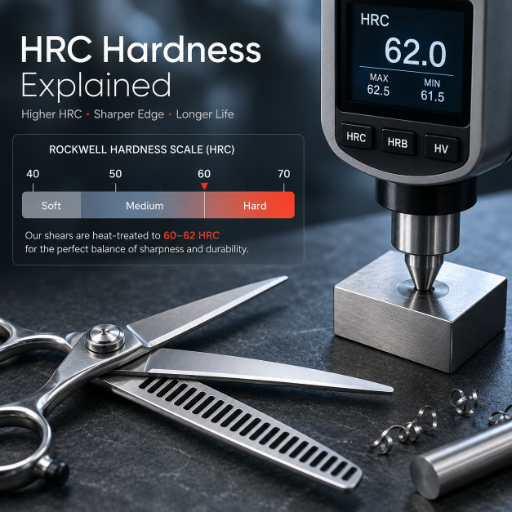
Our approach to crafting these shears is inverted. Each model clearly states its steel grade, its measured rockwell hardness, and details the specific vacuum and cryogenic heat treatment treatments employed. Because these quantitative metrics are verifiably testable, we can provide a third-party hardness and material report upon request. Our steel, originating from genuine Japanese stock, including ats-314 plate directly from Hitachi Group, is forged in our own Chinese manufacturing facilities. The Rockwell C test these figures rely upon is an established industrial standard (ISO 6508-1, Metallic materials – Rockwell hardness test), meaning a “60-62 HRC” rating is a verifiable claim, not a marketing phrase. The evidence is laid out below.
A common pitfall for buyers is accepting the label as a definitive specification. If the seller can only tell you the steel type and nothing about how it was treated, that is a red flag; and if you’ve ever seen white dots on the ends after a cut, that is usually a tool problem, not a talent problem. Even two professional hairdressing scissors manufactured from identical japanese steel can exhibit vastly different wear patterns because the ultimate hardness is determined not by the steel grade itself, but by the meticulously engineered heat treatment treatment. Our standard product lines achieve 60 HRC, while our cobalt line extends to 64 HRC. Unlike reselling intermediaries who merely repeat label claims, we confirm performance against rigorous in-house ISO 9001 testing and independent third-party hardness reports. We refuse to market any numerical specification we cannot substantiate. For any OEM production orders or salon requirements, contact us for a quote; we will supply the relevant spec report alongside the sample.
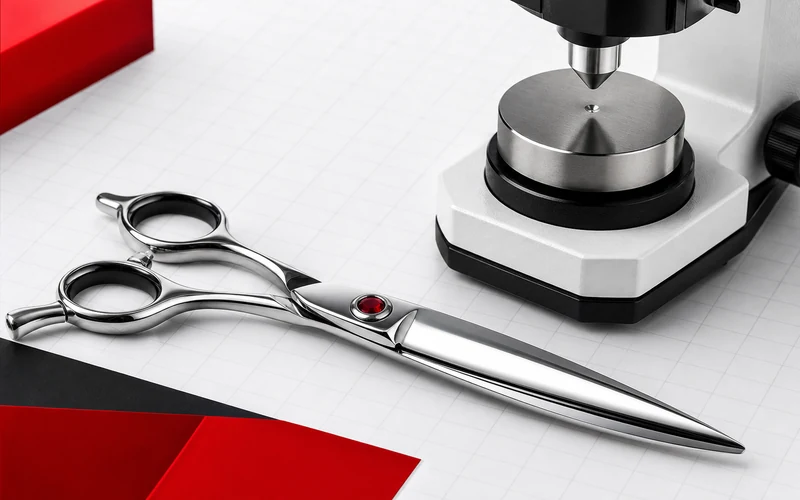
Rockwell C (HRC) is a measure of how well a steel resists permanent indentation on the Rockwell scale. For a shear, that means how fine an edge a blade can take and how many haircuts that edge hold. Harder steel keeps a sharp convex edge for longer through more cutting, while softer steel flexes and starts to push hair before it gets dull. This is why a blade’s working hardness – not its brand on the handle – is the number professionals check first.
But harder isn’t automatically better — any good metallurgy test will confirm that. As hardness increases, toughness decreases — a quick glance at published Charpy-impact test data will show an approximate 10% loss of toughness per point of rockwell hardness increase — so when a blade is driven past its sweet spot, it can become brittle and chip when dropped or used on coarser hair. This is the real trade-off, and it’s why we focus on a deliberate window instead of chasing the highest possible number.
In the case of a hand-honed Japanese convex edge, the optimal range is 58-62 HRC — a window where we can achieve a keen edge while ensuring real-world durability. Below 57 HRC, a blade won’t be able to achieve or hold a fine edge, and above 62 HRC it will perform beautifully but risk brittleness and requires a specialist to maintain its sharpness. Our regular product lines fall in the 60-62 HRC range, with our flagship cobalt model pushing up to 64 HRC for those stylists who require maximum edge longevity and will treat their tool with the care it deserves. The Rockwell C test itself is a highly standardized process that uses a 120 spheroconical diamond indenter and a 150 kgf load, following a protocol defined by ISO 6508 and recommended by NIST, so a reported HRC value is verifiable and consistent.
Hardness also directly impacts how long you’ll go between sharpenings, and the practical numbers for practitioners are very consistent: while a budget, softer blade will need to be serviced every 3-4 months, a properly heat-treated 60-62 HRC shear will maintain its edge for 6-12 months. Real-world working benchmarks estimate a 500-700 haircut lifespan for a mid-hardness blade and 700-900+ haircuts for a high-hardness, forged Japanese steel shear. Each sharpening uses up a little of the steel, so a harder blade that needs less sharpening simply lasts for more years.
Matching the hardness to the work, rather than the number, is key. Since toughness decreases with increased hardness, over-hard blades chip and soft ones don’t hold a good edge, so a truly sharp hair scissors that lasts is heat-treated within a precise window. Resellers rarely discuss this aspect of tool creation. At Mackay blade, we vacuum harden, cryogenically temper and certify our products to ISO 9001 specifications, and all pairs are precision-engineered to a tested 60-62 HRC which you can readily confirm. For OEM programs, this means predictable batch-to-batch quality, not isolated successes.
steel grade is the ultimate goal for blade – your skill in heat treatment and the polish that bring you closer. The vast majority of users spend more money on grade names than on a quality heat treatment. If the heat treat is poor, even the best vg10 blade won’t out-cut a properly tempered 440c blade for edge retention or durability. Choose a grade to match the steel with its operator, and then judge the maker on their ability to verify the hardness. Here’s the mapping of grades we use (and avoid) with their relevant figures.
| Steel grade | Typical HRC | Edge life (haircuts / sharpen) | Toughness | Corrosion resist. | Sharpening | Best for |
|---|---|---|---|---|---|---|
| 420 (economy) | 50–55 | ~150–300 | High | Moderate | Easy | Training / disposable |
| 440A / 440B | 55–57 | ~300–450 | High | Good | Easy | Entry professional |
| 440C (Japanese) | 58–60 | ~500–700 | High (drop-tolerant) | Good | Easy | All-round salon workhorse |
| 9CrMoV / 8Cr | 56–58 | ~350–500 | Moderate | Good | Easy | Value mid-range |
| VG10 (Takefu) | 60–61 | ~600–800 | Moderate | Excellent | Specialist | Wet cutting, long edge life |
| ATS-314 (Hitachi) | 60–62 | ~700–900+ | Moderate–high | Excellent | Specialist | Slide/detail, longest retention |
| Cobalt alloy | up to 64 | ~800–950+ | Variable | Excellent | Specialist | Max edge life, expert users |
| Powder metal (ZDP-189) | 62–65+ | ~900+ | Low (brittle) | Excellent | Very hard | Niche premium; drop-averse |
| German stainless | 58–62 | ~500–700 | High | Good | Moderate | Bevel-edge barbering |
The HRC ranges in this grade column were checked against knife and shear steel benchmarks; the overlap reflects the influence of individual makers’ heat treatment, not just grade alone. The basic geometry of the honing method used in these grades can be found in US Patent 3,374,694, entitled “Convex-edge scissor”.
This table also suggests two practical conclusions: for general work with a salon, you’re usually better off with a drop-tolerant, easy-to-maintain 58-62 HRC 440c or ats-314 blade, rather than an ultra-hard powder steel at 65 HRC; for cutting, corrosion resistance increases significantly with better grades – vg10 and ATS-314 exhibit the best resistance to product and water for chromium and vanadium respectively. Since we forge all four fundamental grades, any buyer has a number that allow matching of steel type to use rather than brand reputation.
Truthfully, there isn’t a single best material for hair cutting scissors for every case, because it hinges on method and budget. vg10 scissors offer an unmatched edge for slide and wet work, while cobalt steel scissors can reach up to 64 HRC to maximize edge longevity and minimize wear, and a properly treated 440c remains an easily handled, shock-tolerant workhorse. Buying based solely on grade name leads to costly errors; failing to ensure adequate heat treatment (the structural factor determining blade lifespan) leads to an easily chipped or dull blade. For that reason, we engineers each blade to a 58-62 HRC standard, followed by ISO 9001 hand-honed; that number can be verified prior to committing to a large OEM purchase, unlike the unverifiable promise of a grade designation.
A given HRC number is only as reliable as the process used to create it and that’s where a reseller can’t compete. We’re a vertically integrated factory that manages every step of the process from raw japanese steel to the finished hand-honed shear in-house at both our southern base in Guangzhou and our base in the Yangtze River Delta scissor cluster in Zhangjiagang. Nothing critical is out sourced, giving us complete control of both our hardness consistency and turnaround times.
Each of our premium shear pairs goes through 80+ distinct steps. Our hardness is produced from heat treatment where blades are vacuum heat-treated to avoid surface scaling, then finished using cryogenic tempering, a cryogenic treatment that converts retained austenite to martensite and sets the blade in a hardened, stable, fine-grained edge. Our sharpness is achieved through geometry where blades are CNC cut for precise form repeatability then hand hand-honed by our artisans to a Japanese convex edge and mirror polish profile. That convex edge geometry isn’t simply decorative; the principles of a convex edge maintaining a clean shear angle isn’t new, documented in US Patent 2,680,294, and the shape roughly nine out of ten stylists cut with today. Finally, every pair is hand-tensioned and checked for sharpness, balance, tension and finish.
While composition provides the potential – we use carbon around 0.95-1.2% for hardness, molybdenum for hardness and corrosion resistance, and cobalt and titanium for hardness and lightness, vanadium for wear resistance and for set-hold in the blade – the same ats-314 blank tempered without care or vacuum plus cryogenic precision will show different HRC readings and cut differently over time. There’s no patent for a shear heat-treatment method because, apart from the recent batch focused on handles and mechanisms (US Patent 7,458,160), metallurgy in shear is craft. It’s a craft we strive to prove, not hide.
Herein lies the element that a reseller cannot duplicate, and it is why our hardness numbers hold up in practice and not just on paper. As we make every cut – from forgings, through CNC and heat treat, to hand honning – we are able to engineer our edges for repeatable 58-62 HRC under ISO 9001 standards across all production batches. One compromise we won’t make is speeding the process at the expense of honing – a poorly honned edge leads to shorter blade life and increased chipping potential. We welcomeOEM or private-label inquiries; we’ll provide you with a spec sheet documenting every step from steel to finished edge.
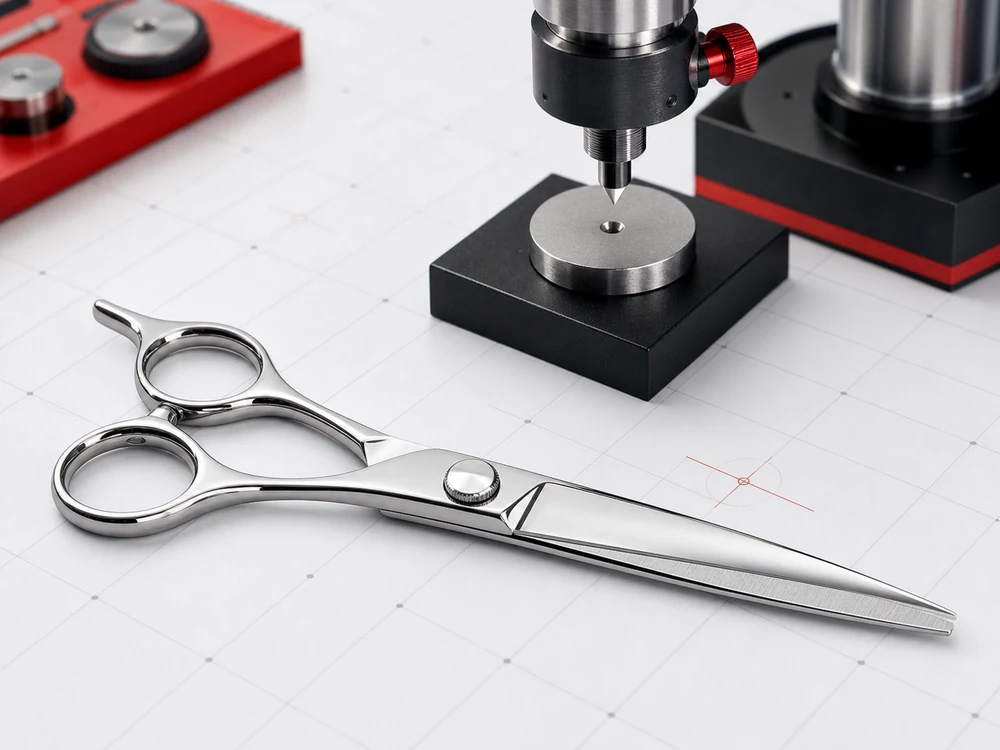
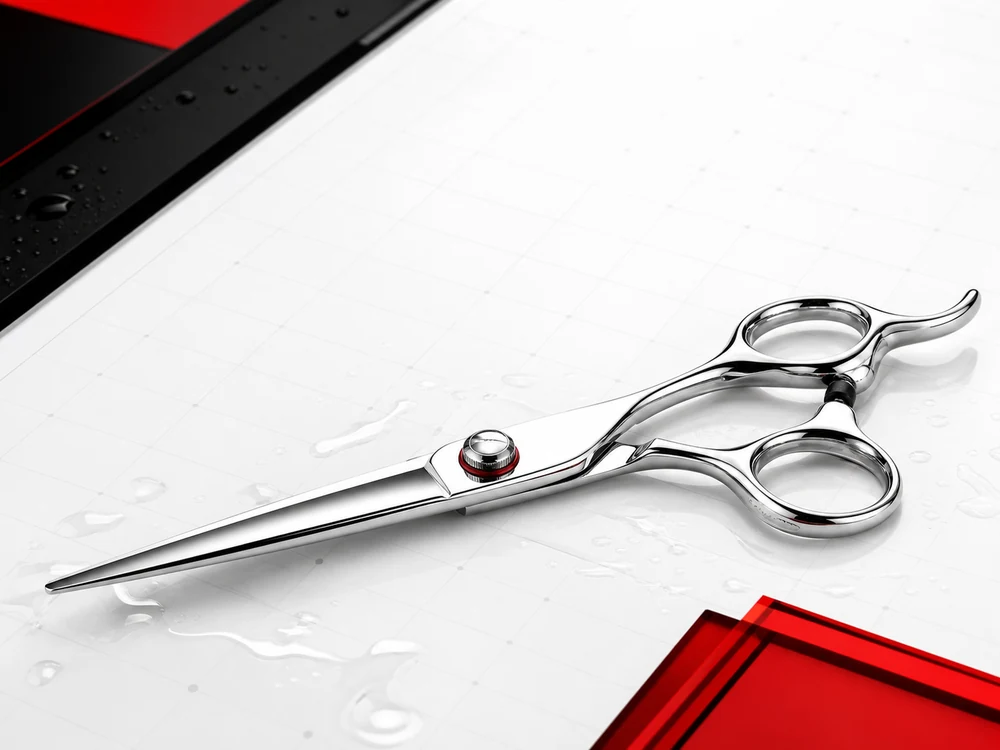
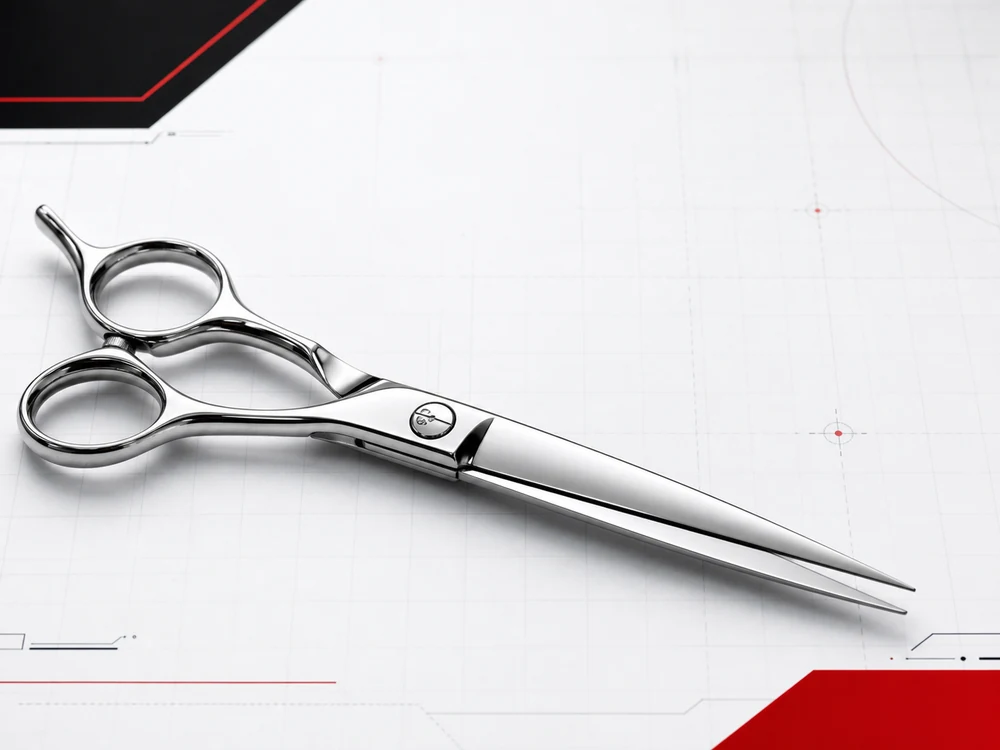
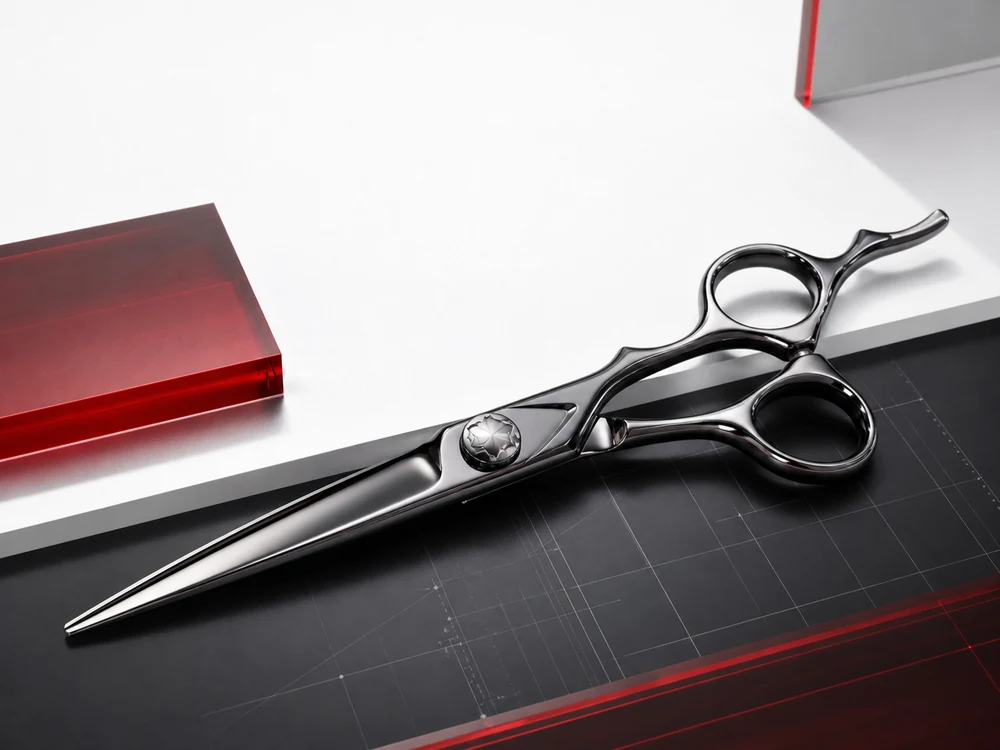
Right shear isn’t about highest cost – it’s about application, hair type, and the daily hand count – we offer our lines across the four core grades, so a buyer, salon chain or private-label brand can build a range from one platform. Our blade comes in 5.0 to 7.0-inch sizes, with straight, offset, crane and swivel handle configurations that give any full-time cutter the grip needed to prevent thumb and wrist fatigue. That same platform accommodates thinning shears texturizers, and grooming shears for our pet-grooming line, so all items below can be specified OEM/ODM with a proven grade and tested hardness.
Let the decision matrix pair use cases to grades, hardness and handle, rather than sorting a price sheet:
| Use Case / Cutting Style | Recommended Grade | Target HRC | Edge Type | Handle | Blade Size |
|---|---|---|---|---|---|
| General salon, blunt & layer cutting | 440C | 58–60 | Convex | Offset | 6.0–6.5 in |
| Slide / point / detail cutting | ATS-314 | 60–62 | Convex | Offset/crane | 5.5–6.0 in |
| Wet cutting, high-humidity salon | VG10 | 60–61 | Convex | Crane | 6.0–6.5 in |
| Barbering, scissor-over-comb | 440C / cobalt | 58–62 | Convex | Straight | 6.5–7.0 in |
| Heavy daily volume (RSI risk) | ATS-314 / cobalt | 60–62 | Convex | Swivel | 5.5–6.0 in |
| Texturizing / thinning | 440C / VG10 | 58–61 | Toothed | Offset | 5.5–6.0 in |
| Left-handed stylists | Any core grade | 58–62 | Convex (true-left) | Offset/crane | 5.5–6.5 in |
| Maximum edge life, expert user | Cobalt | up to 64 | Convex | Offset | 6.0–6.5 in |
| Student / apprentice kit | 440C | 58–59 | Convex | Straight/offset | 6.0 in |
| Pet-grooming line (adjacent) | 440C / cobalt | 58–62 | Convex/curved | Offset | 6.5–8.5 in |
When developing a line, the correct approach is to define by use case rather than price tier-an approach most catalog builders miss. A slide-cutting stylist’s grip and the motions for a scissor-over-comb barber are different; we match grades, hardness and handles to application: texturizers and hair thinning scissors for a slide style will use 440c or vg10, our 60- to 62-HRC ats-314 is suited to detailed work, and our cobalt line up to 64-HRC can handle high-volume cutting. We harden every combination in house and verify to ISO 9001; a consistently resolved tool without concern for mismatched batches. As opposed to a retail catalog, an OEM can cross-reference with our per-item specification sheet prior to production.
New or private label brands lack decades of reviews so must provide alternatives; the substitute of choice for discerning customers searching “how do I verify a scissor brand before buying” is proof-not puffs. We answer with documentation. Our production process is verified by BSCI and SGS, operates on a ISO 9001 quality system, and is bolstered by a relationship with a national-quality inspection center. Upon any order, we’ll furnish a third-party hardness report as well as a material certification, allowing you to independently verify the 60 to 62 HRC rating (up to 64 HRC with our cobalt).
Match the right Japanese steel grade, Rockwell hardness and shear line to how you cut — no guesswork.
The sticker price is not the real cost. Project the 5-year total cost of ownership including sharpening.
Tap a steel grade to see its Rockwell hardness, edge life and trade-offs. The pro sweet spot is 58-62 HRC — harder is not always better.