Get in Touch with Mackayhairscissors Company
We use submitted details to respond to your quote request. Read our Privacy Policy.

![OEM & Private Label Services for Hair Scissors [Shears]](https://mackayhairscissors.com/wp-content/uploads/2026/07/oem-private-label-hair-scissors-guide-featured-1.png)
Buyer guide
OEM & Private Label Services are factory programs that let a brand sell hair scissors under its own name, either from an existing model or from a buyer-defined specification. OEM usually means a factory builds to a buyer’s specification. Private label usually means a product is sold under the buyer’s brand, sometimes from a catalog and sometimes with selected custom specs. For hair scissors, the difference matters because steel, HRC, blade geometry, handle fit, finish, logo, packaging, and proof documents can each sit at a different customization level.
This guide is written for brand founders, salon distributors, academy buyers, barber tool resellers, and grooming-tool companies preparing a first RFQ. It explains what to decide before a factory conversation. It isn’t a duplicate of Mackay’s service page; the service page should own the quote path, while this article owns the buyer check list.
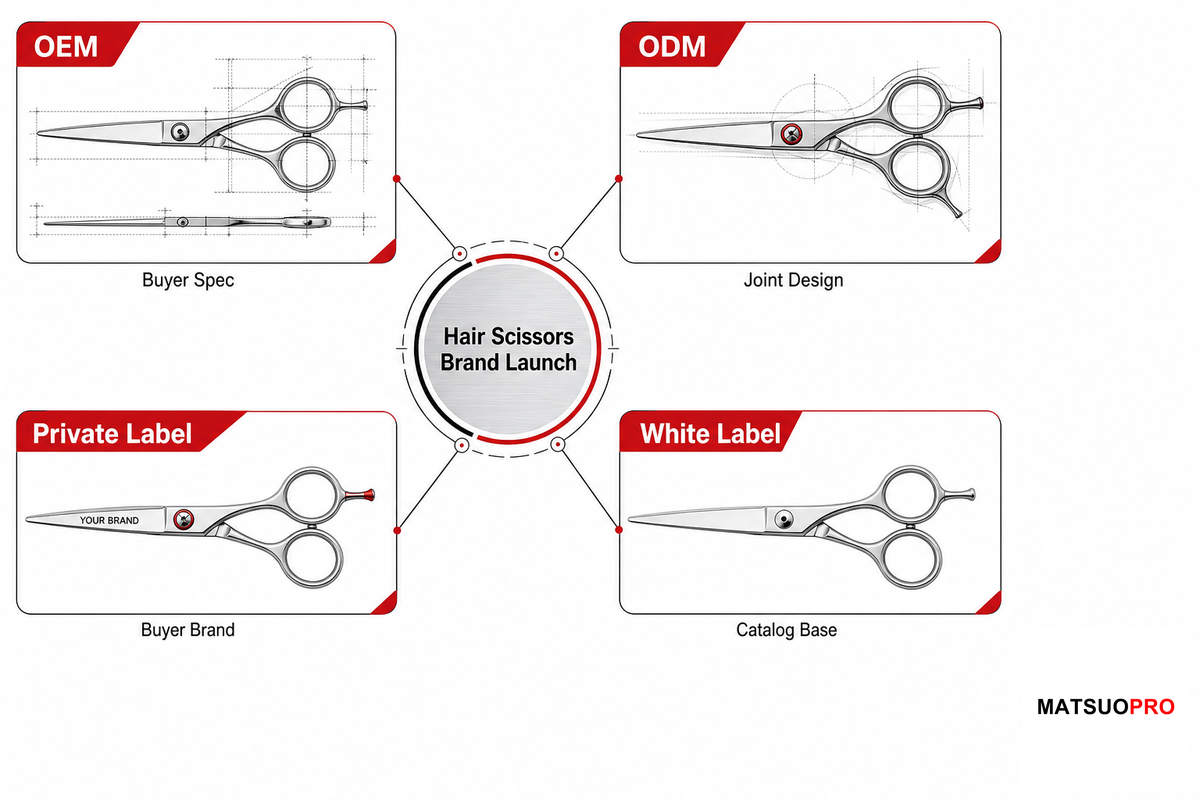
In sourcing language, OEM, ODM, white label, and private label are often mixed together. That causes poor RFQs. One buyer may ask for private label hair scissors but expect a new handle mold, a Japanese convex edge, a left handed barber scissors model, retail packaging, and a signed IP agreement. Someone else may only need a stock shear with a logo and pouch. Both requests may be called private label, yet the factory work is very different.
An original equipment manufacturer builds a product to a buyer’s specification. ODM goes further into factory-assisted design or new tooling. White label usually starts from an existing product with limited branding. private label sits between those routes: the product carries your brand, but the depth of control can range from logo engraving to steel grade, handle, blade, screw system, finish, and packaging.
In professional hair shears, the sourcing model can’t be separated from product evidence. Logo engraving on a shear doesn’t answer whether the blade is 440C, VG10, ATS-314, cobalt alloy, or another stainless steel; whether the HRC target is 60-62 HRC or higher; whether the edge is convex or beveled; or whether every pair is tensioned and checked. Useful RFQ wording defines both the commercial model and the scissor spec.
Buyer risk starts when the commercial label hides a specification gap, because a 6.0 inch sample, an ISO 9001 scope, and a factory QC record answer different questions. For U.S.-bound orders, the term also has a marking consequence: 19 CFR Part 134 treats country-of-origin marking as a separate issue from logo or package branding.
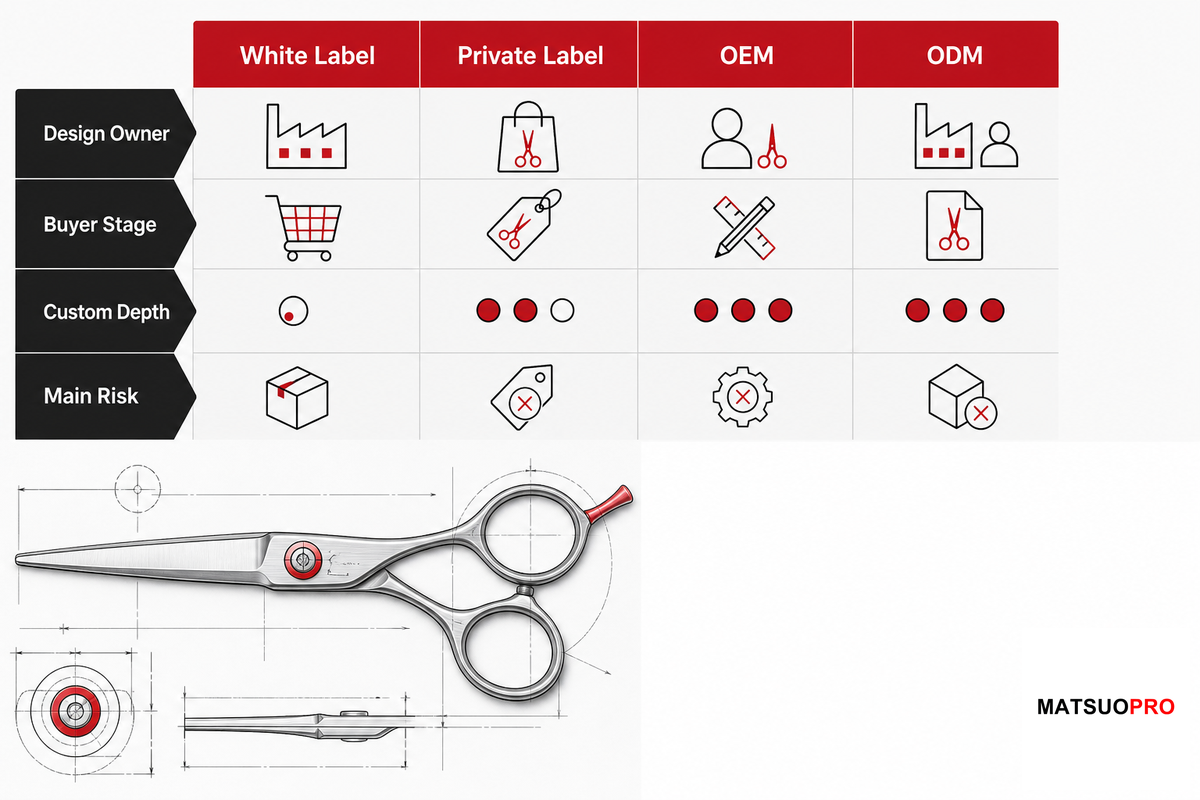
Use the 4-Model OEM Choice Map to choose the sourcing route before you ask for samples. Shared definitions matter more than names. If a supplier and buyer use the same word but mean different work, the sample can still fail. A simple label is not proof: ISO’s explanation of ISO 9001 is a process-scope check rather than a product-spec shortcut.
| Model | Who owns the design | Typical buyer stage | Customization depth | Main risk |
|---|---|---|---|---|
| White label | Factory catalog | Demand test | Logo and packaging | Weak differentiation |
| Private label | Buyer brand | Line launch | Branding plus selected specs | Quality proof gap |
| OEM | Buyer specification | Defined SKU scaling | Product built to spec | Poor RFQ creates poor result |
| ODM | Joint or factory-assisted design | Differentiation stage | New geometry or tooling | IP and sampling risk |
Use white label when speed matters more than spec control. Use private label when you need a branded salon or distributor line but still want a proven base model. Use OEM when you already know the cutting shears, thinning shears, texturizing model, size, steel, hardness, handle, and finish. Use ODM when the product itself should be new enough to need drawing, prototype, and tooling decisions.
Here’s one test: If your RFQ simply says “add my logo,” you aren’t ready for OEM. If your RFQ says “target stylist, shear type, 6.0 or 7.0 inch size, steel grade, HRC range, precision blade edge, handle offset, screw, surface finish, packaging, proof file,” you’re getting warmer.
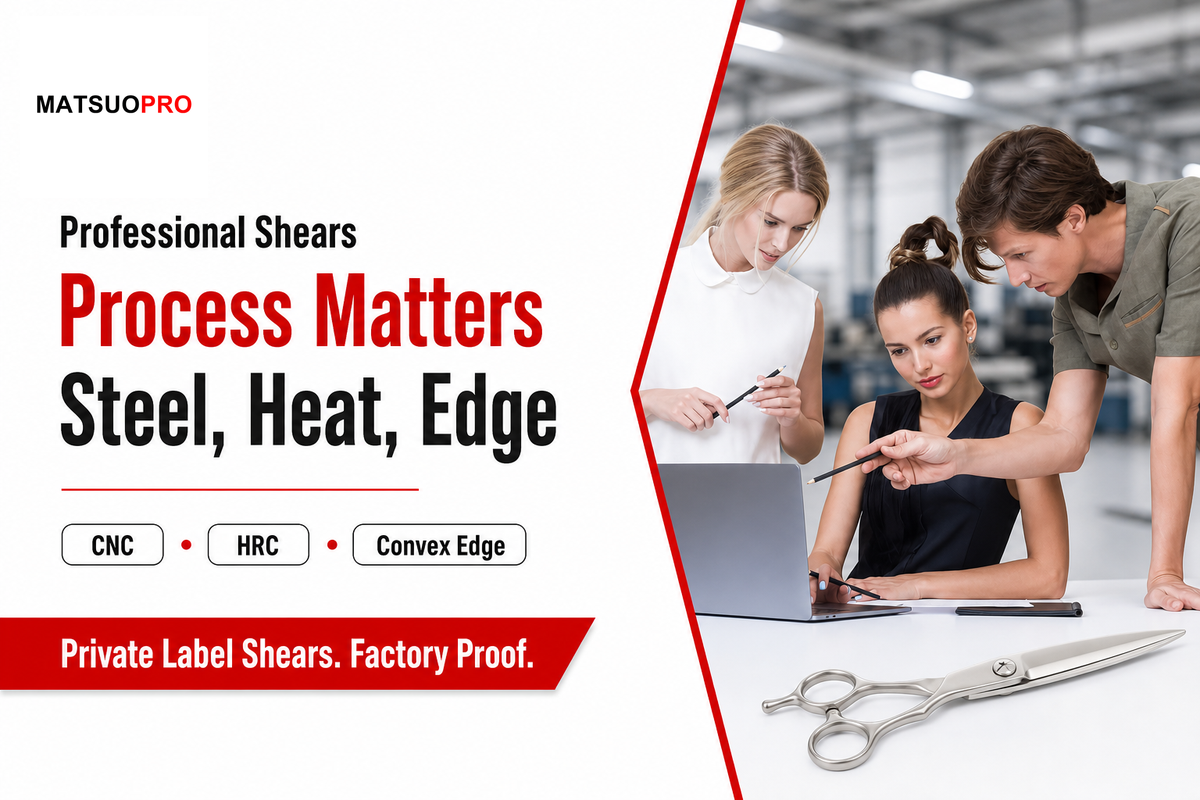
Cosmetics, apparel, and other low-cost accessories can often be “formula, fabric, art, package” filtered. High-end hair scissors demand a tighter product specification. Hair cutting shears are hand-held cutting instruments for stylist use over long periods, day after day. Buyers need to define the feel of the cut, the balance, tension, edge, the way the handle fits in the hand, corrosion resistance, batch-to-batch repeatability – not just branding.
Modern Salon’s professional shear guide discusses Japanese steel, convex or hollow-ground blades, and handle ergonomics. That trade context is a useful primer for why buyers must specify private label hair scissors differently than simple private label products.
Beauty industry buyers also use overlapping names such as professional hairdressing scissors, hairdressing shears, and customized hair scissor lines. Whatever wording appears on the package, consistent quality depends on the manufacturing process and the craftsmanship behind the sample. For material claims, ASTM E18-25 is a reminder that hardness evidence has test-scope limits, so batch evidence still matters. For scissor geometry, patent records such as US20190134832A1 show that blade and handle layout can be treated as engineered structure, not just catalog copy.
Mackay’s factory gives us a first hand look at what a spec sheet looks like with an 80-plus step process, 2 manufacturing locations in Guangzhou and Zhangjiagang, 2000+ m2 facility, 100+ people, Japan’s steel options such as 440C, VG10, ATS-314 and cobalt alloys, vacuum and cryogenic heat treatments, CNC cutting, hand sharpening, PVD coating, laser engraving, pair-by-pair quality control. Again, that’s a factory example not a rule.
In practice, a sample can fail because blade tension, handle geometry, and finish change the user experience; factory evidence such as CNC records and heat treatment logs matters more than photos alone.
On a private-label price quote, proof should be itemized and specific to the product. Buyers should question what’s being measured, by whom, to which lot number it applies, and if the finished shear meets sample.
Explore the bulk wholesale hair scissors for related options.
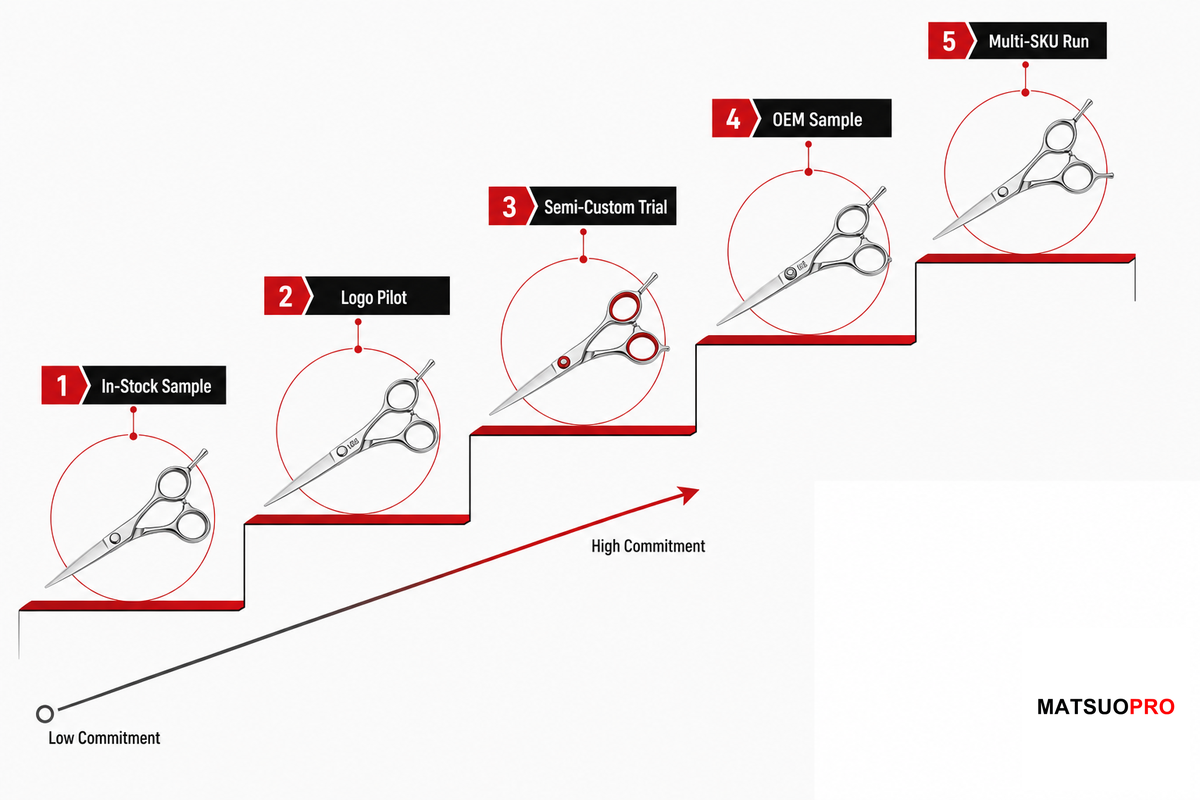
MOQ Risk Ladder separates “Inventory Risk” from “Specification Risk”. Low minimums may protect your cash but it doesn’t protect your brand if the specification sample is ambiguous. Higher MOQs may drive unit cost down, but that’s a risky proposition if you’re not sure the model works for the intended salon, barber, academy, distributor, or grooming markets. A small pilot order still needs a broker check for the scissors classification, and the USITC HTS scissors search is a starting point for that discussion.
Mackay notes custom orders can start as low as 50 units, with in-stock styles starting at one unit. Why is that important? A small brand can sample a private label route without a huge commitment of capital into a full wholesale order. This Mackay factory first-party detail still doesn’t replace sample approval, spec sheets and proof of specification.
The common mistake is treating a 50-unit pilot as proof of scale because finish inconsistency, tension drift, and packaging delay may only appear when the factory repeats the production batch.
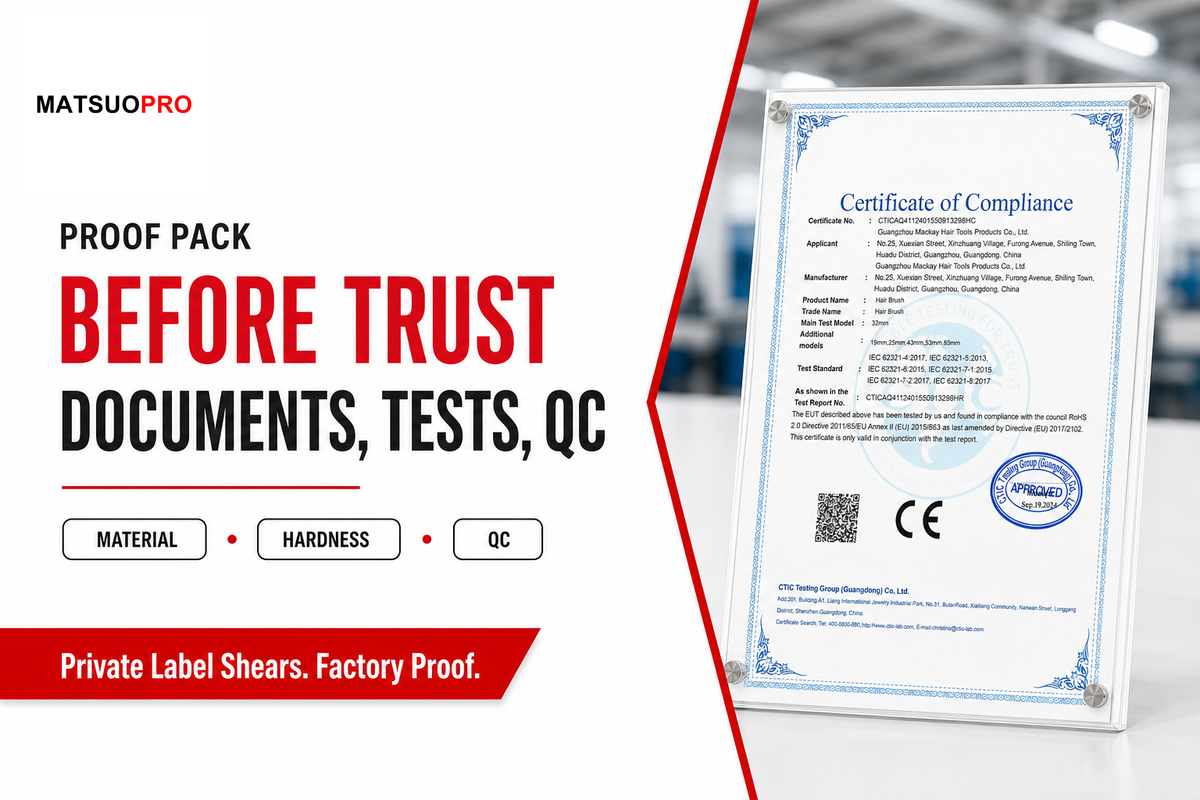
8-Document Proof Pack This table, which is the primary purchase item for this article, shouldn’t be considered a substitute for legal, customs or laboratory advice. Use it to find out what proof to ask for when a manufacturer claims their private label, OEM or ODM quality level.
Buyer note: the risk is an evidence gap because a supplier can show ISO 9001 or an HRC number without proving the actual sample batch, factory process, and target-market marking are aligned.
| Proof item | What it proves | What it does not prove | Red flag |
|---|---|---|---|
| Mill or material certificate | Steel source and grade | Finished edge performance | Only says “Japanese steel” |
| Rockwell hardness report | HRC result for a test point or lot | Whole-shear cutting feel | No lot traceability |
| Material composition report | Alloy verification | Country of manufacture | Missing supplier name |
| ISO 9001 certificate | Quality management system scope | Product certification | Scope mismatch or old version |
| Social or factory audit | Factory process and social-compliance signal | Blade quality by itself | Expired certificate |
| Pre-shipment photo or video | Final appearance, quantity, logo, packaging | Long-term durability | No pair-by-pair evidence |
| Sample approval record | Agreed baseline | Future repeatability alone | No signed sample file |
| Origin and labeling statement | Import marking and marketing claim plan | Tariff classification | “Made in” wording without backup |
| NDA, tooling, and artwork terms | Design handling and brand-file control | Trademark ownership | No written ownership terms |
| Import broker note | HTS and duty discussion path | A legal classification ruling | Supplier quotes tariff cost casually |
ISO explains that ISO 9001 is a quality management standard and does not impose rigid guidelines for day-to-day factory specifics. ISO 9001 official explanation ISO also lists ISO 9001 edition 6 (expected 2026, replacing ISO 9001:2015) as “in publication,” ISO 9001 requirements page indicating that buyers should check scope, issuer, date, and edition rather than a screenshot of the certificate.
ASTM E18-25 is for Rockwell hardness testing of metallic materials. ASTM E18-25 Rockwell hardness page This value has buyer appeal, but an HRC number is not the full quality picture. Ask if the test is tied to the specific heat treatment lot, blade section, steel lot or final inspection process.
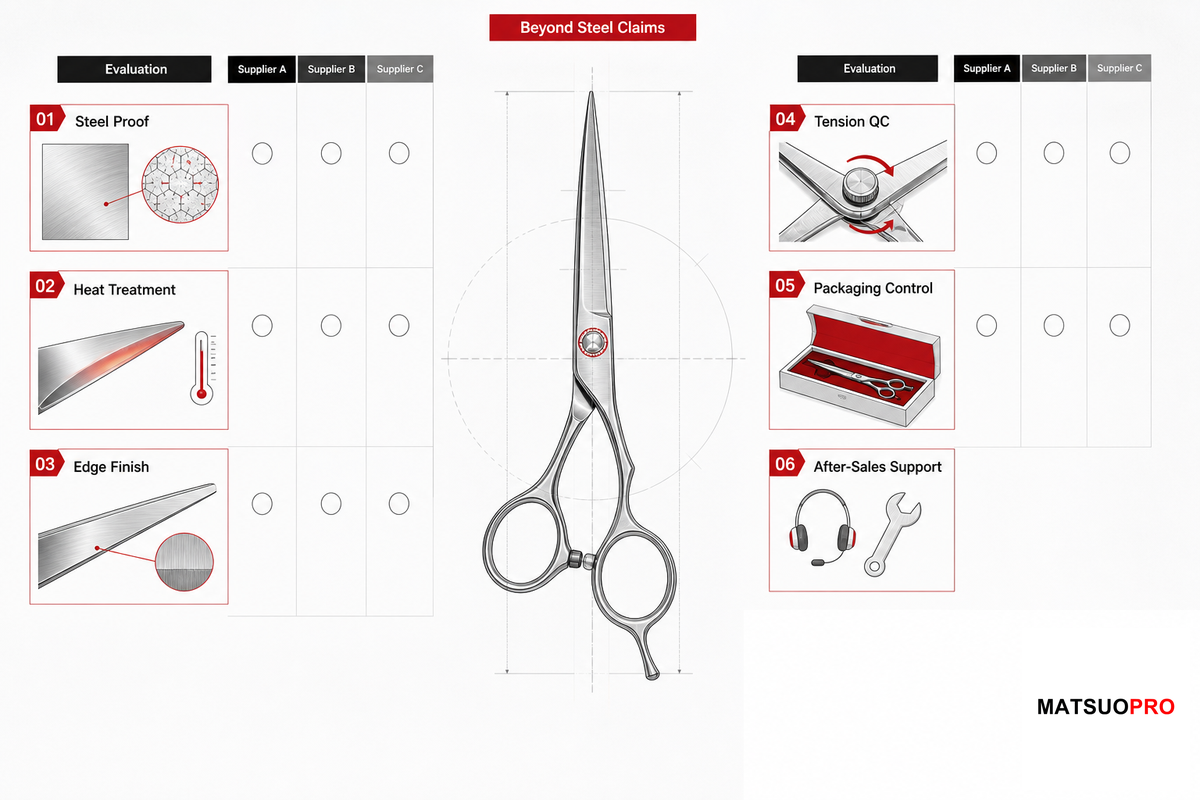
“Japanese steel” is a material description, not a manufacturing description. Strong steel quality may be ruined by poor heat treatment, grinding, edge work, screw adjustment, handle assembly or final inspection by a weak or less-focused manufacturer. It can also serve as cover for weaker factories not willing to show steel reports.
The trap is assuming steel grade alone solves quality risk; because ISO 9001 scope, CNC consistency, hand finishing, and sample inspection sit in different evidence buckets, confirm each against the buyer’s use case.
In the U.S., steel origin and marking requirements are a separate issue from “made in” advertising. 19 CFR Part 134 details country-of-origin marking for imported goods. eCFR Part 134 country-of-origin marking And for advertising claims: Made in USA requires all or virtually all components to be of U.S. origin, FTC Made in USA guidance.
Classification is also a check. A USITC search result for scissors provides the HS heading 8213.00 for “scissors, tailors’ shears, other shears of a kind used for cutting hair, blades and parts thereof of base metal.” USITC HTS scissors search The factory shouldn’t give legal advice, but your customs broker should confirm the correct HTS classification for your market.
Use the evidence stack for manufacturer comparison: Steel grade report, HRC test, Heat treatment certification, blade geometry specifications, Hand finishing time, Handle design and attachment details, finish durability test results, Pair-by-pair QC, Packaging tests, IP and logo details. Buyers looking for context on steel choices before they start specifying their product can check Mackay’s free steel guide for hair shears. Mackay’s public product content
Explore the custom logo engraving for related options.
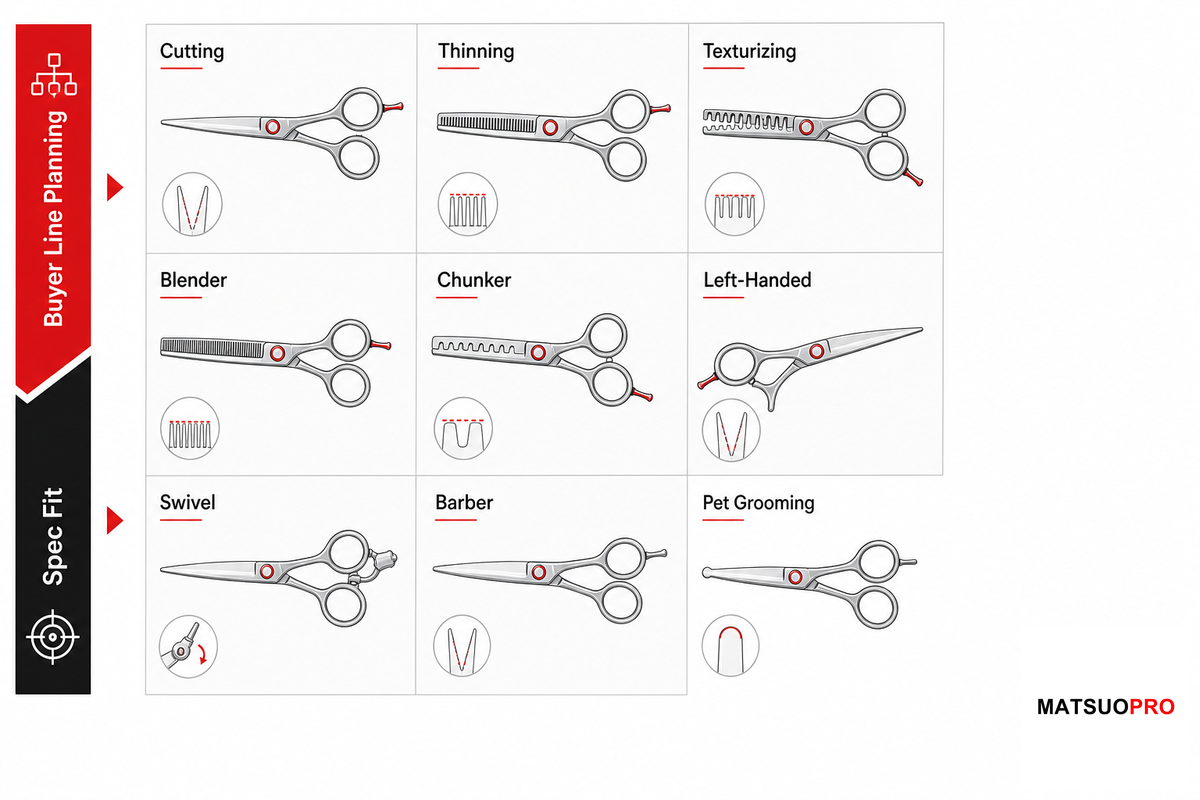
Type matrix detail adds a layer of product-specificity that many service pages lack. It helps buyers quickly decide if one factory is well-equipped for all models or if they need to engage specialists. Patent literature such as US20190134832A1 also shows why blade and handle geometry should be specified separately instead of reduced to a catalog name.
| Shear type | Common buyer use | Approx. length class | Spec to confirm |
|---|---|---|---|
| 5.0 inch cutting shears | Detail work and smaller hands | About 127 mm | Point control, balance, finger-ring size |
| 5.5 inch hair cutting shears | General salon cutting | About 140 mm | Convex edge, tension, thumb offset |
| 6.0 inch barber scissors | All-round barber and stylist use | About 152 mm | Blade length, screw system, handle fit |
| 6.5 inch slicing shears | Slide cutting and longer sections | About 165 mm | Edge polish and smooth travel |
| 7.0 inch long shears | Barber over-comb work | About 178 mm | Weight, tip stability, blade alignment |
| Thinning shears | Bulk removal | Often 152 mm to 178 mm | Tooth count, cut percentage, notch finish |
| Texturizing shears | Softening and texture work | Often 140 mm to 165 mm | Tooth geometry and test swatch result |
| Left handed shears | True left-handed cutting | Match the right-hand mm class | Blade orientation, handle mirror, sample proof |
| Pet-grooming scissors | Groomer line extension | Confirm exact mm length | Curved blade, length, coat test, safety tip |
If your brand requires salon shears as well as grooming shears, don’t assume the same approval sample will work for both families. Mackay has separate sections for hair cutting shear and pet grooming scissors products – a useful hint that type-specific QC can matter.
Metric equivs as RFQ ref. only, not manufacturing tolerances. 4.5 shears ~ 114 mm; 5.0 ~ 127 mm; 5.5 ~ 140 mm; 6.0 ~ 152 mm; 6.25 ~ 159 mm; 6.5 ~ 165 mm; 6.75 ~ 171 mm; 7.0 ~ 178 mm; 7.5 ~ 191 mm. Ask supplier to mark blade length, overall length, handle opening, logo artwork size in mm on the drawing or sample sheet. Logo proofs should show whether 8 mm, 10 mm, or 12 mm artwork widths remain readable on the selected blade, and the RFQ can also ask for example handle-span notes such as 55 mm opening or 85 mm outside span as reference fields, not quality criteria.
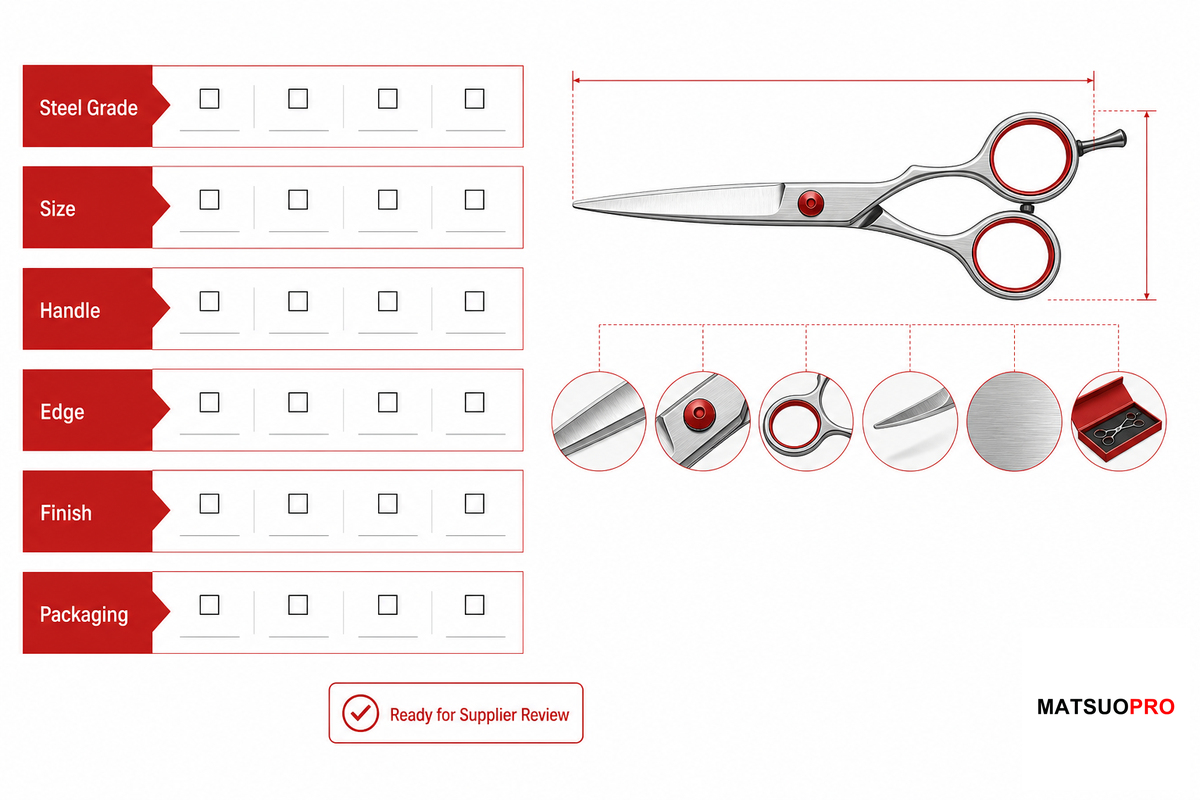
6-Spec RFQ Sheet transforms your plan into a ready-to-use document for your supplier. If a buyer sends just a logo file and asks for the lowest price, the supplier must make too many assumptions. An effective RFQ minimises the need for guessing.
Trade.gov’s China IP guidance: Trade.gov provides information on protecting your IP in China, including early trademark registration. Separately, the CBP IPR protection page explains e-Recordation for registered trademark and copyright owners seeking border enforcement. For private label products, include logo files, artwork ownership details, and terms in the RFQ from the outset.
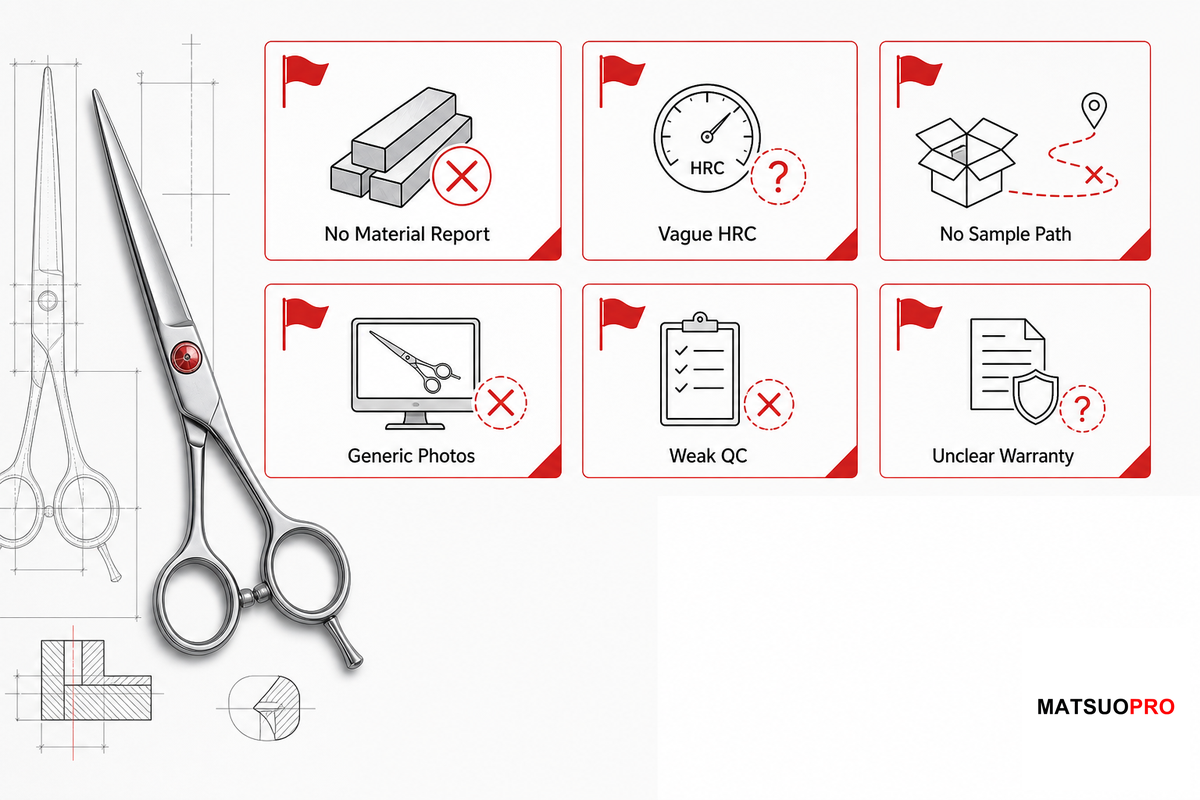
Good photos don’t always guarantee a good supplier; look beyond pricing for process weaknesses. IP silence is also a sourcing red flag; Trade.gov’s China IP guidance tells buyers to handle trademark protection early.
| Red flag | Why it matters | Safer buyer question |
|---|---|---|
| Only says “premium Japanese steel” | No grade or lot proof | Which grade and report support this batch? |
| No hardness report | HRC claim is unsupported | Can you provide a lot-tied Rockwell report? |
| No sample approval file | Bulk order has no baseline | Who signs the final sample and spec sheet? |
| Copied product images | Design and trust risk | Can you show original sample photos? |
| Origin wording is vague | Labeling or advertising risk | What exact country-of-origin and marketing claim is supported? |
| Pushes bulk before sample | Inventory risk moves to buyer | What pilot path is available before bulk? |
| Cannot explain subcontracting | QC and lead time risk | Which steps are in-house and which are outsourced? |
| No packaging proof | Private label brand experience suffers | Can you show box, pouch, insert, and carton samples? |
| No after-sales terms | Distributor risk after launch | How are defects, rework, and replacement handled? |
Readers unfamiliar with steel types and HRC can start with Mackay’s HRC hardness guide. After using it for education, ask the supplier for batch proof.
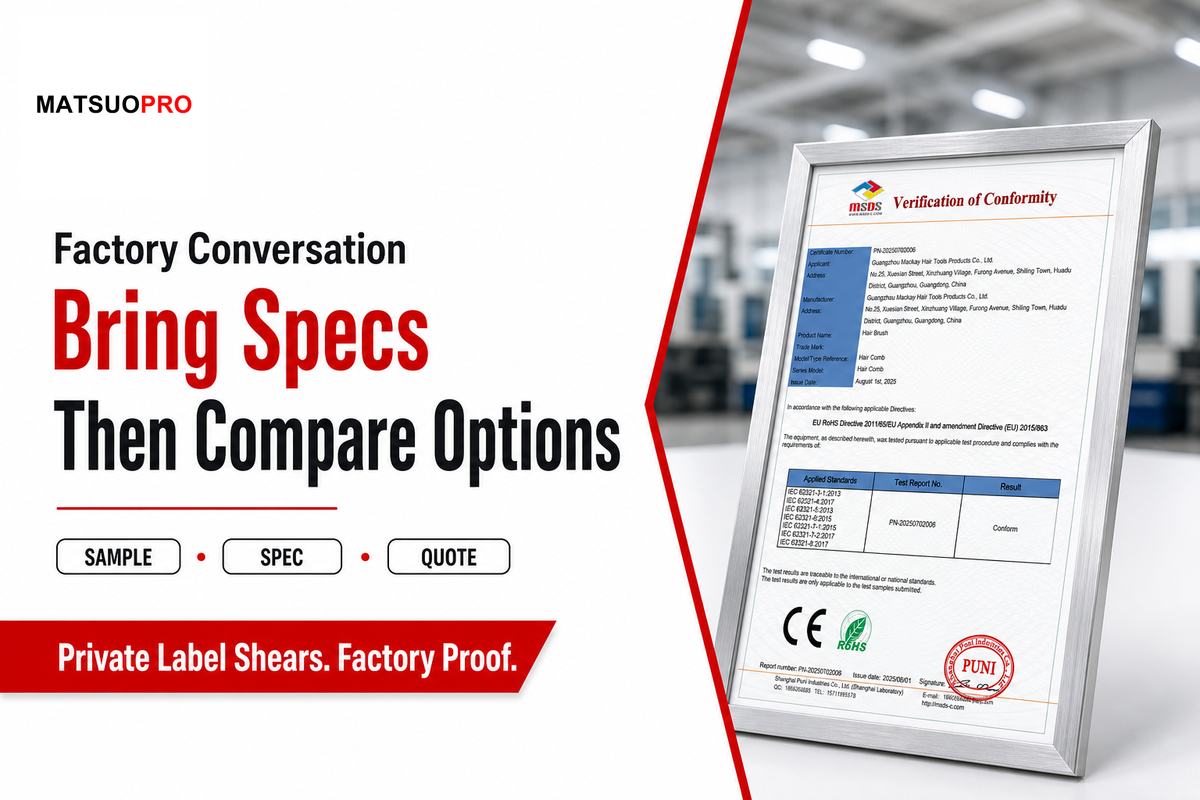
Before engaging with a factory, ensure you can confidently answer these six questions: which sourcing model best fits your needs, who your primary buyer is, which initial SKU is most important, your preferred steel and finish style, the required proof documents, and your sample approval process. If these answers remain unclear, refine your RFQ further.
A late factory conversation can still fail because the buyer lacks a sample plan, drawing, or proof list; bring the 5.5 inch or 6.0 inch target, finish notes, and QC questions before asking for price.
If the above responses are satisfactory, the focus now becomes supplier specific. Next, compare Mackay’s OEM and private-label service options and decide whether you want a 5.5 inch stock sample, a 6.0 inch logo pilot run, a semi-custom trial, or a more open-ended OEM/ODM conversation. Mackay’s About Us page offers a higher level view on their facilities and production process claims. For U.S.-bound launches, review CBP IPR e-Recordation and origin-marking obligations before the purchase order, not after goods are packed.
OEM usually means a product is made to the buyer’s specification. Private label means the product is sold under the buyer’s brand, but the depth of control can vary. In hair scissors, that difference affects steel grade, hardness, blade geometry, handle fit, finish, logo, packaging, proof documents, and the sample approval path. Buyers can also mix routes: for example, a private label launch might start from an existing 6.0 inch shear, then add an OEM handle change in the second production run after the first buyer feedback is known.
White label is usually the lowest customization route. Buyers add branding to an existing catalog item. Private label can go deeper, but the terms vary by supplier, so the RFQ should define the exact scope. For hair shears, that scope may include steel grade, finish, logo method, pouch, carton labeling, and sample approval before a bulk order.
Prepare the target buyer, shear type, size, steel grade, HRC expectation, blade edge, handle style, finish, logo placement, packaging, proof documents, sample route, target market, and import needs. Add metric dimensions where you can, such as 152 mm for a 6.0 inch class shear or the exact mm width of a logo mark. Include whether you need material reports, Rockwell hardness evidence, origin marking, IP terms, and carton labeling. More exact RFQs leave less room for supplier guess work.
Sometimes, but verify each family separately. Cutting, thinning, texturizing, left handed, and pet-grooming scissors need separate samples, tooling checks, and QC notes.
Give each URL a different job. Service pages should own the offer, quotation path, factory capability, MOQ, sample request, and conversion language. Blog posts should own definitions, decision logic, proof documents, RFQ preparation, red flags, and buyer education. Avoid repeating the same H1, same CTA block, and same exact-match anchor several times. One late internal link is enough when the reader is ready for supplier options; supporting links can point to steel, hardness, or product education pages instead.
MATSUOPRO is the Mackay Hair Scissors manufacturing brand for professional hairdressing shears, barber scissors, thinning shears, and pet-grooming scissors. We support salons, distributors, academies, grooming brands, and private-label buyers that need factory-direct production with practical material guidance.
Our buying guides are written to help purchasers compare steel grades, handle styles, blade geometry, surface finishes, logo options, packaging, MOQ, and sample validation before placing an OEM or wholesale order. The goal is to make each scissors specification easier to discuss with a real production team.
Factory-direct supply since 2014, with product lines covering professional cutting shears, barber shears, thinning scissors, texturizing scissors, left-handed models, and pet grooming scissors for international B2B customers.
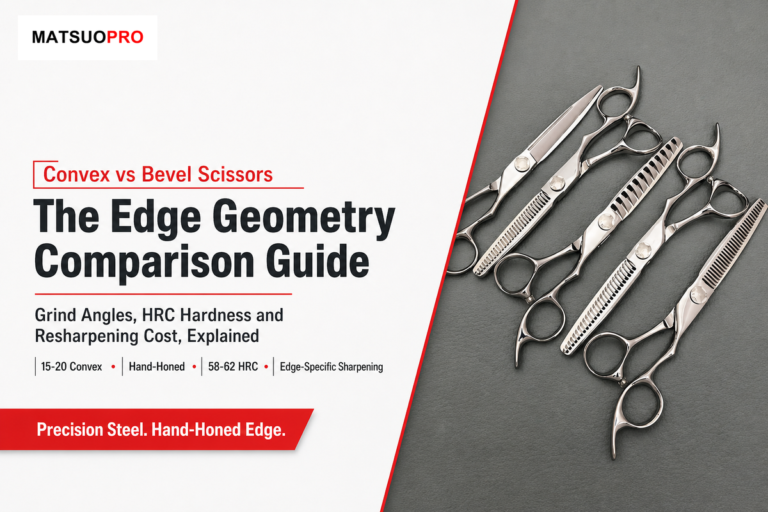
We focus on Japanese 440C, VG10, and ATS-314 steel choices, convex and bevel edge geometry, ergonomic handle balance, tension systems, logo engraving, private-label packaging, and sample-based OEM confirmation.