Get in Touch with Mackayhairscissors Company
We use submitted details to respond to your quote request. Read our Privacy Policy.


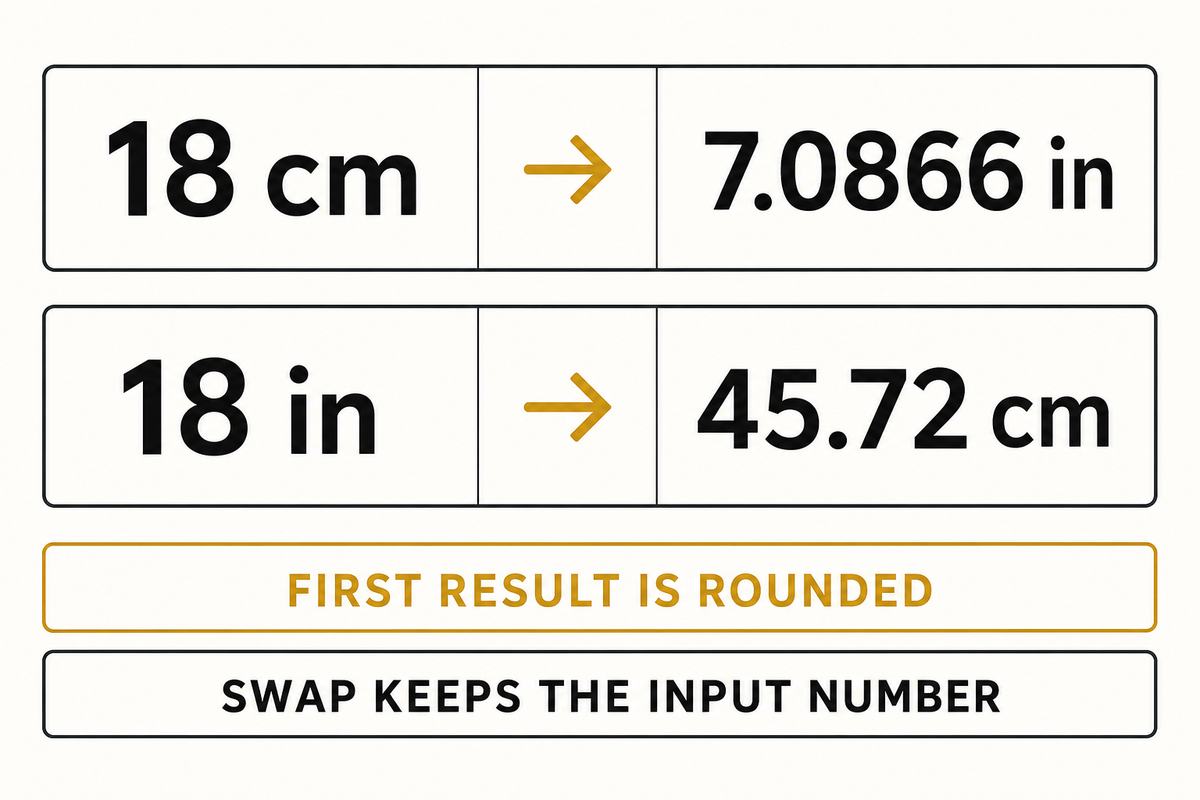
CM to inches conversion is a length calculation that divides a centimeter value by exactly 2.54. For example, 18 cm is approximately 7.0866 inches. Reverse the direction by multiplying inches by 2.54. Always keep the unit you started with when transferring a ruler reading to a form.
Centimetre to inch converter
Decimal length conversion only. Displayed digits do not establish measurement precision or shear fit.
18 cm = 7.0866 in
Enter a nonnegative decimal such as 18.5, without commas or unit letters. A dash means the input is empty, invalid or outside the supported range.
Updated September 2026
Before you convert
A cm to inches converter needs a number and its original unit. Select centimeters as the input and inches as the output for a forward calculation. The equivalent inch value is smaller because an inch is longer than a centimeter. A correct result still depends on entering the intended measurement.
Enter a normal decimal like 18.5, without commas or unit letters. Write 1500 instead of 1,500, and convert a mixed fraction to a decimal before entering. Zero is ok; negative lengths are outside this tool’s range. An invalid, empty, or overly large entry will result in a displayed dash, which isn’t a zero result.
The unit selectors work in both directions. Swap reverses those selectors while keeping the entered number: 18 cm gives approximately 7.0866 in, whereas 18 in gives 45.72 cm. It doesn’t copy the previous answer into the input. Read both labels after you change direction.
Normal calculations show at most four decimal places, with trailing zeros removed. Very small nonzero results use six significant digits. Neither of these rules describes measuring equipment accuracy. The exact conversion factor is taken from the National Institute of Standards and Technology length definitions.
Save the original entry. An 18 cm reading and a displayed 7.0866 in result belong together. If a form requires inches, enter the converted number into the inch field and keep the centimeter note. Altering a label is not a case of converting a measurement.
For centimeters to inches conversion, divide centimeters by 2.54. The international inch is defined through an exact relationship, so the divisor isn’t an approximation. Decimal results can still require rounding. Perform the calculation before you decide how many digits to report for its intended purpose.
One international inch equals exactly 2.54 centimeters, or exactly 25.4 millimeters. NIST dates the international inch definition to July 1, 1959. This factor links the metric and inch-based measurement systems and doesn’t vary with what’s being measured. Pencils, fabric samples, and hand measurements all use the same calculation.
A centimeter is one-hundredth of a meter. NIST metric prefix table defines centi as 0.01 and milli as 0.001. The meter is the base unit of length in the International System of Units, commonly abbreviated SI; cm is the symbol for centimeter.
Formula: inches = centimeters ÷ 2.54
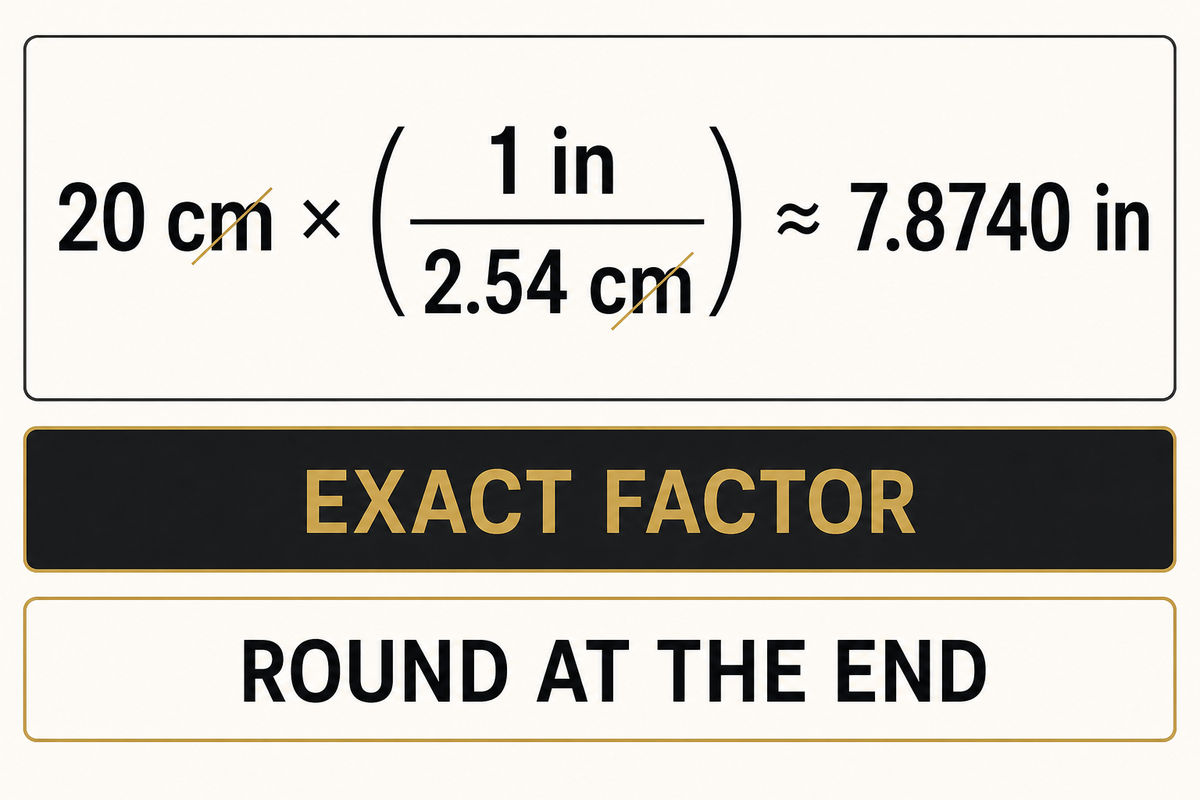
Worked example: 20 cm × (1 in / 2.54 cm) ≈ 7.8740 in.
Writing the factor as a fraction makes the units cancel: cm appears above and below the line, leaving in. Multiplying 20 cm by 2.54 would take the calculation in the wrong direction. NIST’s unit-conversion method uses this type of dimensional check and postpones rounding until the calculation is complete.
The decimal multiplier 0.3937 is convenient yet rounded. To convert centimeters to inches using division, divide by 2.54. For 20 cm, the exact-factor calculation produces about 7.8740 in; writing that rounded display with an approximation sign keeps it distinct from the exact definition of 1 in.
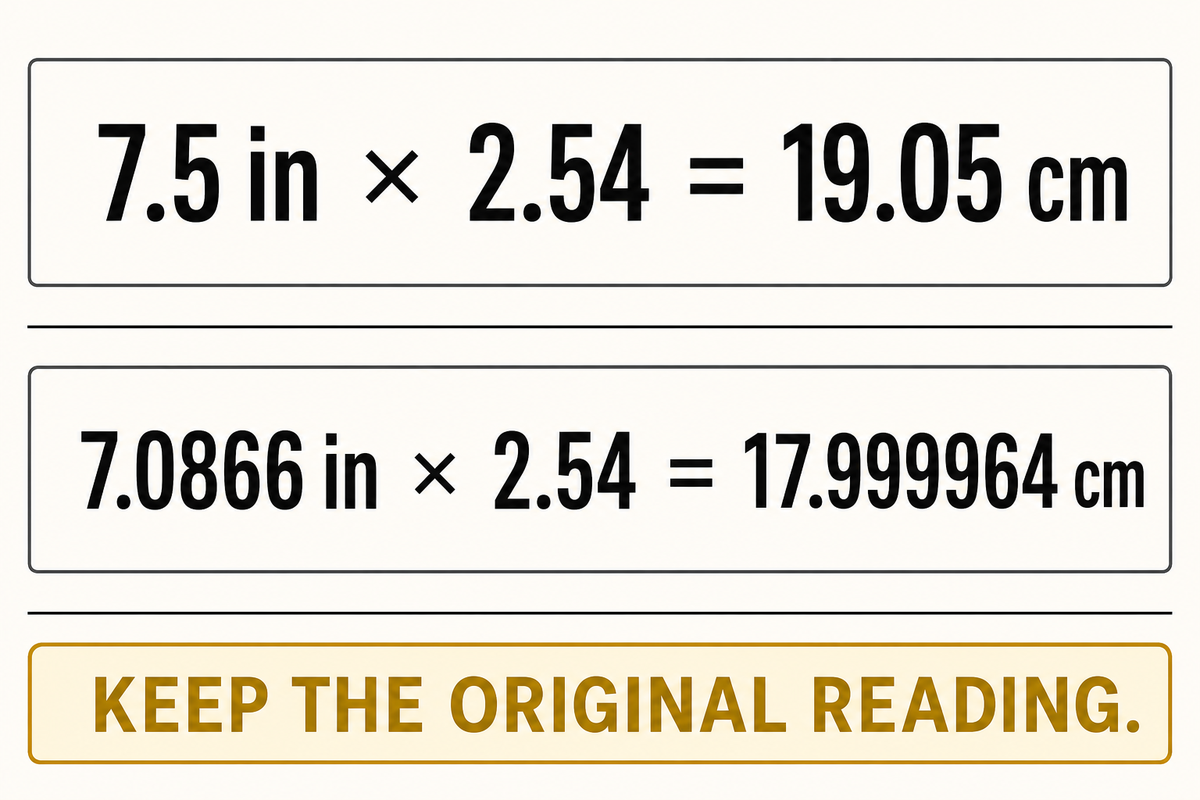
To convert inches to centimeters, multiply the original inch number by 2.54. For example, 7.5 in equals 19.05 cm. Use the inch reading you started with, rather than an already rounded result from an earlier conversion, when you need a reliable check of your calculation.
The same NIST exact length relation works in reverse. Multiply 7.5 inches by 2.54 to get 19.05 centimeters, with no decimal rounding needed. This equality doesn’t ensure that a physical object is exactly 7.5 inches.
| Original inches | Calculation | Centimeters |
|---|---|---|
| 1 in | 1 × 2.54 | 2.54 cm |
| 7.5 in | 7.5 × 2.54 | 19.05 cm |
| 12 in | 12 × 2.54 | 30.48 cm |
There are 12 inches in a foot. Convert a feet-and-inches entry to total inches first: multiply feet by 12, then add the remaining inches. Going from inches to decimal feet instead means dividing inches by 12. Keep that extra step separate from inch conversion to centimeters. NIST also relates the international yard, 36 inches, to 0.9144 meter; all are length conversions.
For a quick reversal check, 19.05 cm divided by 2.54 returns 7.5 in. Reversing a four-place display such as 7.0866 in produces approximately 17.999964 cm, rather than exactly 18 cm. This is due to rounding the intermediate value and not a changing conversion factor.
The cm to inches chart presents common lengths without the need for repeated calculations. Read the instructions cm → inches: every row is divided by the same value of 2.54. Rounded to four decimal places, each inch result is a mathematical reference. The table doesn’t grant a four-place measurement precision to the original centimeter value. For 100 cm to inches, use the last row: approximately 39.3701 in.
| Centimeters | Inches | Display status |
|---|---|---|
| 1 | 0.3937 | Rounded |
| 2 | 0.7874 | Rounded |
| 2.54 | 1.0000 | Exact numerical equivalent |
| 3 | 1.1811 | Rounded |
| 4 | 1.5748 | Rounded |
| 5 | 1.9685 | Rounded |
| 10 | 3.9370 | Rounded |
| 12 | 4.7244 | Rounded |
| 15 | 5.9055 | Rounded |
| 18 | 7.0866 | Rounded |
| 20 | 7.8740 | Rounded |
| 25 | 9.8425 | Rounded |
| 30 | 11.8110 | Rounded |
| 36 | 14.1732 | Rounded |
| 40 | 15.7480 | Rounded |
| 50 | 19.6850 | Rounded |
| 100 | 39.3701 | Rounded |
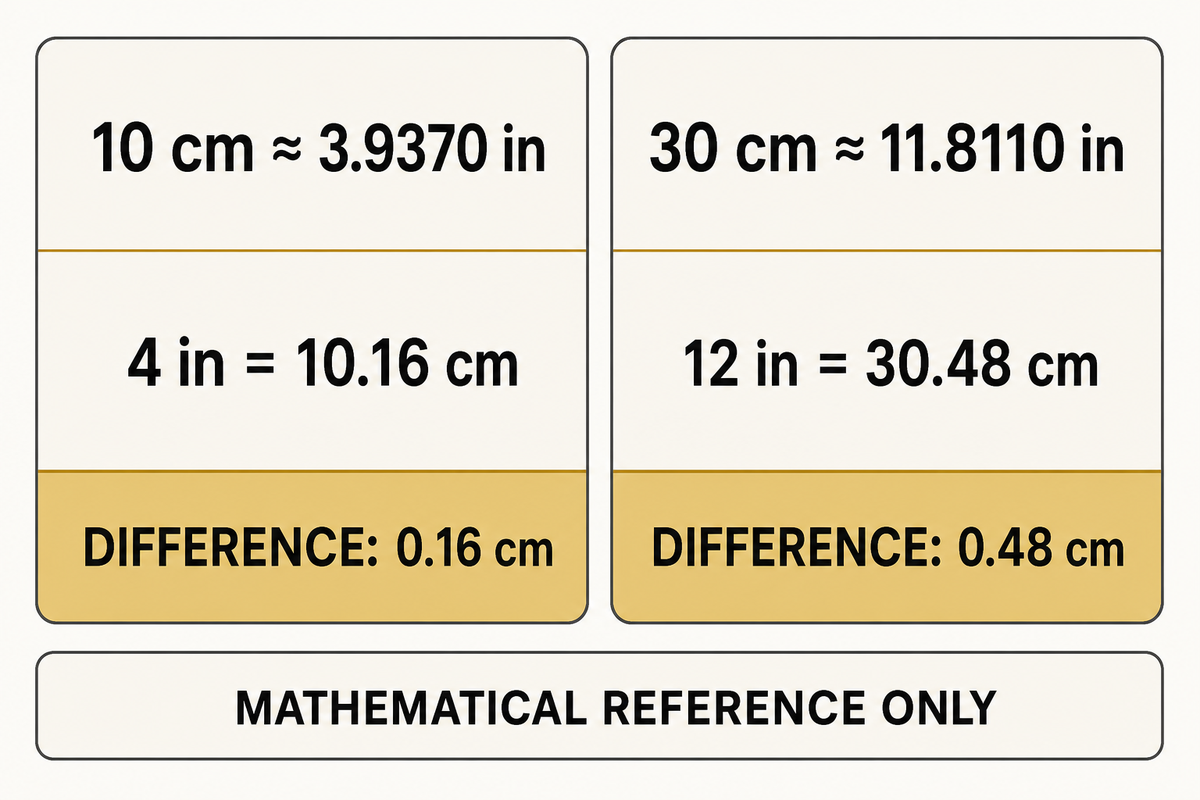
Ten centimeters is approximately 3.9370 inches. It’s close to four inches, but four inches equals 10.16 cm. The difference between those two lengths is 0.16 cm. Use the exact-factor calculation when transferring a numerical measurement, and use the rough comparison only when that difference is acceptable for the task.
When dealing with rounding converted values, the NIST SP 811 looks at the original value and the end goal. A conversion table alone can’t determine the reporting precision needed for your worksheet, supplier or measuring procedure.
For 30 cm, the four-place chart gives 11.8110 in, while 12 in equals 30.48 cm. Treating both as interchangeable would introduce a 0.48 cm difference. Check the actual row before using a familiar inch value as a substitute in a purchase specification.
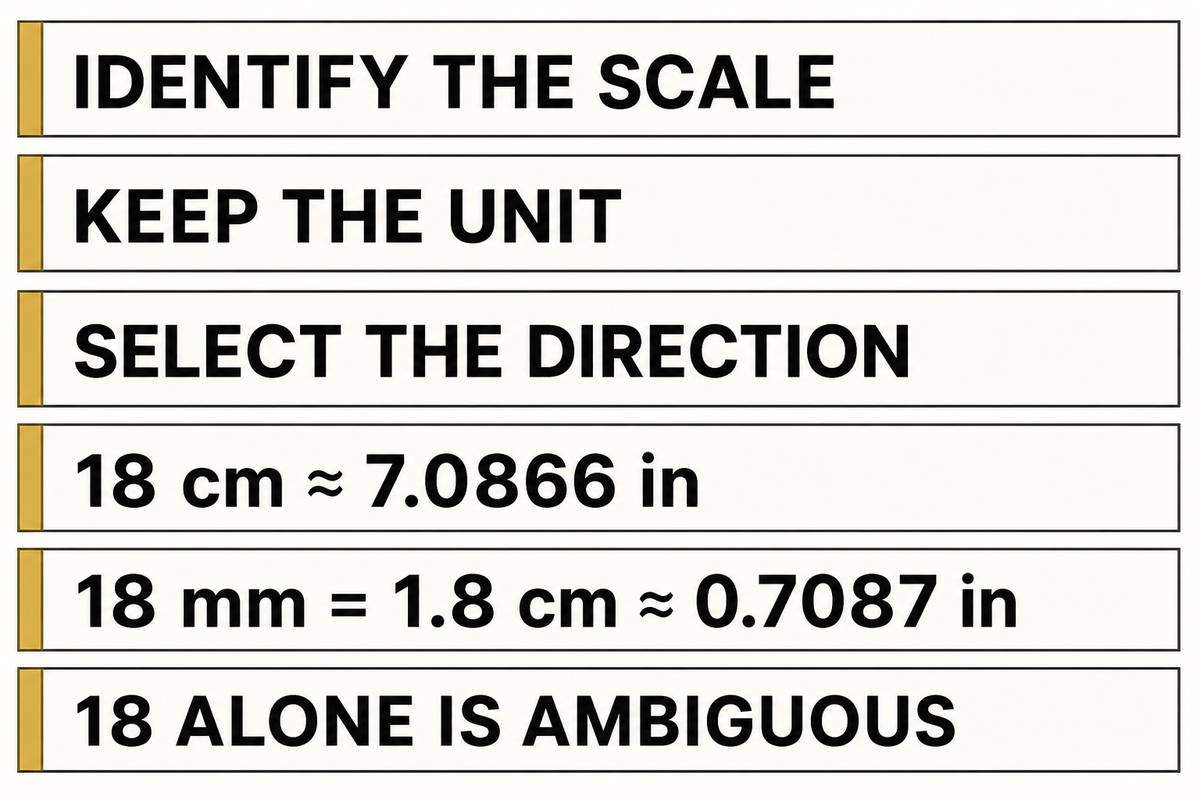
Prior to converting a length, you must read the scale, starting mark and original unit. Centimeter and millimeter numbers can look similar when copied without labels, but 18 cm and 18 mm differ tenfold. A conversion formula can’t identify that transcription error or correct a ruler that was printed at the incorrect scale.
The Open University’s metric-measurement lesson demonstrates the importance of keeping the ruler straight and aligning the object with the zero mark. The edge may actually be located at or before the zero mark. When dealing with a dual-scale ruler, you need to identify which marks are part of the metric system before you write down a value.
The check for scale, unit and direction is a reading check for three elements: identify the marks, write down the unit and pick the conversion direction.
Start with a filled example: a note says 18 cm. The equivalent is approximately 7.0866 in. A different note saying 18 mm means 1.8 cm, approximately 0.7087 in. The digits 18 alone can’t tell you which length was intended.
| What you encounter | What it means | Next action |
|---|---|---|
| 18 with no unit | Original scale is unknown | Recover the label before converting |
| 18 cm | A centimeter value | Divide by 2.54 |
| 18 mm | 1.8 cm, not 18 cm | Convert the unit before using a cm input |
| Ruler edge before zero | Edge and origin differ | Align with the zero mark |
| Two scales on one ruler | Metric and inch markings coexist | Identify the scale being read |
| A resized ruler image | Physical scale is unverified | Use a suitable physical measuring tool |
| 1,500 typed in the input | Comma is unsupported | Enter 1500 if that was the intended number |
| 1 3/16 typed in the input | Mixed fraction is unsupported | Enter 1.1875 and select inches |
| Blank output shown as a dash | No valid calculation is available | Check the entry and selected units |
| Hand width entered as hand length | Different dimensions are being compared | Confirm the requested measurement |
NIST announced updated teaching resources on July 7, 2025. Its SP 376 ruler and SP 365 conversion card identify Edition 2024. Those publication dates don’t revise the inch definition. SP 365 also warns that its web images are for digital viewing, not printed scaled measurement.
A basic reading check helps locate obvious unit and starting point mistakes; however, this is neither a calibration nor a complete uncertainty assessment. An entry of 18 cm can be arithmetically correct even if the original measurement was poorly done. Before using converted digits to settle a dispute on a dimension, double check the actual measurement.
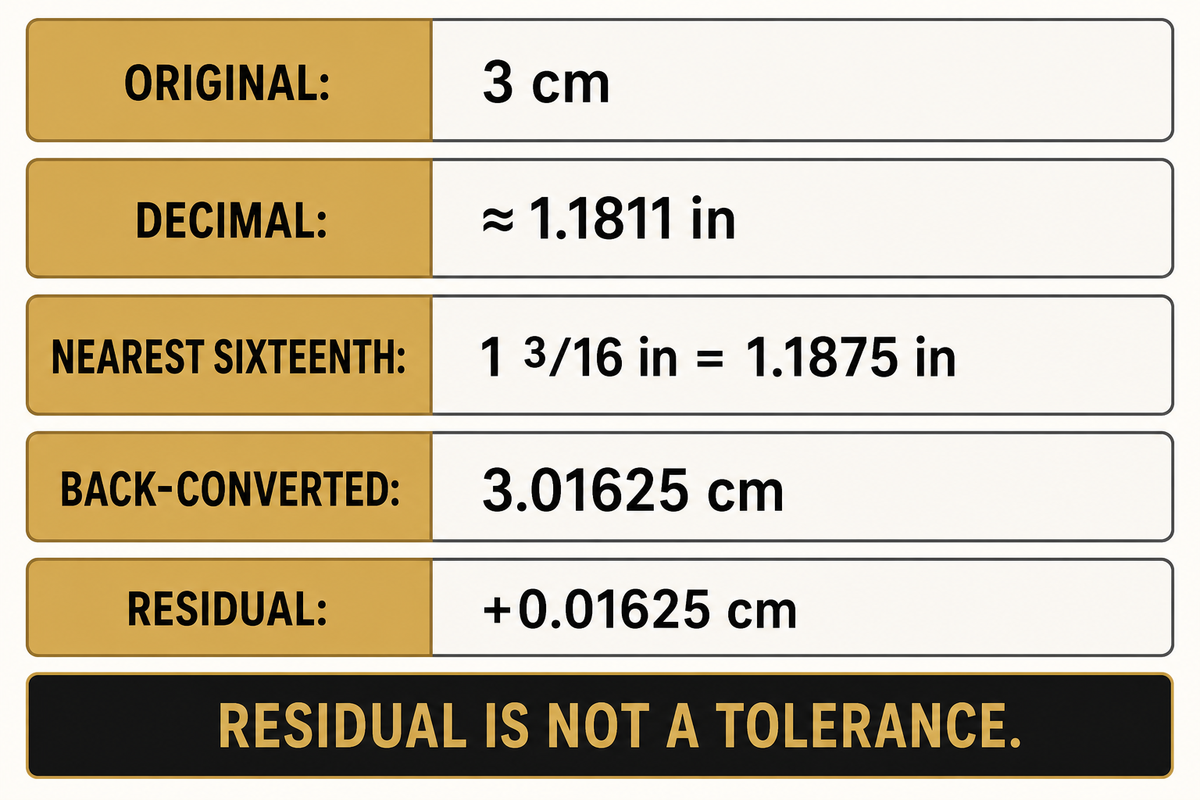
Decimal inches and fractional inches denote the same unit but are represented in different formats. A ruler marked in sixteenths of an inch provides a limited number of positions, so it’s possible that a centimeter conversion may fall between the divisions. Selecting the nearest division rounds the length again; it doesn’t establish an acceptable manufacturing or measuring tolerance.
For 3 cm, divide by 2.54 to obtain approximately 1.1811 in. To find the nearest sixteenth, multiply the unrounded inch result by 16 and round to the nearest whole numerator: 19. Divide that numerator by 16 to get 19/16 in, written as 1 3/16 in.
| Representation | Value | Meaning |
|---|---|---|
| Original value | 3 cm | Starting quantity |
| Decimal display | Approximately 1.1811 in | Four-place rounding |
| Nearest sixteenth | 1 3/16 in = 1.1875 in | Nearest ruler mark |
| Mark converted back | 3.01625 cm | 0.01625 cm above the original value |
“The number of digits displayed does not indicate the resolution of the instrument.”
The 0.01625 cm difference is a rounding residual, not a permitted error. If a receiving specification requires decimal inches, send the decimal result rather than a nearby ruler fraction. NIST’s SP 811 rounding guidance can’t supply a product tolerance that the specification itself doesn’t state.
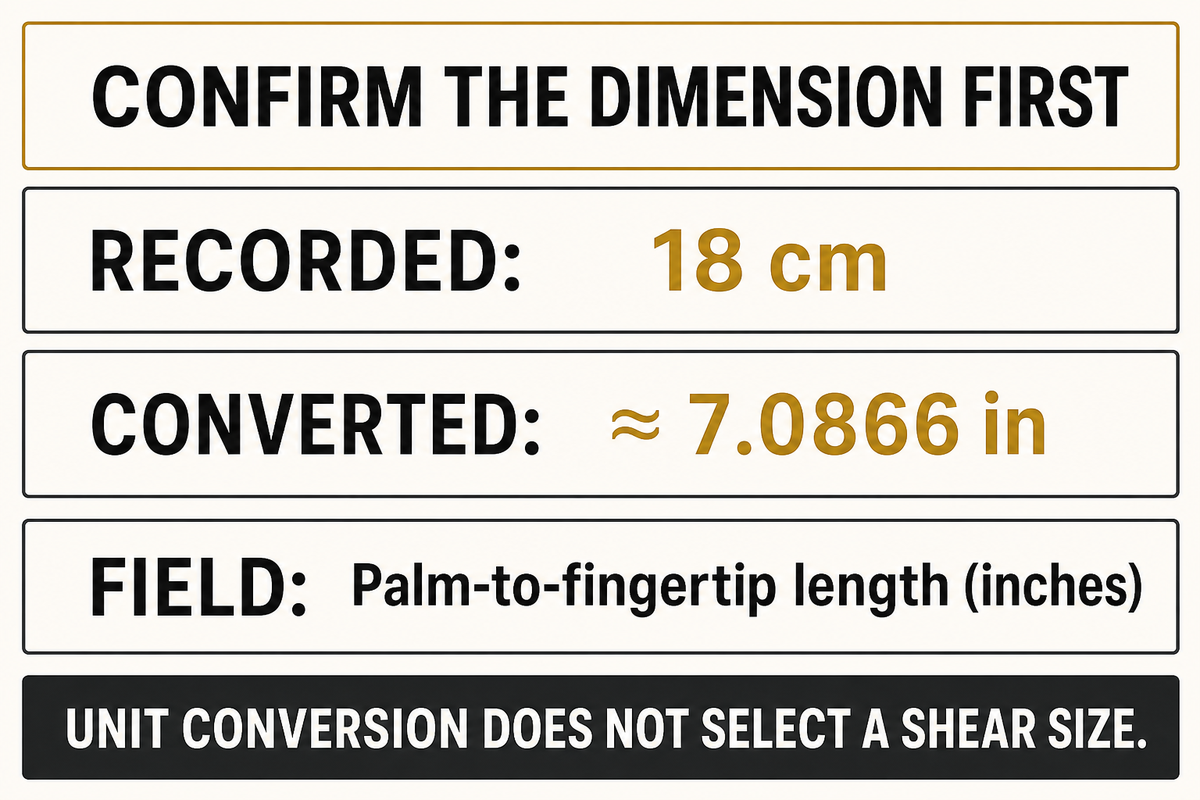
Convert a hand measurement only after confirming which dimension the receiving form requests. MATSUOPRO’s shear size finder currently labels its input “Palm-to-fingertip length (inches).” A centimeter-to-inch calculation changes the unit of that measurement. It can’t determine the correct anatomical landmarks, cutting technique or shear size on its own.
The palm-to-fingertip input in the size finder is first-party evidence of that label. Its wording, as shown, doesn’t specify where the palm begins or ends, which fingertip is used or the position of the hand. Confirm these details if they’re uncertain, as it isn’t appropriate to use thumb length, the hand width, or guess at an appropriate shear size.
Measurement definitions matter separately from unit arithmetic. The overview of ISO 7250-1:2017 covers body-measurement definitions and anatomical landmarks. That overview does not establish if the client tool conforms to the standard, and this article will not describe a standardized hand measurement process.
Suppose the requested dimension has been confirmed and the recorded value is 18 cm. Its numerical equivalent is approximately 7.0866 in. Enter the converted value according to the form’s accepted precision, retain “18 cm” in your notes and use the result for the requested field only. It isn’t a recommendation to buy 7-inch shears.
When shopping and comparing catalogs, seller location (i.e. Europe, United States, Canada or Japan) or country labels become less important compared to measurement units. In imperial and U.S. customary systems of measurement, inches are units of length. Centimeters and millimeters are metric units of length. Once you confirm the measurement unit, check whether the listed number describes length, width or height before comparing products.
When the input has been confirmed, use the professional hair cutting scissors guide to aid the broader selection discussion. The converter answers the unit question; handle geometry, technique and suitability call for their own assessment.
These frequently asked questions compare common centimeter values with familiar inch lengths. All numerical answers use the same exact factor, 2.54 cm per inch. Approximation signs and words identify rounded results. Where a rough comparison could affect a purchase or recorded measurement, retain the original value instead of substituting a convenient integer.
Divide the centimeter value by 2.54 to obtain inches. For example, 20 cm is approximately 7.8740 in. Select the original unit before entering the number, and keep the centimeter value in your notes when you transfer the answer. The calculation changes measurement units; it can’t establish what was measured or which endpoints were used.
No. Four centimeters is approximately 1.5748 inches, while one inch equals exactly 2.54 cm. The two lengths differ by 1.46 cm. A rough visual comparison can hide that difference, especially on a resized screen image. Use a suitable physical ruler to measure an object and the exact factor to convert its recorded numerical length.
Ten centimeters is approximately 3.9370 inches, and four inches equals 10.16 cm. Each pair of centimeter and inch values describes one length, but 10 cm and 4 in aren’t exactly equal. The difference is 0.16 cm. Whether that difference matters depends on the intended use and any stated measurement or product requirements, not on the converter.
Yes. Three centimeters is approximately 1.1811 inches. Because one inch equals 2.54 cm, a 3 cm length exceeds one inch by 0.46 cm.
Dividing by 2.5 gives an estimate that’s 1.6% higher than dividing by 2.54. For 20 cm, the shortcut gives 8 in instead of approximately 7.8740 in. The comparison follows from (2.54 ÷ 2.5 − 1) × 100. Use the exact factor for recorded conversions, and decide separately whether any rounding is acceptable. The shortcut doesn’t validate measurement quality, product tolerance or physical fit.
When you compare a measurement with its converted value, keep your original measurement next to it for hair-cutting shears. If the measurement isn’t clear, send the measurement details to MATSUOPRO before you use the number to finalize the configuration.
Source scope: Conversion definitions and measurement instructions come from the sources listed below. Worked calculations were derived from the exact factor. MATSUOPRO’s finder label is first-party interface information, not independent evidence of fit. No product test, anatomical measurement study or tolerance certification was performed for this guide.
MATSUOPRO is the Mackay Hair Scissors manufacturing brand for professional hairdressing shears, barber scissors, thinning shears, and pet-grooming scissors. We support salons, distributors, academies, grooming brands, and private-label buyers that need factory-direct production with practical material guidance.
Our buying guides are written to help purchasers compare steel grades, handle styles, blade geometry, surface finishes, logo options, packaging, MOQ, and sample validation before placing an OEM or wholesale order. The goal is to make each scissors specification easier to discuss with a real production team.
Factory-direct supply since 2014, with product lines covering professional cutting shears, barber shears, thinning scissors, texturizing scissors, left-handed models, and pet grooming scissors for international B2B customers.
We focus on Japanese 440C, VG10, and ATS-314 steel choices, convex and bevel edge geometry, ergonomic handle balance, tension systems, logo engraving, private-label packaging, and sample-based OEM confirmation.