Get in Touch with Mackayhairscissors Company
We use submitted details to respond to your quote request. Read our Privacy Policy.

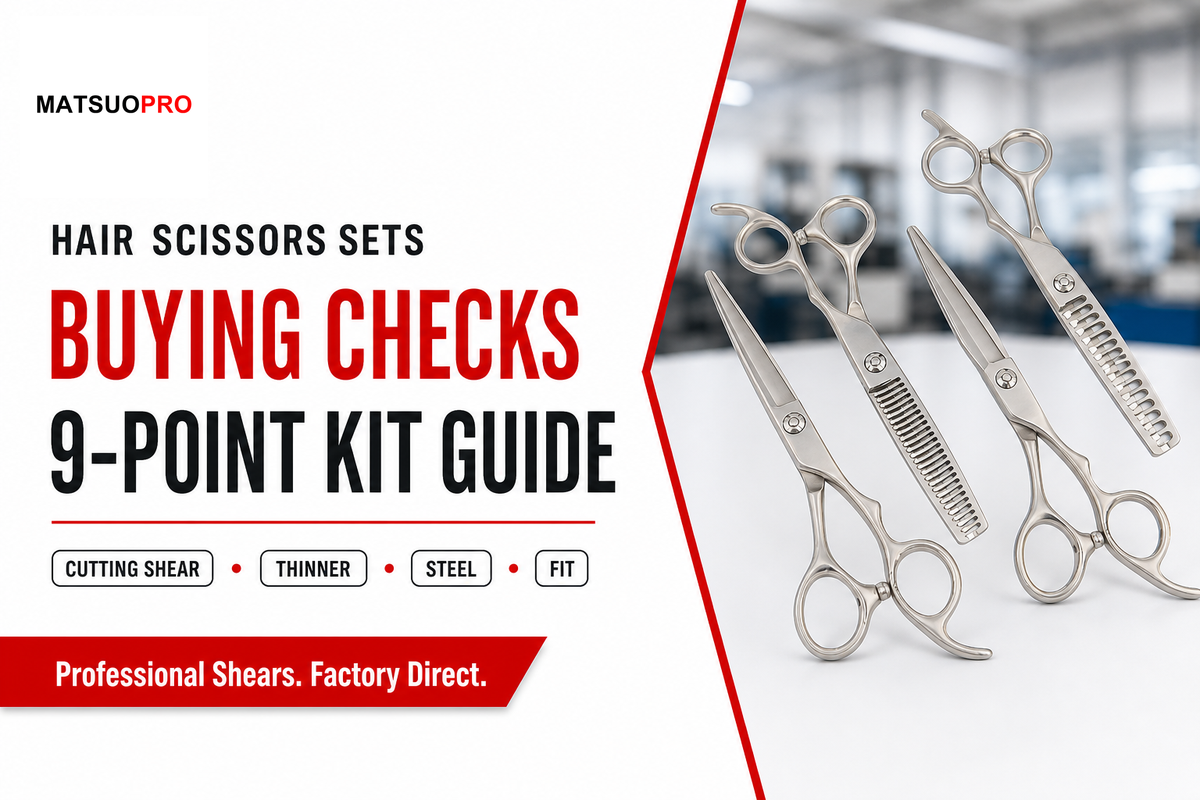
Hair Scissors Sets & Kits are matched groups of professional shears built around a main cutting shear and one or more support tools, not just accessory bundles. The next cut should feel more manageable after a hair scissors set, but that means a buyer must think about what they should be evaluating in a shears kit. “How many pieces are in the set?” isn’t the question. “What does each shear specialize in cutting, and will each tool stay put at its station?” is better.
Hairdressers, barbers, salon owners, dealers and private label purchasers can benefit from a practical method to pre-select a set before opening product pages. This discussion cover the main cutting shear, the second shear, steel proof, handle fit, and other indicators of packaging over function.
Mackay hair scissors also has a separate commercial site page if a purchaser already understands the structure for a given set they desire. This article doesn’t duplicate this page since it remains focused on the selection approach.
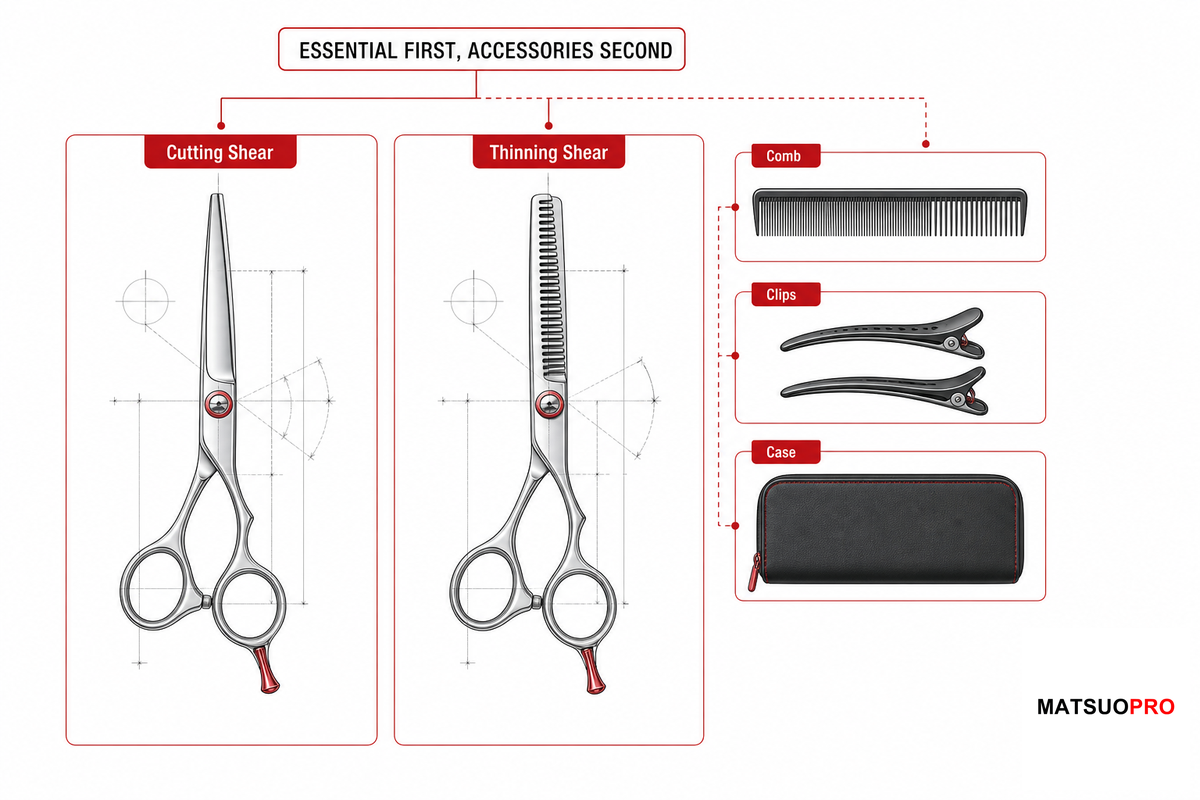
Professional hair scissor kits typically contain two shears: one pair of scissors for cutting and one pair of thinning shears or texturizing hair thinning scissors. An advanced set may include a second shear for some specialized cutting technique, a razor, one comb or two, oil, a cleaning cloth, clips, a tension key, or a case. Add-ons are fine, but not if the essential shears are not top quality.
First, the shear is responsible for making the line, the second shear is responsible for changing the weight and texture, and the case shields them when they can be cleaned to match the job environment. No haircut can be saved if your main hair-cutting scissors feel scratchy and your thinning scissor drags and snags your hair. In addition, hairdressers have also been the subject of occupational studies that reveal frequent complaints about neck and arm and wrist pain in the profession; consequently tool fit is a factor that can’t be treated as a comfort perk when you’re in the buying stage.
Before price enters the discussion, a set that’s a cut above the average will answer three questions: What cut does the main shear deal with?
What cutting or thinning task does the secondary shear deal with?
Can they both be adjusted, cleaned and sharpened with a reasonable degree of ease?
Search results for hair scissors sets often mix professional hair shears with consumer bundle language. Treat the phrases below as sorting signals, then return to steel proof, tension, fit, and service support before making a purchase.
| Marketplace phrase | What it usually signals | Buyer check |
|---|---|---|
| 10 pcs, 13 pcs hair cutting scissors, pcs hair cutting scissors, pcs professional kit | Piece count is being sold before the shear function. | Confirm the cutting shear and thinner are worth using without counting clips, cape, or oil. |
| hair cutting scissors kit, hair cutting kit, haircut kit, haircut scissors kit with cutting comb | The listing may group real tools and accessories into one package. | Separate the main blade, the second shear, and the maintenance items before comparing price. |
| hair cutting scissors shears kits, hair cutting scissors thinning shears, cutting shears set | The seller is describing the set around blade categories. | Ask whether each blade has a defined cutting, thinning, blending, or texturizing job. |
| hair thinning scissors, hair thinning shears, professional hair thinning scissors | The second tool is meant to change weight and texture. | Check tooth count, bite, tension, and whether the thinner leaves visible lines. |
| professional stainless steel, professional stainless steel hair scissors, quality hair cutting tools | Material wording is being used as a trust signal. | Request steel grade, HRC range, heat-treatment proof, and edge type, not only the stainless label. |
| excellent edges, smooth cuts, sharp barber scissors, hair cutting scissors professional | Sharpness claims are being made without proof. | Look for convex or bevel edge details, hand finishing, service policy, and test-cut feedback. |
| matte black, accessories in leather case, salon and home use, shears for home, personal care | Finish, case, or lifestyle language is carrying the offer. | Check whether the case can be cleaned and whether the set still fits a working salon station. |
| hairdressing shears, hairdressing shears set, scissors hairdressing, kit for salon | The phrase points toward a salon or school-use bundle. | Match the set to role, school list, station layout, and sharpening support. |
| professional barber, barber salon, salon barber, hairdressers and barbers | The bundle is trying to serve more than one role. | Check whether the barber blade length and salon texturizing needs can both be served by one set. |
| 6.5 inch professional hair scissors, 7 inch hair shears, shears set for men, men women, women men | Length and audience tags may be replacing a real fit claim. | Use hand fit, thumb angle, and station use case instead of gendered search wording. |
| FCYSY professional, Yasaka and Jaguar | Brand-comparison searches can surface very different steel, handle, and price families. | Compare proof and service route, not brand name alone. |
Factory note: treat every 2-piece or 3-piece kit as a tension and service risk first, because the wrong pair can pass a product photo and still fail the station use case. Mackay’s factory process includes CNC cutting, heat treatment, hand finishing, and piece-by-piece inspection, but the buyer still needs to test the station application before ordering.
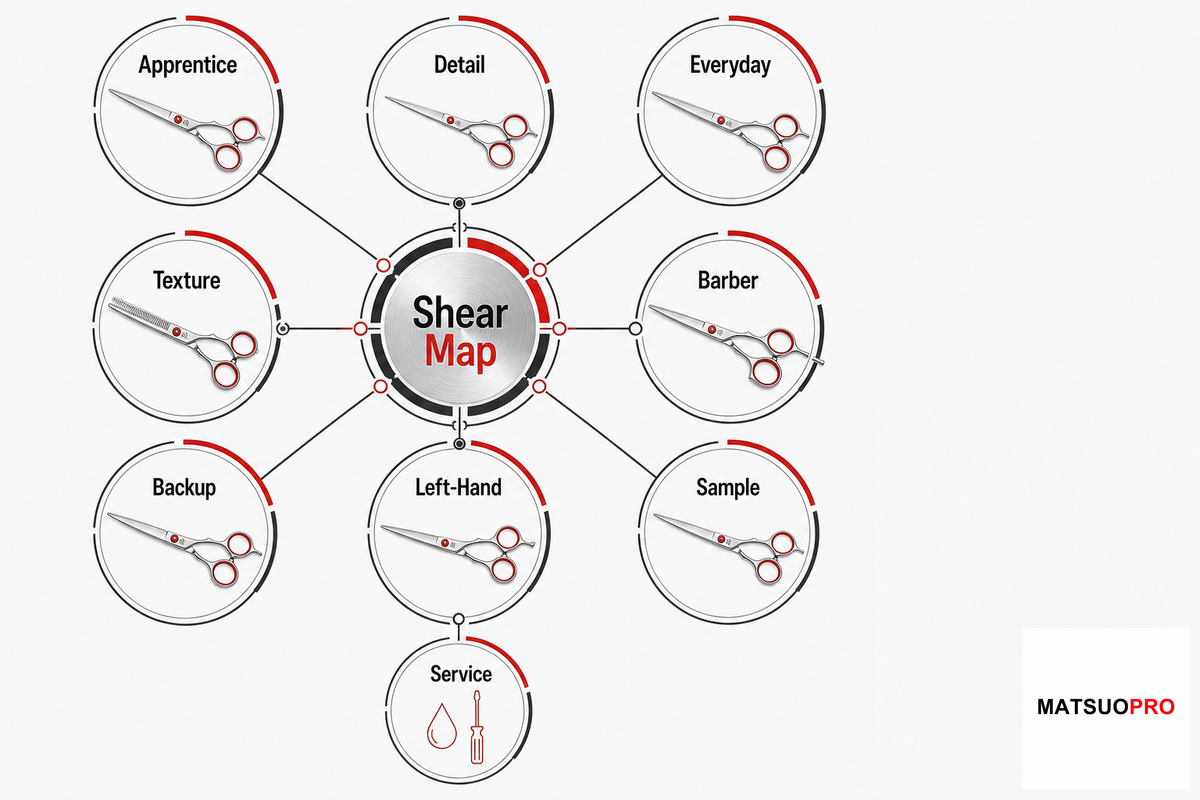
The 9-Station Shear Map is a rough guardrail against buying by piece count. Start at the station, and apply the minimal amount of shears needed to do real work. An apprentice station, an over-busy salon chair, a barber station and a private label sampling line need different hair shears sets.
Another frequently ignored issue with buying a new shear from American Salon is proper fit. Four pieces that fight the hand are far less valuable than a two-piece set that closes tightly and sits properly at the station. Use this map as your first buying tool prior to looking at manufacturers and finishes.
In practice, a 5.5 inch / 140 mm training kit and a 7.0 inch / 178 mm barber kit have different risk profiles because blade length changes the application. Mackay can support OEM sample planning from factory production rather than forcing one universal station kit.
| Work station | Core set | Why it works | What to avoid |
|---|---|---|---|
| Training mannequin station | 2-piece: 5.5 inch / 140 mm cutting shear + thinning shear | Teaches control without a crowded case | 10 pcs kits with weak blades |
| Apprentice salon chair | 2-piece: 6.0 inch / 152 mm cutting shear + 30-tooth thinning shear | Covers most basic cutting hair practice | Duplicate shears with no separate role |
| Daily hairdresser station | 3-piece: 5.5 inch / 140 mm or 6.0 inch / 152 mm cutting + thinning + texturizing | Separates blunt cutting, blending, and texture control | Three blades sharing one length and edge job |
| Texture-heavy salon station | 3-piece: 6.0 inch / 152 mm convex cutting shear + blending shear + texturizing shear | Lets the hairdresser choose removal rate more carefully | One aggressive thinning scissor for every client |
| Barber scissor-over-comb station | 2- or 3-piece with 6.5 inch / 165 mm or 7.0 inch / 178 mm barber shears | Longer blades help cover larger sections | Short shears that slow the comb work |
| Fade and beard detail station | 6.5 inch / 165 mm cutting shear + texturizing support | Gives control for detail work and softer lines | Heavy handles that tire the thumb |
| Left-handed station | True left handed 5.5 inch / 140 mm or 6.0 inch / 152 mm cutting shear + matched thinner | Lets the user see the cutting line | Right-hand blades with a cosmetic handle change |
| Salon owner replacement pool | Standardized 2-piece or 3-piece station set | Simplifies training, tension checks, and replacement stock | Random singles from different steel and handle families |
| Private-label sample line | 3- or 4-piece test set | Shows buyer tiers before inventory expands | Launching every color, size, and case before demand is proven |
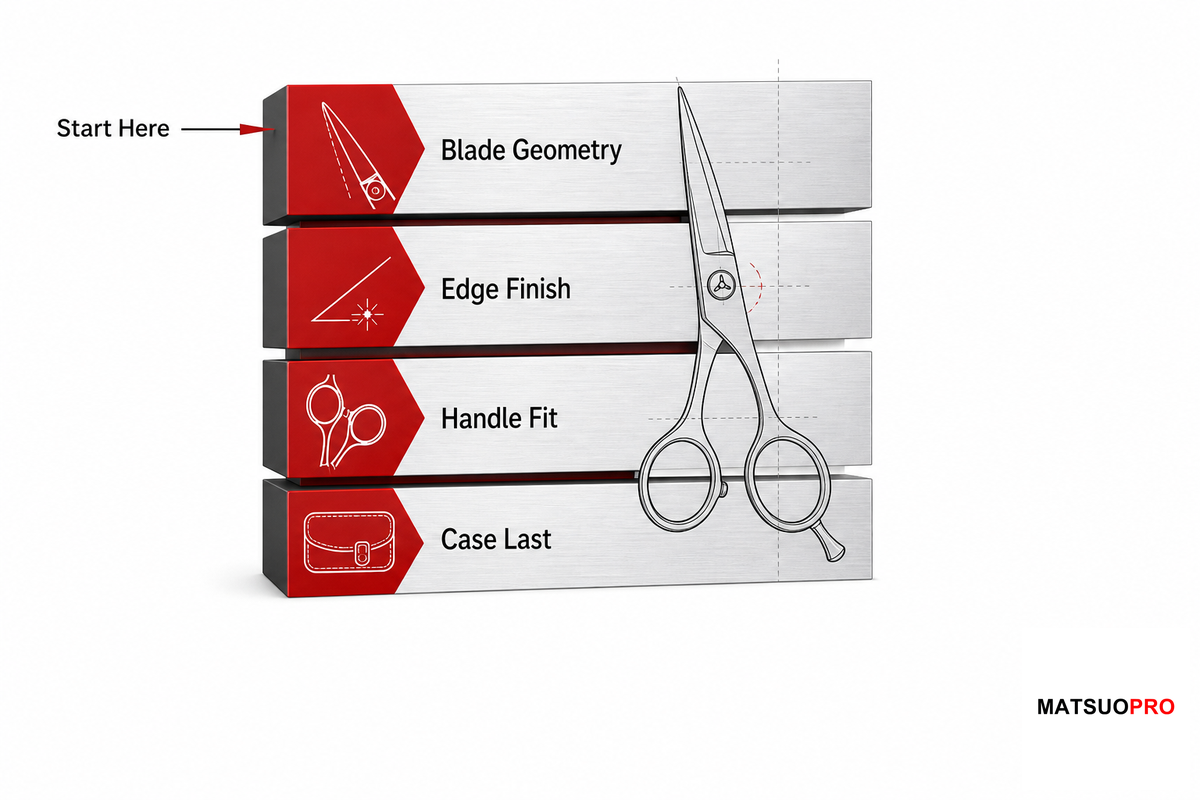
The sharp shear is the first decision. Buy it before the case, clips, cape, or accessory pack. For most stylists, 5.5 inch / 140 mm and 6.0 inch / 152 mm hair cutting scissors will provide sufficient control for detailing and everyday salon work. However, for barber scissors, scissor-over-comb, and quicker section coverage, a 6.5 inch / 165 mm or 7.0 inch / 178 mm shear makes more sense.
Edge geometry is next. Japanese convex edges have a natural slicing feel and precision control, when supported by the correct steel and hand finishing. Simple bevels may be adequate for rougher work but shouldn’t be confused with sharpness; you must inquire about edge creation, finish, and service availability.
Handle design must be a very early choice. Traditional, offset, crane, swivel, and left-handed handles significantly impact your hand and wrist positioning. Design history of hairdressing scissors, with patent records for features like a swiveling thumb grip, highlights this engineering reality over the decades.
In practice, the cutting shear is an OEM sample risk because a 5.5 inch / 140 mm salon blade and a 7.0 inch / 178 mm barber blade serve different applications. Mackay’s factory process uses CNC cutting, heat treatment, grinding, and precision hand finishing, so the sample should be checked against the production feel before a batch order.
If your main shear fails these basic tests, quit. It doesn’t matter what else the set include; a flimsy blade won’t become a workhorse.
Explore the texturizing shears for related options.
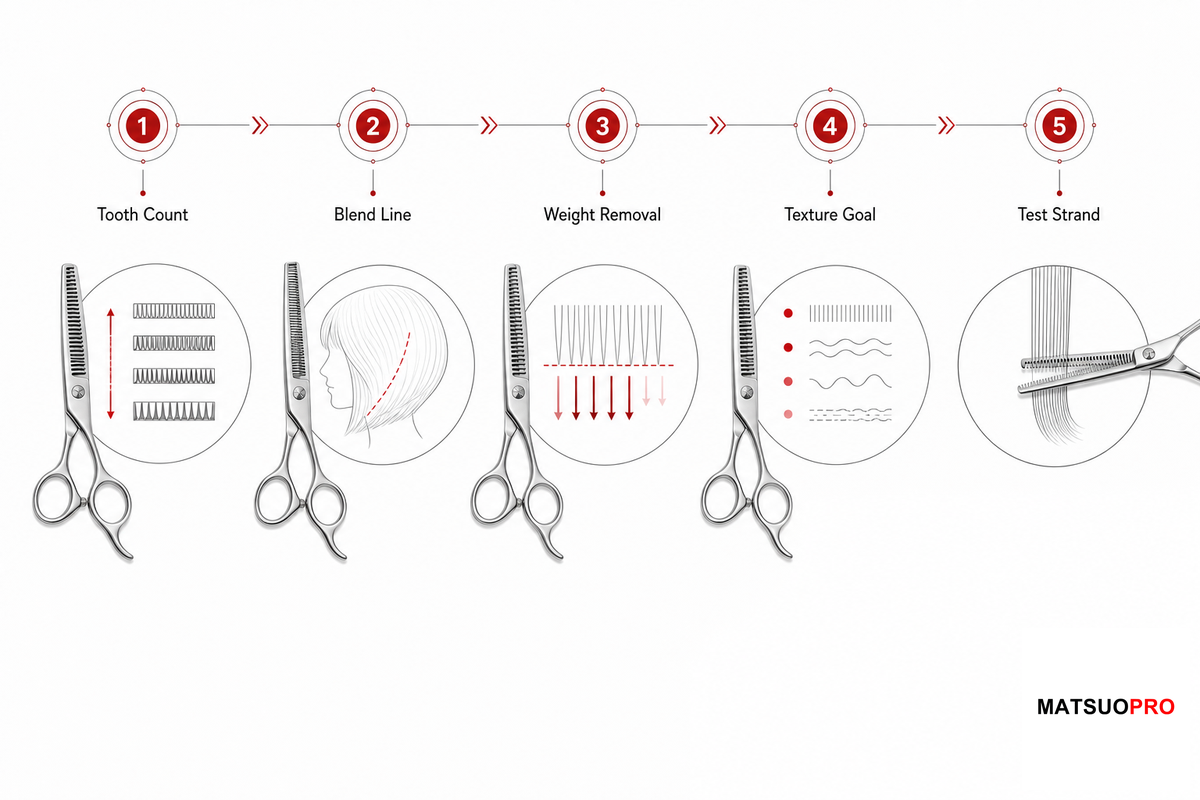
The second shear often decides whether a kit works because it controls weight, release, and texture after the main line is cut. Many buyers still evaluate the main shear as the primary concern and the second as an add-on. That is where many sets underperform. Poor thinning hair scissors grab, leave lines, remove too much volume, or create thinness that the primary hair scissors was meant to balance.
Thinning hair scissors and texturizing hair scissors are distinct tools. Thinning hair scissors remove weight evenly; texturizing hair scissors alter the haircut’s shape and movement. Consider the number of teeth, tooth angle, blade tension, and bite-an over-aggressive set of thinning hair scissors can jeopardize the overall shears kit.
There’s a consensus among stylists that excessive thinning can lead to unnatural layering and a sparse finish. Online forum conversations frequently cite visible lines from poorly chosen or poorly handled thinning hair scissors; heed this as a warning sign.
In practice, a 30-tooth thinner and a texturizing shear create different application risks because bite and tooth count change the result. A Mackay factory sample lets buyers test tension, CNC grinding consistency, and production feel before a volume order.
For a more detailed perspective on hair scissors and relative depths, Mackay’s 40-tooth guide on blending hair scissors breaks down the significance of tooth count and blending characteristics.
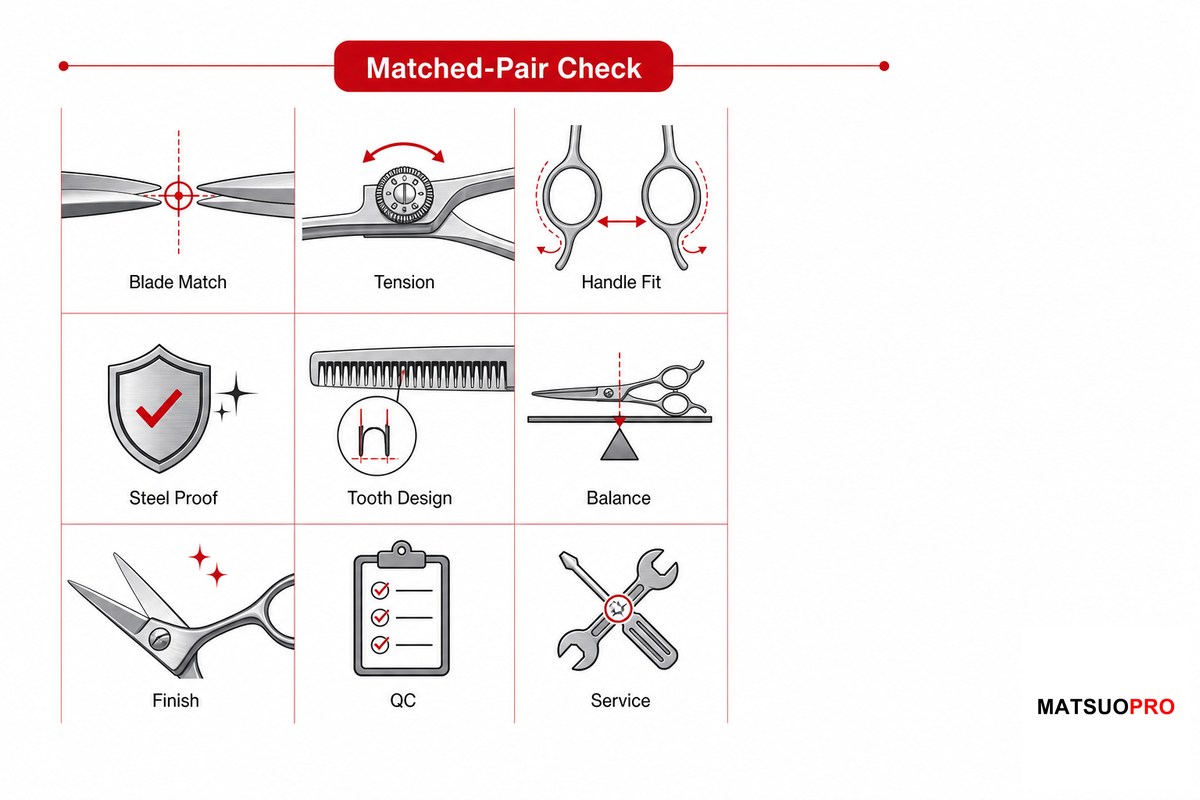
The 9-Point Matched-Pair Failure Check provides a structured evaluation of any hairdressing hair scissors set, a more precise yet faster alternative to counting items and more proactive than dealing with buyer’s remorse on a bulk purchase.
| Check | Pass signal | Failure signal |
|---|---|---|
| Tension | Both shears close smoothly after adjustment | Blade drift, clicking, or uneven closing pressure |
| Main edge | Clean push cut and smooth slide where the edge type allows it | Dragging, folding hair, or rough last third of the blade |
| Thinning teeth | Hair releases without snagging | Pulling, grabbing, or visible tracks |
| Role separation | Each shear has a clear job | Several pieces repeat one role |
| Steel proof | Steel grade and hardness evidence are available | Only vague “premium steel” wording |
| Handle fit | Thumb sits relaxed and wrist stays neutral | Forced thumb angle or cramped rings |
| Service path | Seller can explain sharpening and tension service | No service advice after purchase |
| Accessory value | Case, oil, cloth, comb, and tension key support care; case or pouch can be disinfected where salon rules require it | Accessories hide weak working shears, or the pouch cannot be disinfected after cleaned tools are stored |
| Batch consistency | Sample pair matches production feel | First sample and batch feel unrelated |
For proof steel, bear in mind what a hardness test can-and cannot-say. ASTM E18-25 “Standard Test Methods for Rockwell Hardness of Metallic Materials” allows that “Hardness data may be useful in material selection, quality control and as an index of the hardening achieved… however, test at one location of a piece may not be indicative of the overall piece.” You can view the E18-25 on ASTM’s site for $104. That’s a handy caution for hair cutting shears: Rockwell C data can inform you, but not dictate it, because edge geometry, heat treatment, grinding, and hand tension still hold weight.
Storage is part of inspection, too. California’s cosmetology laws stipulate that disinfected instruments shall not be placed into a container, pouch, or holder that can’t be disinfected.
Not every case presents unsafe storage, but it does suggest a hair scissors kit case should be evaluated as care gear, rather than solely as a photo prop.
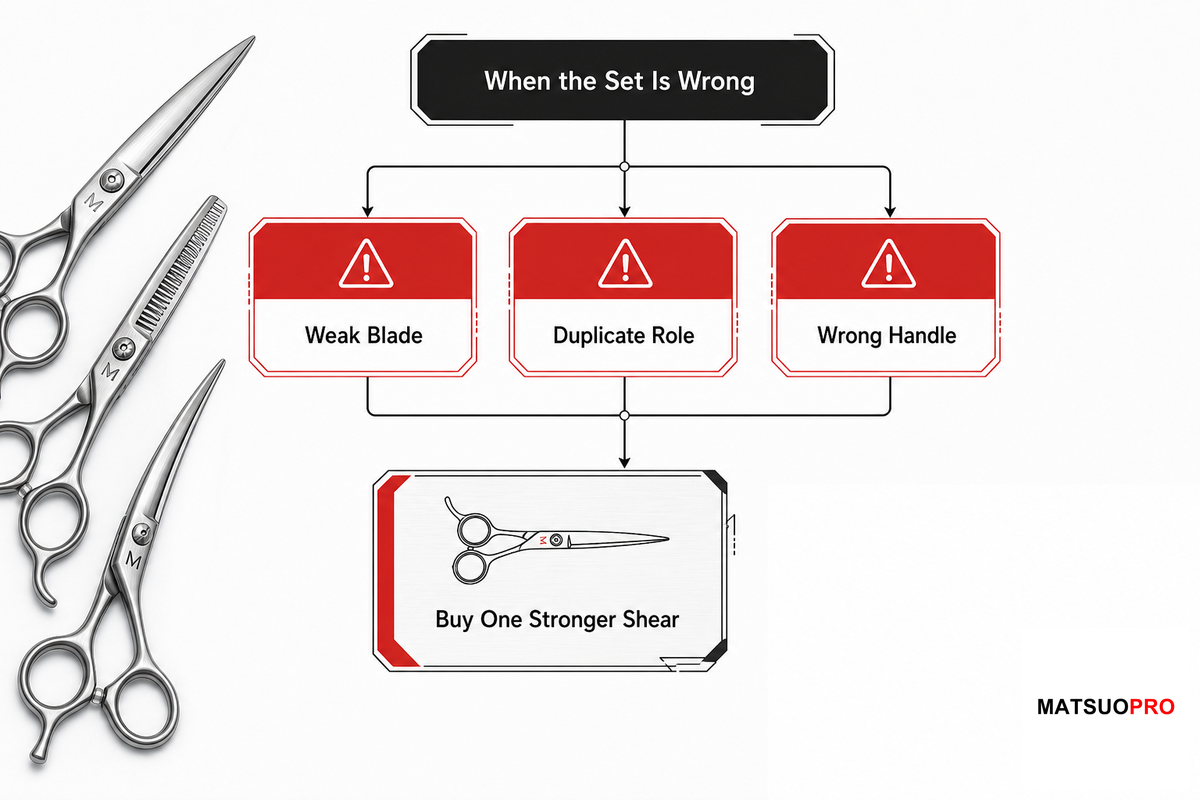
A hair scissors set is the wrong purchase when the bundle hides weak blades, duplicates the same function, or solves a problem better handled by one stronger shear. This section deliberately plays contrary to a sales page to guard against the kit trap of feeling safe with more pieces, when fewer, higher quality shears do better.
Don’t purchase a set if a better single cutting shear immediately solves your need.
Don’t buy it if your second shear lacks an obvious purpose. Don’t buy it if the seller emphasizes piece count while remaining unable to speak to the steel type, heat treatment, edge, tension, or sharpening support. Thirteen pieces of hair cutting scissors look like plenty on a product shot, but a poor cutting shear and a rough thinning shear don’t a good kit make.
Pause again if the kit case, pouch, or holder is unsuitable for your state or school’s sanitation standards. Even a case that looks premium in a product listing may actually weaken your kit if it can’t be disinfected yet you’re using it to hold disinfected shears.
There’s one exception: compliance training. If your school or state training program specifies an exact list of shears for student kits, follow that guide.
Cornell’s Legal Information Institute’s page for Tennessee’s student kit regulations, for example, says that after 200 hours, a student in cosmetology program must possess a kit including a razor and a set of a cutting shear and a thinning shear.
Price can trick in two directions.
Cheap kits often sacrifice quality steel for a wealth of accessories, whereas very expensive hair scissors can fail to suit the individual user. Treating “expensive isn’t always better” as advice rather than an actual selling point reinforces testing fit and function before price.
For a private label brand, the main purchase pitfall is expanding too quickly, or into too many materials. One simple three-piece test set can teach you far more than an entire display of different types. Prioritize the buyer’s need and feedback, and only then add varieties of steel, handle designs, finishes, and packaging.
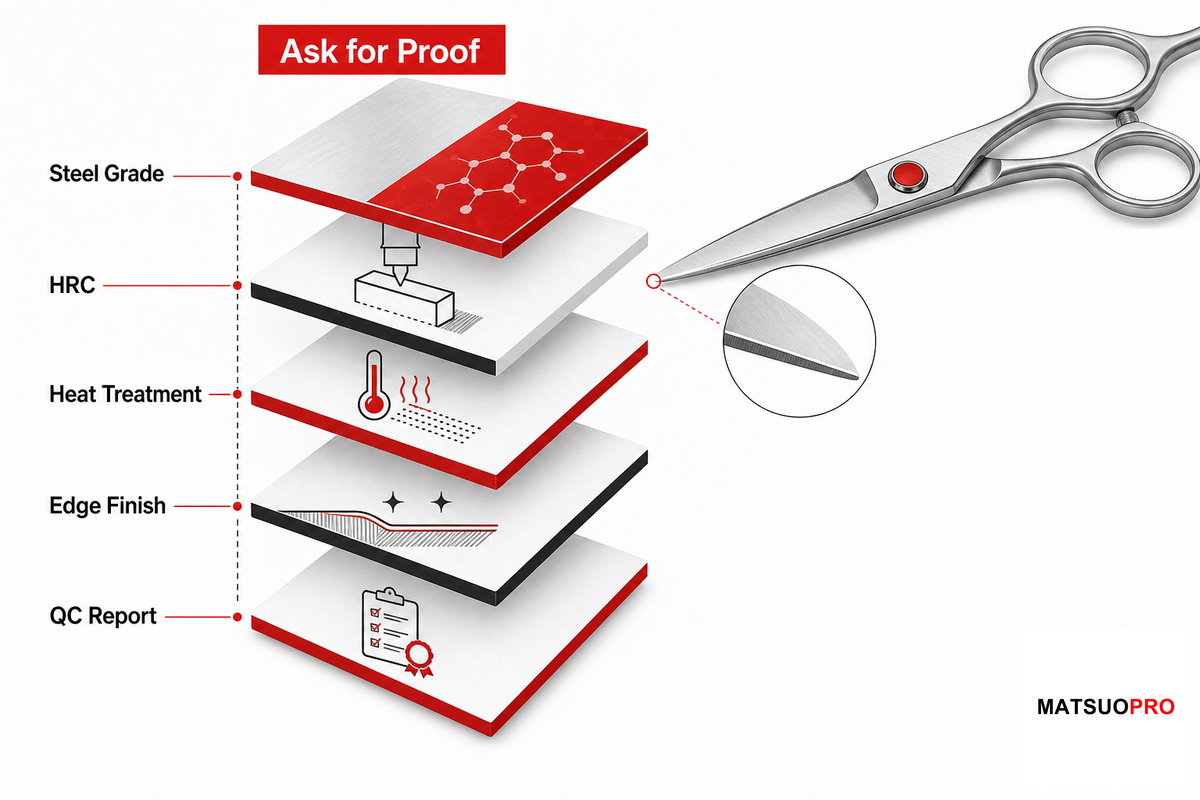
Steel is worth checking, but it’s a minor component of your total evidence trail. Japanese steels used by Mackay, include 440C, VG10, ATS-314, and cobalt alloys. In Japan, the ATS-314 plate comes from the Hitachi Group, Mackay states that for its premium lines, it undergoes vacuum heat-treatment and cryogenics at 60-62 HRC, while the cobalt flagships hit up to 64 HRC.
Higher numbers should be taken in stride. High HRC levels contribute to edge life, but the equation doesn’t substitute for edge geometry, heat-treatment control, or sharpening skills. You could still have an inferior working day if you use a brittle blade or poor grinding or if your tension is rough. Ask for third-party hardness reports or material data before purchasing any salon group products, for your distributor or an OEM purchase.
Likewise, cobalt alloy should be thought of as a performance option rather than a universal improvement. In a 2023 Springer review on occupational allergy in hairdressers, the authors report that some tools like scissors, clips and tweezers can release nickel and cobalt. If your salons follow policies around contact sensitivity to metals, contact the manufacturer for material specifications and surface-finish recommendations before implementing a cobalt product line.
With 80 plus steps, Mackay’s premium option includes cutting with a CNC, hand sharpening using Japanese convex edge, mirroring and hand-tensioning, along with 100% quality control on every piece. Production space at their factory is more than 2,000 sq meters, with over 100 employees. This all go toward saying that it’s about more than just material that makes up a professional Japanese stainless steel shear hair set.
For additional details on the materials involved, view Mackay’s 440C vs VG10 guide, as well as the HRC hardness guide.
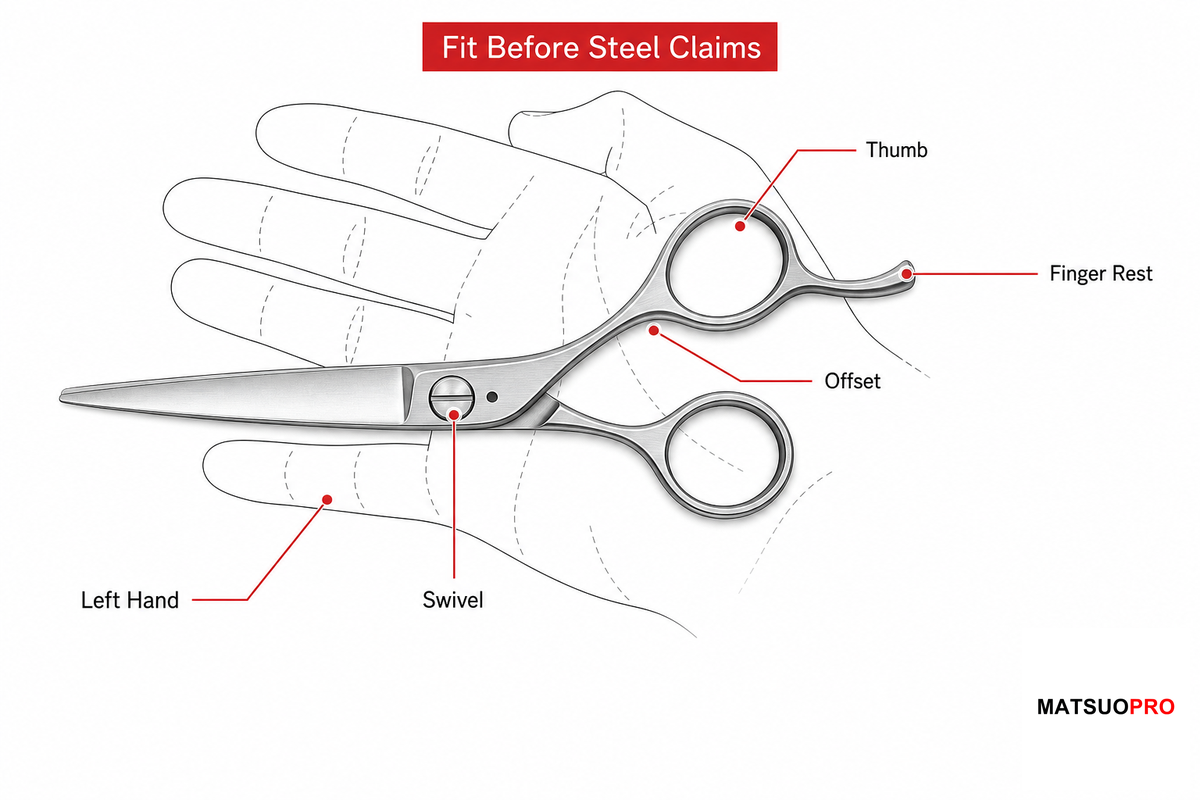
The fitting of many hair shears kit has proven weak spot in comparison tests done on the web. However, they can also cause discomfort even if you use great steel because your handle may work against your hand. Before buying, make an attempt to grip the shear being used for cutting comfortably in an unstressed state. There should be no forced raising of the thumb, nor pressure on the finger area that confines the hand to a particular position for more than a few minutes.
Test the closing strength of your shear next. Close the shear with gradual motion. It will be clear when the blades connect because the movement will stop abruptly near the ends. Apply this technique to your thinning shears, as more effort may be needed even if your cutting shears feel OK.
Ergonomic principles around scissors have received greater scrutiny in ergonomic research; therefore, test results are only current to their publish date. Research conducted some years ago and published as an abstract in ScienceDirect shows less wrist bending from ETD scissors compared with traditional ones, but only as historical information rather than a standard today. OSHA’s current workplace guidance for scissors, wrist movement, and finger stress is more useful as a buying guide; nevertheless, understand it as design context rather than a guarantee against pain.
The best hair cutting style result comes from precision cutting with an ergonomic handle and an ergonomic design the user can repeat under real chair pressure.
In practice, test a 5.5 inch / 140 mm sample and a 6.0 inch / 152 mm sample because wrist angle, ring pressure, and tension change by user. Mackay’s factory process gives salon and OEM buyers a production reference before they lock an application into a larger order.
If you’re a left handed user, more care is needed. Left handed shears cannot just be right handed tools with the handle on the wrong side. Real left hand hair cutting scissors have blade orientation that lets you clearly see the cutting line. Mackay provides a distinct page for left hand options: left hand hair cutting shears.
American Salon’s size guidance, and the PMC’s occupational resources suggest a very basic, and sensible premise: the tool must fit the craftsman, not the other way around. Those arguments that support ergonomics and finger ring size should also apply to handle shape, blade length and the tension in Japanese steel or sharpening angle.
Explore the bulk wholesale program for related options.
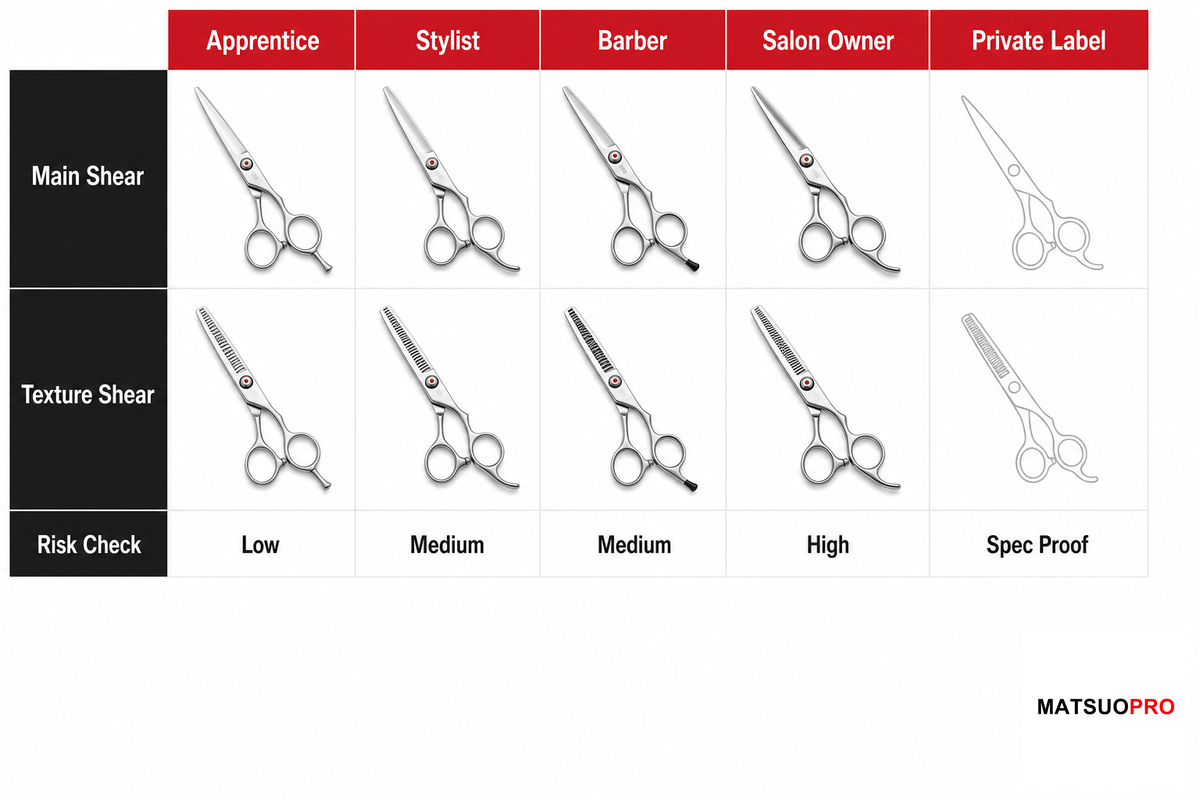
But those buyers also have varied risk profiles depending on how deep set is for your market. In fact, the U.S. Bureau of Labor Statistics not only separates barbers, hairstylists, and cosmetologists by role, but also identifies salon operators as performing clerical and inventory functions.
That suggests a role-first buying process, because a working stylist, salon owner, and product-line buyer carry different risk profiles.
An apprentice generally require a reduced range of tools – unless specified on a school’s required tool list – which consists of a cutting shear, a thinning shear, and a pouch or case; full-time stylists generally require a cutting shear, a thinning shear, and also a texturizing shear since their work shifts daily, from sharp lines, to smooth graduation to creating shape and texture.
In practice, a salon owner can treat a 2-piece station kit as a production control issue: one cutting shear, one thinner, one tension routine, and one service path. Mackay’s OEM factory model supports this because in-stock samples can start from 1 piece and custom production can start from 50 pieces.
Most pro barbers will be looking first at length of the blade. For scissor-over-comb and larger sections, 6.5 or 7.0 inch Barber shears is great for scissor-over-comb and larger sections. Salon owners have less interest in any single set of scissors and more interest in station repeatability – is the feel easy for trainees to pick up, can replacements be reordered without surprise, can each set be inspected fast?
Private label partners carry a risk of its own. It isn’t “how many SKUs” will it take to get going? It’s “What sampling line does the customer want that shows demand?” Mackay’s model facility will work well for this, because the in stock item lines begin at 1 each and the customized item line begins at 50 each. Its facility has the capability to customize steel, handle, finishes, etching and packaging when the lines begin to sell.
When you’re there, then it’s time to transition from this article to Mackay’s factory direct scissor set configuration pages. Remember: this is about the logic of the set, that other page is about Mackay’s set options.
When thinking in standard shear single-purchase mode, Mackay’s professional hair cutting shears page and OEM private-label services page provide additional context.
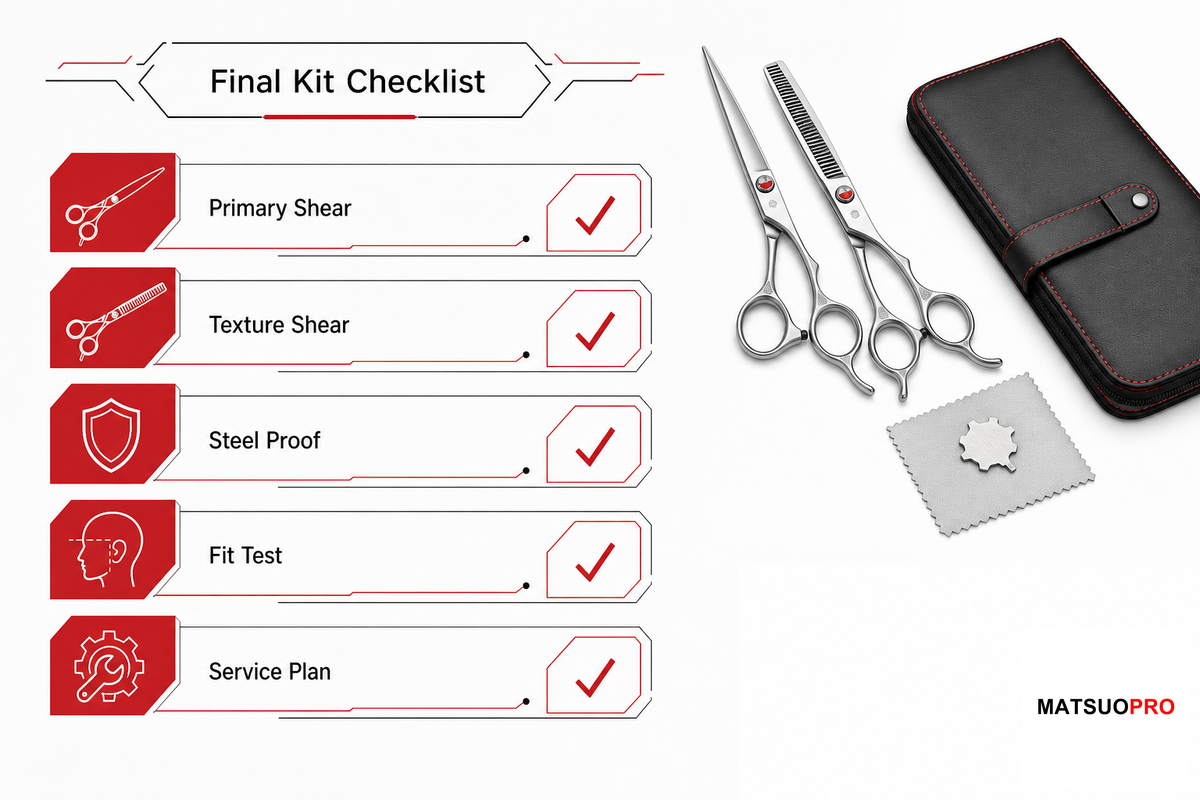
Your top hair cutting kit isn’t the biggest. It’s the smallest that does all the actual work you can verify, hold, tension, sharpen, and replace, using shears.
Most professional sets include a cutting shear and a thinning or texturizing shear, sometimes one of each, and may expand to include a specialty shear, razor, comb, case, oil, cloth, clips, or cape, but accessories aren’t primary and shouldn’t dilute focus on the blades’ steel and intended uses. Daily cutting should be facilitated, not just added to the visual clutter of a set.
A set is worth it when each shear has a discrete job at one workstation. Cutting plus thinning works for many students and barbers; adding texturizing helps salon stylists. Skip the set when the components are low-grade copies or filler accessories.
Hair scissors and hair shears usually mean the same professional cutting tool for making lines. A shears kit is the grouped set around it: the main cutting scissors create the line, while the support shear thins, blends, or texturizes hair.
A good hair scissors set should be priced against blade proof, function separation, fit, service path, and production consistency, not piece count. Cheap sets often trade steel quality for accessories, while professional sets cost more because the blades need better material, heat treatment, hand finishing, and quality control. That price check matters more for distributors and salons, because a sample that cannot be serviced, sharpened, tensioned, or reordered will cost more than the invoice suggests after the busy month.
Market estimates vary greatly; a low-end kit may cost as little as $31.99 online, with professional kits from $199, $349, $449, $498, $599, and others on the higher end.
Consider these price ranges for comparison, not as a guide to the “average” price. Before evaluating price, ensure a set has a distinct cutting shear, a practical thinning or texturizing shear, clearly specified steel grade, an edge type, evidence of hardness, a clear service or warranty path, and a vendor able to explain tension and sharpening. High price demands clarity in these details. A buyer comparing kits should record whether the price covers service access, replacement availability, tension support, and a traceable steel claim.
For beginners, a compact 2-piece set is more practical than a sprawling kit. Beginners usually do best with a reliable thinning shear and an equally comfortable cutting shear, complemented by a case and basic maintenance supplies.
Key features are smooth operation, adjustable tension, and a blade capable of being sharpened. Higher grade steel like VG10 can be considered once workload increases.
MATSUOPRO is the Mackay Hair Scissors manufacturing brand for professional hairdressing shears, barber scissors, thinning shears, and pet-grooming scissors. We support salons, distributors, academies, grooming brands, and private-label buyers that need factory-direct production with practical material guidance.
Our buying guides are written to help purchasers compare steel grades, handle styles, blade geometry, surface finishes, logo options, packaging, MOQ, and sample validation before placing an OEM or wholesale order. The goal is to make each scissors specification easier to discuss with a real production team.
Factory-direct supply since 2014, with product lines covering professional cutting shears, barber shears, thinning scissors, texturizing scissors, left-handed models, and pet grooming scissors for international B2B customers.
We focus on Japanese 440C, VG10, and ATS-314 steel choices, convex and bevel edge geometry, ergonomic handle balance, tension systems, logo engraving, private-label packaging, and sample-based OEM confirmation.