Get in Touch with Mackayhairscissors Company
We use submitted details to respond to your quote request. Read our Privacy Policy.

Buy texturizing shears straight from the factory that forges them, 440C, VG10 and Hitachi ATS-314 Japanese steel, hardened to 60–62 HRC, in tooth counts from 5 to 46. We match tooth geometry to the exact removal rate your cut needs, then hand-hone every convex edge and publish the third-party hardness report to prove it.
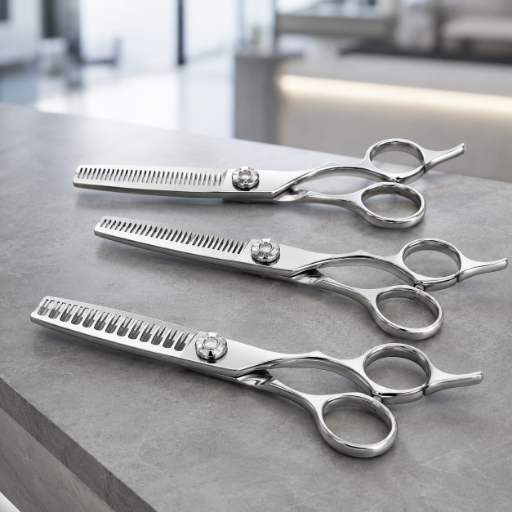
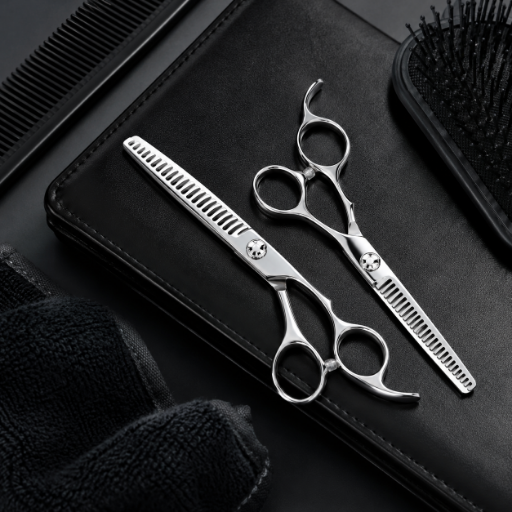
Texturizing shears are hair-cutting scissors with one straight blade and one toothed (serrated) blade that remove bulk and weight, blend hard lines between layers, and add movement, without cutting a blunt line. Tooth number and geometry decide how much hair leaves the comb on each snip.
Also sold as texturizing scissors, chunking shears or hair thinning scissors, one tool covers thinning, blending, texturizing and chunking — four removal rates on one scale, not four different tools. Choosing texturizing shears vs thinning shears comes down to that rate: wide, sparse teeth remove a lot; narrow, dense teeth release almost none.
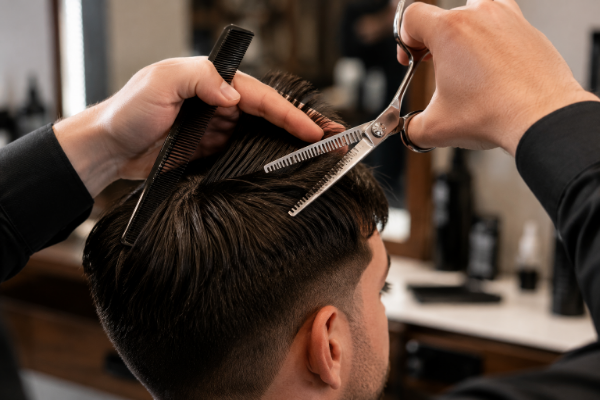
Don’t assume that more teeth equals more power: A 40-tooth blender typically removes only 5-15% of the hair volume per pass, while a 10-tooth chunker removes 50-70% per pass. Additionally, standard thinning or texturizing shears are generally not recommended for very fine hair as their use near the root often results in choppy, wispy lines. Emphasize removal rate with your clients, not tooth count.
Purchasing a shear by tooth count instead of the desired removal rate is a costly mistake that can negatively impact a salon’s client retention rate because an improper selection leads to undesirable lines and requires rework. The explanation lies in a shear’s structure; the tooth’s geometry (not the quantity) determines how much hair the blade releases. For this reason, every MATSUOPRO tooth is ground to a specific removal rate, and the convex blade edge is precisely honed to a 60-62 HRC finish, a documented manufacturing process, not an approximation.
Compared with a razor or scissor-over-comb, texturizing shears give more control when removing excess bulk and softening a hair cut without over-thinning thin or fine hair. Barbers switch between chop, slide and point-cutting techniques on the same blade, so a well-made toothed shear replaces two or three single-purpose tools.
Explore the thinning and texturizing shears for related options.
This reference is the guide clients keep to make selections. Refer to the outcome you wish to achieve, select the removal rate, and the corresponding row in the steel column will indicate the MATSUOPRO line to choose for all orders, including custom private label runs, where you can select the tooth count.
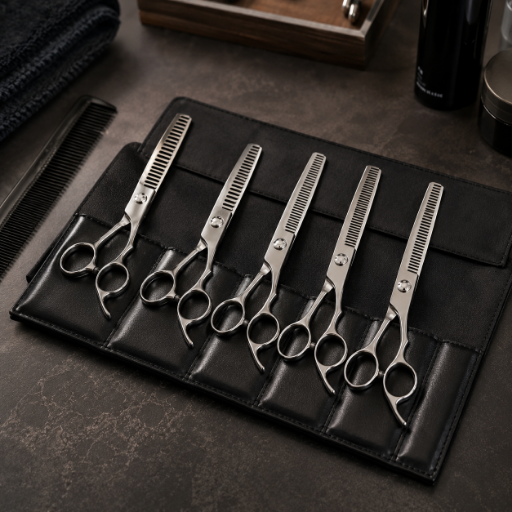
Two shears with the identical number of teeth may remove drastically different quantities of hair due to variation in tooth spacing, width and the angle of the convex edge. We machine the tooth geometry to meet specific removal ranges, ensuring predictable performance, such as our 30-tooth blender, which doesn’t push or track hair.
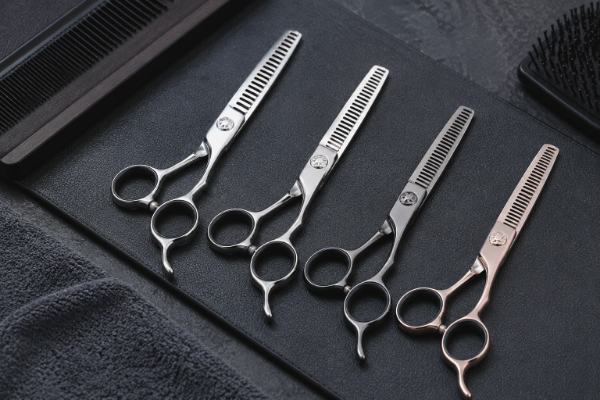
MATSUOPRO builds four texturizing shears for hair of every type on the same ~80-step production run — the difference is the steel and the surface finish. All ship with a hand-honed Japanese convex edge, hand-tensioned pivot and piece-by-piece quality control, and all cut wet or dry hair. Each line lists its MOQ in the table below so buyers can size an RFQ in one read.
A Japanese-polished, convex cutting surface on a MATSUOPRO hair shear gives smooth hair-flow rather than catch and drag. On a toothed blade, this means that instead of a chop-happy jagged result, the textured surface is going to create that smooth, natural texture that clients really love. It works this way because the two pieces have to operate in tandem and not at cross-purposes for any tool to work. This pivoted twin-blade construction follows documented hair-shear engineering.
Ergonomic offset and swivel handles cut hand fatigue over a full day, which is why professional stylists and hairstylists specify them for high-volume salons. Blade length runs 6.0 to 6.5 inches — a professional hair scissors 6.5 inch format suits longer hair and scissor-over-comb work, while 6.0 inches gives tighter control on detail.
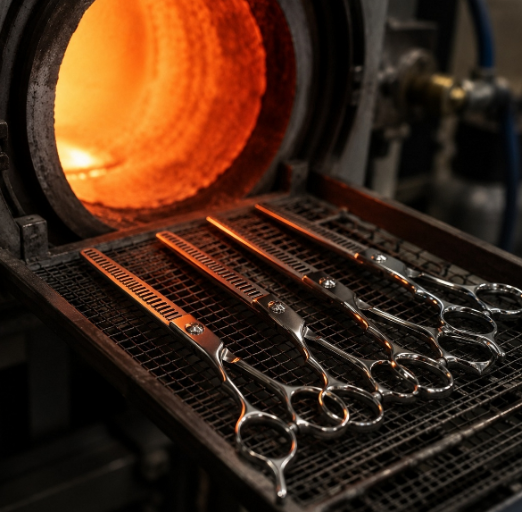
There’s a fact that isn’t typically advertised for marketing sake: it isn’t steel name but the Heat Treatment process that defines hardness, and ultimately performance. A 440C with adequate hardening and cryogenic treatment is going to out-perform any poorly heat treated VG10 any day, so ‘VG10’ doesn’t automatically equal ‘a shear that will hold an edge well.’ The vacuum hardened, cryo treated, individually quality controlled product is what’s important, and the only thing a factory can show for it.
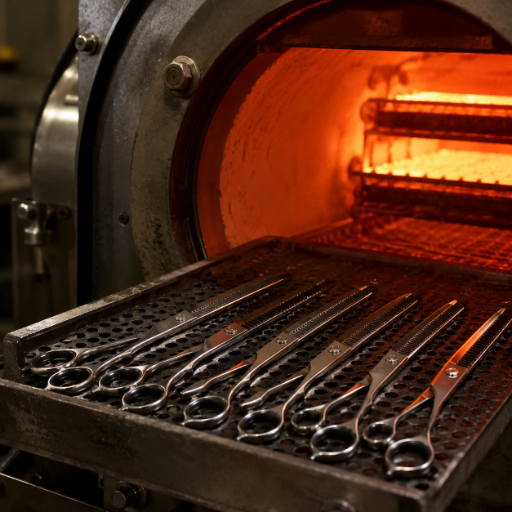
Steel type only represents a starting point-it isn’t a guarantee of durability, and a lot of manufacturers rely on steel brand-names to charge more for their product. The structural reason we’re able to heat treat our MATSUOPRO 440C steel to 60-62 HRC, after it has been cryogenically tempered and subjected to vacuum heat-treating in our in-house facilities, and have the third party to confirm our report, is why your shears will actually last 10-15 years as opposed to 3. Our honest trade-off is simple: we will not claim a steel name we cannot back with a hardness number.
Barbers say it plainly on the forums: the more expensive shears do hold an edge longer, but do not buy on brand name alone — as one put it, “the ‘Japanese steel’ talk is overstated,” and the quality does not always equal the price. Origin is marketing; the hardness report is proof.
“We tension and test every pair by hand, then pull samples for third-party hardness testing. A steel name on the box means nothing if the cryo-temper isn’t right — that’s why we publish the report instead of asking buyers to trust the label.”
— MATSUOPRO Blade Engineering Team
A decent professional texturizing shears will cost anywhere from $150 to $1,200 depending on the grade of steel, tooth arrangement, and type of handle-and your biggest error in judgement is going for the least expensive tag. As one trade guide puts it, “cheap hairdressing scissors aren’t actually cheap” — they are a financing arrangement you repay in sharpening fees and lost clients, which makes them the expensive choice over five years. Budget shears last three to four years; a well-treated premium pair lasts 10–15.
Buying direct from the source eliminates the distributor mark-up and the anonymity of private-label, as MATSUOPRO makes everything from the raw steel to your exact specification in-house and sell it directly to you. You get a steel identified by name, an HRC number, and OEM/ODM freedom over your designs (number of teeth, steels, handle materials, PVD treatments, laser etchings, and packaging), all with reasonable minimums for growing companies. That is the honest, quality-first trade a distributor markup cannot match, and it removes the risk of unnamed steel; the structural reason MATSUOPRO holds ISO 9001 is that quality control never leaves the factory.
Estimated value of the ~5 minutes per cut a sharp, well-balanced shear saves a stylist at 25 clients/week
Source: independent 5-year TCO study of 40 stylists (industry data) — Silver-tier estimate, not a MATSUOPRO guarantee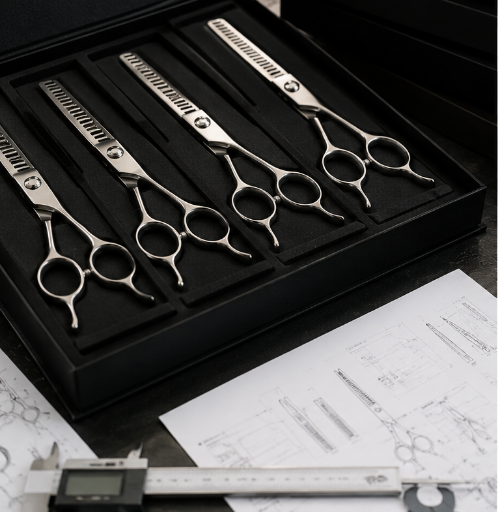
Beyond texturizing shears, MATSUOPRO manufactures the full professional range — hair shears and hair scissors, hairdressing shears and hairdressing scissors, barber shears and barber scissors, professional blending shears, steel hair cutting shears in japanese stainless steel, and grooming scissors — so a distributor can source a complete hair cutting scissors set from one hairdresser-grade supplier. Every stainless steel hair cutting scissors we ship is professional-grade haircutting equipment: professional hair shears, professional hair cutting scissors, texture shears and scissors for hair built for blending and texturizing. We also private-label shears professional buyers rebrand — professional salon barber haircut scissors made to your spec. Distributors building a full assortment can pair these with our wider thinning and texturizing shear range.
custom orders from 50 pieces, in-stock styles from a single pair.
we use your logo, tooth count, steel and packaging – engraved & boxed as required.
everything from raw Japanese steel to the final hand-honed shear happens in-house. Nothing critical is outsourced, so quality and lead time stay in our hands.
When you place a bulk order, always insist on a specific named steel, the HRC achieved from a 3rd party report, and the BSCI audit certificates. This market is saturated with so-called ‘Japanese brand’ shears that are discreetly churned out using unmarked steel; if they are prepared to give you hardness reports and ISO 9001 certificates on the table, then you’re dealing with honest people. Our shears are made to ISO 7153-1, BSCI, and SGS audited specifications.
Access our engineering-grade selectors and financial calculators to determine precise specifications, project lifecycle costs, and configure OEM procurement parameters.
Match removal rate to the cut. Define hair outcome, steel requirement, and geometry to find the exact MATSUOPRO line.
Calculate Total Cost of Ownership. Compare upfront capital against long-term sharpening and replacement intervals.
Estimate volume pricing, Minimum Order Quantities (MOQ), and private label customization parameters.
Though similar, they’re distinguished by the proportion of hair they remove in one action. Texturizing shears have between 14 and 25 teeth and are designed to cut 25-40% of hair to introduce visible texture and movement; thinning or blending shears range from 28 to 46 teeth and cut 5-25% of hair to create invisible softness. They’re part of the same tool family but have different tooth numbers.
Your hair texture will dictate the number of teeth you choose. 5-10 for de-bulking thick hair; 14-25 for day-to-day movement and texture; 30-46 for soft blending and a fine finish. See the tooth-Count Selection Framework at the top – don’t assume more teeth cuts more, less hair.
On fine hair, be extremely cautious or avoid them entirely. Too much thinning on fine hair can lead to wispy or frizzy ends, soopt for high tooth counts (35-46), keep the blade away from the roots, and cut only the lower half of the strand.
Either works with our shears. While many professionals use them dry for immediate visual feedback of texture, wet cuts are acceptable for removing bulk weight. Our convex edge glides smoothly through either texture.
It’s the heat treatment and proof that matter more than the country of origin. A well vacuum-hardened and cryo-tempered 440C will be far superior to an poorly heat-treated VG10, no matter the flag on the box. We manufacture Japanese steel, including Hitachi ATS-314, publish third-party hardness reports, and maintain BSCI and SGS certifications – data that many branded shears simply refuse to provide.
Custom orders are possible with minimums of 50 units for OEM/ODM orders, or buy our in-stock models in single pairs. Customize everything from steel grade, tooth configuration, and handle type (offset or swivel) to PVD coating, engraving, and packaging for full private labeling.
Pricing is determined by a combination of steel quality, tooth design, handle shape, finishing option, and the size of your order. As a manufacturer we cut out the distributor mark-up, so contact us for a custom quote specifying your required tooth count and volume.