Get in Touch with Mackayhairscissors Company
We use submitted details to respond to your quote request. Read our Privacy Policy.

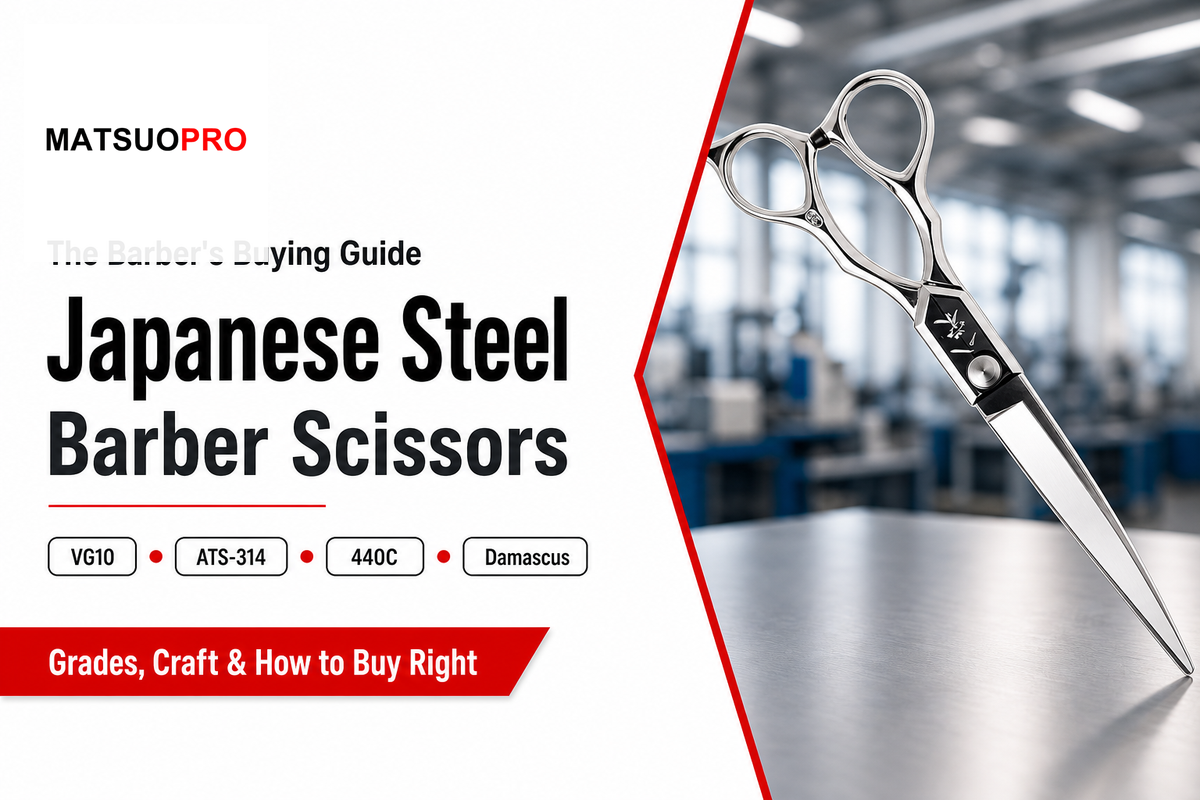
Japanese steel barber scissors are barber-style cutting shears forged from a small group of precisely engineered, brand-name alloys, primarily the VG10, Hitachi/Proterial’s ATS-314, or 440C steels. These alloys are typically heat-treated to a hardness of 56-63 HRC and then ground and hand-honed to the barber’s standard length of 6.0” to 7.0”. However, beyond the grade designation and hardness level, the method by which the steel was forged and its verification method are equally important to the performance of the shears as the alloy itself.
| Common grades | VG10, ATS-314, 440C, multi-layer Damascus |
| Hardness range | 56-63 HRC (Rockwell C) |
| Barber blade length | 6.0″-7.0″ (longer than a 5.5″-6.0″ general stylist shear) |
| Common edge type | Convex (hamaguri-ba) for slide/blend work, bevelled for heavy dry cutting |
When a barber graduates from the shears in their beginner kit, they generally move up to Japanese steel barber scissors – a term that adorns products from $40 bargain bin models to the $700 high-end, professional grade models. Whatever grade – whether it’s a VG10, ATS-314, 440C or one of the patterned Damascus composites – the steel typically hails from a select few name-brand Japanese steel mills. But the designation “Japanese steel” provides precious little information on its own about the actual mill it comes from, let alone whether the blades were made using methods suggested by marketing claims. This distinction is finer than the broader Japanese hair cutting shears question a general hair stylist or hairdressing professional faces, because the type of cut and daily wear patterns are specific to a barber’s craft.
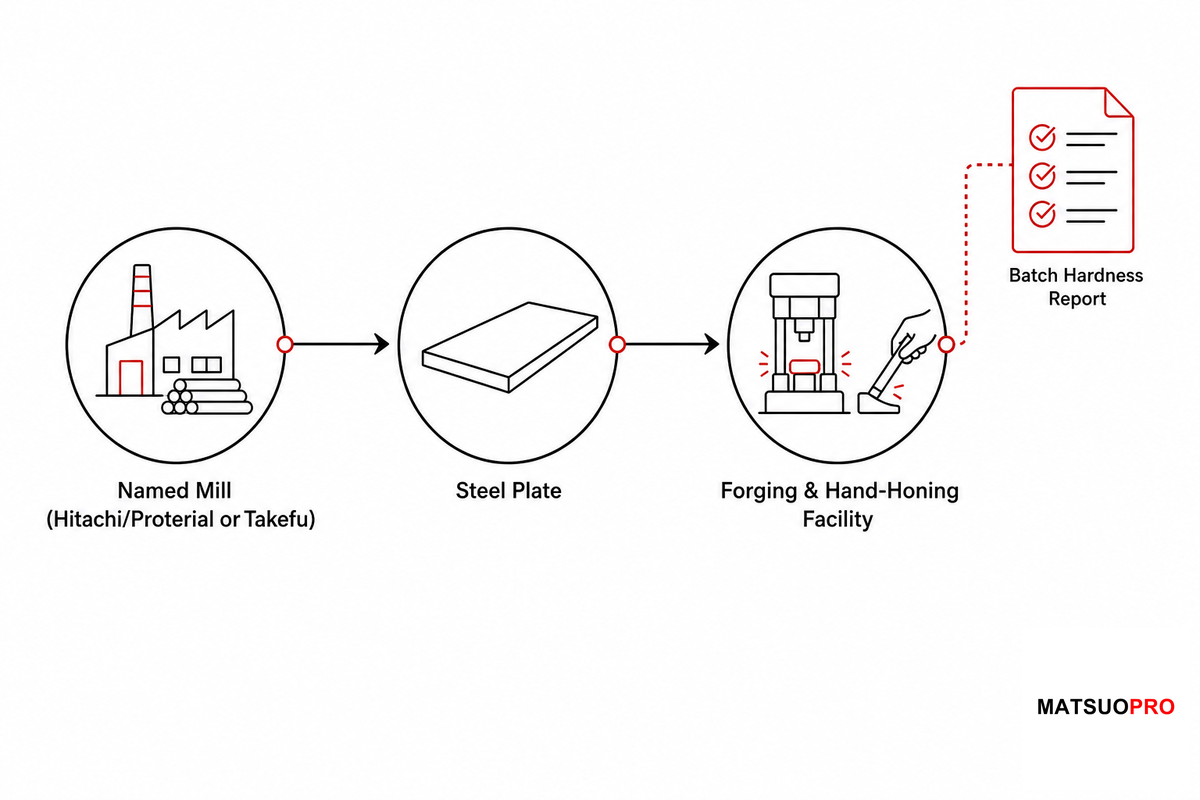
Ask ten suppliers where their “Japanese steel” comes from, and most will cite a specific alloy grade – such as VG10, ATS-314, or 440C – rather than the name of the particular Japanese mill responsible for producing the raw material. This omission make a significant difference because, while a grade designation is merely a material specification, the mill’s name indicates an actual entity you can vet.
Two specific Japanese steel mills emerge repeatedly from discussions on barber forums and with industry experts regarding the provenance of high-end blade steel for shears: Takefu Special Steel, the recognized originator of the VG10 alloy, and Hitachi Metals (now known as Proterial, Ltd.), which manufactures a distinct line of premium blade steels under its Yasugi Specialty Steel brand, the same family of steels from which ATS-314 is derived. Both the Hitachi ATS-314, their in-house proprietary alloy, and the Takefu VG10 are cited by practitioners as the recognizable benchmarks of quality in response to vague claims of “premium Japanese steel.”
The most common pitfalls stem from assuming that “Japanese steel” is an inherently trustworthy claim on its own. This isn’t the case. It’s entirely possible for steel from a well-known Japanese mill to be shipped overseas for forging, grinding, and hand-honing – that’s standard procedure. What separates a reliable, transparent vendor from one that’s simply being evasive is their willingness to name the specific mill of origin and support their claims with concrete lot or batch-level test data, rather than a general statement about the country of origin.
Many will move on without asking. But this designation of “Japanese steel” is just a starting point. One follow-up query – which mill produced the steel, and where is the hardness data for this specific batch? – effectively separates a documented, trustworthy supply chain from marketing jargon.
Imagine a barber behind a supply-house counter comparing two almost indistinguishable 6.5″ shears: Both boast “premium Japanese steel,” but they differ by $180. One’s box contains no further specifics. That pricier pair, however, comes with a printed hardness certificate detailing the mill, the HRC range, and the batch number.
That printed page represents the only difference in the purchasing risk – it’s the reason for the structural disparity which allows one supplier to charge more and still provide the superior value; it’s not some superficial prestige. Realistically, it’s the piece of paper that a barber go home with, not the packaging text. At Mackay/MATSUOPRO, we manufacture our own barber-shear line using precisely this type of batch-level documentation since a grade name alone offers no relevant information to the customer.
Key Takeaway: “Japanese steel” denotes a class of alloys, not a standardized guarantee. Prior to treating this label as proof of quality, request the mill name (you’ll most commonly hear Hitachi/Proterial or Takefu) and a batch-level hardness report – this principle has been demonstrated in 440C vs. VG10 steel composition data.
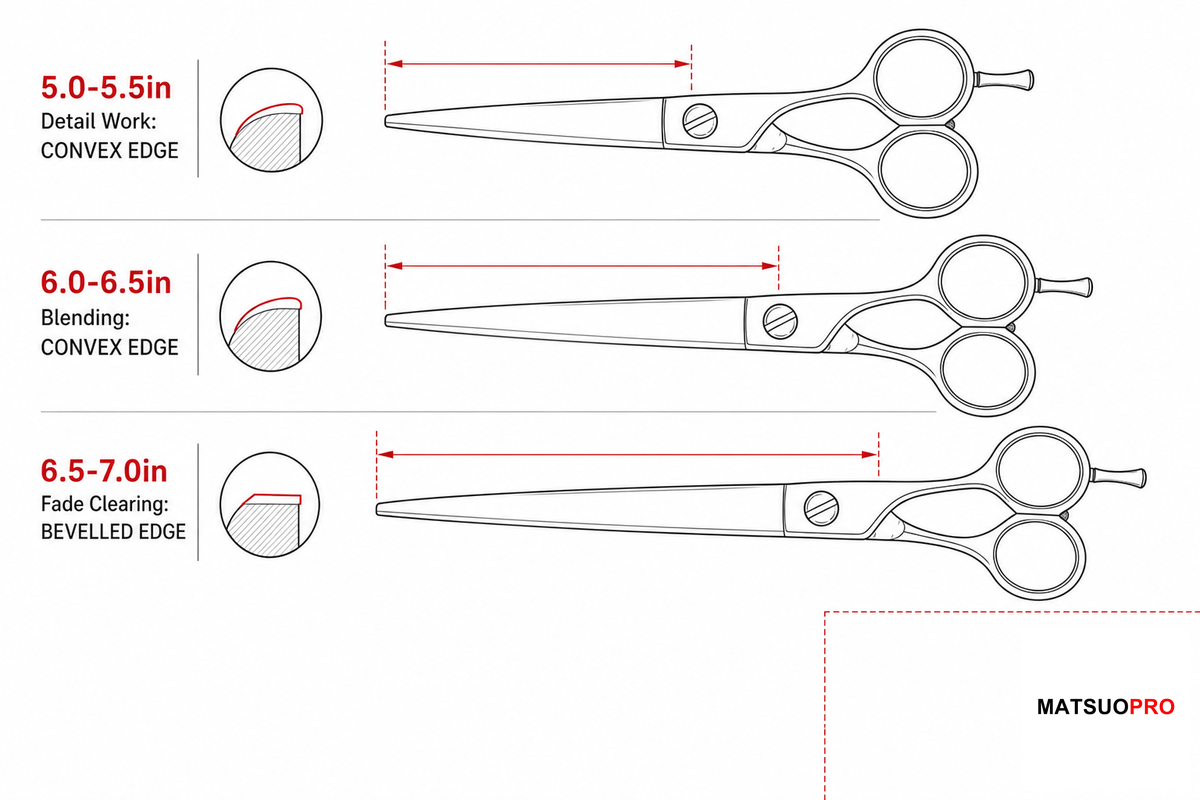
For barber work involving scissor-over-comb or fading, longer blades of 6.5″ to 7.0″ are favored because the extra length enables longer strokes that clear the comb with fewer passes. On the other hand, the 5.0″ to 5.5″ blade length necessitates more staccato movements over the same section, making the fade longer and the blend more uneven. Detail work and neckline trimming flip that logic; shorter blades provide more precise control where length becomes detrimental rather than advantageous.
Similar to blade length, the grade of steel and the geometry of the edge should be considered in context of how each shear will be utilized in a barber’s toolkit. Unlike shorter, multi-purpose hair shears for stylists, the following table specifically focuses on barbering techniques and not a generalized haircut kit.
| Barber Technique | Blade Length | Edge Type | Duty Class | Typical Grade |
|---|---|---|---|---|
| Scissor-over-comb / fade clearing | 6.5″-7.0″ | Bevelled or convex | Primary | 440C / ATS-314 |
| Blending / slide cutting into a fade | 6.0″-6.5″ | Convex (hamaguri-ba) | Primary | VG10 / ATS-314 |
| Neckline / outline detail | 5.0″-5.5″ | Convex | Secondary | VG10 |
| Heavy dry bulk removal | 7.0″ | Bevelled | Primary | 440C |
| Texturizing within a fade | 5.5″-6.0″ | Toothed (thinning) | Secondary | 440C / VG10 |
| Beard and facial hair detailing | 5.0″-5.5″ | Convex | Specialty | VG10 |
| Wet blunt cutting on longer top styles | 6.5″-7.0″ | Bevelled | Secondary | ATS-314 / Damascus |
| Point cutting for crown texture | 6.0″-6.5″ | Convex | Specialty | VG10 / ATS-314 |
| Clean-up around ears and hairline | 5.0″-5.5″ | Convex | Secondary | VG10 |
Why would the type of edge be split across similar blade lengths rather than adhering to a single guide line?
Beveled and convex edges are designed to address different needs. The convex edge glides through hair with less friction, ideal for smooth blends, but it’s less tolerant of high-friction cutting with dry, heavy hair, where a beveled edge’s added durability is beneficial. In practice, barbers who perform multiple fades per day will frequently have two shears available in rotation for these distinct reasons, rather than choosing one as superior over the other.
The texturizing row in that matrix deserves its own note, because “thinning shears,” “hairdressing shears,” and “hair thinning scissors” get used almost interchangeably in the trade even though they serve different jobs. A dedicated thinning shear or texturizing shear removes weight from hair without shortening it, which is a separate function from the primary bevelled or convex barber shear that does the actual length-cutting; most working barbers carry at least one 6 inch primary shear alongside a smaller thinning/texturizing pair rather than trying to make a single tool do both jobs, regardless of hair type or whether the work is wet and dry cutting.
To assemble a two-shear barber kit from scratch, prioritize investing in a 6.5″-7.0″ bevelled or convex shear for blending fade cuts first, as it will be used most frequently, and then add a 5.0″-5.5″ convex shear for precision detailing as it earns its keep.
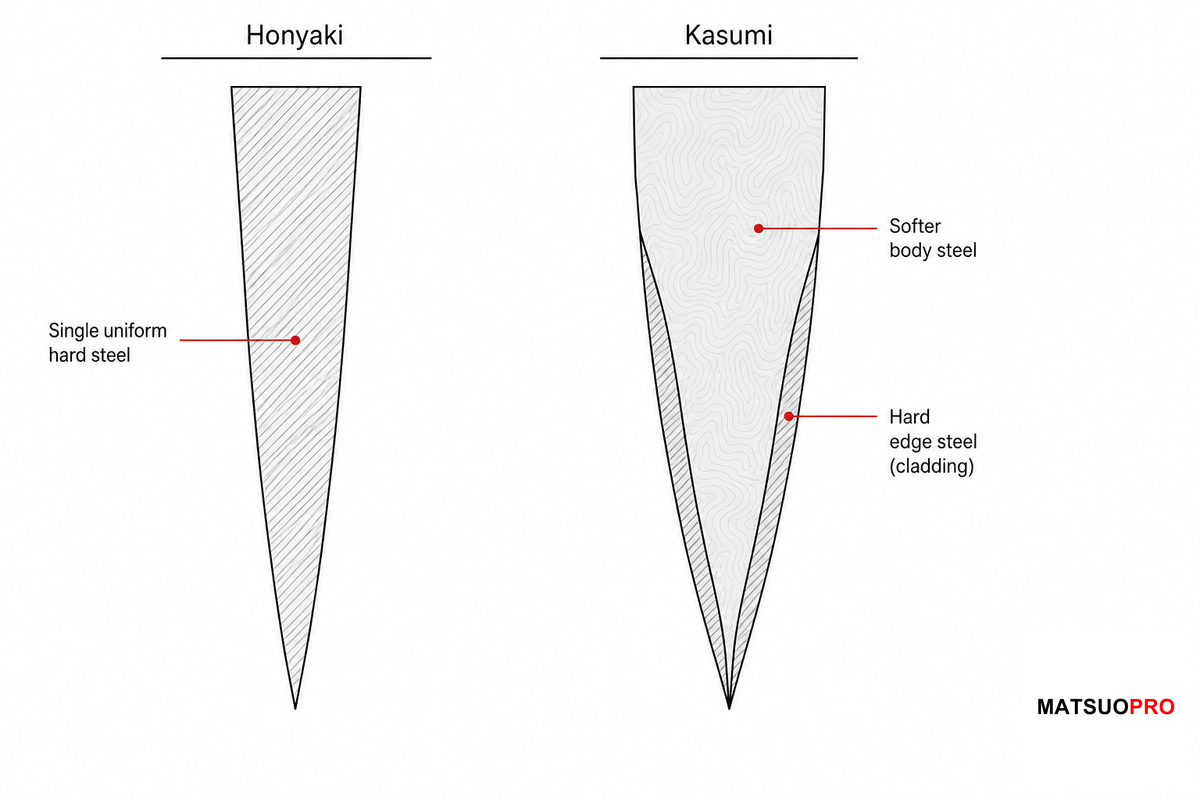
Here’s a distinction you almost never see advertised in barber-shear marketing, yet it’s one of the most fundamental, and historically important, distinctions in Japanese bladesmithing: not all “Japanese steel” is made the same way. For centuries, Japanese cutting implements have fallen into two basic construction categories, honyaki and kasumi, and which one your shear uses shapes how it performs and how forgiving it is far more than its listed grade name does.
Honyaki construction forges a blade out of one solid piece of hard steel. A classic honyaki is differentially hardened: the smith apply a differential clay coat-thin along the edge, thick along the spine-and then quenches the blade. That exposed edge cools rapidly and becomes hard; the spine cool slower and remains comparatively soft and tough.
This creates the characteristic hamon wavy line seen on many finely crafted Japanese knives and swords. While this provides exceptional edge retention, it also means the blade has nowhere to yield. Single-piece hard steel has no softer material to absorb shock, so a honyaki blade is brittle, difficult to sharpen, and expensive to manufacture because many attempts fail and break during quenching.
Kasumi construction does the opposite: a thin, hard cutting edge is forge-welded to a softer iron or steel core. Hard steel does the cutting; the softer core provide support and flexibility, allows the edge to be sharpened cooperatively on a stone, and forgives minor impacts that would chip a honyaki blade.
This two-material construction isn’t a cost-saving measure; it’s intelligent engineering that maximizes the cutting potential of hard steel without making the blade too brittle. For that reason, it’s the dominant construction in all categories of Japanese cutlery.
How does this apply to a barber shear?
Nearly all production barber shears, including multi-layer damascus models that fold a hard steel core into multiple outer layers, adhere to kasumi-style construction, a smart design choice for a tool that’s dropped, twisted, and subjected to daily use rather than simply being admired on a shelf. Rather than the honyaki ideal of a single monolithic piece of hard steel, kasumi-style blades feature a hard cutting layer backed by a softer, more resilient one. Understanding whether your shear follows kasumi principles, not just the grade name of the steel used in its construction, will help you understand its capabilities.
“Grade name tells you the alloy. Construction tells you how that alloy was actually put to work in the blade. A shear built kasumi-style will always forgive a bad drop better than a single-piece hard blade will; that’s not a flaw, it’s the whole point of the design.”
— Mackay Hair Scissors technical team
TLDR — Honyaki vs. Kasumi: The Two Forging Paths Behind ‘Japanese Steel’. Honyaki (all-one piece steel, strongest, most fragile edge) and kasumi (layered construction, more durable edge) represent two methods of construction in traditional Japanese blades, often oversimplified by simply saying “Japanese steel,” a distinction not often applied to barber shears but central to explaining performance differences that buyers mistakenly blame on grade alone. That’s another reason investing in a well-built professional hair shear from a transparent supplier is well worth the extra inquiry.
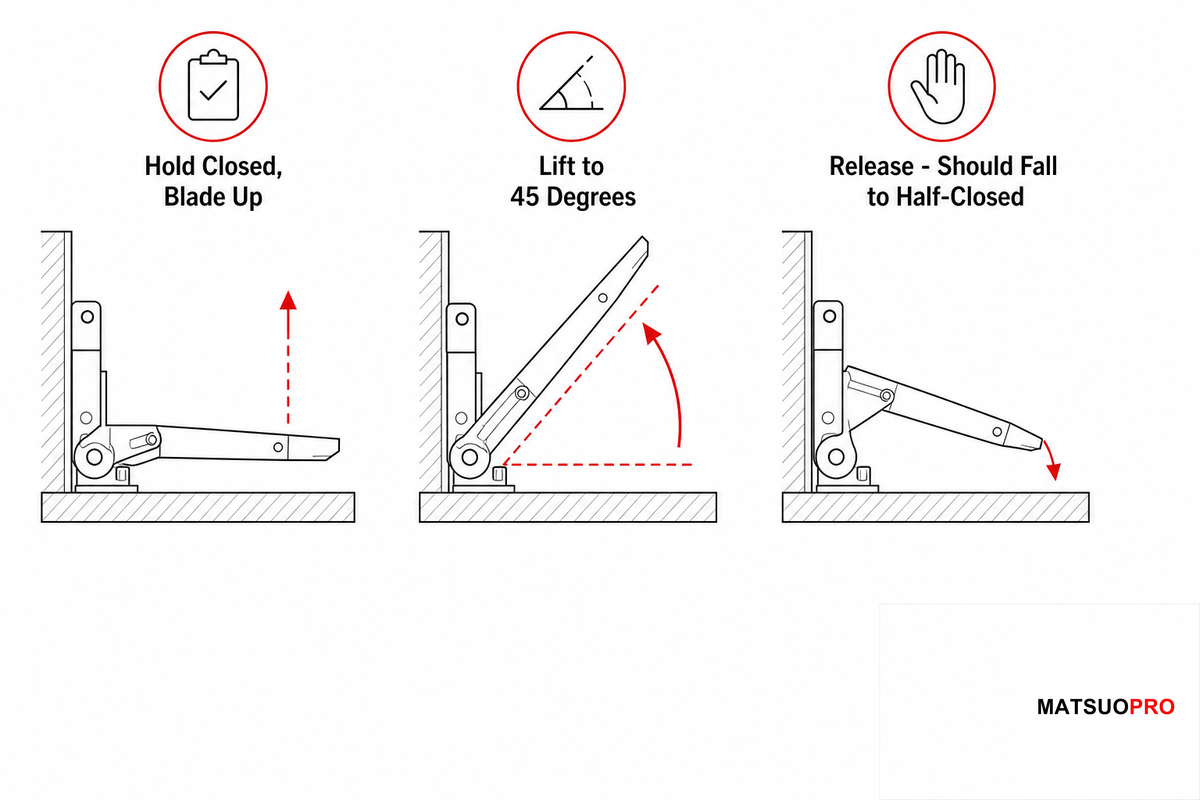
Specifications can only get you so far. Most everything else has to be felt and verified on the shop floor or before you pay to have a sample sent to you. Start by performing the “drop test”: with the shear closed, lift the top blade to about 45 degrees, and let go. If it drops of its own accord and closes 30-60%, it’s correctly tensioned; it should shut hard and fast if the tension is too loose, or it shouldn’t move at all if the tension is too tight. A well-tensioned shear may feel like a new shear even if its edge need a touch-up.
A “lifetime warranty” sticker deserves the same skepticism as a bare “premium shears” or “high-quality Japanese steel” label on stainless steel hair cutting shears — none of those phrases are checkable on their own, and a warranty is only worth what the paperwork behind it says. In addition to checking tension, the four following questions can differentiate a capable supplier from one reselling another company’s merchandise: From which mill did they source the steel plate? Is hardness tested on a lot or a batch basis? Does the stated sample lead time account for any custom engraving? Can a third-party hardness certificate be provided upon request, rather than just mentioned in their marketing materials? (This list is covered in full in our guide on breaking down the cost of professional hair cutting shears, which walks through a detailed verification process for any shears in the $300-750 range).
Lists claiming the best “Japanese steel” barber shears on the market are primarily marketing content masked as reviews-the mill-verification questions outlined above have far more predictive value. For many barbers these days, brand reputation takes a backseat to concrete, checkable evidence, such as mill sources, documented hardness data, and edge profiles, as explained more thoroughly in our comparison of major players in the salon shears market. Professional stylists, professional hairdressing staff, and professional hairstylists shopping for sharp shears for professional use across general hairdressing scissors and thinning scissors face the same problem: professional shears and professional grooming tools are all marketed as “professional quality,” but only some suppliers can back that claim with lot-level Japanese stainless or Japanese 440C composition data instead of a japanese steel scissors label alone.
The shear drop test before assuming a dull edge needs sharpening. For many barbers on online forums, perceived dullness has been traced back to improper tension, a need for cleaning, or dried-out pivots rather than an actual blunted edge.
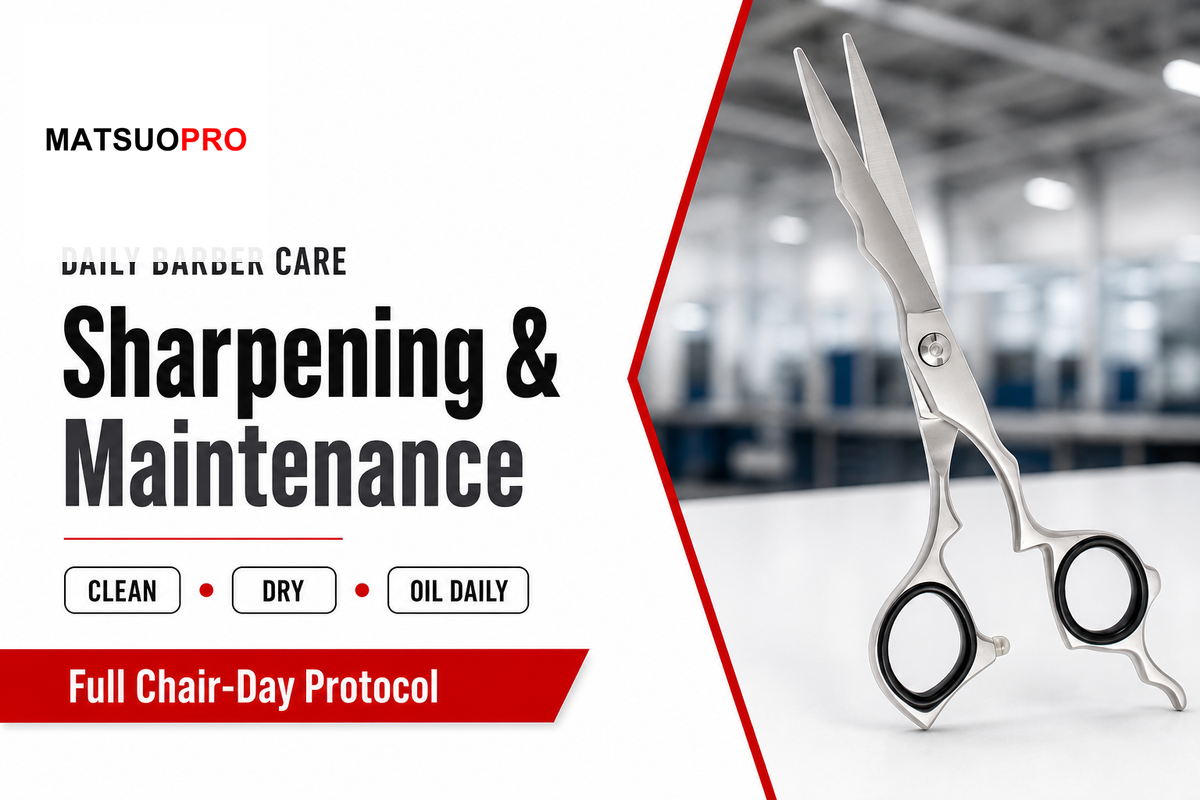
A barber cutting 40-60 fades a week places a different type of load on a shear than a stylist doing predominantly wet, sectioned cutting. Dry hair is harder on the edge; scissor-over-comb use results in repeated metal-on-metal friction against comb teeth; and a full week of fades leaves the shear very little downtime between cuts. Standard industry sharpening guide lines – roughly 3-4 months for a low-end 440C, 5-8 months for a VG10/ATS-314, and 9-14 months for a high-end Damascus construction (details can be found in the 440C vs VG10 sharpening and grit progression guide) – apply to average professional cutting workloads. Barbering’s heavy daily dry cutting profile generally falls to the lower end of those time frames rather than the upper, although no definitive guide offers specific quantification, so this should be used as an directional guide only.
Cleaning is more than housekeeping, it’s a regulatory obligation. Most state boards mandate the use of an EPA-registered, liquid-form disinfectant on tools between clients, from California’s Board of Barbering and Cosmetology to Indiana’s state cosmetology and barber examiners rule, with Georgia, Colorado, and Missouri publishing similar requirements. However, even that disinfection process creates wear on the hardened blade, so wiping the tool clean after each client, fully drying the blades following disinfection, and oiling the pivot daily all contribute to the life of the steel. Many barbers neglect the drying-and-oiling step following disinfection and in so doing subtly cut the life of their investment short.
A barber performing eight consecutive clients on a Saturday will put the shear through eight cycles of disinfection, eight cycles of dry, coarse hair across a 6.5″ blade, with no opportunity for downtime. At the end of that Saturday, the shear not regularly oiled will likely feel looser and will have a greater degree of drag than one which was treated with 30 seconds of maintenance per client. The greater a hard, Japanese-steel’s inherent strength and edge-holding capacity, the more this effect will compound, as the Mackay/MATSUOPRO tension data reveals drift is already present before the edge begins to dull. In practice, this explains how the drop-test discussed earlier catches issues the calendar alone doesn’t.
Using a general salon-based maintenance routine intended for a less demanding, primarily-wet workload when in fact the bulk of the work is high-volume dry fades. The true signal is drag or snagging well before the calendar based guideline for your specific steel grade is reached, not the calendar itself.

The foregoing assumes the purchase of a single shear for personal use at the chair. If outfitting a multi-chair salon, initiating a private-label barber-tool brand, or stocking a retail catalog, the calculation change. Minimum order quantities, sampling lead times and individual batch documentation will take center stage, overshadowing steel grade and cutting edge type.
MATSUOPRO’s in-house Japanese steel barber scissors catalog has all of this – its full four-grade lineup (VG10, ATS-314, 440C, and multi-layer Damascus) – complete with per-SKU hardness data, a 50-piece minimum on custom orders, 3-day sample turn around, and verifiable ISO 9001/BSCI/SGS certification-the batch-level transparency we’ve argued is essential for any supplier, individual or bulk. And if you’ve read this far as an individual barber looking for your next pair, the same mill verification and construction standards apply, whether you’re purchasing one shear or fifty.
See the Full Grade Catalog & Request a Sample →
The single most consequential trend in this market isn’t a growth number; it’s who actually owns and signs for the tool. 76% of barbers in the US are self-employed according to U.S. Bureau of Labor Statistics data, meaning that the majority of Japanese steel barber shear sales are personal capital decisions for the individual user, not mass-purchase strategies from salon owners looking to outfit dozens of chairs. As this self-employed purchasing base grows, decision-making is weighted more heavily toward concrete, verifiable claims and individual return-on-investment than toward brand prestige alone. This is the structural shift toward which this guide’s framework-focused on mill names and construction literacy-has been building.
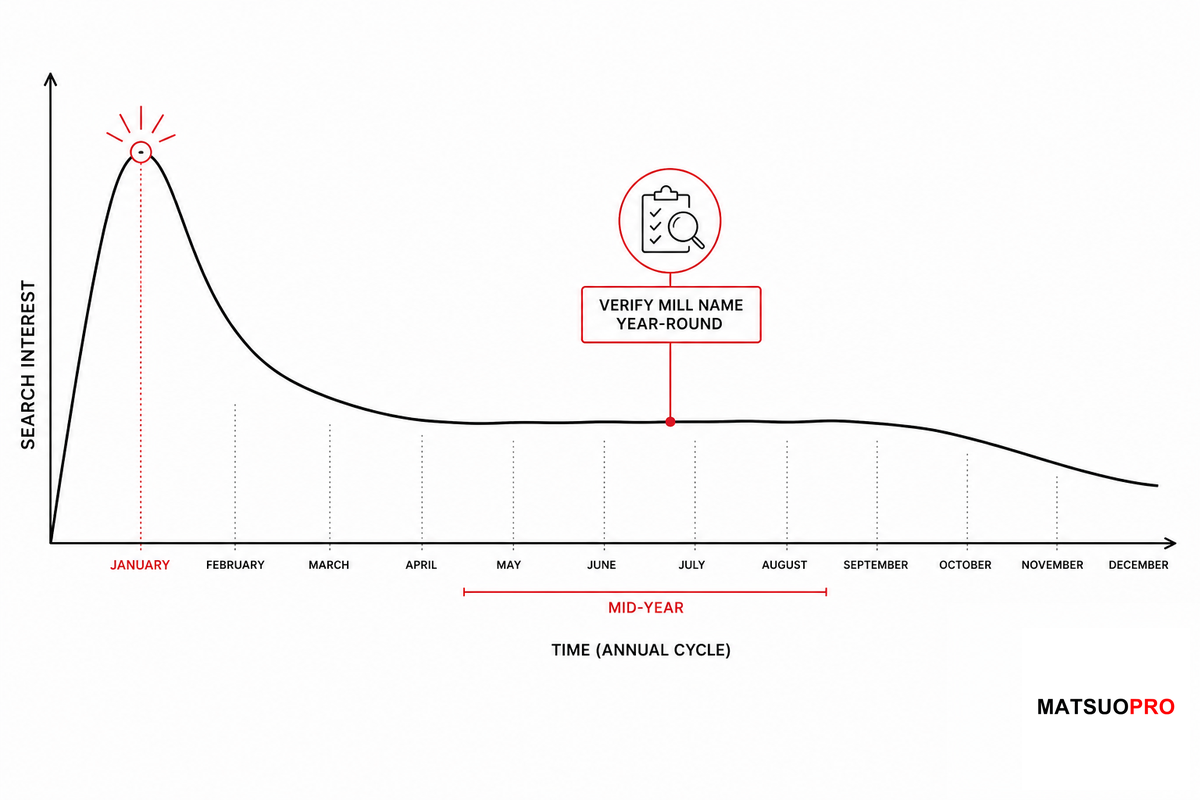
Imagine, on a January afternoon, a barber browsing ads for “best barber shears,” surrounded by Japanese scissors brands vying to catch the year’s new-equipment upgrade budget cycle. Indeed, searches for “Japanese steel” show a distinct seasonal surge specifically during this time of year (in fact, the demand for “Japanese steel” peaks sharply in January and holds fairly steady until mid-summer), whereas searches for “barber shears” and “professional barber shears” remained relatively flat through this same period. This isn’t a sign of the category’s decline, but a buyer’s cycle challenge, wherein increased marketing pressure on a consistently desirable product can make it more difficult to differentiate vague “Japanese steel hair scissors” claims. In practice, the questions regarding the mill name and construction detailed earlier in this guide are only more relevant in this crowded season, with 2026 forecasts from independent industry sources indicating a continued trend toward Japanese high-carbon steel and ergonomic design among professional consumers.
If you’re considering an equipment purchase for the year ahead: Make your decisions based on the mill name and construction details this guide has outlined, not on the calendar, nor on any ‘value’ that may appear in a barber scissors kit. A well-matched, verifiable shear purchased in June is every bit as capable as the same model purchased during the January scramble-the primary difference being the amount of scrutiny that investment receives, with Mackay/MATSUOPRO’s batch-specific documentation built to hold up under that scrutiny regardless of season.
Most published material on Japanese barber shears repeats grade names and edge-style talking points without explaining the actual blade structure. We wrote this guide to break down the often-overlooked honyaki-vs-kasumi distinction, well-explained in Japanese kitchen cutlery but almost never applied to barber shears, and what it means for chipping, sharpening, and daily shop performance. Reviewed by the Mackay Hair Scissors Technical Team.
MATSUOPRO is the Mackay Hair Scissors manufacturing brand for professional hairdressing shears, barber scissors, thinning shears, and pet-grooming scissors. We support salons, distributors, academies, grooming brands, and private-label buyers that need factory-direct production with practical material guidance.
Our buying guides are written to help purchasers compare steel grades, handle styles, blade geometry, surface finishes, logo options, packaging, MOQ, and sample validation before placing an OEM or wholesale order. The goal is to make each scissors specification easier to discuss with a real production team.
Factory-direct supply since 2014, with product lines covering professional cutting shears, barber shears, thinning scissors, texturizing scissors, left-handed models, and pet grooming scissors for international B2B customers.
We focus on Japanese 440C, VG10, and ATS-314 steel choices, convex and bevel edge geometry, ergonomic handle balance, tension systems, logo engraving, private-label packaging, and sample-based OEM confirmation.