Get in Touch with Mackayhairscissors Company
We use submitted details to respond to your quote request. Read our Privacy Policy.

Japanese 440C hair scissors are professional hairdressing shears made from ASTM A276 martensitic stainless steel, a steel grade that shows up on a $6 Amazon listing and on a $700 handmade pair alike, with no solid explanation of what it actually means. The same unsubstantiated steel claims show up no matter which version of the search you type in – “japanese steel hair scissors,” “japanese stainless steel hair shears,” “best japanese hair scissors,” “best japanese shears,” “japanese thinning shears,” “hair cutting scissors,” “barber shears,” or “hair cutting shears” – the disclosure gap doesn’t discriminate by exact phrase. This overview look at the buyer side of what “Japanese 440c” actually means as a steel grade, which sellers substantiate that claim with actual data, and how to determine whether that’s the grade for you chair.
| Steel spec | ASTM A276 Type 440C, martensitic stainless |
| Composition | 0.95–1.20% carbon, 16.0–18.0% chromium, ≤0.75% molybdenum |
| Hardness seen in listings | 56–63 HRC, depending on seller and heat-treatment control |
| Typical blade sizes | 5.5″–7.0″, with 6.0″ and 6.5″ the most common all-purpose sizes; 6 inch and 6.5 inch thinning shears are usually sold alongside a matching cutting shear |
| Market price range | $10–$150 unbranded / $150–$500 branded mid-tier / $600+ handmade premium |
| Resharpen interval | 3–6 months for full-time use, longer for part-time |
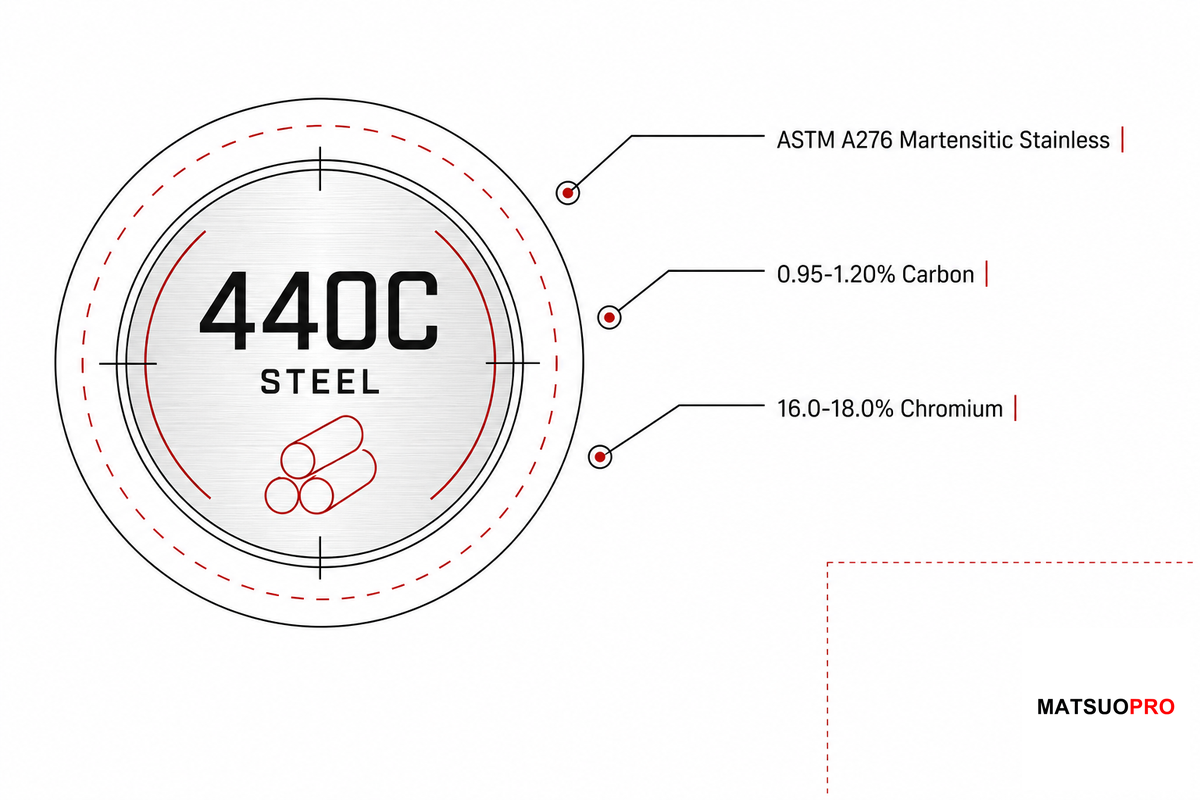
440 C isn’t a marketing term. This is a precise alloy linearly defined under ASTM A276, a martensitic stainless steel containing 0.95-1.20% carbon and 16.0-18.0% chromium, with a maximum 0.75% molybdenum. This exact alloy is marketed under several regional identities – X105CrMo17 in Europe, 1.4125 by DIN number, SUS440c in Japan’s JIS system – but the chemistry standard itself is the same document, not a country-specific formula.
According to AZoM’s materials resource, 440 C-grade steels exhibit the highest hardness, wear resistance, and strength of any standard stainless grade after heat treatment – and that’s where the story gets more complicated than a steel name implies.
Most professional hairdressers see this steel well before they consider metallurgy – it’s what a medium grade professional hair cutting shear at a hair salon supply counter is generally constructed of. “Japanese steel” and “made in Japan” are two entirely different statements, and traders frequently conflate them. Scissors can legally be forged from Japanese-sourced 440c billet and finished elsewhere, built from 440 C produced entirely outside Japan to the ASTM standard, or actually both sourced and manufactured in Japan. None of those three scenarios is inherently fraudulent – but only one of them is the consumer’s conception when they read “japanese 440c” on a product page. This is the same underlying principle that governs truth-in-advertising for country-of-origin claims generally: an origin claim is only as good as the seller’s willingness to substantiate it on request, not merely state it – disclosure and traceability are two different obligations, and a seller can satisfy one without the other. It’s worth being precise about what’s actually regulated here: federal country-of-origin marking law governs the finished product’s import declaration, not the steel’s marketing description – so “Japanese steel” on a listing is a claim about the alloy, and a country-of-origin mark is a claim about where the scissors themselves were made, and neither one substitutes for the other.
Not always, and this is the single most disputed issue in the domain. “Japanese steel” indicates the alloy – whether the ingot was produced in Japan or follows the chemistry standard – not where the finished pair of scissors was assembled, polished, and packed. A shear can correctly use Japanese-produced 440c billet while being cut, shined, and finished in another country’s factory. Chasing a country stamp isn’t the practical solution – asking the seller for the specific alloy designation (440 C, not just “Japanese steel”), the composition it’s tested to, and where each manufacturing step occurs. Sellers who can respond to all three without hesitation, and who are comfortable putting those specifics in writing rather than repeating a brand story, are a genuinely different class of trader than sellers who lack those answers or dodge the question with vague reassurance instead.
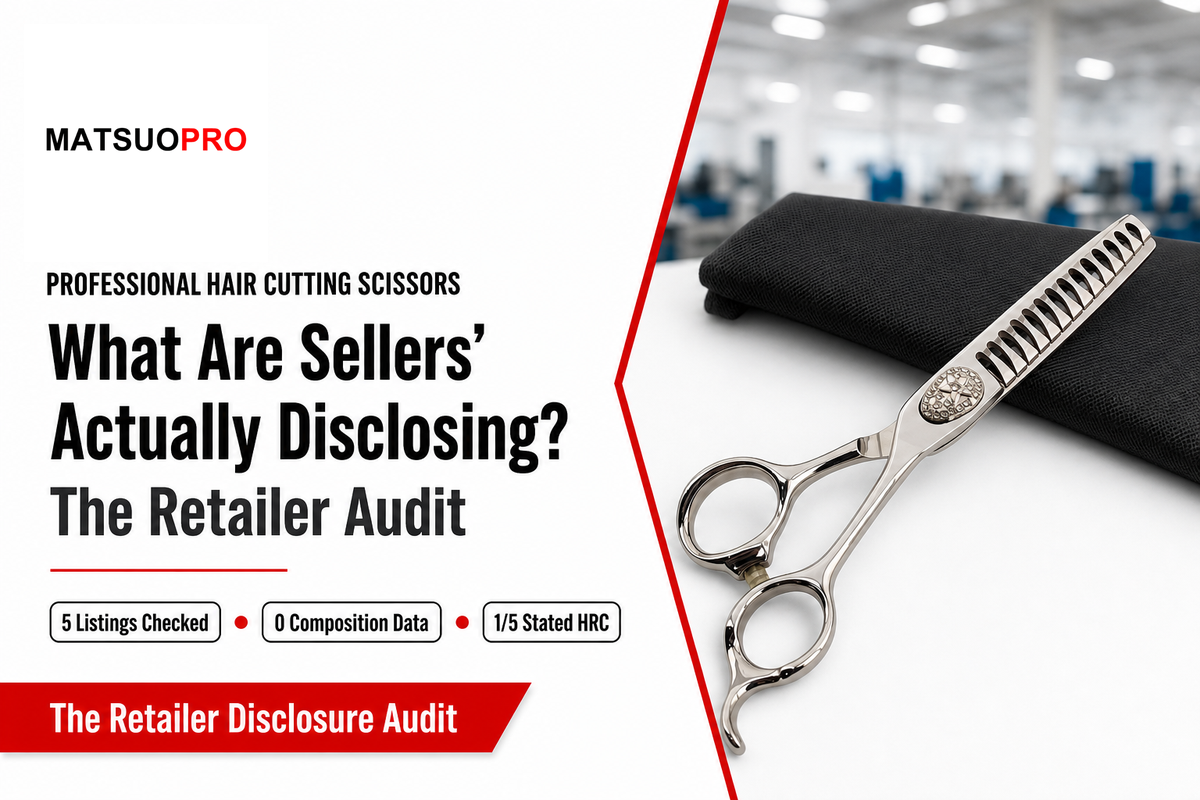
Here’s a question nearly nobody in this category answers directly: when a listing displays “japanese 440c,” what has the seller actually disclosed to you? We examined how five representative sellers of 440c hair scissors declare their steel claims – not to single any one out, but to analyze whether disclosure is the norm or the exception.
| Listing type | Steel claim stated | HRC stated? | Composition disclosed? | Batch/test report? |
|---|---|---|---|---|
| Marketplace listing (Amazon) | “Premium 440C,” Japanese style | No | No | No |
| Specialty retailer, mid-tier series | “Authentic Japanese 440C steel” | Yes, single number | No | No |
| Branded shear-set retailer | “440C steel cutting shears” | No | No | No |
| Handmade shear brand | “Japanese 440c Stainless Steel” | No | No | No |
| Barber-supply retailer | “SUS440C stainless steel” | No | No | No |
Of the five we checked, just one even listed a hardness number and not one included a composition certificate or an outside test result, a genuine outlier look like a listing that discloses a batch-verified HRC 57-59 band alongside the composition, not just a country adjective. Worth being upfront about scope here: five listings is a snapshot, not a market census, and it’s not a random sample – treat it as a directional signal about how this category tends to describe itself, not a precise industry-wide percentage. It isn’t proof anyone’s misrepresenting the steel; it simply proves that a consumer has no way to know for sure. It’s the same problem you find everywhere: for years on cutlery message boards-particularly Kitchen Knife Forums, where buyers and makers trade information about “Japanese” blades that turn out not to be-buyers and makers agree on the same simple advice: a steel name on a title is the beginning of a question, not an end to one.
Watch out for phony steel designations. Miraculous Steel or Smart Steel are not designated alloys of any of the recognized grading systems. If they will not specify an alloy grade (e.g., 440c, VG10, ATS-314) and a hardness number for any listing then consider any brand names a selling point and not a specification.
So why is this of interest besides morbid curiosity?
Prices for products in this segment run truly enormous ranges: “real world” listings identified by a term like “japanese 440c hair scissors” can be found for less than $10 on general marketplace sites, or for as much as $700 or more for handmade lines. When one expands the aperture to look at general hair shears made by professional artists, the spread become even wider: one thread from working barbers discussing shears on Reddit (the context isn’t strictly 440c but is illustrative of what people are willing to spend in this tier) ranged from $10 all the way to $1,000, with the vast majority clustering around $75–$150. Of course, some of that price spread has to do with differences in heat-treating process quality and the labor required for hand finishing; some has to do with nothing more than brand-value padding.
It’s not something you can necessarily ascertain from the listing itself – the reason for the checklist in this guide later is because you should ask questions, rather than try to infer quality from price. Search “japanese 440c hair scissors amazon,” “japanese 440c hair scissors price,” or “japanese 440c hair scissors for sale” and you’ll pull the same wide, context-free spread – marketplace search doesn’t sort by disclosure quality, only by price and reviews.
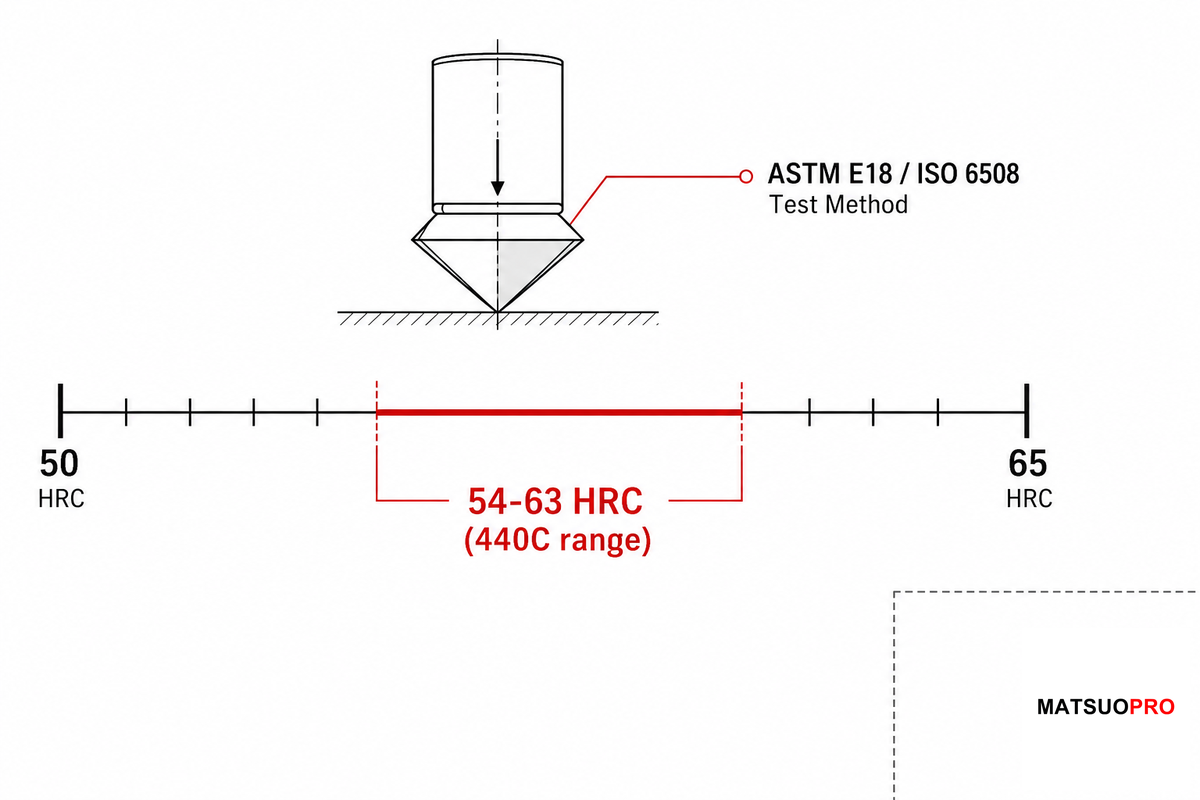
Inevitably all 440c listings will present you with an HRC value – 56, 58, 60, often more. HRC is Rockwell C hardness and measures the depth of indentation caused by a diamond indentor applied to the material with a fixed load. ASTM E18, and ISO 6508 are the standardized measures and the recent updating of these standards (ASTM E18-25 is the most recent at the ASTM site) itself gives a hint of the seller: do you have confidence in their quality claim if they use an older, withdrawn test specification in their current one?
Two things are more important than the sheer number: First, a piece of 440c alloy can still have anything in the ballpark of 54-63 HRC, all depending on how closely the quench-and-temper is controlled (same steel, but tighter or looser heat-treating). Second, hardness and toughness have a trade-off that’s discussed next. Skipping that check is a real risk – a seller quoting an unverified HRC number off an outdated test method is a hidden gap you’re paying for without knowing it. Batch-to-batch, that same alloy can also land anywhere across the 54-63 HRC window depending on how tightly the heat-treat and quench-and-temper process is controlled at the factory doing the finishing. For the mechanics of the Rockwell scale – including how it relates to Brinell and Vickers and how 440C stacks up against other shear steels like VG10 and ATS-314 – read our companion guide, Understanding the HRC (Rockwell C) Hardness Scale, which examines the 20-point hardness scale more thoroughly.
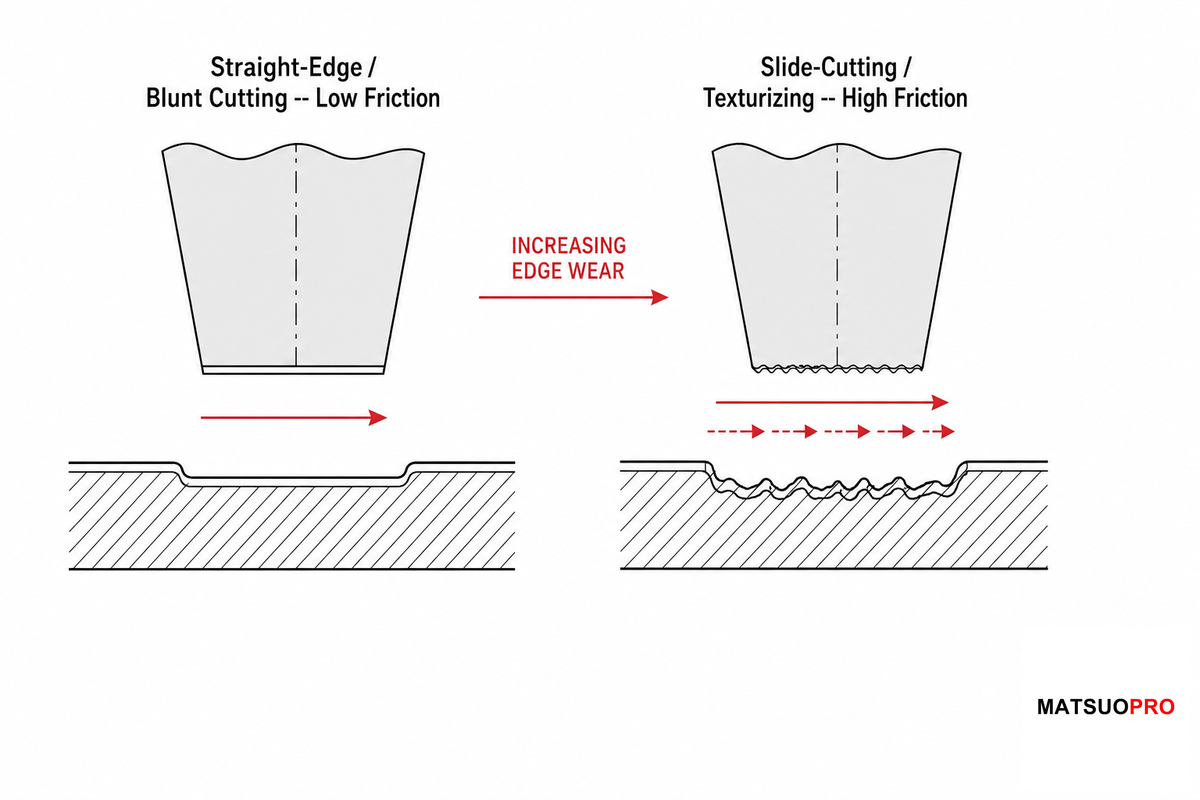
“Good enough” is less about the HRC rating than about how you use your shear. Straight-edge, clean cutting-is most forgiving to steels that fall somewhere in the middle hardness range. That’s because each cutting engagement is short and sweet. Slide-cutting and aggressive texturizing puts the edge in more contact with hair over a longer duration, resulting in greater friction and more edge wear.
Edge geometry has more to do with edge-retention in those conditions than hardness. For example, the V-notched teeth on a thin-walled shear cut up more cutting volume than the same steel treated with straight bevel, even at identical hardness values.
Cutting wet or dry makes a difference too. You’ll find that dry hair produce more friction per stroke than freshly washed, wet hair. So your edge will dull slightly faster in a day filled with precision dry-cutting, requiring more frequent sharpening (or sharpenings) than wet-cutting sessions.
A tough-soft compromise come into play here as well, and metallurgical comparisons of blade steels back it up: as hardness rises, impact-resistance falls; in other words, the steel become more prone to chipping if you drop it or it gets twisted. That same 440c shear with 58-60 HRC will hold a sharp edge — even a razor-sharp one, fresh off a proper sharpening — throughout heavy slide-cutting and texturizing sessions, but it will be more susceptible to cracking when dropped. If your work involves a lot of blunt-cutting, that trade-off will probably be minimal. If you’re a prolific texturizing barber, it’s the single factor differentiating 440C from a steel designed to be tougher, like VG10 or ATS-314.
If your week is 80% blunt-point-and-shear cutting and 20% everything else, there’s little argument to pay more than a well-heat-treated 440c. If 90% of your day is texturizing, precision cutting, slide-cutting, and slice cutting, the sharpness price increase will quickly eat up a week-that’s where a steel difference becomes real.
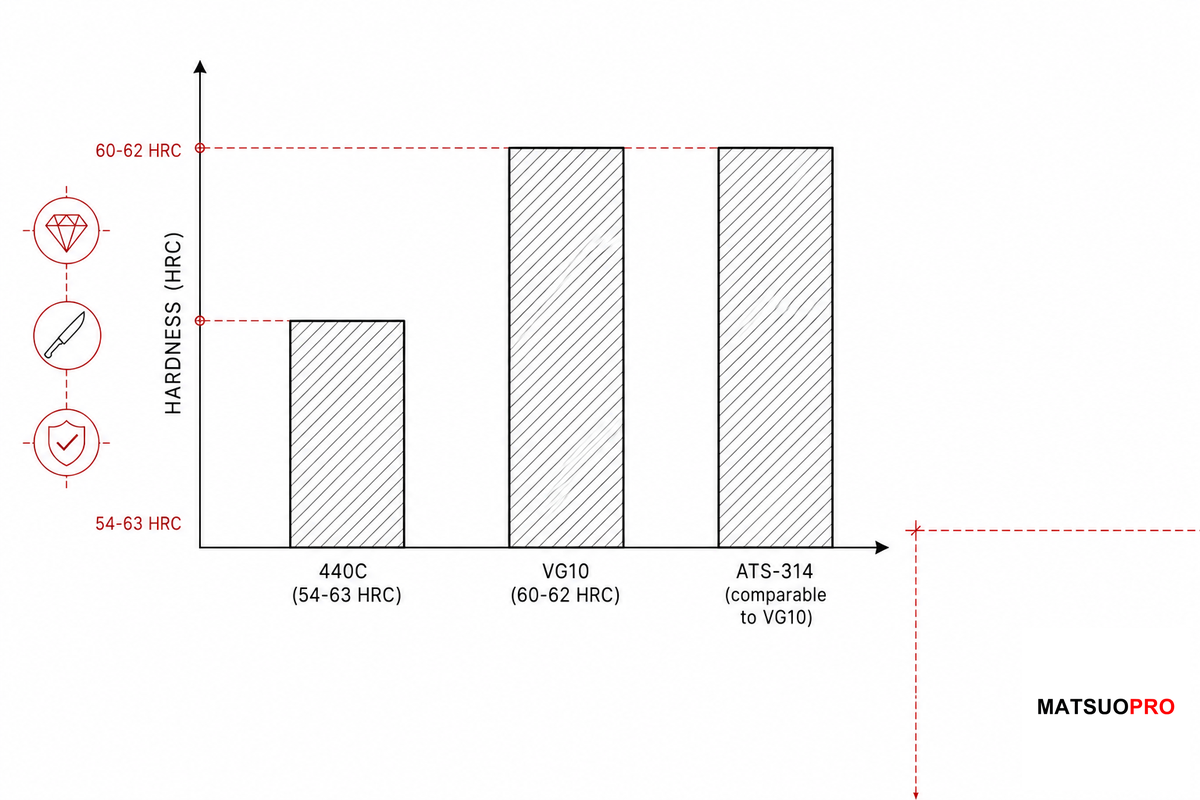
440c steel marks the low end of “serious” Japanese-style steel, not the high end. VG10 generally achieves a higher peak hardness level (60-62 HRC), thanks to additional alloying elements like cobalt and vanadium, which boost edge retention and prolong time between resharpens – sometimes by another 2-3 HRC points once heat-treat is dialed in. ATS-314 steel, an alloy produced by Hitachi, occupies similar territory with its own carbides, also benchmarked under ISO 6508 rather than a seller’s in-house method.
There’s no absolute winner, and both are more expensive than 440c, require more skill to sharpen at home, and their edge-holding advantages only truly materialize with the increased friction of those other techniques. That trade-off exists because pushing peak hardness higher is engineered to trade some toughness away, and it demands more precision in grinding and heat-treat to hit that hardness consistently, batch after batch – which is exactly why VG10 and ATS-314 shears cost more to manufacture in the first place.
In practice, that gap in use case only matters once your cutting mix pushes past moderate slide-cutting volume; for straight-edge, blunt cutting, the difference barely shows up across a working week. For a detailed comparison of 440c and VG10 steel, including metallurgical breakdowns and hardness data, check out our in-depth comparison, 440C vs VG10 Steel Explained.
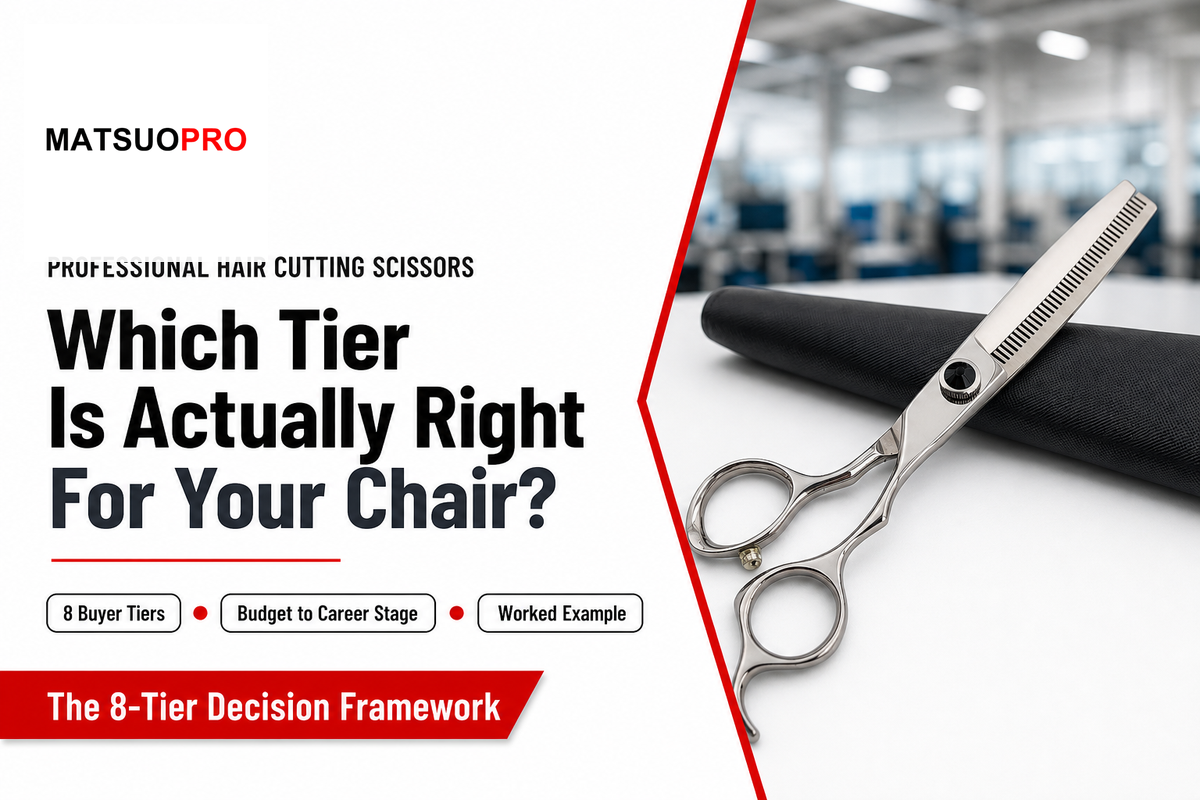
Steel choice for your 440c shears shouldn’t be about the best possible steel, but rather the best balance of cost, experience level, and the frequency with which you use high-friction cutting techniques. Worth noting: steel tier is only one input into this decision.
Occupational-health research on hairdressers ties repetitive cutting motion and tool weight/fit to a meaningfully higher rate of hand, wrist, and shoulder strain over a career, so handle ergonomics and blade weight deserve at least as much attention as the steel grade once you’re past the entry tier.
If you’re an average working stylist, investing in a professional quality pair of 440c shears from a professional barber supply shop, especially a pair with sensible ergonomic design (semi-offset or offset handle, adjustable tension) that fits your hand well, is usually the smart move. For stylists who land in a higher tier below, VG10’s cobalt-infused Japanese steel is the natural upgrade path. The table below breaks that call into 8-Tier Decision Framework bands – refer to it, and then work through the example calculation.
| Buyer tier / career stage | Typical budget | Cutting mix | Recommendation |
|---|---|---|---|
| Student / apprentice | $100–200 | Mostly blunt cutting, learning technique | 440C, entry configuration — the technique gap matters more than the steel gap here |
| Early-career, part-time chair | $150–400 | Mixed technique, moderate volume | Well-treated 440C (57–59 HRC range) is a genuine professional tool, not a compromise |
| Early-career, full-time chair | $200–450 | Mixed technique, higher volume | Well-treated 440C — prioritize a documented HRC and warranty over brand story |
| Mid-career, part-time chair | $250–500 | Growing texturizing share | 440C is still adequate; revisit the next tier once texturizing crosses roughly a third of your week |
| Established, full-time chair (moderate texturizing) | $400–700 | Balanced cutting mix, some slide-cutting | Well-treated 440C or entry-tier VG10 — either is a defensible call at this mix |
| Established, full-time chair (heavy texturizing) | $500–900 | Heavy texturizing / slide-cutting share | Consider VG10 or ATS-314 — the edge-retention gap pays for itself in sharpening frequency |
| High-volume specialist | $600+ | Daily high-friction technique, career-long tool | Premium cobalt/powder-metal tier; 440C would be under-specced for the workload |
| Competition / platform stylist | $800+ | Showcase precision work, minimal cutting volume | Steel tier matters less here than edge geometry and hand fit; any well-heat-treated tier works |
Suppose you’re a part-time stylist who makes 15 cuts per week on average; about 70% are blunt/scissor-over-comb cutting and the remaining 30% is texturizing. Consult the table-part-time chair + mixed technique = “well-treated 440c.” If you resharpen every 3-6 months (next section) and pay a $20-50 resharpening fee, a pair of $200 440C shears will cost roughly $80-200 annually in maintenance. That’s cheaper over 3 years than a $600 pair of VG10 shears on a matching maintenance schedule, because even though VG10 needs sharpening half as often, the upfront cost gap is bigger than the maintenance-frequency gap at this cutting volume. As you add more texturizing to your work-past 50% of your week, roughly-the cumulative effect of increased edge wear and therefore resharpening frequency will begin to favor the more expensive VG10 steel.
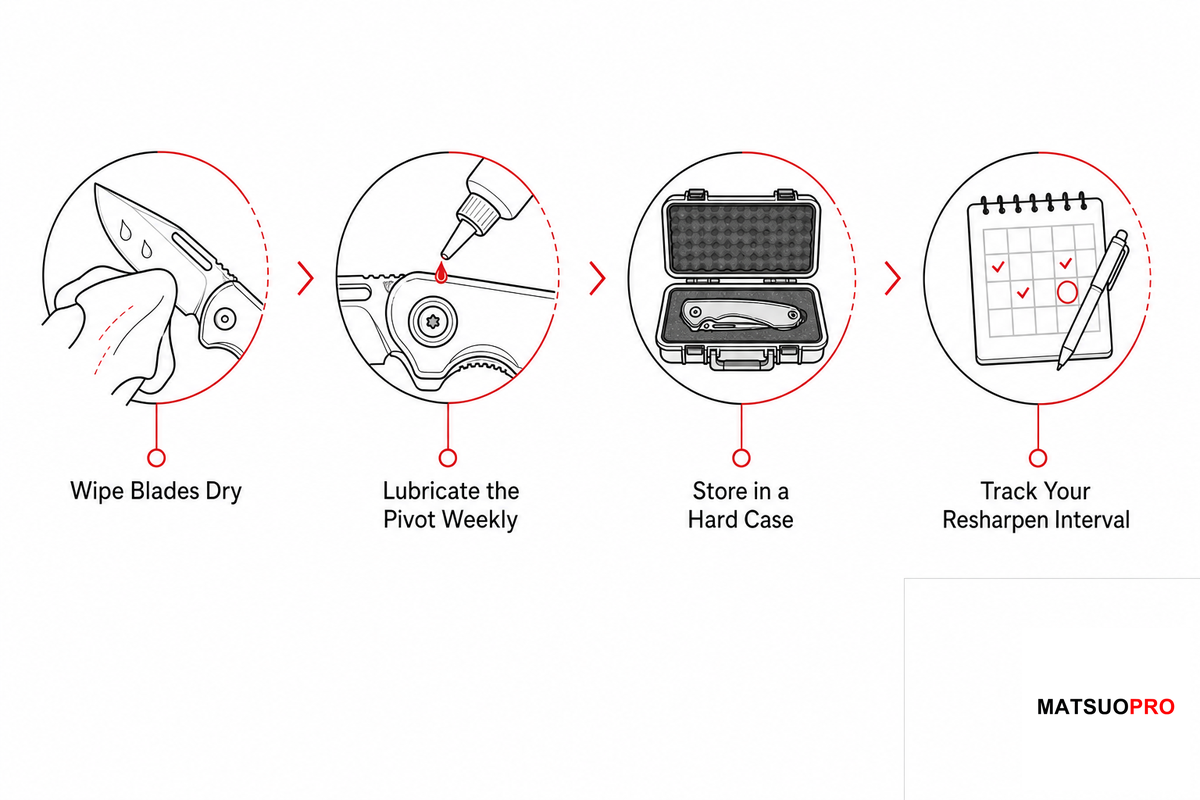
440c’s 16-18% chromium is what gives it corrosion resistance against the moisture and product residue that a shear encounters on a daily basis, but that resistance only extends to some basic care. Sharpening frequency for 440C shears trends very consistently across several independent sources, which is in itself information; when unrelated sources show consensus within a range, it’s a better indication than any individual’s claims. General guidance from professional sharpening services suggests every 3-6 months for full-time users and 6-12 months for part-time. A specific breakdown by a shear specialist assigns lower-hardness steels to 1-3 month intervals, mid-tier steels to 4-6 months, and higher-tier steels to year-plus schedules between professional services. An informal survey among working stylists indicated practical resharpening schedules from 2-4 months for heavy cutting to 9-14 months for low-volume work; a typical shear can handle around 20-30 sharpenings in its lifetime before the geometry wears past a simple regrind.
Independent sharpening services consistently frame the interval the same way: it is a range set by cutting volume and technique, not a fixed number stamped on the steel. A shear worked through eight hours of daily texturizing needs service on a completely different clock than the same shear sitting in a part-time kit, and the honest answer to “how often” is always “track your own use,” not a single number copied from a spec sheet.
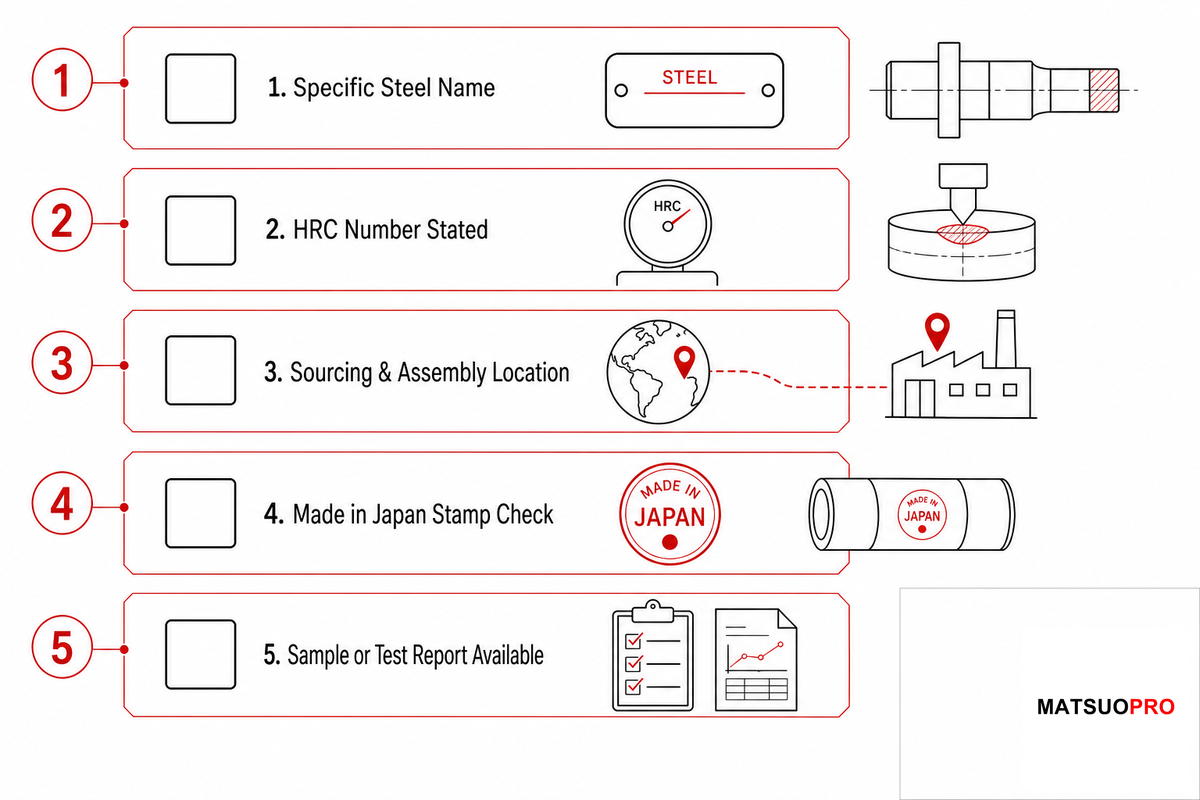
Since this level of detail is rare within the industry, it’s up to the buyer to inquire before purchase. Knife and cutlery buyers have wrestled with this same labeling confusion for generations, and the identifying habits transfer directly. Many high-quality traditional Japanese tools (including a large proportion of scissor and shear products) have origins in Seki City, the center of Japanese blade making for hundreds of years; while this is a rich history, a “handcrafted in Japan” or “made in Japan” claim by itself refers to the region of origin or craftsmanship, not necessarily the steel composition or its hardness level. Real professional hair cutting shears carry that designation by evidence, not rhetoric.
For a look at what a fully-answered checklist look like in practice, MATSUOPRO’s Japanese 440C hair scissors product page publishes the batch HRC band, composition range, and wholesale/OEM sample terms side by side.
One simple, direct question the listing fails to answer: what’s the hardness, and how was it measured? A legit seller of actual ASTM A276 440c should be able to answer this directly (no weaseling, the chemistry’s a spec you can test, not a secret) – otherwise, when you see a steel called “Japanese” with no grade and no commitment to prove it, treat that as exactly what it is: an unverified claim you’re paying a premium for. Not that the scissors are necessarily bad, it’s just that you don’t know what you’re buying.
Pressure here isn’t coming from changes to the chemistry of 440c (it hasn’t been altered), but from buyers who are no longer willing to take steel names on faith alone. That’s happening because buyers who skip the risk assessment in the checklist above tend to find out the hard way when a shear underperforms its claimed hardness – a gap that’s expensive to discover only after the sale. This broader demand for proof of origin and safety, even in less glamorous market segments like personal-care tools and haircare, is moving beyond just a ‘nice to have’ and heading towards a ‘must-have’ as we head into 2026, and hairdressing-tool shoppers are a part of this trend: a stylist looking between two identical “japanese 440c” options now increasingly seeks out a supplier with the data to back it up, not just someone shouting about being “Japanese.” This isn’t a marketing issue, it’s a disclosure issue; the retailer audit exists to spotlight the gap.
Look for two things over the next 1-2 years. First, the hardness testing standards continue to get more stringent, and recent revisions of ISO 6508 and ASTM E18 since 2023 mean that citing old test documents as “current” is a reasonable red flag, not a pedantic technicality. Second, and in the long run more importantly, as buyers start to ask the five questions in the checklist above, suppliers who already have concrete answers (batch hardness reports, clear chemical composition sheets, plain statements of origin) have a genuine competitive edge, built around plain, checkable disclosure rather than a name on a listing. For context only: current estimates place the hair scissors category globally in the low $100M range and it will grow into the early 2030s, with 440c and other ti-coated lines cited as key growth drivers – a market trend signal, not an endorsement of any single product.
The statement “japanese 440c” doesn’t inform you about how meticulously the specific batch was heat-treated. Request the hardness value and the methods of verification instead of treating the country name as a measure of quality.
MATSUOPRO produces high-end hair, barber, and pet-grooming shears, including a japanese 440c series that’s precisely heat-treated within a disclosed, batch-verified HRC range of 57-59, one of the practices this guide suggests should become industry standard. We produced this market audit because the lack of transparency documented here’s a reality that need to be highlighted, even in instances involving businesses other than our own.
Review performed by the technical team at Mackay Group Asia Limited.
MATSUOPRO is the Mackay Hair Scissors manufacturing brand for professional hairdressing shears, barber scissors, thinning shears, and pet-grooming scissors. We support salons, distributors, academies, grooming brands, and private-label buyers that need factory-direct production with practical material guidance.
Our buying guides are written to help purchasers compare steel grades, handle styles, blade geometry, surface finishes, logo options, packaging, MOQ, and sample validation before placing an OEM or wholesale order. The goal is to make each scissors specification easier to discuss with a real production team.
Factory-direct supply since 2014, with product lines covering professional cutting shears, barber shears, thinning scissors, texturizing scissors, left-handed models, and pet grooming scissors for international B2B customers.
We focus on Japanese 440C, VG10, and ATS-314 steel choices, convex and bevel edge geometry, ergonomic handle balance, tension systems, logo engraving, private-label packaging, and sample-based OEM confirmation.