Get in Touch with Mackayhairscissors Company
We use submitted details to respond to your quote request. Read our Privacy Policy.

Updated July 2026. Reviewed by the Mackay Hair Scissors technical team.
VG10 hair shears are professional hair cutting shears forged from VG10 Japanese stainless steel, the mid-tier benchmark grade that shows up across dozens of unrelated brands at prices from around $130 to well over $1,000. That price spread confuses more buyers than the steel itself does. This guide isn’t another composition chart, two sibling articles on this site already cover the metallurgy and the Rockwell hardness science in depth. What follows is the part almost nobody publishes: who actually sells VG10, what it really costs across the market, whether upgrading is worth it for your situation, and how to own a pair once you’ve bought one.
| Steel origin | Takefu Special Steel, Fukui Prefecture, Japan |
| Typical hardness | 60-62 HRC |
| Market price range | ~$130 entry to $1,000+ flagship (guide prices, move with brand and stock) |
| Common sizes | 5.0″-7.0″, offset/crane/swivel handles |
| Edge type | Convex (hamaguri), hand-honed on most professional lines |
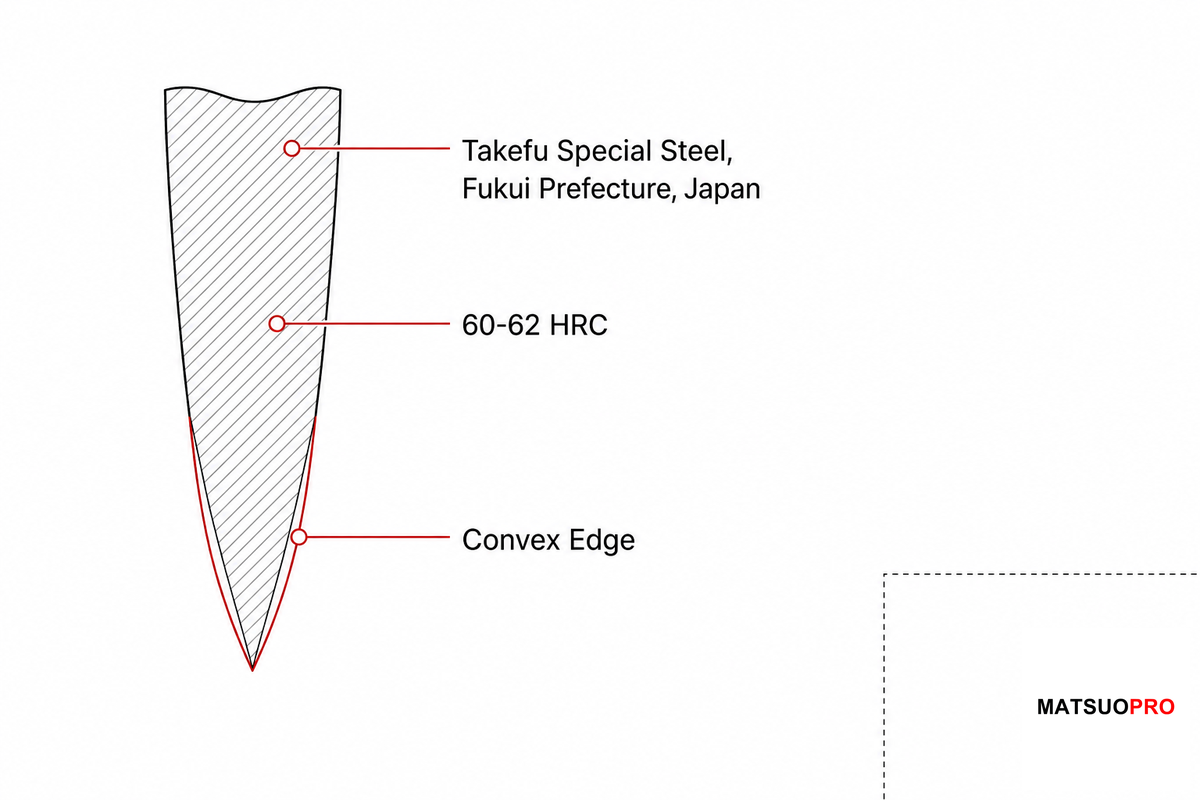
VG10 is a proprietary Japanese stainless steel produced by Takefu Special Steel in Fukui Prefecture, carrying roughly 1% carbon, about 15% chromium, and a cobalt-vanadium addition that most professional lines harden to a 60-62 HRC working range. That single fact answers the question most buyers actually have, which is simply “what am I looking at when a listing says VG10.”
Composition-to-hardness relationships, corrosion chemistry, and the full comparison against 440C are their own subject, and they already have a dedicated home on this site. If you want the atomic-level breakdown, read 440C vs VG10 Steel Explained. If you want the Rockwell hardness science itself, what the 60-62 HRC number physically measures and why harder isn’t automatically better, that’s covered in Understanding the HRC (Rockwell C) Hardness Scale. This guide starts where those two leave off: what happens after you’ve decided VG10 is the grade you’re considering — whether you’re a working stylist buying one pair or a shop owner sourcing hair cutting tools for a whole chair line.
VG10 isn’t the only Japanese grade professional stylists and barbers compare it against. Hitachi’s ATS-314 and the ZA-18 alloy show up on the same supplier catalogs, and Japanese 440C remains the volume workhorse — knowing roughly where VG10 sits between those grades matters more than memorizing the full composition table, which is exactly what the sibling metallurgy guide linked above is for.
A “VG10 hair shears” listing tells you the alloy, not the build quality. Two shears stamped with the identical steel name can perform very differently once heat treatment, grinding, and hand-honing are factored in — the sections below are built around that reality, not just the steel name.
Search interest around VG10 shears doesn’t cluster on one brand, it spreads across a recognizable set of names. Real search-volume data shows Joewell and Kenchii each pulling around 1,300 monthly searches in the US, Yasaka running 320-720/month, and the generic phrase “scissor brands” itself drawing 390/month, all figures independently gathered this session via DataForSEO, not estimated.
Layer that against the actual SERP and buyer’s-guide landscape and a structure appears that nobody selling shears seems to describe directly. Saki Shears markets its flagship line as a “Grand Master” hair shear tier, and other heritage names run similar top-of-catalog badging, while a second tier of professional hair shears — often the same premium Japanese VG10 steel, hand-forged and hand-honed the same way — sells for a fraction of the price once you step outside that badge marketing.
Craftsmanship claims are easy to make and hard to verify from a product photo, so treat “handcrafted” or “artistry” in a listing as a starting question, not a finished answer: ask what part of the process was actually done by hand versus by machine, and whether the seller will say so plainly.
Many premium VG10 hair shear lines also offer matching thinning shears (sometimes listed as thinning scissors or hair cutting and thinning sets) on the same VG-10 Japanese steel core, which lets a stylist standardize an entire kit without mixing grades between cutting and texturizing tools — worth confirming with the seller rather than assumed. A smaller number of makers also offer Damascus-pattern or sword blade-style VG10 lines for stylists who want the pattern as well as the performance, though the core steel underneath the cladding is still what actually does the cutting.
Nearly every VG10 shear sold traces back to one of two channels, and knowing which one you’re buying from changes what questions are worth asking. This split holds for barber shears as much as it does for stylist-focused hair shears — barbers shopping VG-10 steel for scissor-over-comb work see the same two-channel pattern.
Neither channel is inherently better; they solve different problems. One pair for a stylist’s own kit is usually a channel-one purchase, while multi-unit sourcing for a salon chain, distributor, or private-label brand is usually better served by channel two, where MATSUOPRO’s own VG10 hair shears line publishes its composition and hardness certificate rather than asking buyers to take a brand name on faith.
“We hear from buyers who assume the badge on the handle tells them something the steel doesn’t. Most of the time it just tells them who did the marketing.”
Mackay Hair Scissors engineering team
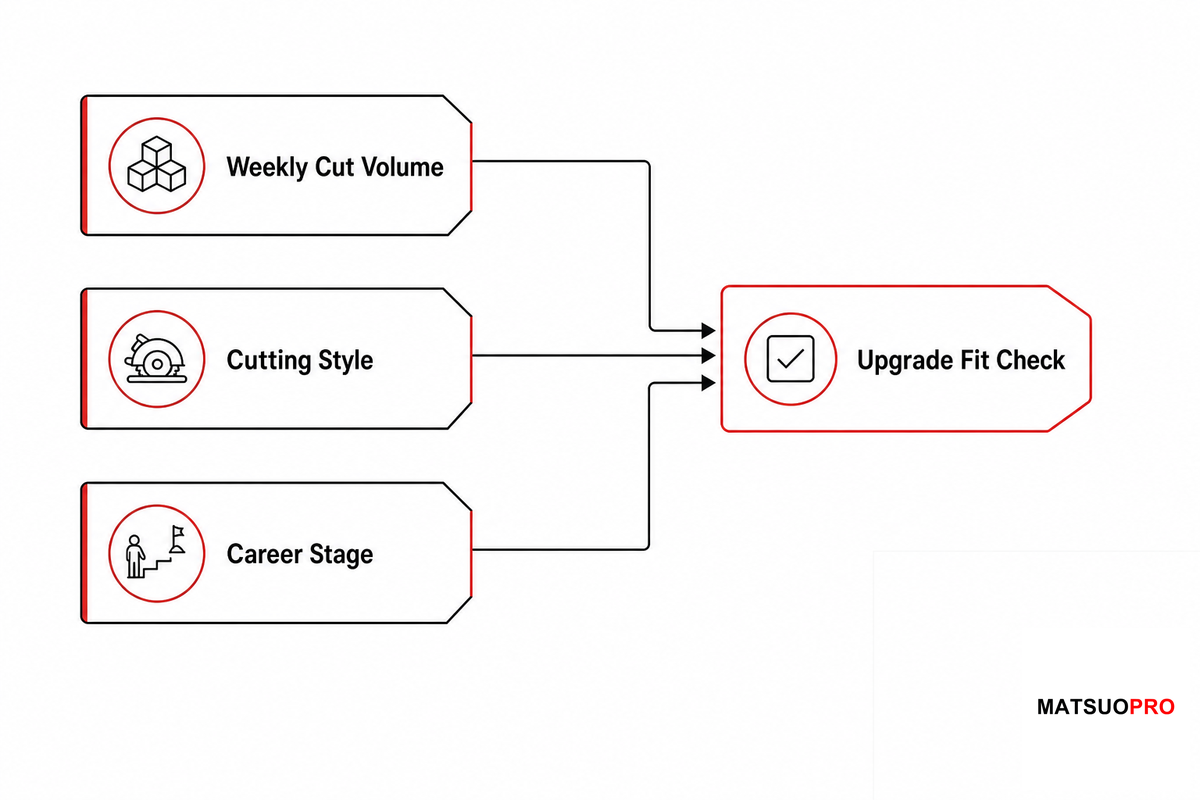
Not every stylist should spend the extra money on VG10, and the honest answer depends on three things: how many heads you cut per week, what cutting style you actually use, and where you’re in your career. The fit check below breaks those three factors into concrete bands rather than leaving it as a vague “it depends,” so you can place your own situation on the table and get a straight yes, no, or borderline answer.
| Weekly volume | Cutting style | Career stage | Fit check |
|---|---|---|---|
| Under 15 cuts | Wet, blunt-heavy | Student / apprentice | Not yet — a 440C pair holds up fine and resharpens more forgivingly while you build technique |
| 15-30 cuts | Mixed wet/dry, some slide cutting | Working stylist | Borderline — VG10 starts paying back once the gap between sharpenings starts costing real time |
| 30+ cuts | Dry cutting, slide, texturizing | High-volume / specialist | Yes — the longer edge life and finer factory edge earn their keep at this pace |
| Any | Frequent drops, rough handling | Any | Reconsider — VG10’s hardness trades away some drop tolerance versus 440C |
Cutting techniques matter as much as raw cut count. A stylist doing mostly wet, blunt haircutting sees far less benefit from VG10 than one doing dry hair work, slide cutting, or heavy texturizing, where a finer factory edge is felt on every pass. Professional hair scissors marketed for “professional haircutting” or general-purpose steel hair shears use are usually a safe, technique-agnostic starting point if you’re not sure which bucket you fall into yet.
Usually not yet. A 440C pair holds a clean edge through training and resharpens more forgivingly at a lower entry price while technique is still developing, and industry buyer’s guides consistently point new stylists toward that grade first. VG10 starts paying for itself once you’re cutting full columns of clients and the gap between sharpenings starts mattering to your schedule and your wallet, for most stylists, that’s a second-pair decision, not a first one.
None of this is a knock on VG10 as a grade, it’s a matter of matching the tool to where you’re right now. For a steel-agnostic framework that walks through sizing, edge type, and technique fit before you even get to grade selection, see How to Choose Hair Salon Shears Without Buying the Badge.
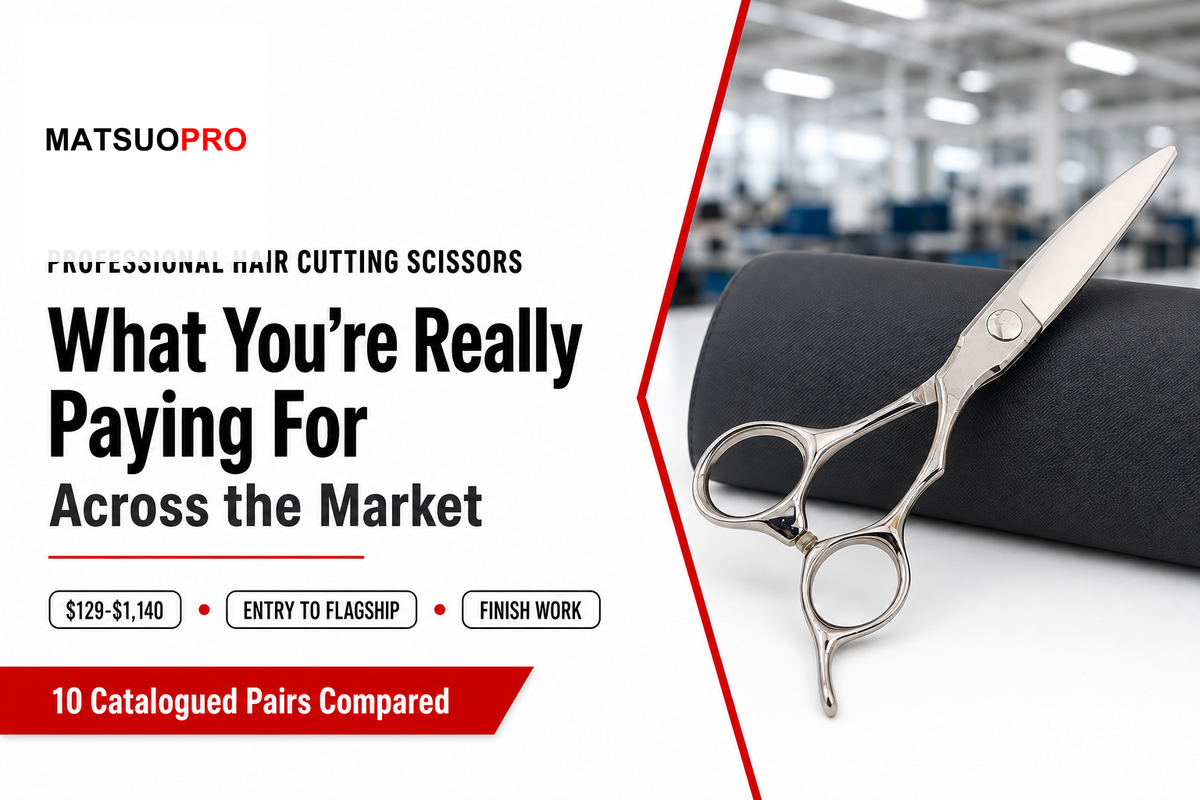
Verified market pricing (guide prices checked against product listings, one professional buyer’s-guide source, dated mid-2026) shows VG10 shears spanning roughly $129 at the low end to over $1,000 at the flagship tier, with the busiest price band sitting around $180-$275 where most mainstream brands compete.
Shoppers comparing a specific VG10 hair shears review against listings for sale on Amazon or a brand’s own site will see the same steel priced differently depending on which of these tiers it sits in. These are guide prices, not fixed figures, they move with brand, handle finish, and stock, and the source data itself is a single professional buyer’s-guide index rather than a cross-verified price database, so treat the bands as a way to sanity-check a quote, not a contract. What you’re paying for as the tier climbs is mostly handle engineering, tension systems, and finish work, not a different steel, the alloy is the same VG10 family at $130 and at $1,000.
| Model | Price tier | Guide price | Sizes |
|---|---|---|---|
| Juntetsu Classic II | Entry | $129 | 5.5″ / 6.0″ |
| Juntetsu VG10 Azure | Entry | $181 | 5.5″-7.0″ |
| Ichiro Premium Taiyo | Entry | $185 | 6.0″ |
| Kasho Design Master Offset | Mid | $227 | 5.0″-6.0″ |
| Juntetsu Matte Black Offset | Mid | $259 | 5.0″-7.0″ |
| Shihan Meister | Mid | $275 | 5.75″ |
| Toki AB S Series | Premium | $400 | 5.5″ / 6.0″ |
| Osaka Mikazuki | Premium | $488 | 5.5″-6.3″ |
| Matakki Talon | Premium | $489 | 5.5″ / 6.0″ |
| Kasho Green Series 7.0 | Flagship | $1,140 | 7.0″ |
Shopping the per-pair retail ladder isn’t the only option, the factory-direct/OEM channel prices around minimum order quantity and volume instead of a single sticker price, which is worth knowing if you’re sourcing for a salon chain or building a private-label line rather than buying one pair. MATSUOPRO’s own VG10 sourcing terms follow this second pattern, quoted by MOQ and sample lead time rather than a single retail price tag.
Whichever channel you buy from, the price tier itself isn’t a proxy for build quality. Build quality can invert the price ladder outright, a well-honed mid-tier pair at $220 can out-cut a $400 pair that skipped the hand-finishing step, so treat the bands above as what the market charges, not what any specific pair is actually worth in your hand.
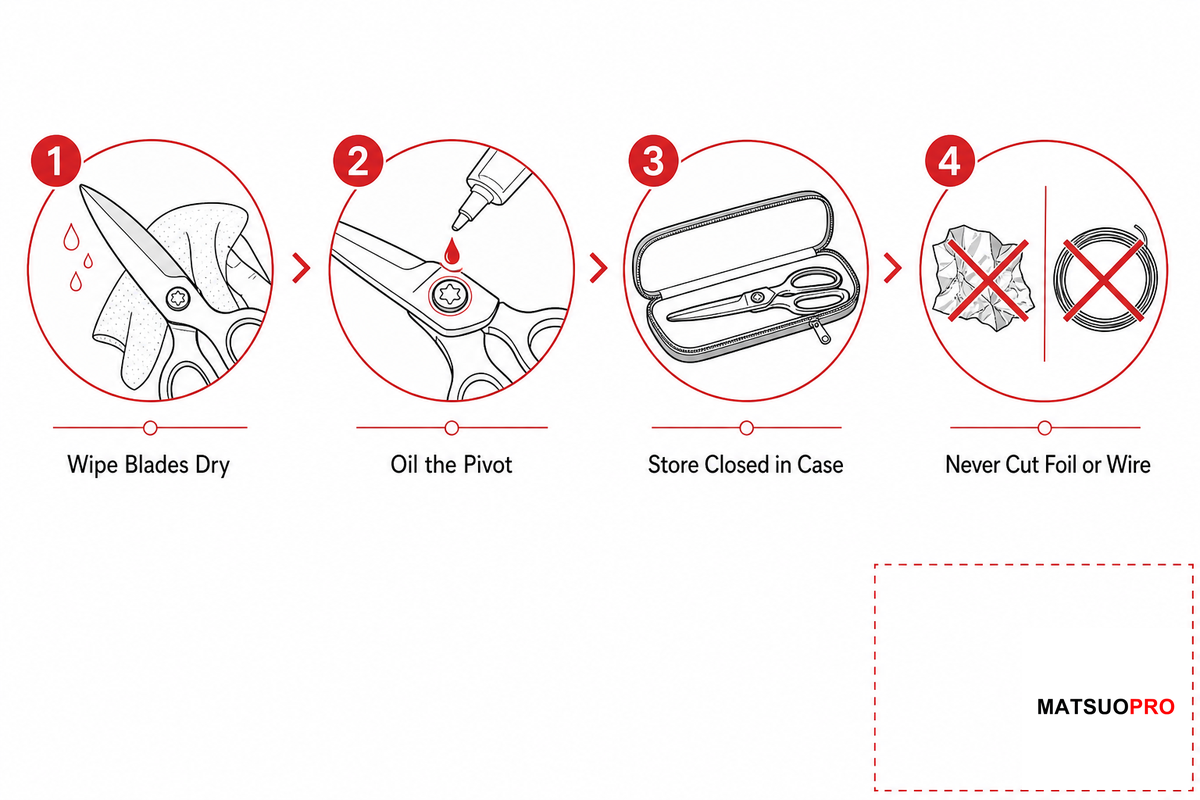
Sharpening intervals get plenty of coverage. What almost nobody publishes is the routine care that happens between sharpenings, the habits that determine whether a VG10 pair reaches its full working life or starts chipping and staining well before it should.
A common mistake is treating “VG10 = low maintenance” as meaning no daily care at all. Longer sharpening intervals only apply to the edge itself — the pivot, the surface finish, and the handle still need the same daily attention any professional tool needs, and skipping that routine is how a shear ends up needing an early, avoidable resharpening.
For the actual sharpening cadence and grit progression once a pair does need it, that ground is already covered step by step in 440C vs VG10 Steel Explained‘s grit-to-hardness table, this section is deliberately about what happens on every other day, not sharpening day.
Edge retention is what most buyers actually mean when they ask for “razor-sharp, long lasting” cutting blades, and daily care is what protects that investment between visits to the sharpener. A well-cared-for VG10 pair delivers clean, razor sharp cutting and enduring sharpness for years as a premium professional grade Japanese steel tool; a neglected one loses its edge fast regardless of the steel underneath. This same routine applies whether the shears are plain VG10 or a Damascus-pattern line with a VG10 core wrapped in patterned cladding — the cladding is cosmetic, the core steel still sets the maintenance rules.
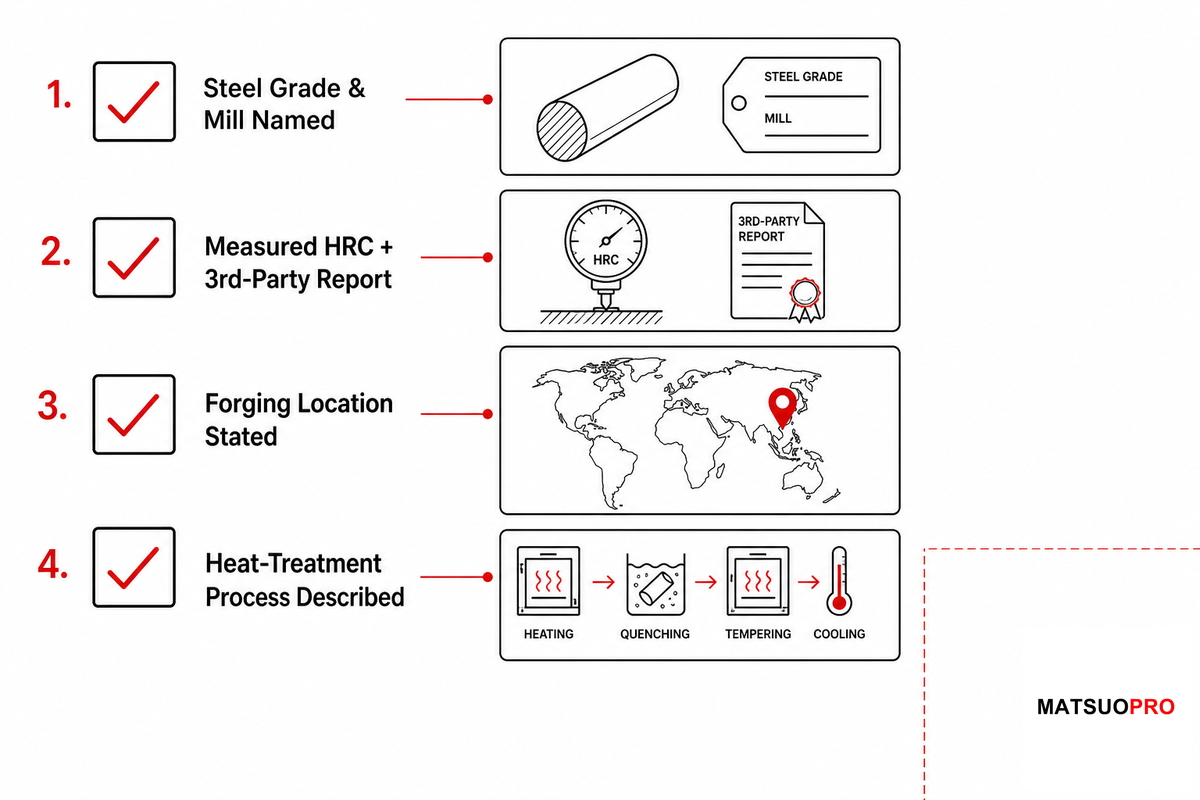
Printing a steel name on a pair of cutting shears proves nothing by itself, and the risk isn’t hypothetical: picture a stylist ordering a “VG10” pair from a marketplace listing with no composition source, no measured hardness, and no forging location behind the claim. In practice the only real test they get is the edge itself, months into daily use, because a genuine 60-62 HRC VG10 edge and a mislabeled 56-58 HRC substitute both look identical in a product photo, and by the time the difference shows up the return window has usually closed. Whether you’re buying from a heritage retail brand or a factory-direct supplier like MATSUOPRO, the same four questions separate a verifiable claim from a marketing paragraph before that gamble gets made.
Answering all four in a specific sentence is what separates a seller giving you verifiable data from one leaning on adjectives — “premium,” “professional-grade,” “expertly crafted” — without a grade, a number, a location, or a process, and that pattern holds regardless of which of the two market channels you’re buying from. This framework is a market-wide version of the same four questions this site’s own HRC hardness guide uses to check any hardness claim, not just a VG10-specific one, and the logic holds for any hardened steel tool.
One practical filter: ask before you commit, not after. A seller willing to send a sample or a spec sheet ahead of a bulk order is signaling confidence in the answers; one who only offers assurances after payment is a reason to slow down, whichever channel you’re buying from.
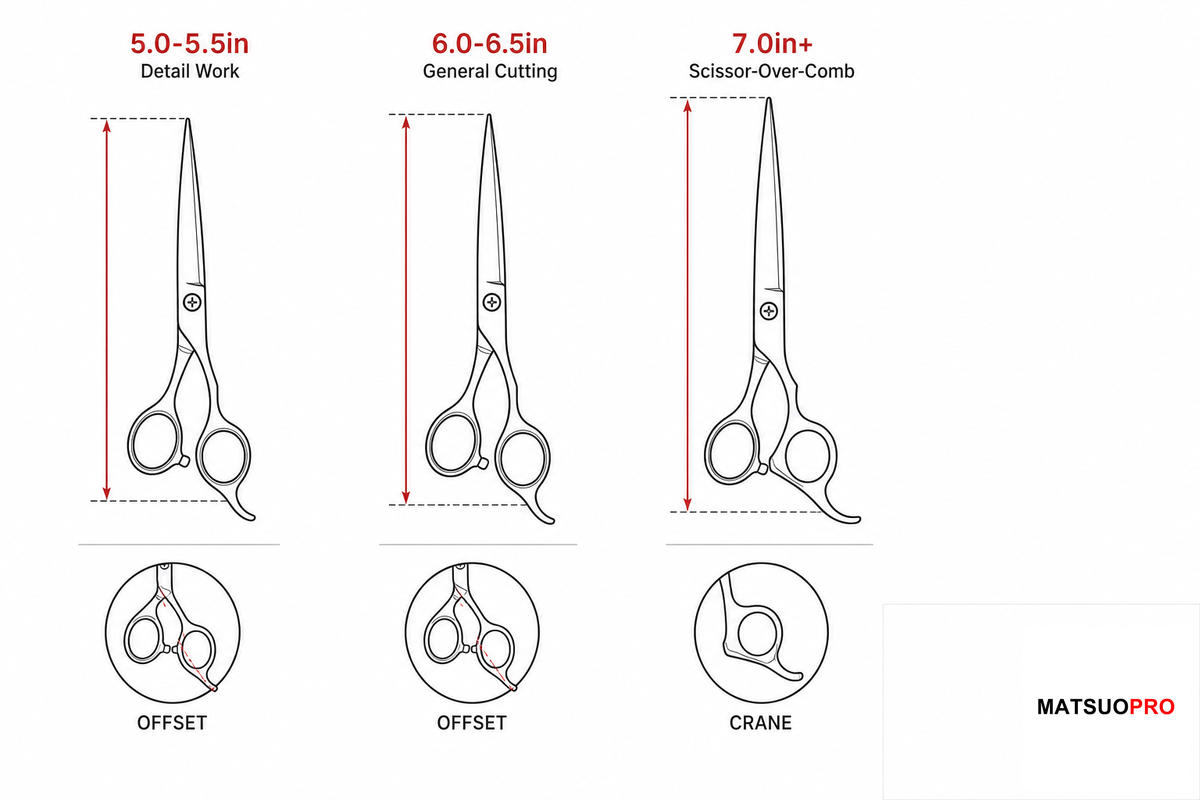
VG10 shear lines across the market run 5.0″ to 7.0″, and the right length has more to do with your technique and hand size than with the steel grade itself.
| Length | Best fit | Handle notes |
|---|---|---|
| 5.0″-5.5″ | Precision, point cutting, smaller hands | Offset handle standard on most lines |
| 6.0″-6.5″ | General salon cutting, most common size sold | Offset or crane, depending on hand fatigue |
| 7.0″+ | Scissor-over-comb, barbering, longer reach | Crane or swivel-thumb reduces wrist strain at this length |
Fit matters most at the higher end of the size range. An ergonomic crane or swivel-thumb handle keeps the wrist in a more neutral position across a full chair day, and that difference shows up fastest on longer blades, where torque on the joint and hand fatigue add up over repeated cuts. If you’re choosing between edge types as well as sizes, that decision is covered alongside sizing in How to Choose Hair Salon Shears Without Buying the Badge.
One sizing mistake shows up more than any other: buying the same length as a stylist you admire without accounting for hand size. Someone with a large hand might feel perfectly balanced holding a 7.0″ shear with a full finger rest, but the same pair can feel front-heavy and fatiguing well before the end of a shift in a smaller hand, regardless of how good the steel underneath it is. Getting an ergonomic offset handle, sound ergonomic design, and precise cut geometry matched to your own grip does more for a full day’s comfort than chasing an extra half-inch of blade length. The 6-inch length is a common haircut workhorse size across professional-level lines and a reasonable default if you’re unsure where to start.
Search demand for VG10 itself has stayed close to flat over the past year, with a mild bump each November-December and no clear multi-year growth trend visible in the available data, a background detail, not the point of this section.
Related searches around this topic tell their own story: “vg10 hair shears review,” “best vg10 hair shears,” “vg10 hair shears for sale,” and “vg10 hair shears amazon” all point to buyers who already know the steel and are hunting for a specific pair, not asking what VG10 is. Something more consequential is shifting one layer up, in how those buyers actually research a purchase. Checking Google’s AI Overview for “VG10 hair shears” directly during this guide’s research turned up a multi-brand price landscape, specific model names, price points, and handle features, pulled together automatically, and citing individual retailer and brand pages, not a single review authority. Sellers who don’t publish a verifiable steel source, a measured hardness figure, and a stated forging location are increasingly invisible not just to a browsing buyer, but to the AI layer now doing a chunk of that research for them. That’s a real, checkable shift, not a projection: ask any seller for those three data points before you buy, because it’s now also what determines whether they show up in an AI-generated answer at all.
“VG10” as a name should mean the full Takefu-specification alloy, while marketing phrases like “VG10-infused” or “VG10 cobalt blend” often signal a modified or diluted composition that doesn’t match the original mill spec. If a listing uses a qualifier alongside the steel name instead of stating VG10 plainly, that’s worth a direct question to the seller about the actual composition, not an assumption either way.
Not a different method than other professional shears use, but the stakes are higher if you skip it. VG10’s added hardness makes the edge less forgiving of a rap against the inside of a carrying case or contact with other sharp-edged tools in transit, so a hard case or padded pouch matters more here than it would for a softer, lower-hardness pair.
Most VG10 content is either a single retailer’s spec sheet or a “best of the best” ranking article, and neither tells you whether the higher spec is worthwhile for your own situation or what happens to the shear after the sale. We publish our own VG10 hardness and composition certificate on our product line for exactly that reason: a steel’s designation name is a starting point, not the full story. Reviewed by the Mackay Hair Scissors technical team.
MATSUOPRO is the Mackay Hair Scissors manufacturing brand for professional hairdressing shears, barber scissors, thinning shears, and pet-grooming scissors. We support salons, distributors, academies, grooming brands, and private-label buyers that need factory-direct production with practical material guidance.
Our buying guides are written to help purchasers compare steel grades, handle styles, blade geometry, surface finishes, logo options, packaging, MOQ, and sample validation before placing an OEM or wholesale order. The goal is to make each scissors specification easier to discuss with a real production team.
Factory-direct supply since 2014, with product lines covering professional cutting shears, barber shears, thinning scissors, texturizing scissors, left-handed models, and pet grooming scissors for international B2B customers.
We focus on Japanese 440C, VG10, and ATS-314 steel choices, convex and bevel edge geometry, ergonomic handle balance, tension systems, logo engraving, private-label packaging, and sample-based OEM confirmation.