Get in Touch with Mackayhairscissors Company
We use submitted details to respond to your quote request. Read our Privacy Policy.

MATSUOPRO’s 40- to 46-tooth blending shears slice weight, not your line – built factory-direct in VG10 or 440C Japanese steel at HRC 60-64, with zero markup from supplier to your bench. Every pair comes with a stated steel grade, a hand-honed Japanese convex edge, and an indicated country of origin. Try a single stocked model, or launch your private label program from 50 pieces.
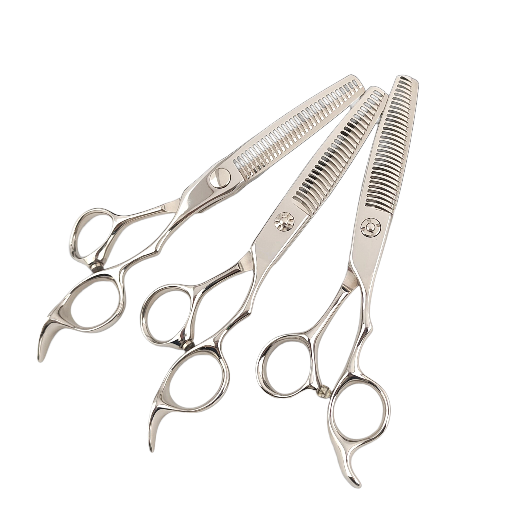
Unlike a straight hair-cutting shear, a blending shear pairs one straight blade with one toothed blade, and at 40 teeth or more it shaves off only a thin fraction of weight per pass so the cut and uncut hair fall together with no visible line. That is the tool’s whole job: soften, not sculpt. The trouble starts when you try to buy the same result twice.
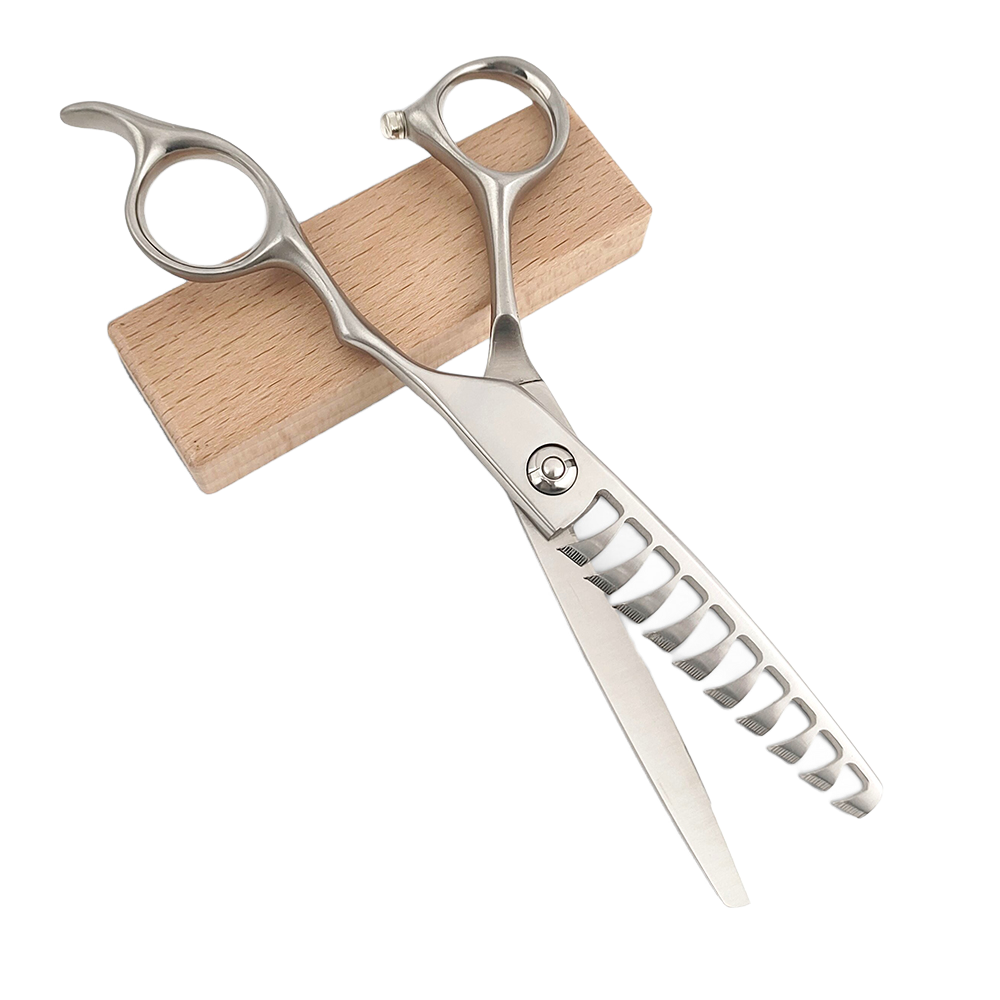
Tooth count is merely a marker; true removal rate is dictated by spacing, tooth width, tooth depth and the shear’s blade design (documented in US Patent 4,660,285). So even two shears advertised as 40T can perform differently.
This leads to three barriers when you’re shopping for the perfect blending shear:
There is a fourth wall, and it is emotional.
Search “thinning shears” and the loudest voices are stylists who felt burned — “my hair was ruined… shredded, frizzy, split ends” — because a dull or badly-spaced blade shredded the cuticle instead of slicing it.
MATSUOPRO eliminates each of these barriers through transparent, verifiable production: our full-scale, in-house operation, overseen by ISO 9001, manages everything from raw steel forging and vacuum heat treatment to CNC precision grinding and 100% inspection. This enables us to declare the exact steel grade and measured HRC, chart the precise tooth-count-to-removal matrix, etch each pair with its country of origin, and consistently replicate the same build across orders of 50 to 50,000 units. We explain this process thoroughly throughout this page.
Sourcing a consistent blender program? Request a quote and a sample to verify the spec first.
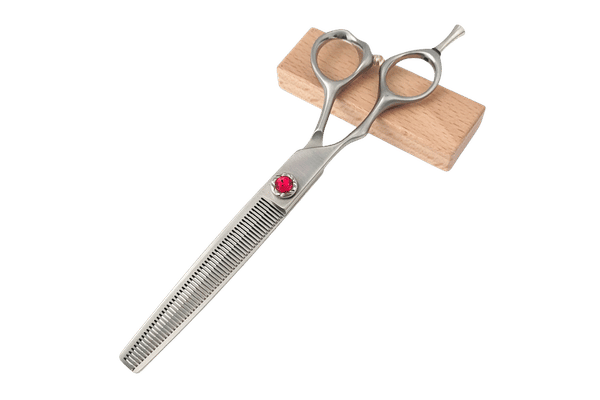
Get Instant Quote →Our flagship is our singular, in-stock offering: the MP-SC-046, engineered to flawlessly blend fine hair in a salon setting or provide the final touch in pet grooming, without any lines. Any configurations above this flagship-in varying steel types, sizes, tooth orientations, or handle styles-are customizable to your specifications. Unlike the extensive, often misleading options in online catalogs, we present just one straightforward flagship model and build the rest to your unique requirements.
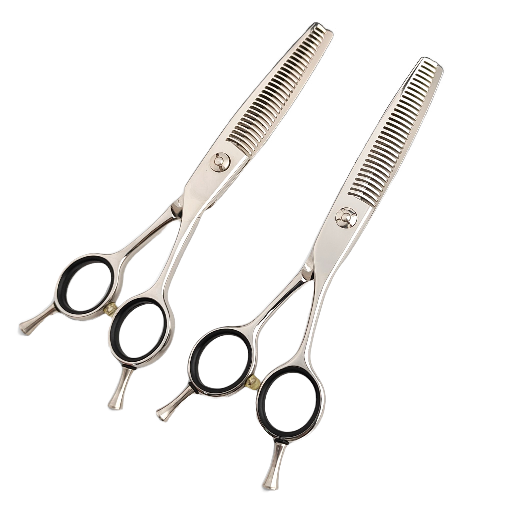
Need a different balance of edge life, price and finish? Same fine-blending geometry shipped in four steel grades and three tooth configurations. This is where your decision matrix comes to the fore.
If your end market is fine or thinning hair, spec the reverse-teeth build. With the smooth blade on the underside, the cut line sits away from the hair surface, so the blend reads even softer. It is a small feature on the order form that saves your stylists from chasing cut marks on the chair.
The problem with this job is that it is the consistency, where many suppliers subtly fail. As the entire process — forgings, heat treating, CNC grinding to ±0.01 mm, testing via Rockwell — happens under ISO 9001, your ten-thousandth pair will have the same HRC 60-62 and tooth geometry as your accepted sample — not some lottery ticket ground off a traded blank.
So that you don't take this on faith, here's the real truth to a chart everyone uses as gospel: no industry-wide standard for "cut percentage," and each brand has a number with a meaning all its own. What you see next is our MATSUOPRO Tooth-Count to Removal Blending Matrix - our empirically tested per-pass numbers, with a huge caveat: tooth geometry is the determining factor, not the number of teeth alone.
| Teeth | Class | MATSUOPRO removal / pass* | Cut visibility | Best for |
|---|---|---|---|---|
| 7–15 | Heavy Texturizing / Chunking | 40–50% | Visible, chunky | Aggressive debulk, coarse hair, strong texture |
| 16–24 | Texturizing | 25–40% | Visible separation | Movement, piecey texture |
| 25–35 | Standard Thinning | 25–35% | Low | Everyday weight removal, medium density |
| 40–46 | Fine Blending (MP-SC-046) | 10–20% | None — line-free | Finishing, fine hair, eye/nose detail, pet finishing |
"More teeth, less hair." That clean rule everyone repeats is simply incorrect mechanically. Tooth geometry dictates outcome, not tooth count; it's written in patent law.
In U.S. Patent 4,660,285, the solution for blending hair line-free isn't the number of teeth, but using them at differential lengths. This cuts hair to varying lengths on a single stroke, so the "visible steps detrimental to the appearance of the hair-style" disappear.
Similarly, U.S. Patent 7,841,091 (still active) describes staggered long and short teeth to do the same and reduce the conventional 14° to 3°-7° blade edge angle to expand the entry zone. The number of teeth is just a proxy; it's the teeth shape and edge angle that are your variables.
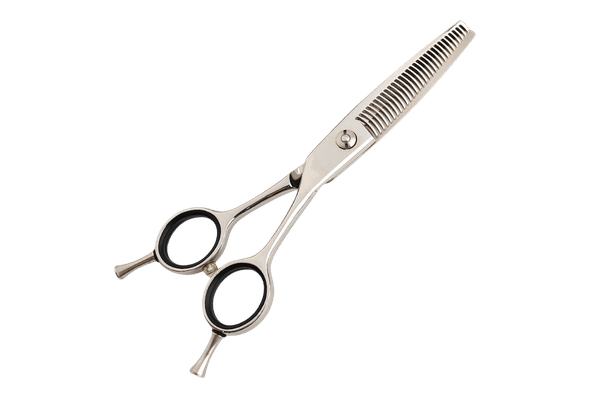
Explore the thinning and texturizing shear collection for related options.
Customers break their own work, picking the wrong type of toothed shear - a chunker when they should have used a blender. There are four distinct tools here, not four different ways to say the same thing. This matrix is the tool-type matrix we distribute to dealers.
| Dimension | Fine Blender (40–46T) | Standard Thinner (25–35T) | Texturizer (16–24T) | Chunker (7–15T) |
|---|---|---|---|---|
| Removal / pass | 10–20% | 25–35% | 25–40% | 40–50% |
| Tooth spacing | Narrow | Narrow-medium | Wide | Very wide (fishtail) |
| Cut line left | None | Faint | Visible | Chunky notches |
| Primary job | Blend, soften, finish | General weight removal | Texture, movement | Fast debulk |
| Right hair type | Fine / already-thinned / detail | Medium-thick | Medium | Thick / coarse |
| Stage of cut | Last 10% — finishing | Mid-cut | Mid-cut | Early bulk |
| MATSUOPRO model | MP-SC-046 (40T) | MP-SC-036/38 (30T) | MP-SC-045 (14T) | MP-SC-044 (10T) |
Take-home value for a stylist: A fine blender adorns a hairstyle, it doesn't construct it. 40-teeth in dry hair, away from the root, should be your final finishing softness pass - reach for a smaller count when you actually need to displace weight.
Unlike sellers who lump every toothed shear under "thinners," we build each class to a distinct geometry — because the trade-off between removal speed and finish is set at the grind, not on the label. Every MATSUOPRO class is CNC-ground and Rockwell-tested to the same HRC 60–62 standard, so the only variable you choose is tooth count.
Sizing a mixed program across all four classes?
Request a custom comparison and a quote for your market.
Steel grade is the single spec most brands hide and most buyers should demand. Unlike a house-name "proprietary steel," every grade below is a named high-carbon stainless steel; what separates them is composition and heat treatment, and those decide edge life, resistance to chipping, and how long the blade slices instead of pushes. Here is our full ladder, grades and hardness published, nothing withheld.
"A low quality shear will push the hair so much that you need to sharpen it every 1-2 months," warns one industry guide — the hidden running cost of buying on price. A properly heat-treated VG10 edge, by contrast, holds 5–8 months between services.
MARKET INSIGHT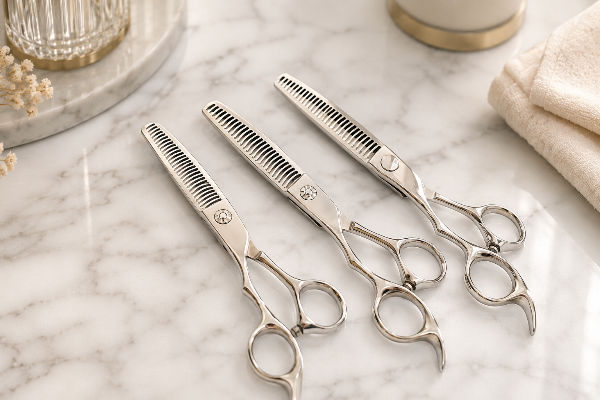
* Hardness data is the company's own published heat-treat data per grade - Rockwell C, confirmed on every pair - it's not inherent to the alloy itself, as HRC varies with heat treatment depending on maker.
One HRC number, taken at one point, doesn't by itself predict the life of an entire shear's blades. Heat treatment-the part you can't see and the reason cheaper makers cut corners-is just as important as grade. This is why we verify Rockwell C hardness on each and every shear and can give you a third party hardness report with test method and location.
A Couple of honest remarks regarding the above. VG10 is made by Takefu Special Steel - and on unbiased testing shows 60.7 Rc, right inside our published band. ATS-314 is Hitachi steel and includes cobalt. We know that only a few companies truly produce and use this quality steel, so to avoid you trusting in our name only, we'll furnish the mill certificate if asked.
"On a 40-tooth blender the failure point is never the steel grade on paper, it is tooth-tip consistency. We hand-finish every tip after CNC because one rough tip out of forty is all it takes to feel a pull on fine hair. That is the step buyers never see and always feel."
MATSUOPRO Production & QC Team, GuangzhouComparing grades for a private-label spec?
Request comparison & certificates →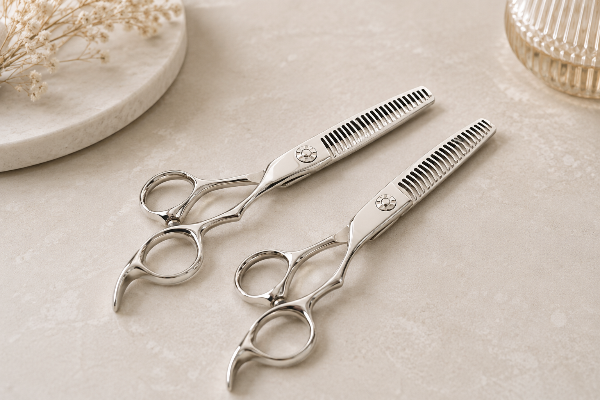
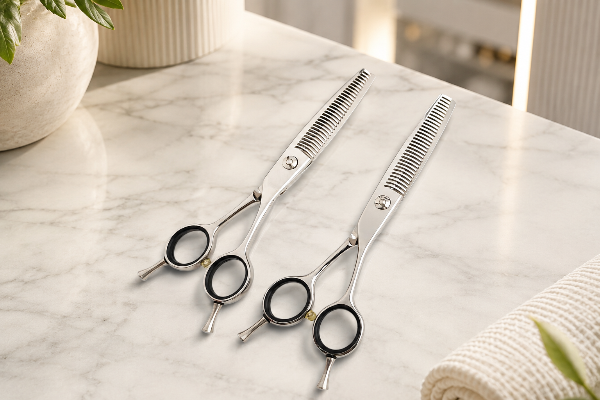
The 7.5-inch, 40-tooth body was built to cross two benches. On hair it's a finisher; on coats it's a detailer. The applications are specific, not generic.
The same 40-tooth detail shear is a fixture for hairdressers and professional dog groomers alike, wherever line-free finishing matters. Master groomers use it under the eyes of a Shih Tzu, to blend the feathers on Golden Retrievers and Pomeranians, and to skim two coat lengths together without a blunt edge — a staggered-tooth blending geometry described in US Patent 7,841,091.
A fine blender is slower than a chunker; it takes more strokes to move the same weight. Groomers and stylists accept that trade because the finish is natural and forgiving - it's nearly impossible to gouge a hole with a 40-tooth. Reach for it to perfect a shape, not to build one.
Industry 5-year total cost of ownership for a professional VG10 / convex-edge shear — purchase plus sharpening, with the edge holding 5–8 months between services.
> Source: ScissorPedia 5-year TCO analysis. Manufacturer-direct pricing removes the 200–400% markup that traveling salesmen and rebranders add on the way to the chair.
> As one industry cost guide puts it plainly: "Scissors sold by traveling salesmen are typically marked up 200 to 400% over online authorized dealer prices." Buying factory-direct removes exactly that layer.
The point isn't that cheaper is better; it's that the TCO gap is smaller than the sticker gap. A premium blade sharpened once a year can cost less to own than a budget pair resharpened every quarter - and going factory-direct simply removes the reseller's cut from both ends.
Modeling landed cost on a wholesale volume? Get a quote →A new brand earns trust with verifiable evidence, not a logo wall - so here's exactly what each credential does and doesn't mean. We use precise language on purpose, because the loose version is a red flag buyers are trained to spot.
Two more trust signals matter to a professional buyer more than any badge. Every pair we ship carries a marked country of origin, and the trade is blunt about why: "If they don't have a country of origin marked on them, then they are not authentic." Our steel grade is printed too, not hidden behind a house name like "proprietary steel complex."
Most brands you see on the shelf are actually from China and resold here under their own name; it’s how the industry works. While others don’t tell you, we're transparent about the fact that while you own the brand, we maintain a stable build that ensures there are no hidden risks in your supply chain at audit time.
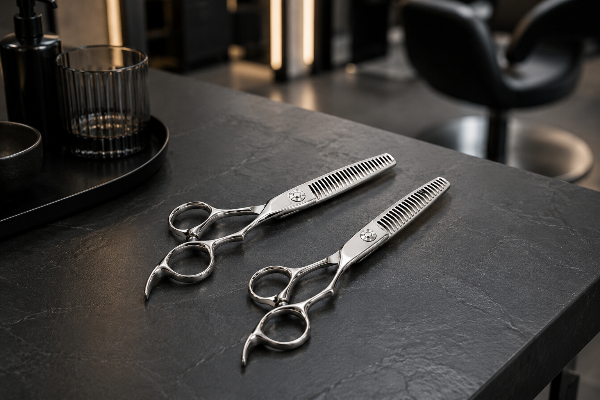
“Will the ten-thousandth pair look just like the first?” - The answer is a physical one with us. Every part of our forging, heat treating, CNC grinding, and inspection is completed under one roof, and this allows us to maintain exact tooth shape and Rockwell 60-62 on all pairs. The build doesn’t wander, unlike those who re-order their blanks from the lowest bid that month.
Custom branded scissors sold into the United States must display the country of origin as required under 19 U.S.C. 1304 and it’s impossible to claim Made in USA unless manufactured in the USA (FTC). We comply with the required country of origin markings on each pair we make so you can import with confidence and your marketing remains defensible.
Calculate the precise thinning and blending ratios by defining the exact teeth configuration required for your custom OEM/ODM production lines.
Compare premium Japanese and German stainless steel alloys to match your specific hardness, edge retention, and wear-resistance parameters.
Analyze bulk procurement costs, lifecycle maintenance cycles, and long-term total cost of ownership for global distribution planning.
The pitch: genuine VG10 steel (HRC 60-62), clear material spec with documented performance, honest country-of-origin markings, and one identical build per 50+ piece order. No opaque "proprietary" steel or hidden traded blanks; just pure, direct manufacturing with complete transparency. Try a sample pair to see for yourself, or submit your own specifications for a quote.
They’re similar but distinct. The term “thinning” is often used interchangeably with “blending” as many of the 30 to 40 tooth shears work by thinning out the hair; most brands prefer “blending” for fear of intimidating the client by referencing thin hair. Texture and chunking shears remove material by leaving behind visible lines with widely spaced teeth and won’t “blend out” a line.
40+ teeth work for a line-free finish or thinning fine hair that already has been thinned; under 38 teeth the spaces between teeth are too wide, leaving lines or gaps on finer hair types. For heavy removal on very thick hair, a low count is the place to begin. Then follow up with 40 teeth.
The MP-SC-046 are approximately 10-20% hair removal per pass. No set standard exists in the industry though as it depends on the angle of the tooth, whether the hair is dry or wet and how many times the shears are passed through. The best test is a strand.
Yes, the 7.5 inch 40-tooth MP-SC-046 can indeed be used by pet groomers. They employ this fine blending shear for fine facial detail, blending the feathery parts of double coated breeds, or skimming coat lengths in a smooth line.
The tool category does not damage hair — scissors do not change follicle density, and hair falls from the root, not the blade. Damage comes from a dull or cheaply-made edge and poor technique, the same way a careless razor can wreck a hair cut; shredded ends trace back to a blade that tore rather than sliced. A sharp convex edge on properly heat-treated steel is exactly the fix.
Quality tracks the steel grade and hardness, not the country. A blade in genuine VG10, ATS-314, or 440C at HRC 60–64 sits in the same premium tier as a Japanese-brand shear; the objection only holds for cheap basic grades like 3Cr13. We publish the grade and the origin so you can verify, rather than pay a reputation premium.
The flagship shear is made with Takefu VG10 (HRC 60–62). We can also provide OEM versions in a range of other steels such as Hitachi ATS-314 and 440C, with the higher-end options in a high-performance cobalt alloy up to HRC 64. All steel grades and hardness are stamped on each shear, and we can supply material certificates on request.
In-stock orders ship immediately, custom OEM private label production begins at 50 pieces. Physical samples typically take 3 business days and bulk production can be completed in 60 days. We allow complete customisation for all of the design aspects - from the steel and tooth count to handle, finish and engraving.
A premium hair salon shears like the Sam Villa range are typically $300-622/pair, while inexpensive shears on Amazon run for $10, with actual 5-year cost, including sharpenings, typically $450-900. Buying factory-direct cuts out the 200-400% margin charged by resellers, travelling salesmen and brands — you're paying for the steel and the cut, not the reputation. Quote for your required quantity today.