Get in Touch with Mackayhairscissors Company
We use submitted details to respond to your quote request. Read our Privacy Policy.

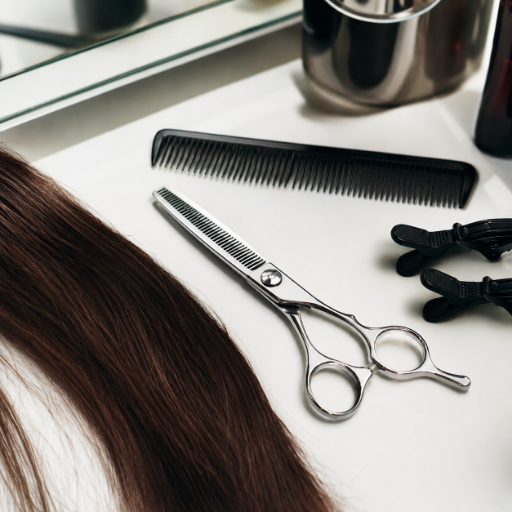
Thinning shears designed for heavy hair can slice the excess weight off without pulling – as long as the teeth per inch count and the blade cut rate is appropriate for the weight of your hair, not jammed in with excessive force. Many clients are wrongly attributing the hair damage they feel comes from thinning shears actually to a pushy cut, a bad cut rate or the proximity of the blade to the scalp. With MATSUOPRO’s hair thinning shears, you’ll never experience this because the convex edge and the hair-weight cut rate is engineered for the specific task of weight removal on even very thick hair without frizz or unwanted thinness.
Explore the full thinning and texturizing shear range for related options.
Outcomes: a clean slice instead of a push (no frayed, frizzy ends), and a cut rate matched to density (no accidental over-thinning).
Sourcing thinning shears for your brand, salon chain, or distribution line?
Request Wholesale / OEM Quote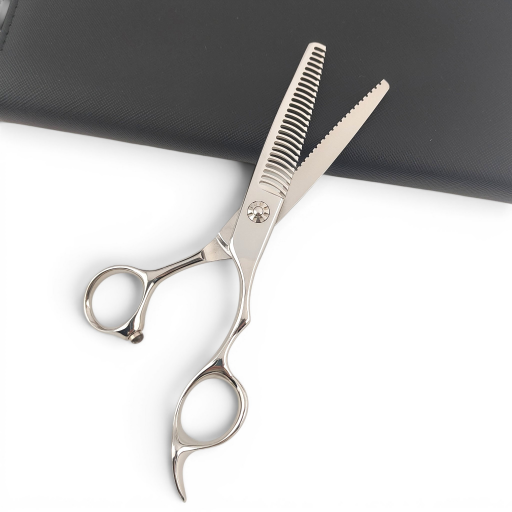
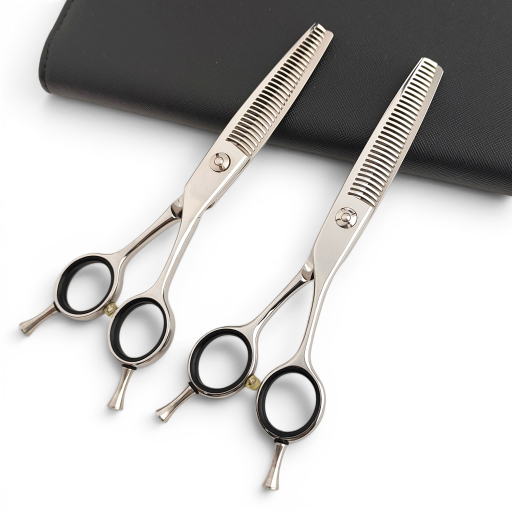
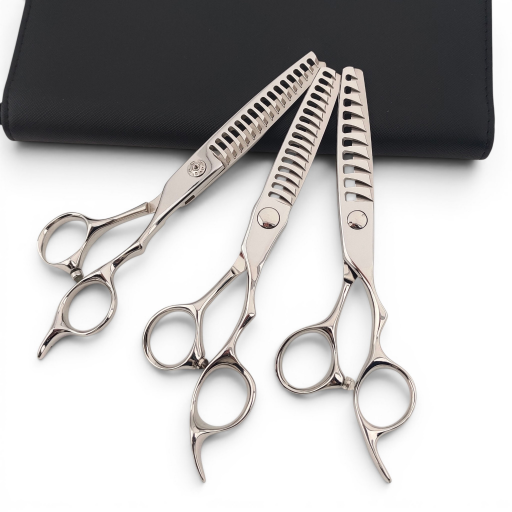
Such a review is indeed legit, it’s just pointing fingers in the wrong direction. It isn’t the thinning shear that’s at fault-in the hair-science communities, it’s frankly stated that “thinning shears are just a means of cutting hair, not changing hair growth.” While there are many scary reviews out there to suggest the contrary, a well-sharpened thinning shear doesn’t ruin thick hair like a blunt shear does when carelessly employed.
Honestly, the tool takes blame it does not deserve. Complaints that “a hairdresser hacked off half my hair” or that “the way it makes my ends appear damaged and my hair messy and frizzy” trace back to edge, rate, or technique — never the category itself. So the real cause is controllable, and three factors decide the outcome.
“This woman destroyed my hair with thinning shears… I now have extremely short, frizzy and stringy pieces on top.”
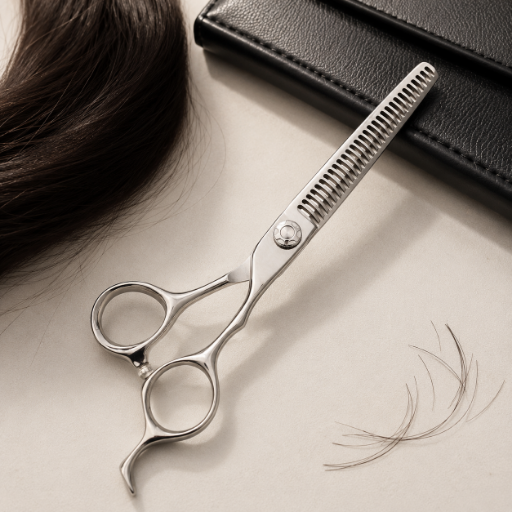
A dull or soft edge pushes and frays the hair strands instead of slicing them — that is real hair damage: split ends, dry frizz, the same look a careless razor thinning leaves. Sharp blades that slice cleanly avoid it.
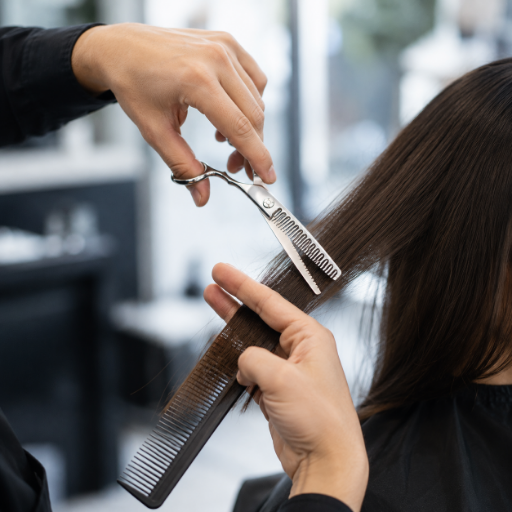
Standard thinning shears remove roughly 30–50% of a section per close. The wrong rate on thick hair strips too much at once.
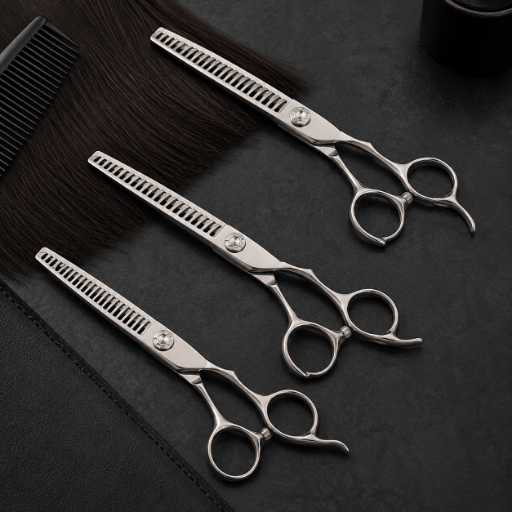
Cutting too close to the scalp, or over-passing with point cutting or slide cutting, leaves short hairs that stand up. A scissor-over-comb pass keeps control — the error is technique, not the thinning scissors.
MATSUOPRO answers the first two directly. Every blade is finished with a hand-honed convex edge that slices each strand of a section of hair rather than crushing it — the toothed-versus-straight blade principle set out in US Patent US4170064A — and the range is split by tooth count so the cut rate fits the density in front of you. Control, not brute force, is what keeps thick hair from looking over-thinned.
In practice: a stylist facing dense, coarse hair debulks with a 25-tooth shear, then switches to a 40-tooth blender to soften the interior — unlike a single-rate import that strips the whole section in one heavy pass. That staged control is the line between thinned and over-thinned, and it is exactly what the chart below maps.
💬 Fielding “will this ruin my hair?” from your own clients?
Get the Damage-Free Thinning one-pager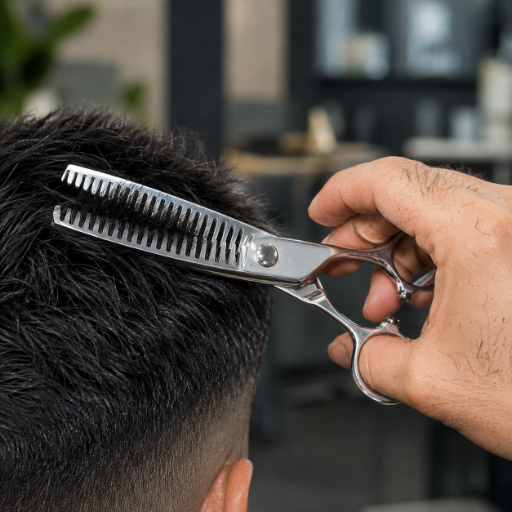
| Tooth count | Approx. cut rate | Typical job |
|---|---|---|
| 5–10 | 50–70% | Aggressive chunking |
| 14–15 | 30–40% | Heavy weight removal |
| 20–25 | 25–35% | Moderate debulking |
| 30–35 | 15–25% | General texturizing & blending |
| 38–46 | 5–15% | Finishing, invisible texture |
Cut rates are starting points; closing depth, blade angle, and number of passes shift the real result.
| Hair density | Goal | MATSUOPRO model | Teeth | Blade | Target cut rate |
|---|---|---|---|---|---|
| Very thick / coarse | Debulk fast | Volume Reducer | 25–28T | V-groove | ~25–35% |
| Thick, straight | Everyday thinning | Balanced Thinner | 30–35T | Flat | ~15–25% |
| Thick, wavy | Blend + soften | Balanced Thinner | 30–35T | Flat | ~15–25% |
| Thick + curly | Avoid visible notches | Finishing Blender | 40–44T | Step/flat | ~5–15% |
| Medium-thick | Versatile control | Balanced Thinner | 30–35T | Flat | ~15–25% |
| Fine over-dense | Invisible softening | Finishing Blender | 40–44T | Step | ~5–15% |
| Thick beard / barber | Weight + texture | Volume Reducer | 25–28T | V-groove | ~25–35% |
| Two-step thick cut | Debulk then finish | Reducer → Blender | 25T → 40T | V + step | Staged |
| Extensions / weft | Feather edges only | Finishing Blender | 40–44T | Step | ~5–15% |
Read it as thinning rate by density: wide-teeth V-groove texturizing shears remove heavy hair fast, while high-count blending shears feather curly hair or straight hair without harsh lines, and back off entirely on fine hair or thin hair.
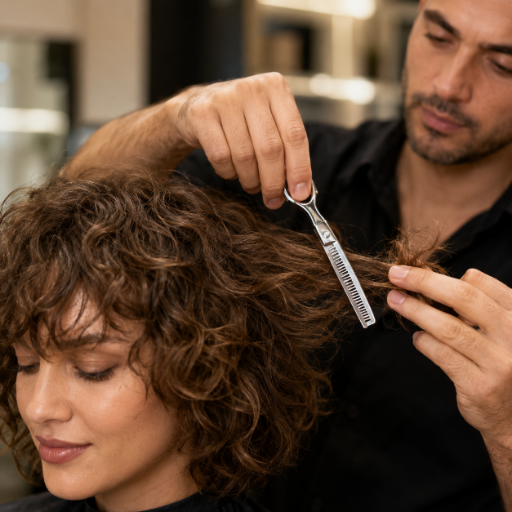
It’s exactly the process of how professionals use thinning shears to thin hair-first, lighten it with a lower number and then finish it off with a higher number to get that smooth, blended finish. When a barber is taking weight off super-thick hair, they’ll grab a 25T. When a stylist is softening a curly interior, they’ll use a 40T to prevent any obvious line from forming. That layered process is also why a single-rate shear falters when a paired set wouldn’t.
| Steel | Rockwell (industry) | Character |
|---|---|---|
| 440C (Japan/China) | 58–59 HRC | High-carbon, durable everyday edge |
| VG10 | 59–61 HRC | High carbon + cobalt, takes a very sharp edge |
| ATS-314 (Hitachi) | 59–61 HRC | Cobalt/titanium/vanadium, premium retention |
| MATSUOPRO build | 60–62 HRC (up to 64 cobalt) | Vacuum + cryogenic heat treatment |
Higher-grade steel stays sharper longer and takes more sharpenings before retiring.
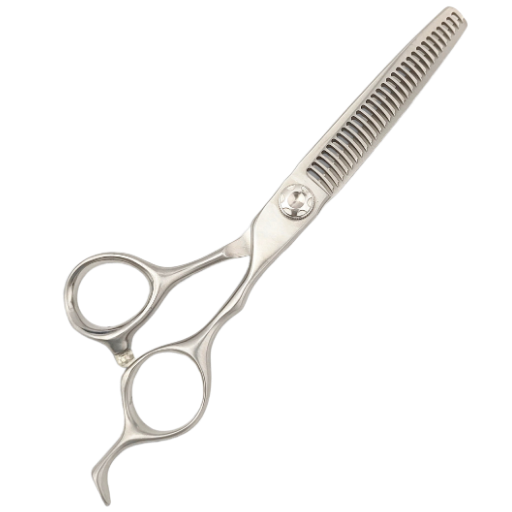
Tooth count determines your baseline cut rate – how much of a single close with a shear will remove. Lots of small teeth remove less than few large teeth — the toothed-blade geometry first patented in US1962264A. A bit of insider info: a shear with more teeth won’t necessarily control better if the tooth spacing and design (step-comb, flat, or V-groove) vary. A well-manufactured 30-tooth will offer more control than a cheaply made 40-tooth. Its trade-off is visibility: a V-groove is the harshest bite and the sharpest control line, while flat and step-comb teeth provide a softer transition.
🎯 Not sure which tooth count fits your clients’ hair? Get a Density-Match Tooth Recommendation — send us your typical hair types and we’ll map the models.
GET TOOTH RECOMMENDATION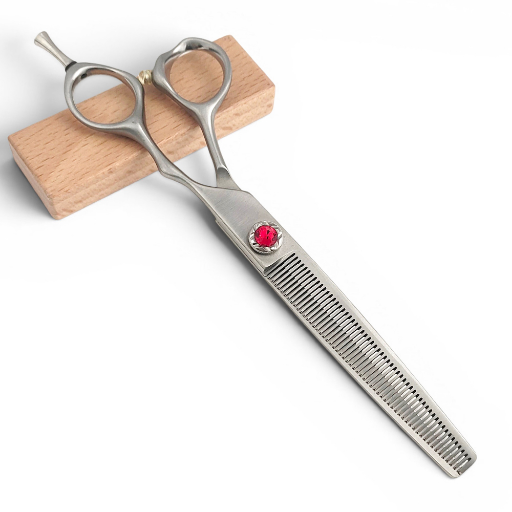
Most of the bargain “thinning shears for thick hair” available on online retail sites come in a single tooth count, a single rate, and an unnamed grade of steel. This is the perfect recipe for over-thinning: one sharp, aggressive rate applied to all hair types. With a properly matched system, there’s no guesswork.
On the question of “China factory”: what we’re selling is price by channel, not a quality compromise. Honestly, MATSUOPRO forges the same Japanese VG10 and Hitachi ATS-314 steels found in high-end branded shears that sell for $300+, from the same instrument-grade stainless families defined in ISO 7153-1, and states the HRC numbers in the open. In essence, what you pay more for in a branded pair of shears is the middle-man, not better steel.
MATSUOPRO is the actual manufacturer, not a reseller, enabling smaller brands to develop custom hair shears with a minimum of just 50 units, produced under an ISO 9001 quality-management system. We run one factory for hair cutting shears, hair thinning, and hair texturizing tools, with the same steel expertise in 440C, VG10, ATS-314, and cobalt alloy behind our professional hair scissors line.
Custom orders for as few as 50 pieces; stock models are available in units as low as one piece for sampling.
Steels available for models include 440C, VG10, ATS-314, and cobalt alloys.
Handle styles, finishes, and tooth counts are selected to match different hair types.
Laser engraving, colors, tension dial options and custom packaging are all part of our private-label offerings.
Full OEM/ODM capabilities are available to turn your designs into finished, hand-tensioned shears.
Pricing depends on your choice of steel, the number of teeth, finish, and order size; send us your models and quantity, and we’ll provide a quote with an estimated lead time for sample development and mass production. Distributors can use our in-stock shears to flesh out a catalog, while custom private label production gets tooled up simultaneously.
✂️ Testing quality before you commit? Request Free Samples (from 1 piece) — cut with them before you place a bulk order.
REQUEST OEM/ODM QUOTE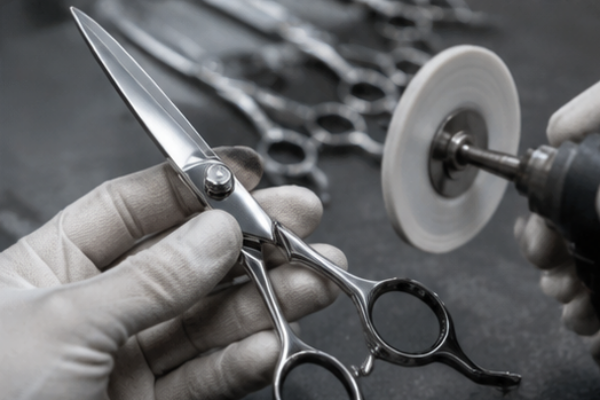
Any new factory should prove itself based on concrete data, not inflated language. Every pair of MATSUOPRO thinning shears goes through more than 80 stages, from vacuum and cryo-heat treating to precision CNC blade cutting and manual honing, hand tensioning, and 100% quality inspection prior to shipping.
Our shear’s mechanical properties-toothed thinning geometry and Rockwell scale hardness-are thoroughly documented in public patents, allowing buyers to independently verify our claims.
🧪 Need proof for your QC file?
Request a Hardness Test Report with your sample orderDigital configuration tools for professional thinning shears. Match tooth profiles to hair density, calculate exact cut rates, or configure OEM specifications.
Map shear tooth configurations directly to specific hair densities and textures.
Calculate baseline weight removal percentages based on specific tooth geometry.
Configure manufacturing parameters and build custom specifications for volume orders.
Yes-they can be the fastest and most efficient method to remove weight from dense hair when used correctly. As one barber on r/Barber said, there is nothing better for removing weight in super thick hair than a high-tooth shear. The key is matching the tooth count to hair density and using a light hand to avoid stripping the section. Experienced stylists keep multiple thinning shears on hand for various hair types, choosing the tooth count to complement the haircut in front of them.
Over-thinning comes from too high a cut rate, a blunt edge, or cutting too close to the scalp, not from thinning shears as a class. Our hand-honed convex edge slices cleanly, and the right tooth count keeps removal in the 5-25% range for finishing work, which minimizes the over-thinning risk.
For rapidly debulking very thick or coarse hair, begin with 25-28 teeth; for standard thinning and blending, use 30-35 teeth; and for an invisible finish on curly or fine-over-dense hair, opt for 40+ teeth. Many stylists carry two sets: a lower count for bulk reduction and a higher count for fine-tuning. Keep your quality thinning shears and texturizing scissors separate from your straight hair cutting shears, and hold all three if your client base varies.
We build in premium steel types such as 440C, VG10, Hitachi-made ATS-314, and cobalt alloy, finished to 60-62 HRC (up to 64 HRC for cobalt models) through vacuum and cryogenic heat treatment. These materials and processes are standard in high-end Japanese shears, and we transparently disclose all hardness ratings.
Custom and private-label orders require a minimum of 50 units. Sample orders for in-stock models can be placed for a single unit. Our full OEM services cover steel selection, handle design, finishing options, tooth count, custom engraving, and packaging.
Upon request, we can provide third-party HRC test reports, further substantiated by BSCI, SGS, and ISO 9001 audits, along with a partnership with a national inspection center. Warranty terms are specific to each order and are outlined in the quote.