Get in Touch with Mackayhairscissors Company
We use submitted details to respond to your quote request. Read our Privacy Policy.

Buy the steel you can actually verify, VG10, Japanese 440C, and ATS-314 cobalt, forged and hand-honed in our own factory, with published HRC by grade and third-party hardness reports available on request.
Japanese steel hair scissors are only as good as the factory that finishes them. At MATSUOPRO we forge professional hair and barber shears from genuine Japanese steel, VG10, 440C, and ATS-314 cobalt alloy, then hand-hone every convex edge and inspect each pair one by one before it ships. As the manufacturer rather than a reseller, we cut, temper, and test the exact specs printed on this page.
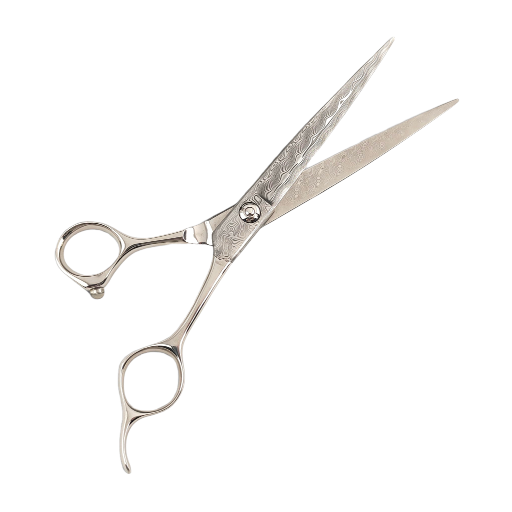
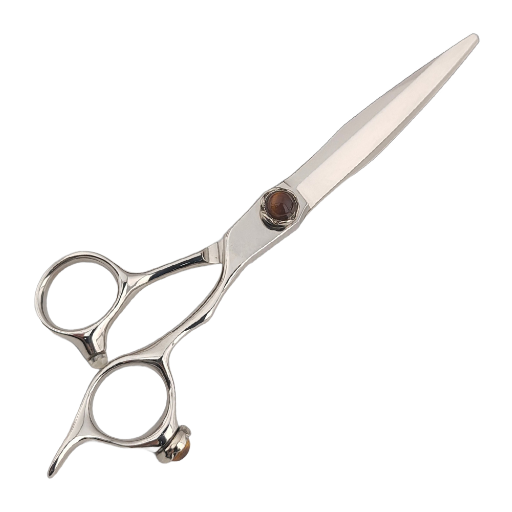
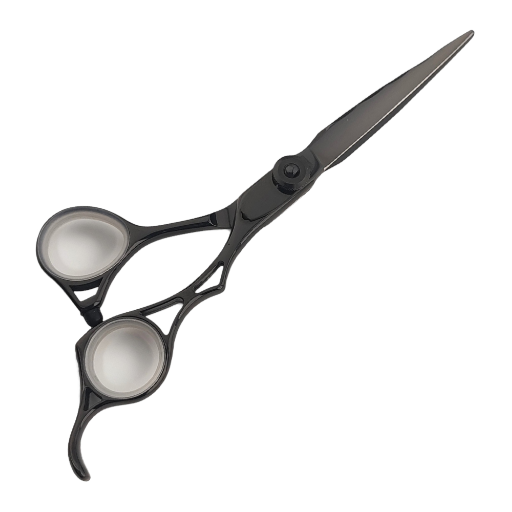
“Japanese steel” on a product listing tells you almost nothing. The phrase describes the steel billet, not where the shear was built or how the edge was finished, and buyers get burned by it.
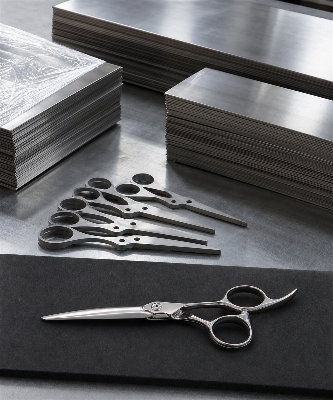
Here’s our honest answer to the question buyers actually ask. MATSUOPRO shears are made from authentic Japanese steel and hand-finished in our own plant in China, they aren’t “Made in Japan,” and we never claim they’re. US regulators weigh origin by a page’s overall impression, not one disclaimer — see the FTC’s guidance on origin claims. What we do claim, we document.
One stylist bought a “$150 Yasaka” on a marketplace; the tension screw stripped in two months, because it was never a real Yasaka at all. Two hairdressing scissors can carry the identical steel grade and cut completely differently once heat treatment and honing diverge.
Before you pay a Japanese-steel premium, ask any supplier these four questions. If they can’t answer all four in writing, the label is doing the selling.
“Japanese steel” isn’t a grade, VG10, 440C, and ATS-314 are.
VG10 comes from Takefu Special Steel; ATS-314 from the Japanese maker formerly Hitachi Metals, now Proterial.
A supplier who tests to HRC will print the number and the method, Rockwell C, ASTM E18.
Independent hardness and material reports ship on request.
Want the paperwork first?
Request a third-party hardness & material report →Steel grade sets the ceiling on hardness and edge life, but it’s only one of several factors, geometry, tempering, and honing decide the rest. Use the ladder below to match a grade to the work and the budget, then open the tier you need.
| Grade | Key chemistry | Hardness (HRC) | Edge life vs 440C | Re-sharpen interval* | Best for |
|---|---|---|---|---|---|
| China 440C (value) | UNS S44004 · Cr 16–18% · C 0.95–1.20% | 56–58 | Baseline | 1–3 months | Apprentices, emerging barbershops |
| Japanese 440C (mid) | Same S44004 chemistry, cleaner melt | 58–60 | Baseline+ | 4–6 months | Growing salons & barbershops |
| VG10 (premium) | Cr ~15% · Co 1.3–1.5% · V 0.1–0.3% | 60–61 | Longer (cobalt + vanadium refine grain) | 6–12 months | Full-time professional stylists |
| ATS-314 cobalt (flagship) | VG10-adjacent cobalt chemistry (Proterial) | 60–62 | Longest in our range | 12 months+ | Daily precision / dry cutting |
*Interval reflects trade and vendor consensus for typical professional use, not a lab edge-retention cycle. Hardness values are design and per-lot figures verified by Rockwell C testing (ISO 6508 / ASTM E18).
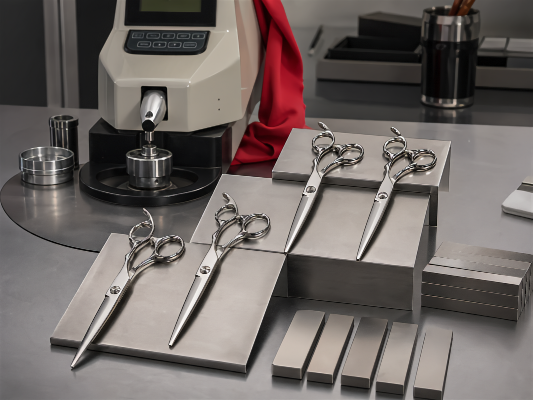
One honesty point competitors skip: China 440C and Japanese 440C share the exact same UNS S44004 chemistry. The tier gap is heat-treatment, melt cleanliness, and honing consistency, not a different alloy, which is why we price them as three tiers, not three “secret recipes.”
In practice, a regional buyer often splits the order: Japanese 440C at 58–60 HRC for staff kits, VG10 at 60–61 HRC for signature lines. Unlike resellers who bury the grade in a blog, we print the number on the product, the honest version of “premium.”
| Your priority | Recommended grade | Why |
|---|---|---|
| Lowest entry cost, warrantied | China 440C — China 440C value hair scissors | Same 440C alloy, HRC 56–58, factory-direct pricing |
| Balance of price and edge life | Japanese 440C — Japanese 440C hair scissors | HRC 58–60, strong corrosion resistance |
| Longest edge for daily pro work | VG10 — VG10 hair shears | Cobalt-vanadium grain, HRC 60–61 |
Grade is half the decision; size and handle finish the fit. The 5.5″ shear favours detail work and shorter cuts, the 6.0″ (a 6-inch all-rounder) is what most hairstylists reach for daily, and 6.5″–7.5″ lengths suit barbering, trimming, and scissor-over-comb across every hair type.
Factory-direct is where the value lives. Pros already know Japanese-steel budget shears can be “true bang for the buck” — buying from the maker removes the brand markup without touching the premium Japanese steel. From VG-10 to 440C, the same professional-grade Japanese hair cutting scissors reach you at a factory price, not a boutique one.
Not ready for a bulk order?
Order a single sample (MOQ 1 pc) →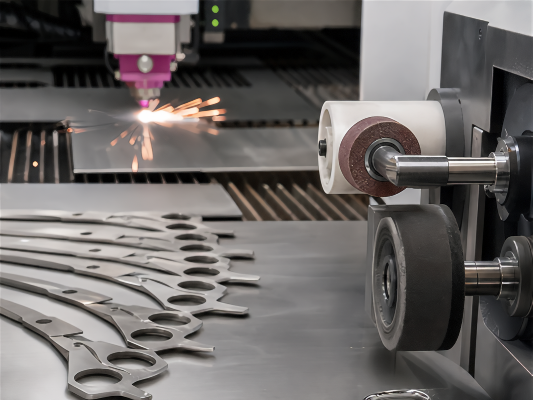
“A convex edge is unforgiving of shortcuts. We hand-hone every premium blade after grinding because the last few microns of geometry decide whether the shear slides through hair or pushes it, no machine finish we tested matched a trained hand.”— Senior Application Engineer, MATSUOPRO Engineering Team
In practice, the payoff is consistency: a busy barbershop running daily production will feel a 62 HRC convex edge hold where a softer, unhardened blade slips and wears within weeks. Unlike a machine-only finish, every premium pair is hand-corrected, the honest reason two shears in the same steel can perform a tier apart.
The steel name alone tells you very little. What separates a shear that holds a razor edge from one that dulls in a month is the process after the billet arrives, and that process is where a factory either earns trust or hides.
This is where craftsmanship stops being a slogan and becomes a measurable step. Every premium blade passes through more than 80 individual operations, and the last of them is always a trained hand, not a machine.
In practice, a barbershop chain in daily production feels a 62 HRC convex edge hold where a soft, unhardened blade slips and wears within weeks, the honest reason two shears in the same steel perform a tier apart, unlike a machine-only finish.
Vacuum hardening followed by a deep-cold (cryogenic) hold converts retained austenite to martensite — the hardening mechanism behind high-carbon martensitic stainless blade steel — which stabilizes hardness and edge stability across the blade. On a thin, curved shear blade this consistency is what keeps a convex edge biting cut after cut, the reason we run it on every premium line, not just the flagship.
Buyers ask whether Japanese or German shears are “better.” Whether you are a hair stylist, a hairdresser, a professional barber, or a cosmetology student cutting hair every day, the honest answer is that they solve different problems — and for most hair professionals the edge geometry matters as much as the country on the box.
| Attribute | Japanese convex Precision | German bevel Durability |
|---|---|---|
| Edge geometry | Convex (hamaguri), mirror-polished | Beveled, flat-ground facet |
| Typical hardness | Higher (HRC 58–62) | Lower, tougher (HRC ~56–58) |
| Cut feel | Sharper, cleaner slice and slide cutting | Sturdier, forgiving on abuse |
| Chip resistance | Requires care | Higher — softer steel resists chipping |
| Best for | Precision, slice and dry cutting, detailing | Heavy daily volume, less finesse |
If your work is precision and slice cutting, a hardened Japanese convex edge is the professional hair shears choice; if it’s high-volume rough work, a tougher bevel forgives more. For the metallurgy behind the choice, compare grades in our 440C vs VG10 steel guide.
This is the layer resellers can’t offer, because they don’t own the line. Minimums stay genuinely low, and each order is built to your brand, from raw Japanese steel to a finished, engraved, packaged shear.
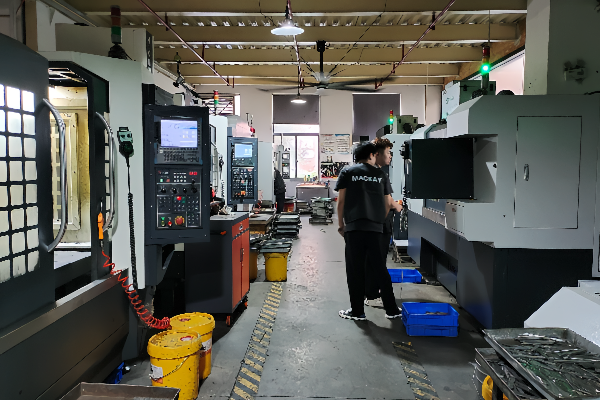
Small brands know the real problem: minimum orders of 500+ pieces, hidden tooling fees, and a 30% deposit lock them out before the first sample. Because MATSUOPRO controls and delivers every stage in its own factory, a 2,000 m² production floor, a 100-plus team, 80+ in-house steps, we quote small runs other suppliers decline, whereas resellers never touch the line.
One growing private-label brand might start with a 50-piece VG10 run under custom engraving, while a multi-chair salon standardizes its team on Japanese 440C for the price-to-edge balance. Both order the same verified steel; only the tier and finish change. Every order — from single hairdressing shears to a full set of shears and scissors — carries a lifetime warranty against manufacturing defects plus re-sharpening and customer support, so the relationship doesn’t end at delivery.
Rather than a misleading list price, your unit cost is driven by a handful of choices. Tell us these and we quote precisely:
Explore the full build-to-spec program on our OEM & private-label services page, or see the wider range in our hair cutting shear collection.
Hardness only means something if it is measured and traceable. We publish HRC by grade, test to Rockwell C (ASTM E18), and keep per-lot results you can request before you commit.
An unverified hardness number is an audit risk: a soft blade that fails in the field or a low-chromium melt can sink a whole shipment. In practice, a distributor running a customer audit of a 5,000-unit order can check our per-lot 60 HRC report before release, unlike marketplace listings that assert a number with no document behind it.
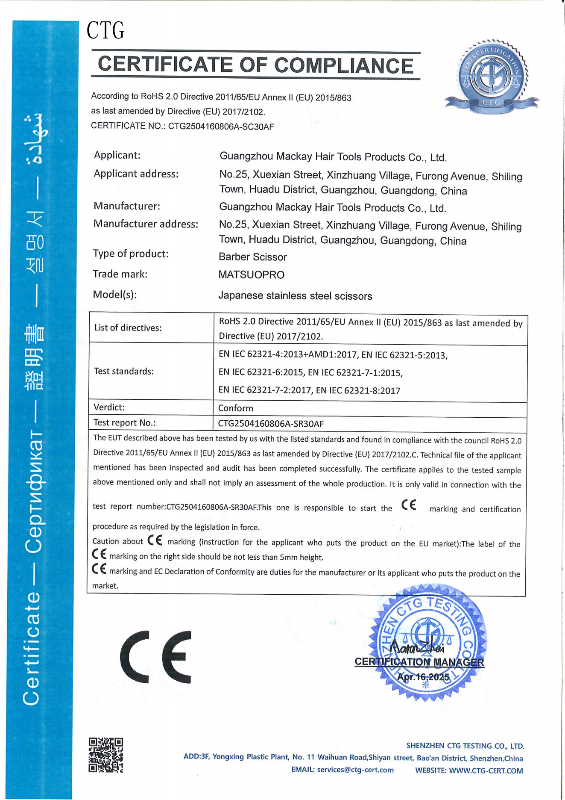
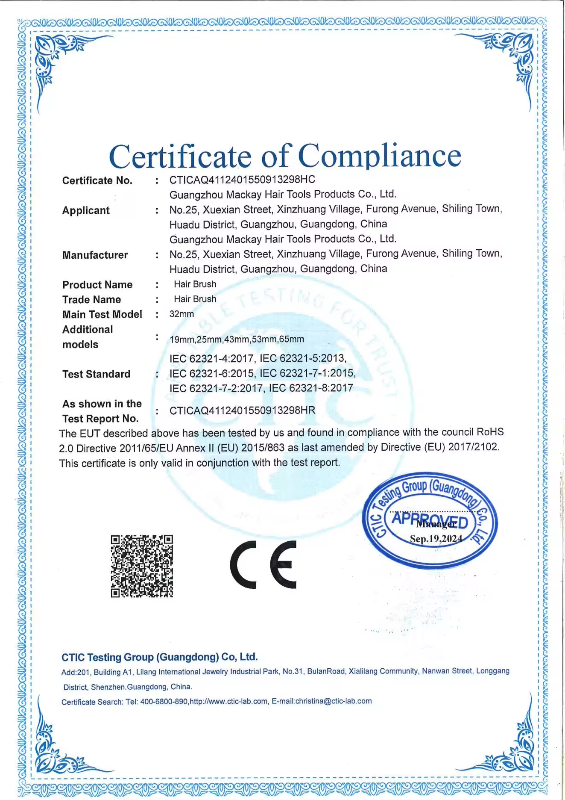
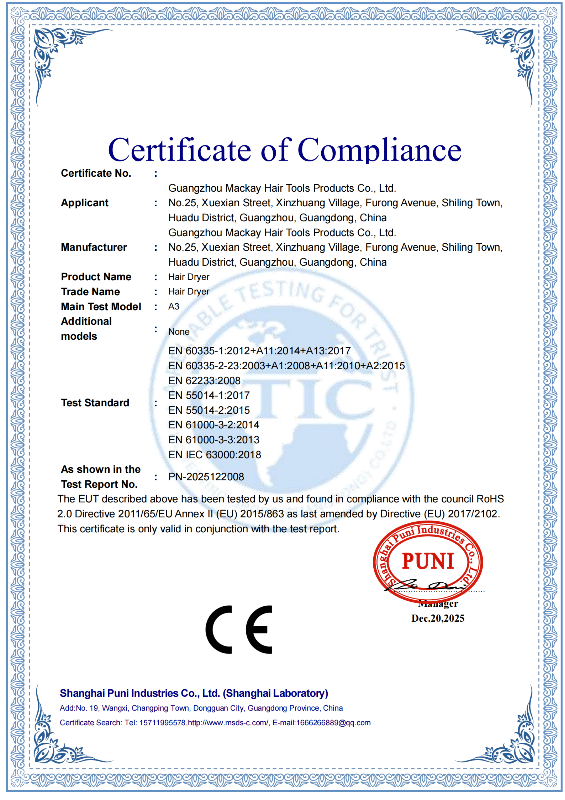
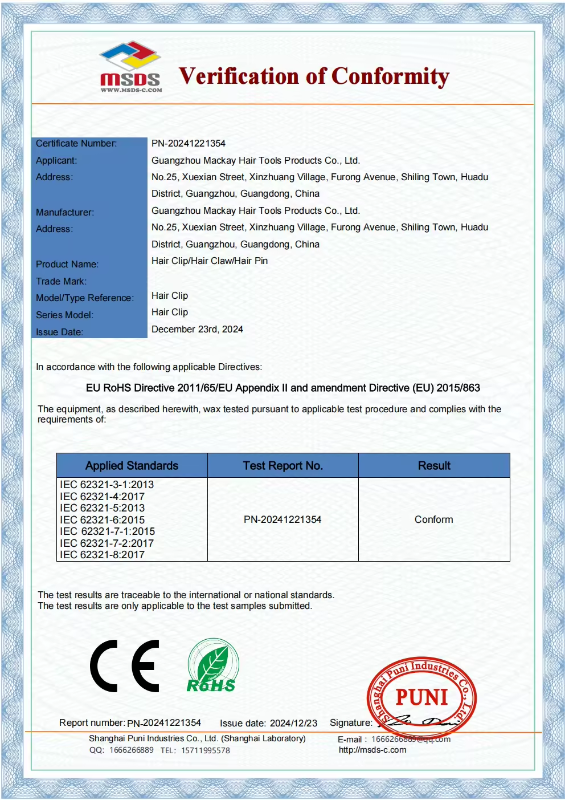
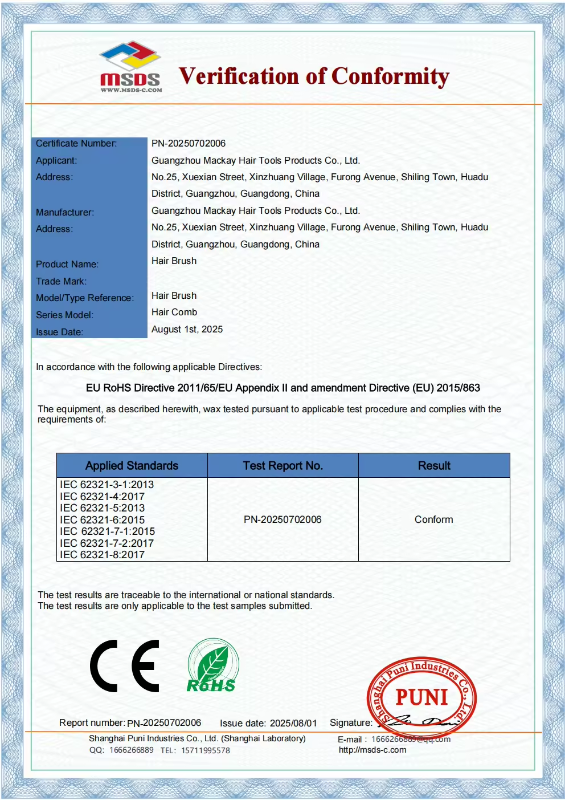
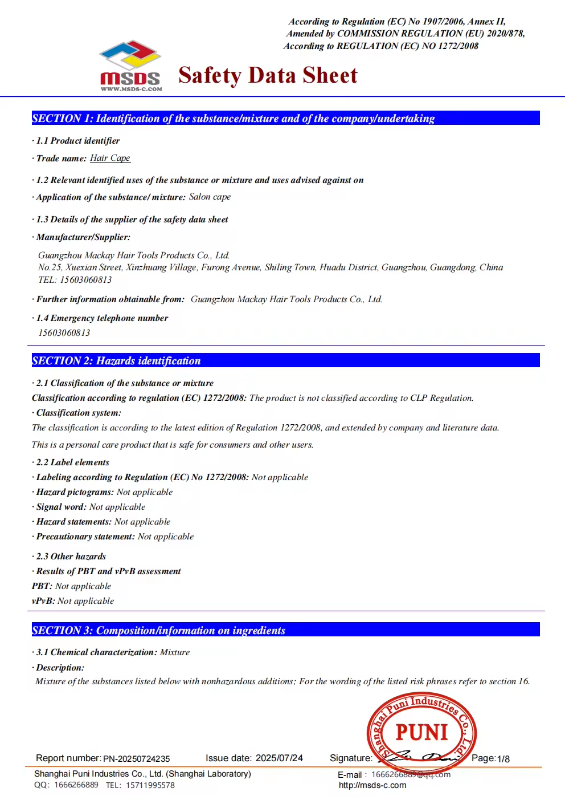
We manufacture under an ISO 9001 quality management system and are audited to BSCI and SGS standards, these govern our process and factory, not a per-product certification. Product-level evidence is the RoHS report above plus third-party hardness and material reports on request.
A cheap pair can go rusty within six months, and buyers blame the steel when the real cause is usually care and a low-chromium melt. Every grade we run carries 14.5–18% chromium, which forms the passive layer that fights corrosion, but no stainless is rust-proof, so we ship care guidance with each order rather than pretend otherwise.
Standardize your procurement, trace material lineage, and calculate real-world maintenance cycles using our direct-access factory engineering calculators.
Match Japanese VG10, 440C, or ATS-314 Cobalt alloys to your target private-label market placement and HRC specifications.
Project exact blade wear limits, estimated trade usage life, and maintenance frequency based on ASTM testing standards.
Run our 4-point verification checklist to trace raw Japanese steel sheets, inspect factory QC records, and audit independent testing papers.
Both are stainless, but VG10 adds roughly 1.3–1.5% cobalt and a trace of vanadium that refine the grain, so it reaches and holds a slightly harder edge, HRC 60–61 — than 440C at HRC 58–60. In practice that means 440C gives you excellent corrosion resistance and value for a growing salon, while VG10 buys longer edge life for a stylist cutting all day, every day. Neither is “better” in the abstract; they sit on different rungs of the same ladder.
Yes, grades like VG10 and ATS-314 hit high hardness with a fine grain, which suits a keen convex edge. But steel is a ceiling, not a guarantee: heat treatment and honing decide whether that ceiling is reached.
Very few at working-professional prices, most “Japanese steel” shears are finished outside Japan, often in China. We use authentic Japanese steel and hand-finish in our own factory in China, and we say so plainly; the verifiable facts are the named grade, published HRC, and a report on request.
Usually from moisture left on the blade plus a low-chromium steel, not from “bad Japanese steel.” Our grades carry 14.5–18% chromium for a strong passive layer, and we ship care guidance, wipe dry, oil the pivot, store closed, to keep the edge clean.
A large share of a luxury shear’s price is brand and distribution margin, not steel. Buying factory-direct in the same grade removes that markup, which is exactly why we publish the steel data instead of the mystique.
A quality Japanese-steel pair typically takes 20–30 re-sharpenings over seven to eight years before retirement. A convex edge should be honed by a convex-trained sharpener, because a flat-grind service can flatten the geometry, so match the service to the edge rather than handing a Japanese convex blade to a generic sharpener.