Get in Touch with Mackayhairscissors Company
We use submitted details to respond to your quote request. Read our Privacy Policy.

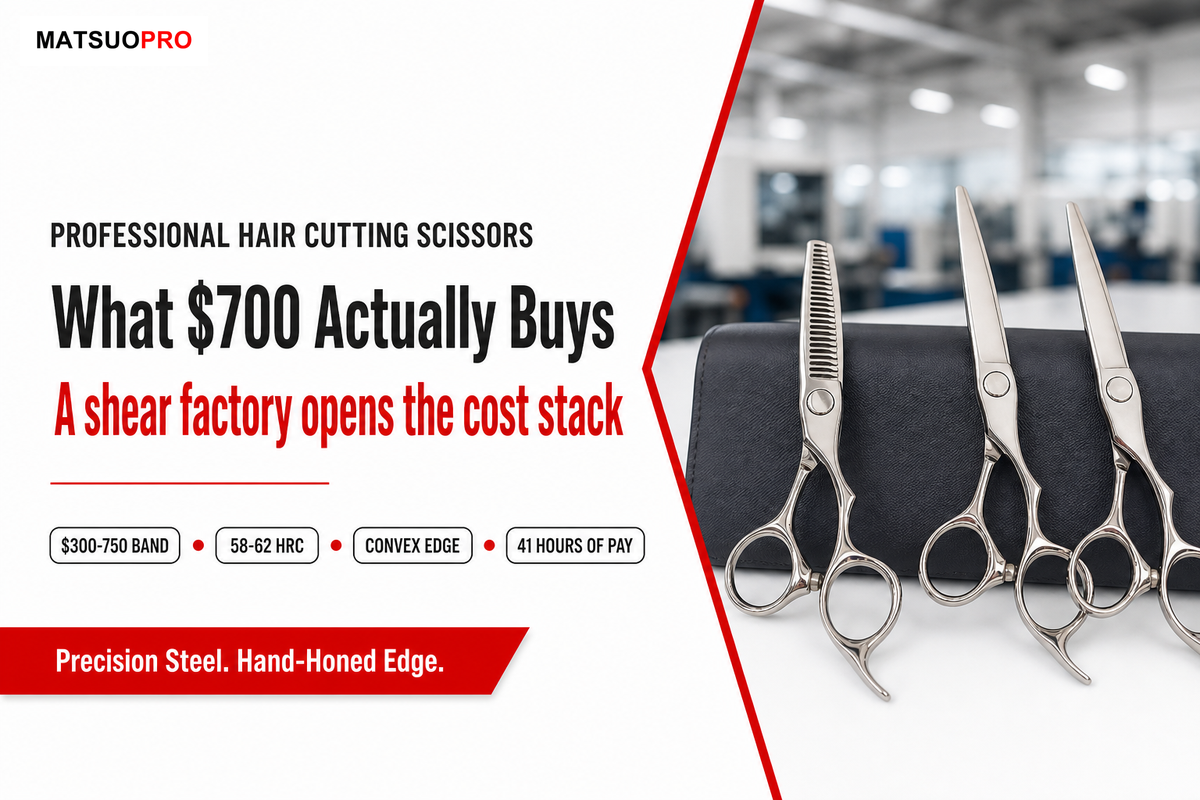
Updated July 2026 · Written by the people who forge them
Professional hair cutting scissors are sold at prices that range from about $40 to well past $750, and almost nobody selling them explains why. Storefronts that dominate this search quote a number and move on. So here’s the other side of the counter: we’re a shear factory, we control every stage from Japanese steel intake to the hand-honed edge, and this is what actually sits inside that price, what each band buys, what it doesn’t, and which parts of the pitch you should refuse to accept without evidence.
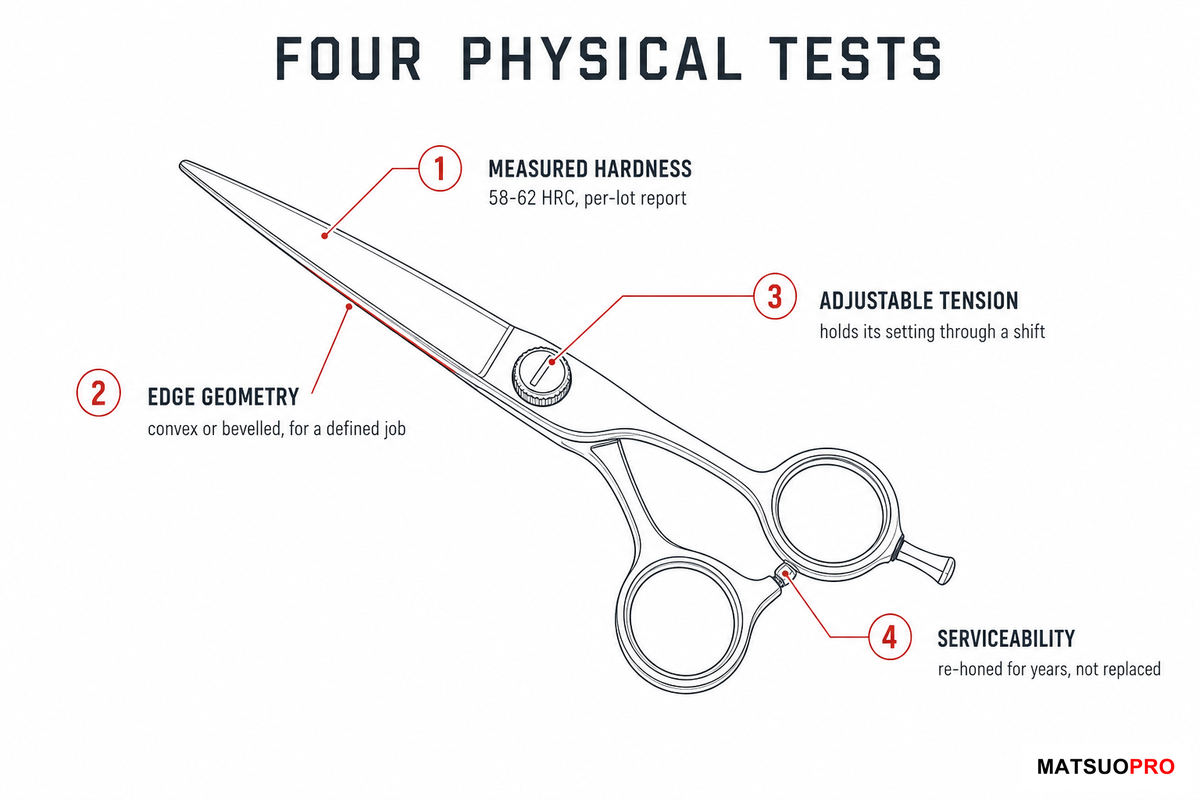
| Blade hardness | 58–62 HRC in working practice — a market convention, not a standard. Measured per ISO 6508-1:2023 |
| Edge geometry | Convex or bevelled — a duty choice, not a rank |
| Tension system | User-adjustable, holds setting through a full day |
| Blade length | 5.0–7.0 in, matched to technique mix |
| Serviceable | Re-honed for years, not replaced |
| Typical retail band | $300–350 entry professional · $700–750+ premium |
“Professional” isn’t a protected word. No licensing body defines it, and no standard governs which hairdressing scissors may carry it. A $19 pair on a marketplace listing and a $700 pair on a brand site can both print it on the box, legally.
Vocabulary won’t help you either. Listings sell the same tool as hair cutting scissors, professional hair cutting shears, professional hairdressing scissors, japanese hair cutting shears or salon shears, and the words are largely interchangeable. Quality hair shears earn the name through measurable properties instead. A professional hair cutting scissors set is likewise a bundling decision, not a quality signal.
What does hold up is a set of four physical properties you can test in your hand or demand on paper. Everything else in this article is downstream of them.
That last one quietly decides the real cost of ownership, and we come back to it twice below. Any shear that can’t be serviced isn’t cheap, it’s temporary.
Working hairdressers use hardened stainless steel hair cutting shears in the 5.0–7.0 inch range, usually more than one pair, chosen by technique rather than by brand tier. A stylist doing precision bob work and a barber doing scissor-over-comb fades aren’t using the same tool and shouldn’t be shopping from the same shortlist. Most build a small kit over time: one quality pair of scissors for primary cutting, something shorter for detail, and hair thinning shears for weight removal. Which hairdressing shears you reach for depends on hair types and the cutting techniques in your week, not on which pair cost the most. The full hair cutting shears range splits along exactly those lines, because that’s how the work splits.
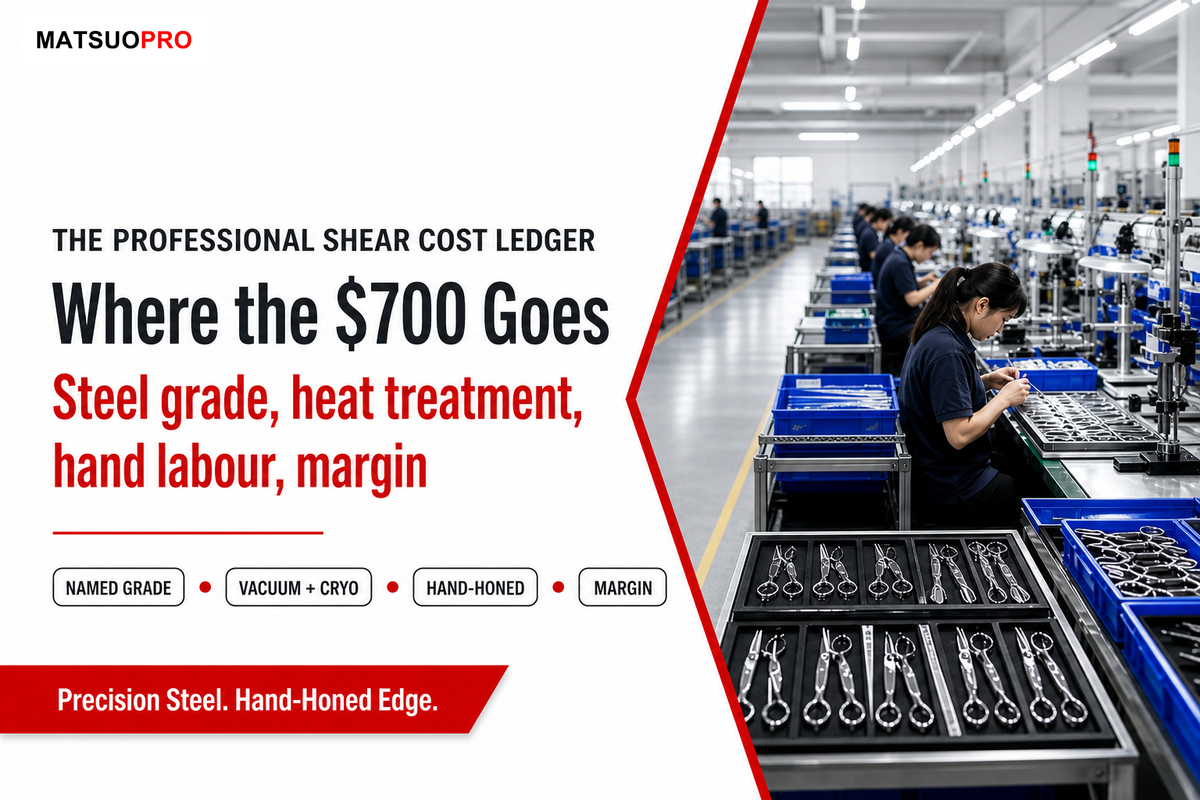
Professional hair cutting scissors cost $300 to $750 because four things stack up: a named steel grade, vacuum and cryogenic heat treatment that takes the blade to 60–62 HRC, skilled hand-honing of a convex edge, and distribution margin. The first three are manufacturing costs a factory can point at. The fourth is real and rarely disclosed. Start with the number the price conversation always leaves out: what the buyer earns.
The US Bureau of Labor Statistics puts the median hourly wage for hairdressers, hairstylists and cosmetologists at $16.95 as of May 2024, and $18.73 for barbers. (That is the vintage the handbook still publishes; BLS released its May 2025 wage estimates in May 2026, so the handbook figure lags one release and the real number today is a little higher.) Against that, a $700 premium shear costs roughly 41 hours of gross pay: $700 ÷ $16.95 = 41.3 hours. One working week, before tax, for one tool.
The BLS wage survey behind that median doesn’t cover self-employed workers. And BLS separately reports that 48% of hairdressers and 76% of barbers are self-employed. So the 41-hour figure describes the roughly half of the profession who are employees, while the people most likely to buy their own shears are precisely the half whose earnings BLS doesn’t measure. Nobody publishes what a self-employed stylist nets per hour. Treat 41 hours as the employed-side anchor, and assume the self-employed side is making the same decision with less visibility, not more.
So this section is built on a different frame. Not “is $700 justified,” but “what does each band buy, priced in your own hours.”
| Cost driver | Sub-$60 pair | $150–300 | $400–750+ |
|---|---|---|---|
| Steel class | Unnamed “stainless” | Named grade (440C class) | Named Japanese grade (VG10, ATS-314 class) |
| Heat treatment | Batch furnace, unstated | Controlled, hardness stated | Vacuum + cryogenic, per-lot hardness on request |
| Hardness achieved | Often unstated | ~56–59 HRC | 60–62 HRC |
| Edge forming | Machine bevel, no hand stage | Machine grind + light hand finish | CNC grind + full hand-honed convex |
| Hand labour | Effectively none | Minutes per pair | The single largest variable cost at this band |
| Tension hardware | Fixed or crude screw | Adjustable screw | Engineered pivot, holds setting |
| Inspection | Sampled per carton | Sampled | Piece-by-piece |
| Serviceability | Not economic to service | Serviceable | Serviceable for years |
| Distribution margin | Thin, volume-driven | Moderate | Brand, showroom, warranty and reputation — a real share, and rarely disclosed |
| Cost in your hours (at $16.95/hr) | ~3 hours | ~9–18 hours | ~24–44 hours |
Marketing language clusters at the top of that table: craftsmanship, handmade, high-quality, super sharp, a lifetime warranty, a matte black finish. Some of it is real — a hand-honed edge genuinely is handmade labour, and longevity genuinely does follow from hardness. But a matte black coating is a finish, and japanese stainless names a steel family rather than a grade. A listing that says only “stainless steel hair cutting scissors” has told you nothing at all about day 400.
Two honest notes on this ledger. First, it maps cost drivers, not cost shares: we haven’t published a percentage breakdown of our own bill of materials and we aren’t going to invent one for a table. Second, the bottom row is the one that matters: the jump from mid to premium costs roughly two to three more working days than the mid band does, and it buys hardness, hand-honing and service life, not a different category of haircut.
Search results will hand you a ranked list of the best hair cutting shears for professionals, the best hair shears, the best professional hair scissors, assembled almost always by people who have never ground a blade. Best budget and best overall are shopping categories, not engineering ones. Worth noting too: the best hair cutting scissors for home use and the best hair cutting shears for beginners are genuinely different questions from this one, and a search that mixes them will mix the answers.
Which is why the honest answer to “do I need the top band” is often no. That’s an odd thing for a factory to write. It’s also what working barbers say among themselves, where the reported buying band sits far below the premium tier and stylists openly ask whether a $200 shear really outperforms a $50 one. If a $250 shear at 60 HRC holds an edge through your week, the $700 pair is buying you refinement, not capability. Our own professional hair cutting scissors exist across that whole ladder for exactly this reason, and you can run your own numbers with the 5-year cost of ownership calculator rather than taking ours.
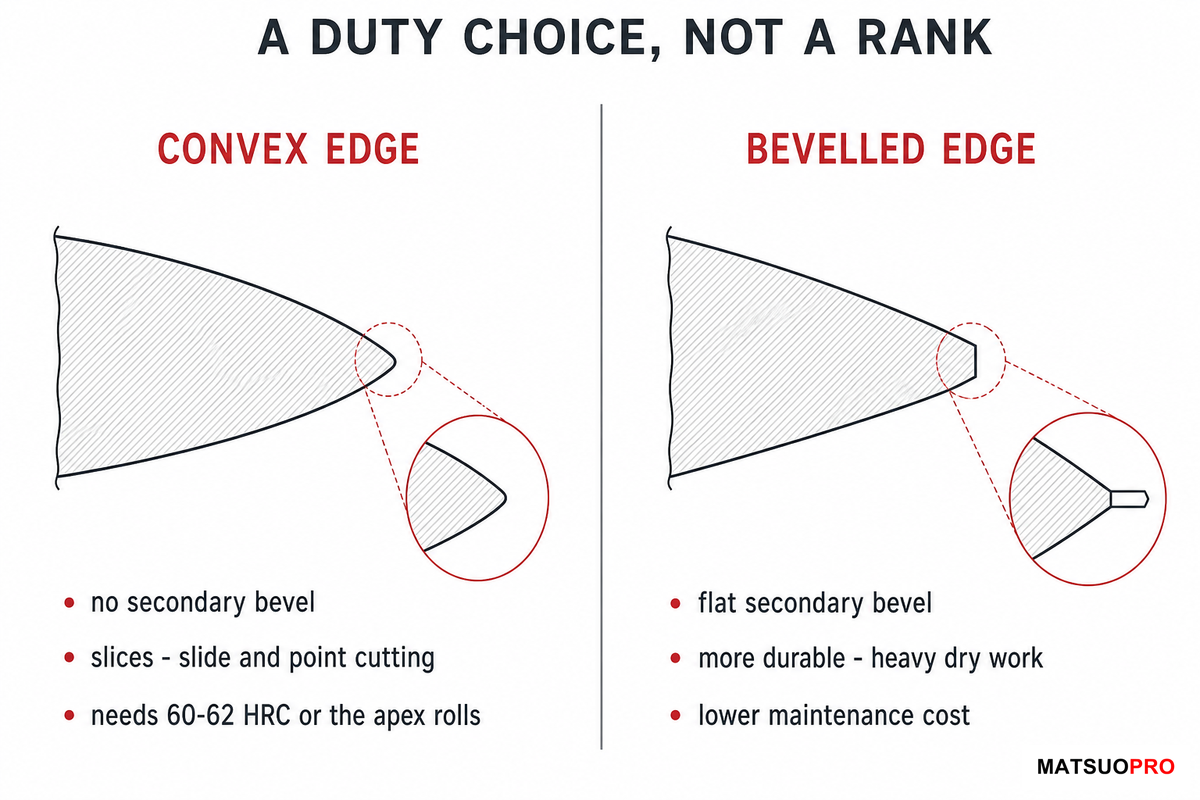
The industry sells convex as the premium edge and bevelled as the budget one. That framing is wrong, and it costs people money.
A convex edge is ground so the blade faces curve smoothly to the apex, rather than meeting it at a flat secondary bevel. It slices rather than pushes, hair slides along the edge, which is what makes slide cutting and point work feel effortless. It also demands a harder blade, because a fine convex apex on soft steel simply rolls over. That’s the real link between edge and price: geometry sets a hardness requirement, and hardness sets a steel and heat-treatment requirement.
But convex isn’t universally better, and the trade press says so plainly: a bevelled edge is the more durable geometry, and a convex edge isn’t always the right choice for blunt cutting. Bevelled edges tolerate abuse, hold up under heavy dry work, and cost less to maintain. Convex edges reward technique and punish neglect.
Choosing convex isn’t just choosing a feel. It’s choosing a maintenance path you’re stuck with for the life of the shear, which is the subject of the next two sections. Steel grade sits underneath all of this; if you want that layer, the hair scissor steel guide and the 440C vs VG10 comparison cover it properly instead of us repeating it here.
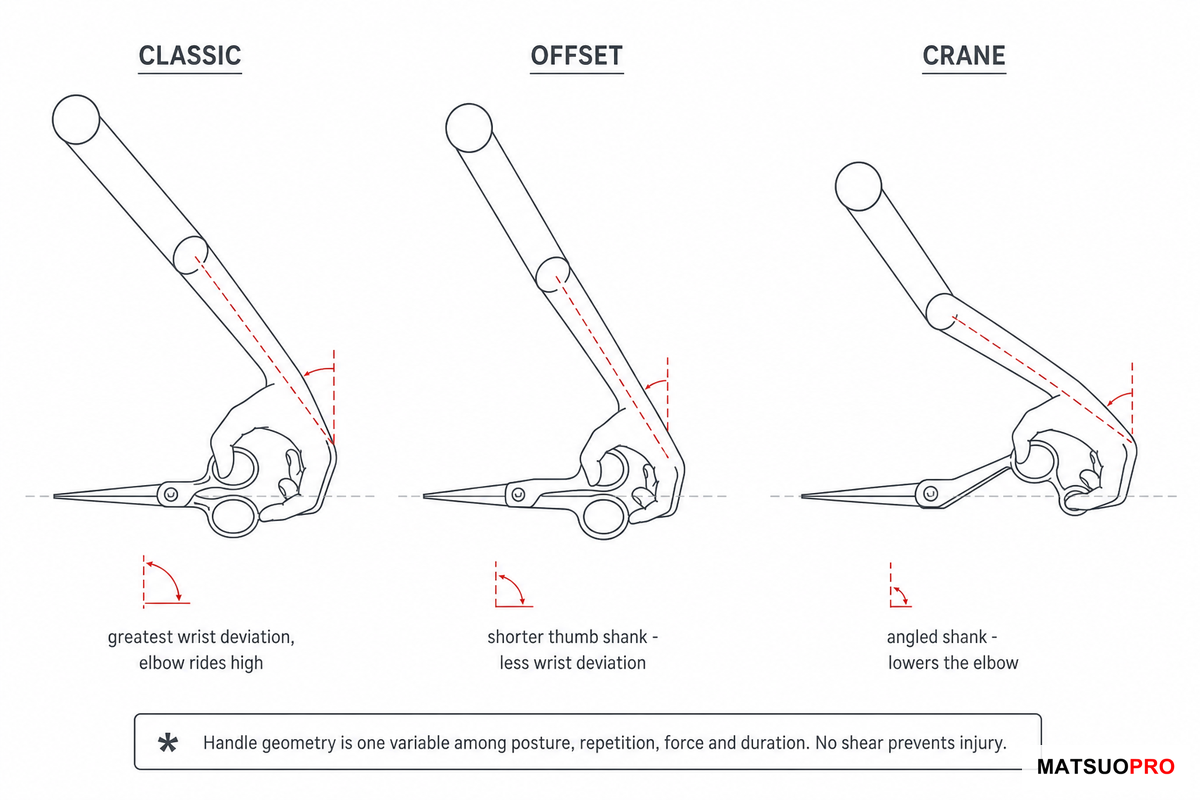
This is the one area where real occupational research exists, so it deserves to be reported accurately rather than turned into a sales line.
A cross-sectional study of work-related musculoskeletal disorders among hairdressers, published in the Journal of Occupational Health in 2021, compared 384 hairdressers with 384 age-matched controls in two Indian cities. It measured association, not causation, and it surveyed an Indian cohort — so read the size of the gap, not the exact percentages, as the transferable finding. Wrist and hand pain was reported by 22.4% of hairdressers versus 10.7% of controls, an age-adjusted odds ratio of 2.42 (95% CI 1.55–3.77). Elbow pain came in at 16.4% versus 10.9%, but with a confidence interval crossing 1.0, so that one isn’t statistically significant and we aren’t going to present it as though it were.
Handle geometry is a lever, not a cure. That study measured an occupation, not a tool, it didn’t test handles. NIOSH treats musculoskeletal disorders as multifactorial, driven by posture, repetition, force and duration together. Offset and crane handles reduce how far the wrist must deviate and how high the elbow must ride; that mechanism is well enough understood to have been engineered and patented for decades, see US20110016728A1, “Ergonomic scissors”, which claims an adjustable thumb offset specifically to allow unstrained wrist movement. Patents prove a design exists and was worth protecting. They don’t prove a health outcome, and no shear has been shown to prevent injury. Handle choice is one variable you control among several.
Practically: an ergonomic handle with an offset thumb and a finger rest changes the angle your wrist works at, and stylists consistently report it does reduce hand fatigue across a full day — ease of use stops being a soft metric when the alternative is pain. Right-handed and left-handed builds are not mirror images of each other either. Match the handle to your grip and your day, not to the catalogue photo. If you’re left-handed, this matters more than any steel decision you’ll make, a true reverse-ground left-handed shear is a different tool, not a mirrored label.
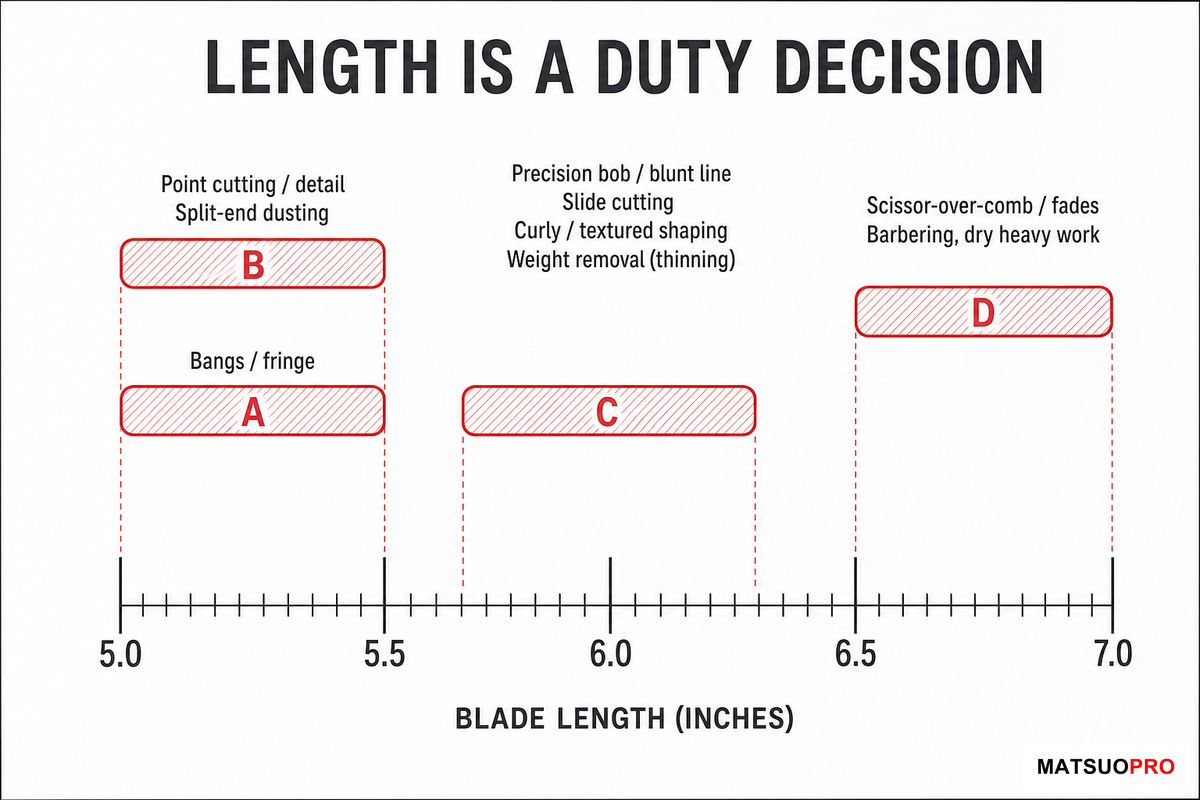
Length is a duty decision before it’s a hand-size decision. The register below is our own selection framework, drawn from how we spec shears for salon and barber programmes, it’s a methodology, not a survey result, and we would rather label it that way than dress it up.
| Duty | Length | Edge | Handle |
|---|---|---|---|
| Precision bob / blunt line | 5.5–6.0 in | Bevelled or semi-convex | Offset |
| Slide cutting | 5.5–6.0 in | Convex | Offset / crane |
| Point cutting / detail | 5.0–5.5 in | Convex | Offset |
| Scissor-over-comb / fades | 6.5–7.0 in | Bevelled | Classic / offset |
| Barbering, dry heavy work | 6.5–7.0 in | Bevelled | Classic |
| Curly / textured hair shaping | 5.5–6.0 in | Convex | Crane |
| Split-end dusting | 5.0–5.5 in | Convex | Offset |
| Bangs / fringe | 5.0 in | Convex | Offset |
| Weight removal (thinning) | 5.5–6.0 in | Toothed blade | Offset |
| Texturizing / blending | 5.5–6.0 in | Toothed, lower tooth count | Offset |
Professional stylists building a kit for varied hairstyles usually finish with two or three shears rather than one: precision cutting on a short convex blade, bulk work on a longer bevelled one, and hair thinning scissors for density. Razor cutting sits outside this table entirely, being a different tool with a different edge, and a shear pressed into service as a razor substitute will disappoint at both jobs.
The last two rows are a different tool family: thinning shears, thinning scissors and texturizing pairs remove weight rather than length, and choosing them is a tooth-count problem, not a length problem. If you want the length and handle question narrowed for your own hand, the blade length and handle finder walks it through.
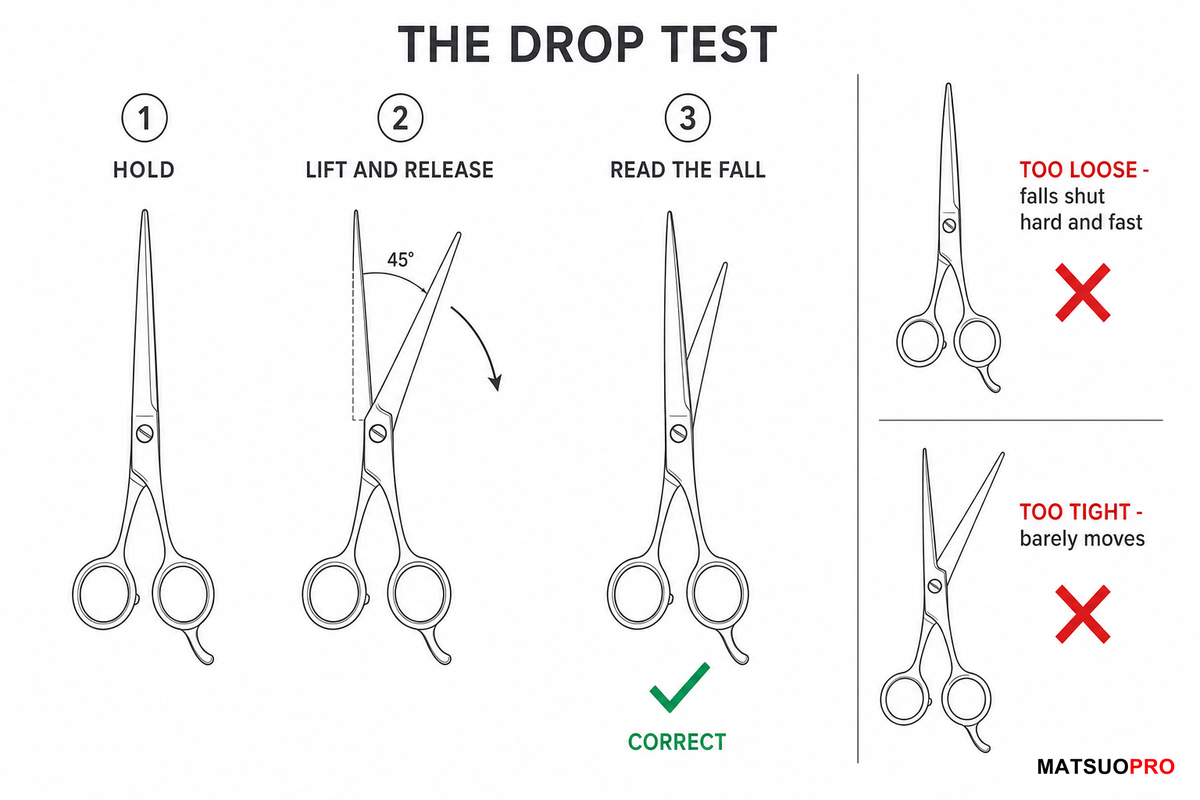
Here’s the most expensive misdiagnosis in this trade: a shear that folds hair instead of cutting it’s very often not blunt. It’s loose.
Tension is the force holding the two blades in contact as they pass. Too loose and hair bends into the gap and escapes, which feels exactly like a dull edge. Too tight and the blades bind, the edges wear each other, and your hand pays for it all day. The pivot is a real mechanical assembly designed to be set, not a decorative screw: patents for haircutting scissors describe the hinged joint as a hinge screw and screw nut precisely because the setting is meant to be adjustable and repeatable, see US6408523B1.
Hold the shear closed, blades pointing up. Lift the top blade to roughly 45° and let go. It should fall on its own and stop about a third to halfway closed. Falls shut hard and fast — too loose. Barely moves — too tight. Adjust, clean, dry, oil the pivot, and re-test before you conclude the edge is gone.
Cleaning isn’t just performance housekeeping either. BLS lists “clean and disinfect all tools and work areas” among the defined duties of this occupation, and state cosmetology boards, not the shear itself, regulate how that’s done. Which creates a tension of its own: the disinfectant routine your licence requires is also a corrosion exposure on a hardened blade. Wipe hair and product residue off after each client, dry the blades fully after any disinfectant contact, and oil the pivot daily. Hair is mildly acidic and chemical service residue is worse; steel at 60 HRC is hard, not immune.
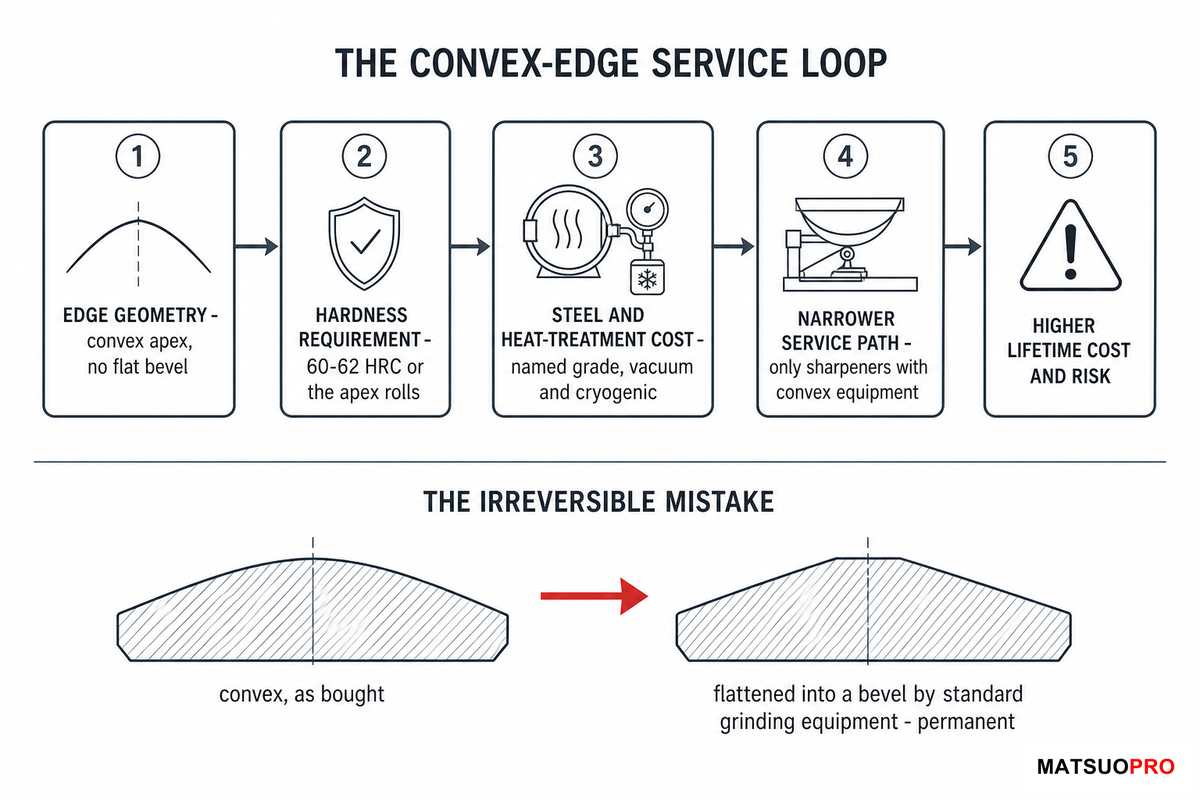
Now the part that closes the loop opened three sections ago.
When you buy a convex edge, you aren’t only buying a cutting feel. You’re committing to a sharpening path for the rest of the shear’s life, and quietly narrowing the set of people who are allowed to touch it.
Convex edges carry no flat secondary bevel. Restoring one means re-establishing a curved face, which needs different equipment and a different technique from the flat-bevel grinding that most general sharpening services run. Put a convex shear on a standard bevel setup and the curve is flattened into a bevel: the geometry you paid for is gone, permanently, and the shear will never slide-cut the way it did. Practitioners describe exactly this outcome, shears returned from a service worse than they went in, with the edge shape changed rather than restored, and it’s the single most common way an expensive shear becomes a cheap one.
So the loop closes like this: edge geometry → hardness requirement → steel and heat-treatment cost → a narrower service path → higher lifetime cost and higher risk from the wrong sharpener. That chain is the honest reason a convex shear costs what it costs, and it’s why “who will sharpen this” belongs in the purchase decision, not after it.
Run it in hours, not feelings. Take a $250 shear serviced twice a year at roughly $30 a visit: that’s $60 a year, about 3.5 hours of gross pay at the $16.95 employed median, to keep a working tool working. Replacing a $60 unserviceable pair twice a year costs $120, more money, worse tool, every year, forever. Only at the bottom of the market does the arithmetic invert, where the shear was never economic to service in the first place. That’s the real dividing line between a tool and a consumable, and it has nothing to do with the word “professional” on the box.
Interval depends on your volume, not on a calendar rule. Stylists commonly rotate several pairs and send them out on roughly a quarterly cadence rather than running one pair to failure, rotation spreads wear and means no client ever sits in the chair while you fight a tired edge. Before you hand over a $700 tool, ask the sharpener one question: do you work on convex edges, and what equipment do you use for them? If the answer is vague, walk. You can model the trade-off with the sharpening cost-of-ownership calculator.
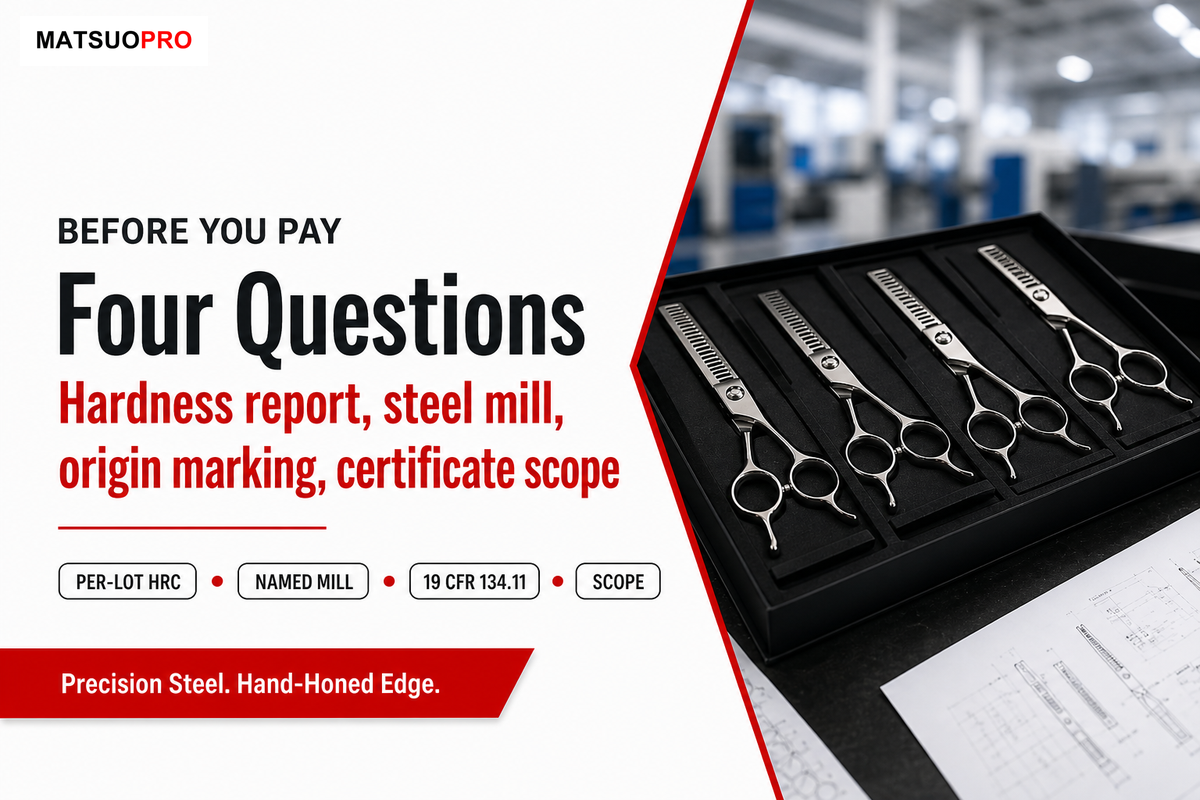
Every seller in this category says Japanese steel, hand-forged, precision, certified. Here are four questions that separate the ones who can prove it. They apply to us as much as to anyone else.
On that last point, the single most misread word in this industry is “certified.” The standards body itself is blunt about what it does and does not do:
“ISO does not perform certification or issue certificates, and it does not permit anyone to use the ISO logo in connection with certification.”
— International Organization for Standardization, official certification guidance
ISO 9001 describes a quality management system. BSCI and SGS describe audits. None of them is a statement about whether a blade holds an edge.
That doesn’t make certificates worthless, it makes them checkable. A certificate is only meaningful if you can confirm four things: who issued it (an independent certification body, not the factory), whether that body is accredited (and by which national accreditation body, you can cross-check via IAF CertSearch), what its scope statement actually covers, and which site address and expiry date it names. Certificates naming a different facility, an expired date, or a scope that excludes your product are decoration. Ask for the certificate number and verify it at the source. The Japanese steel provenance test and the HRC hardness guide go deeper on the first two questions.
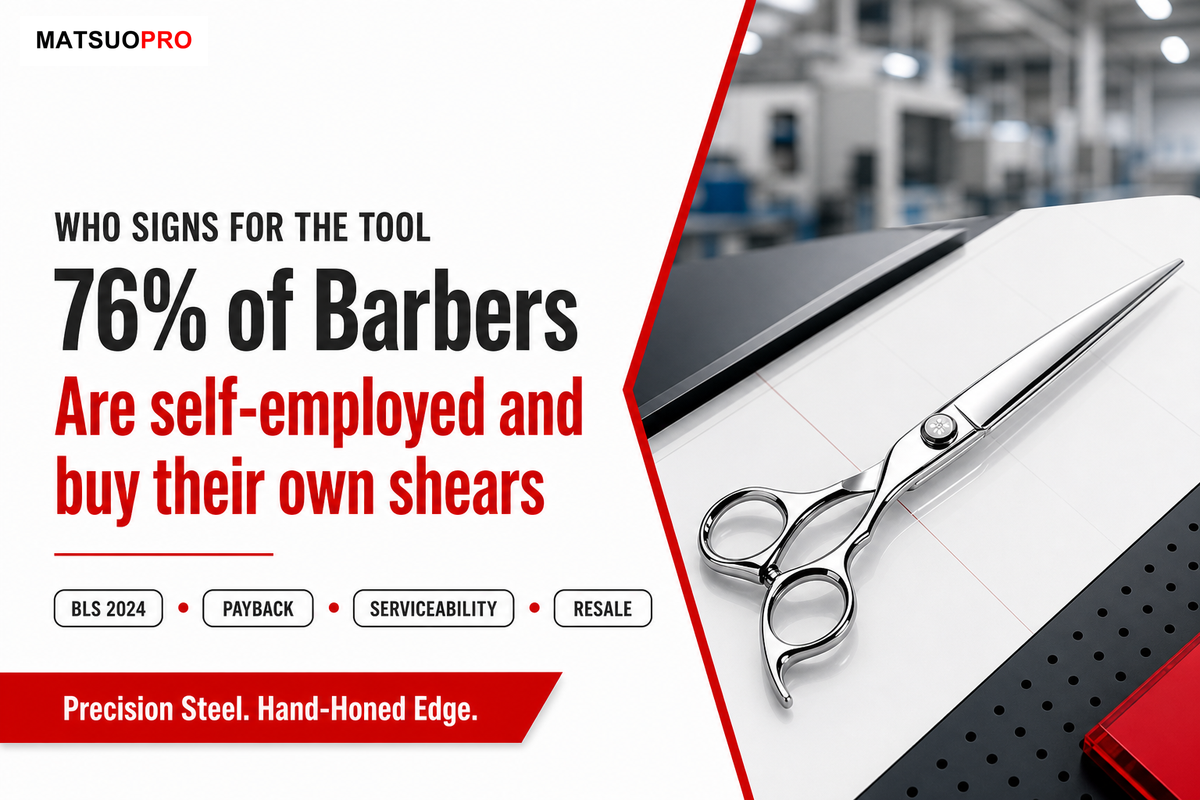
What is changing is not demand, it is who pays. Most people who cut hair for a living now buy their own shears rather than being issued them: BLS puts self-employment at 76% of barbers and 48% of hairstylists. That makes a shear a personal capital decision judged on payback, serviceability and resale, not a salon fleet decision judged on standardisation. The most consequential fact about this market isn’t a growth rate. It’s who signs for the tool.
Per the US Bureau of Labor Statistics Occupational Outlook Handbook, 76% of barbers and 48% of hairdressers, hairstylists and cosmetologists are self-employed, and BLS notes that some lease booth space from a salon owner. For most of this profession, a shear isn’t a line on a salon’s equipment budget, it comes out of the individual’s own pocket, and competes with rent.
Ownership changes what a shear has to prove before it gets bought. Salons standardising twenty chairs care about consistency and replacement cost. Self-employed stylists buying one pair with 41 hours of their own gross pay care about three different things: how long until it pays for itself, whether it can be serviced locally, and what it’s worth in two years if the plan changes. This is why we keep pushing the ownership arithmetic instead of the specification sheet, for half this trade, the specification sheet is somebody else’s problem and the invoice is theirs.
One honest limit on this: BLS reports a 2024 snapshot, not a time series, so we aren’t claiming the self-employed share is rising. We’re saying it’s already the majority position among barbers and half the position among stylists, today. BLS projects the occupation to grow 5% between 2024 and 2034, with about 84,200 openings a year, most from replacement rather than expansion. For market context only, and at order-of-magnitude accuracy: third-party analysts size the global hair scissors market near USD 96 million in 2025. That number tells you nothing useful about your next purchase, which is rather the point.
We forge professional hair cutting scissors from Japanese VG10, 440C and ATS-314 steel and hand-hone the convex edges ourselves, which is why the Cost Ledger maps cost drivers by production stage rather than repeating retail talking points. Where we couldn’t prove something, we said so: we haven’t published our own cost-share percentages, so the ledger carries none, and the 41-hour figure covers only the employed half of the trade because BLS doesn’t survey the self-employed half. Reviewed by the Mackay Hair Scissors technical team.
MATSUOPRO is the Mackay Hair Scissors manufacturing brand for professional hairdressing shears, barber scissors, thinning shears, and pet-grooming scissors. We support salons, distributors, academies, grooming brands, and private-label buyers that need factory-direct production with practical material guidance.
Our buying guides are written to help purchasers compare steel grades, handle styles, blade geometry, surface finishes, logo options, packaging, MOQ, and sample validation before placing an OEM or wholesale order. The goal is to make each scissors specification easier to discuss with a real production team.
Factory-direct supply since 2014, with product lines covering professional cutting shears, barber shears, thinning scissors, texturizing scissors, left-handed models, and pet grooming scissors for international B2B customers.
We focus on Japanese 440C, VG10, and ATS-314 steel choices, convex and bevel edge geometry, ergonomic handle balance, tension systems, logo engraving, private-label packaging, and sample-based OEM confirmation.