Get in Touch with Mackayhairscissors Company
We use submitted details to respond to your quote request. Read our Privacy Policy.

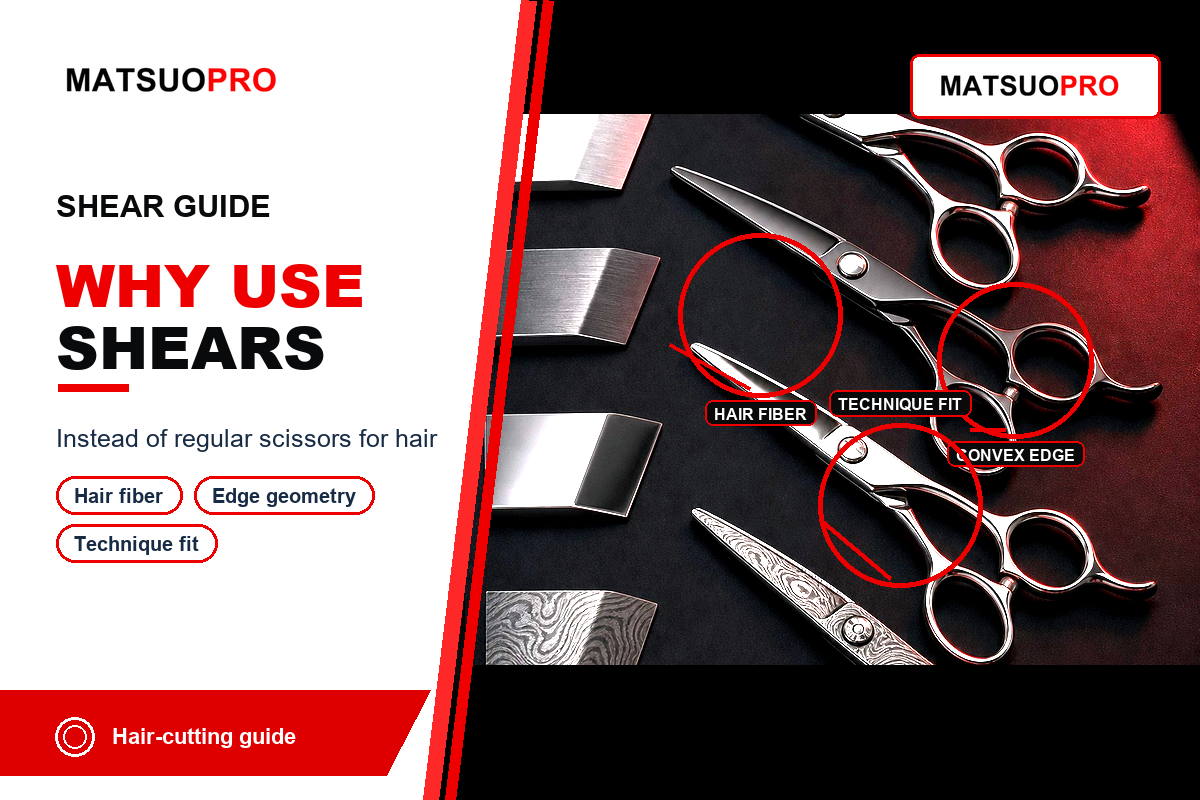
Why use shears instead of scissors is the practical question a stylist should answer before any technique decision: is this tool built and verified for repeated professional hair work, or is it a general-purpose pair that happens to close on hair? Professional hair shears are engineered around blade length, edge geometry, handle fit, and balance for sustained salon and barber technique – ordinary scissors aren’t automatically the right comparison tool once the task moves from an occasional trim to daily client work.
Professional hair shears are evaluated for controlled, repeated hair-cutting technique, while ordinary scissors are built for general household or office material. Slide cutting specifically needs a convex-edge shear, since a beveled household blade can’t support it. The switch matter most once technique, hand fatigue, or client volume enter the decision.
| Convex edge angle (industry-reported range) | 30–40° — directional, not a fixed standard |
| Beveled edge angle (industry-reported range) | 45–60° |
| Convex-edge sharpening frequency | Roughly every 6–12 months with specialist care |
| Technique most dependent on edge type | Slide cutting (convex required) |
| Regulatory reference | California BBC shear disinfection procedure (§979(f)) |
One scope note before the comparison tables below: “shears” is not a hair-only word, and mixing it up with other trades is a common source of confusion when shopping. A gardener reaches for pruning shears to prune a branch or trim a hedge, cutting plants and thick stems that a household pair could never manage – a professional pruner treats blade angle the same way a barber does. In a kitchen, kitchen shears handle poultry and packaging, and paper scissors sit in an office drawer for envelopes. None of those tools are suitable for hair. The difference between scissors and shears covered in this guide is specifically about which cutting tool – dedicated hair shears, or ordinary scissors or shears sold as a household pair – is the right cutting tool for professional hair-cutting technique, not which of the two shears-and-scissors terms sounds more official. In parts of Australia and the UK, gardeners call the same pruning tool secateurs, using it to shape a shrub, thin foliage, or pick fruiting plants; a groomer’s shears trim a pet’s coat, and a seamstress reaches for embroidery scissors for fine thread work. None of those trades share a technique profile with professional hair cutting, even though the tool names overlap.
What changes when the material being cut is hair versus paper, cardboard, or fabric? Hair is a fine, springy fiber that compresses before it shears – the closing blades have to catch and cut it cleanly rather than crush or bend it. That single mechanical difference is why professional hair shears exist as a distinct category rather than a marketing label on top of ordinary scissors. Cosmetology course materials from institutions such as Pivot Point and Snow College list professional cutting shears as standard student-kit tools precisely because repeated hair work is treated as a distinct technical skill, not an extension of household cutting.
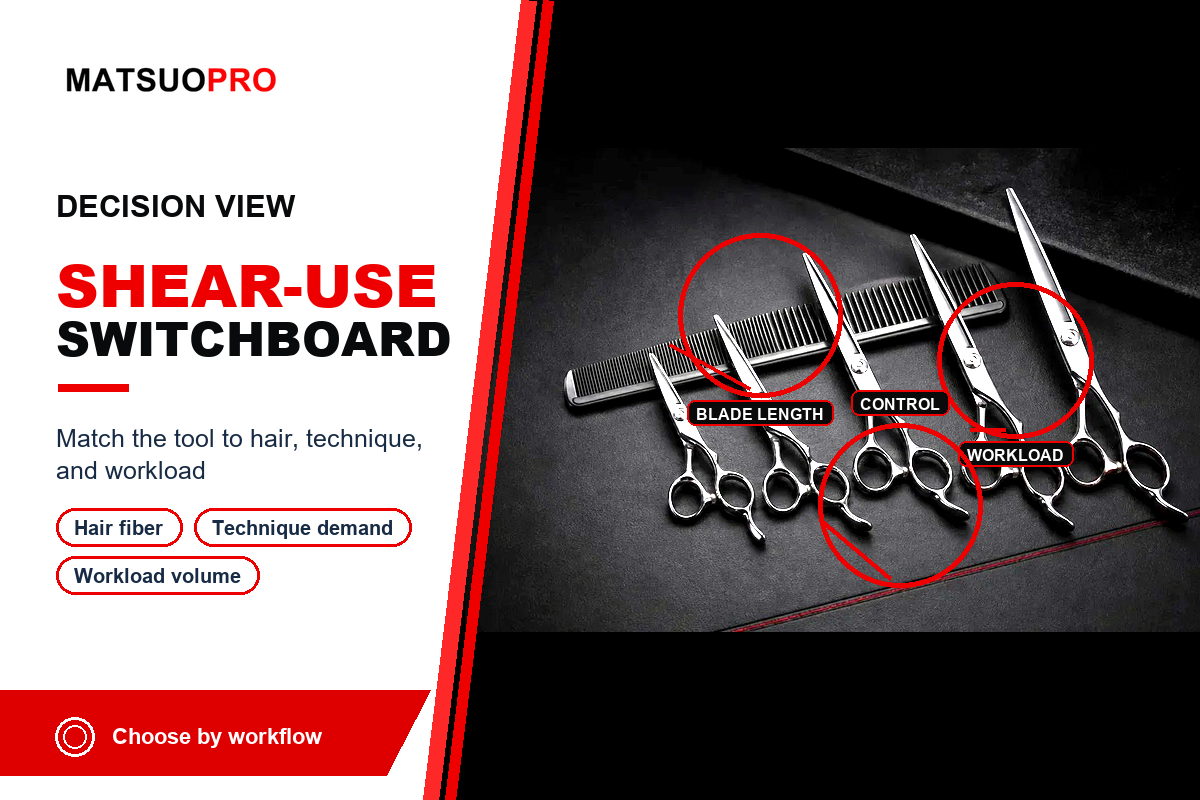
The competitors who cover this exact question tend to stop at “professional shears are better” without saying for which task, at what point in a stylist’s workload, or under what evidence. That’s a table-stakes answer, not a decision framework. The table below – call it the Shear-Use Switchboard – reframes the question around the task in front of you rather than the terminology on the package.
| Task | Control Need | Ordinary-Scissor Limitation | Switch Decision |
|---|---|---|---|
| One-time personal fringe trim at home | Low | Thicker household blade catches loose strands | Not required |
| Repeated client blunt cutting | Moderate–high | Wider household edge angle compresses the hair shaft instead of shearing it | Switch |
| Wet or dry slide cutting | High | Flat/beveled edge catches the strand instead of letting it glide | Switch (convex edge only) |
| Texturizing and blending | Moderate | No notched-blade geometry available | Switch to a thinning shear |
| Scissor-over-comb barbering | High | Handle balance not built for sustained one-hand control | Switch |
| High-volume salon workday | High (fatigue) | Household handle shape tires the hand over hours of use | Switch to an ergonomic handle fit |
| Point-cutting fine detail near the face | High precision | Household blade tip too blunt for detail work | Switch |
| Left-handed stylist workflow | High | Household scissors default to a right-handed grip | Switch to a left-handed shear |
| Cosmetology-school training | Foundational | Not built to the training standard course kits specify | Switch to an entry-level training shear |
| Cutting non-hair material mid-service (tags, foils) | Low | Using the hair shear itself would dull its edge | Do not switch — keep a separate household pair |
Read the Switchboard task-first: it isn’t asking whether you own “shears” versus “scissors,” it’s asking what the next haircut actually demands. That framing also matter for the raw search term behind this article – why use shears instead of scissors pulls a mix of gardening and hair results because the phrase is used identically in both contexts. Every section below stays anchored to professional hair-cutting technique.
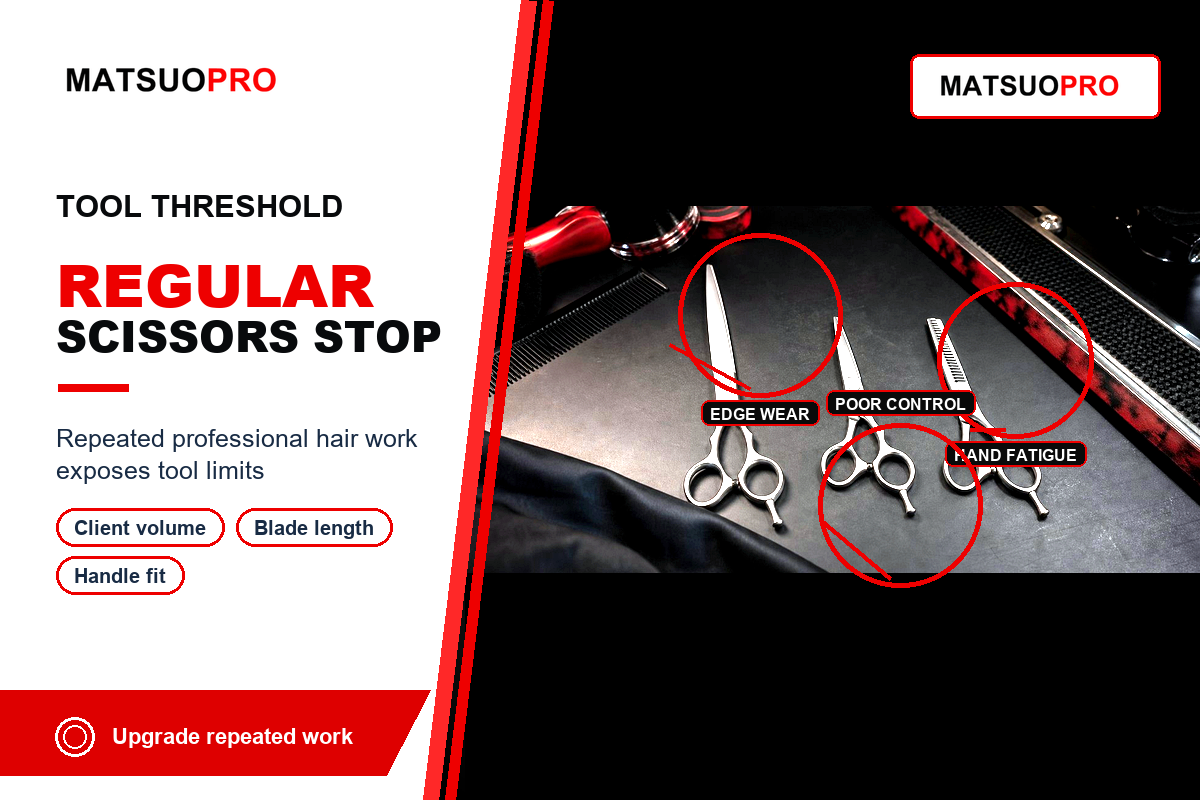
Regular scissors become the wrong tool once hair work is repeated and professional rather than occasional. One household pair can manage a single at-home trim without issue, but daily client volume exposes gaps in edge geometry, blade length, and handle fit that a general-purpose pair was never engineered to close. The sections below cover the specific scissors-versus-shears distinctions that matter once that volume threshold is crossed.
You can physically cut hair with a pair of household scissors – the blades will close and the strand will split apart. Is this the same question as whether general scissors are the right tools for repeated professional client work? When you’re doing one at-home fringe snip, the risk is mostly cosmetic: an uneven line you can conceal until your next salon visit.
When you’re a stylist doing that 40 hours a week, however, the calculus is different because now the tool has to stand up to volume, accuracy, and client demands that a pair designed for a household couple wouldn’t have been built with.
A senior stylist on a hairdressing-scissors community thread simply put the case: if anyone cutting hair at least 40 hours a week, tool choice “usually matters” – serious hair shears have a tendency to hold a whole lot better in the hand than a general-purpose pair ever built for the task. That’s an experience-based piece of knowledge, not a laboratory measurement, and it bears considering as “professional-grade” proof that a hair-specific pair will survive frequent use.
As far as interchangeable any pair of sharp blades will do for hair simply because they are being marketed as “sharp.” Edge sharpness varies; edge type, blade length, and handle fit are different variables that the odd sharp household pair doesn’t necessarily get perfect first time every time.
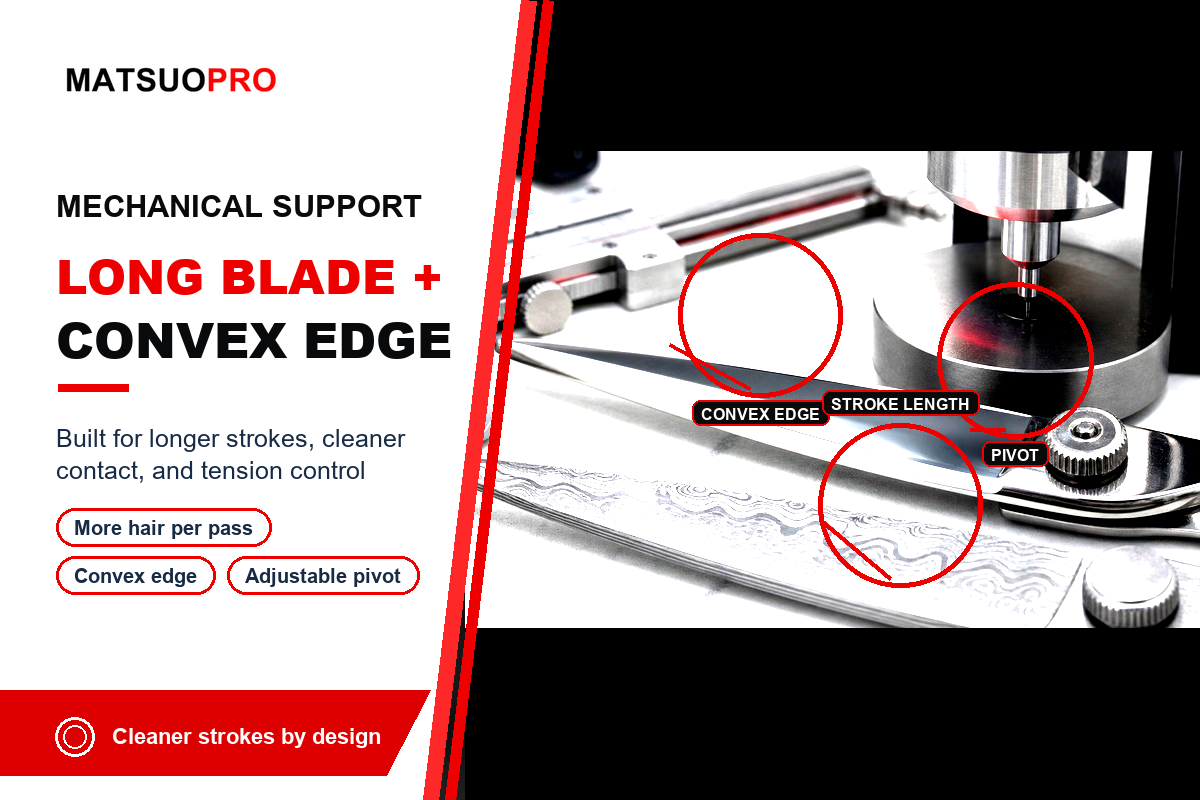
Once a professional master accepts that hair work is a specialized skill, the next step is to determine what physical features really make a difference and why. Blade length affects how much hair moves per stroke – longer blades provide more hair per pass, which professional scissor users doing sweeping, bulk removal rely on.
Edge type affects how the blade interacts with the hair shaft as it closes. The two most common professional edge types are convex and beveled, and the mechanical difference between the two explains most of what “professional-grade” claims are actually describing.
Underneath the edge-type discussion is a simpler mechanism: most professional shears use an adjustable screw-tension pivot rather than a fixed rivet, so the hinge can be retightened as the blades wear, and the finger loop is sized so one hand controls the whole stroke without excess play. In every pair, one blade stays anchored against the thumb while the other does the cutting stroke, which is why pivot tension matters as much as edge sharpness. Blade steel choice follows the same logic – some shears are designed around hardened carbon steel for an extremely sharp edge that’s easy to hone, others around stainless steel for corrosion resistance in a humid salon environment, and either choice trades off differently against cutting force and edge retention. None of this detail matters for a pair of scissors kept in a kitchen drawer, only for a specialized scissors design built and maintained for daily technique.
“The convex blade is now considered the professional standard for haircutting scissors, the previous being a beveled blade, which are today found in basic scissors such as traditional barber scissors, household scissors, fabric shears, etc.”
Jesse Linares, Sam Villa ArTeam, quoted in Modern Salon
In mechanical terms, the reason is simple: A convex edge is ground to a very acute angle-industry technical sources describe roughly 30-40-with a continuously curved surface, which allows hair to slide off the blade with minimum friction as it’s cut. Semi-convex edges lie in the middle, ground to a compromise profile around 40-50 degrees. A bevel edge, by contrast, is wider-around 45-60 degrees-and has more steel supporting the cutting edge, making it hardier for tough use and less likely to chip, but presenting a flatter surface to the hair, which offers friction rather than slip. Neither type is universally better-a convex edge offer compromise hardness for maximum slide potential; a semi-convex, a blend of both; and a beveled, maximum durability for the sacrifice of slide potential-which is another reason the numerical benchmarks here are to be seen as relative, rather than absolute. This data is derived from technical-industry documents, rather than an industry standard of certification, and actual manufacturer grinds may vary.
Convex edges are typically honed by a specialist who understands the naturally curved (often referred to as “hamaguri” in the business) surface; honing a convex blade on an ordinary flat hone or even a bench grinder will flatten the curve and turn it into a semi-convex or beveled blade. If the only sharpener you or your service provider uses for styling shears is a flat hone or grinder, the time has come to seek a specialist for your convex-edge shear. Sharpening frequency varies with edge type as well: under regular professional use, trade sources put convex edges at roughly 6 months to 12 months between specialist sharpenings, semi-convex at roughly 8 months to 14 months, and beveled at roughly 4 months to 10 months-directional maintenance benchmarks, not a fixed service schedule.
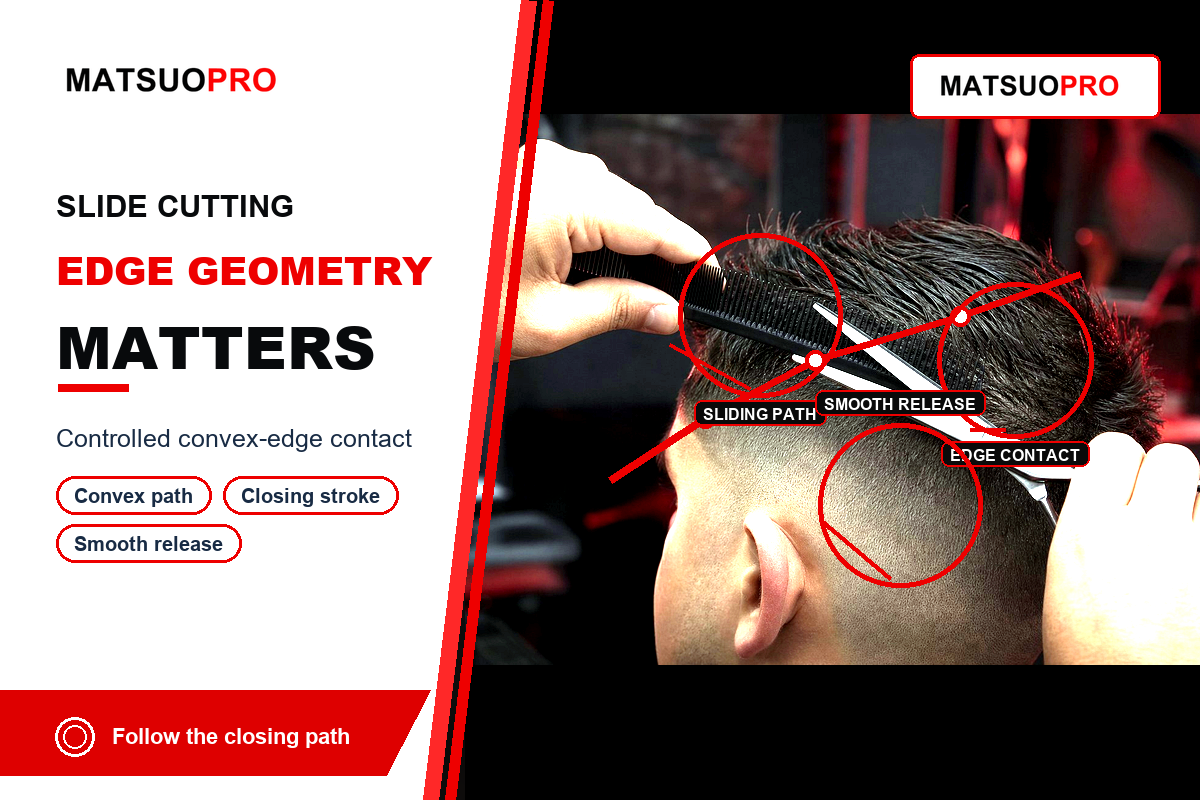
Slide cutting changes the tool conversation because it is the one hair-cutting technique that depends directly on edge geometry rather than general sharpness. A blunt cut or scissor-over-comb pass tolerates a beveled or convex edge about equally well, but sliding the blade along a strand while it closes only works cleanly with a convex edge. That single technique requirement, covered next, is why edge type moves from a preference to a hard constraint.
Yes-that’s the shear’s fundamental goal-but a more operative question, professionally, relates to the particular cutting technique being employed, not simply whether the blades are sharp; slide cutting is the only hair-cutting technique that fundamentally relies on the type of edge being used.
In a slide cutting motion, the stylist move the blade along the length of a strand or lock of hair, gradually closing it as it moves, to slice through the hair without having to draw the blade through it at a single point in time, as in a blunt cut. To effect this, the blade must be designed with a convex edge. Because the curve of the edge’s surface traces an arc, it will pass against the hair with minimum resistance, whereas a bevel edge would offer a flat, wider resistance surface with which the hair would necessarily catch, potentially stretching, bending, or roughening the strands.
That’s precisely why both trade and some retail technical resources strongly advise against slide cutting using a beveled or general-purpose blade. It’s not a matter of personal taste; it’s dictated by the geometry of the blade itself. In practice, on the salon floor, a stylist can confirm this on the bench in under a minute: draw a beveled blade along a test strand in a slide motion and feel it catch, then repeat with a convex edge and feel it release. If slide cutting will be part of your routine, that single piece of information-not blade length, not brand, not price-is the primary determining factor in edge-type selection.
If you practice mostly blunt cutting with only occasional use of the slide cutting motion, a semi-convex edge serves as a nice middle ground between full slide capabilities and the service requirements of a convex blade.
When your client work is repeated, the requirements that shape the selection of a cutting tool change, and they change for salon work differently from how they change for barber work. A salon stylist performing contemporary cutting cutting, slide technique and layer work will likely have a technique profile that calls for a convex edge and a shear tool that can make long, precise strokes. But a barber doing scissor-over-comb interleaved with clipper work is going to need a shear that can handle quick finger changes between tools, will be used along side the clipper (not instead of), and – given the volume and wear often associated with barbering – can be trusted with a tougher bevel or semi-convex edge that doesn’t require a technician’s touch.
Neither workflow is “more professional” than the other; they just load different variables. A stylist who attempts to impose a barber-optimized, durability-first shear in a slide-laden salon methodology will struggle with the tool, while a barber who adopts a delicate convex-edge shear designed for salon-precision work may find chips or dulling outpace their volume and use pattern. Choosing a shear based on workflow, rather than the designation in his profile, is the stronger arguable decision criterion. What both workflows share, regardless of edge type or blade length, is the same tool-sanitation baseline: California’s Board of Barbering and Cosmetology requires the same shear-disinfection procedure in salon and barbershop settings alike, so the workflow split changes cutting technique and maintenance cadence, not the underlying hygiene standard the tool must meet.
While we’re most familiar with understanding blade shapes in the context of “shears over scissors,” it’s how your chosen shear fits and how the handle is oriented (handedness) that determines whether it will actually serve you well, in your hand, over the course of an entire shift. There are three primary handle styles for shears, and the differences between them affect where the thumb sits and where the fingers grip over time (affecting fatigue): Symmetrical handle; Offset handle; Forward-Set handle. On the salon floor, in practice, that difference shows up hours into a shift, not in the first five minutes of holding a new pair.
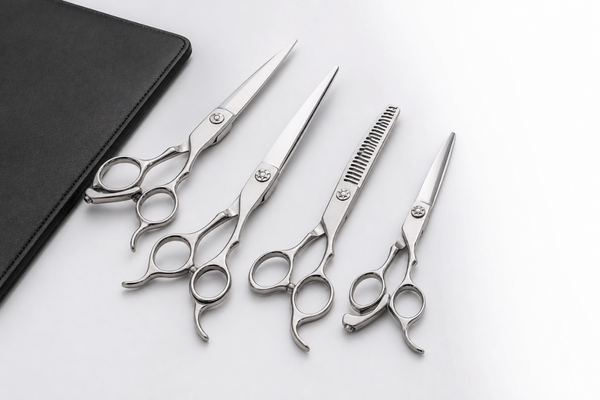
“Only the tip should enter the [thumb] ring… the thumb’s sole purpose is to move the blade up and down, not to grip or push the shear.”
Jesse Linares, quoted in Salon Magazine
That one physical characteristic-the degree to which the thumb is seated and the extension the index finger make past the second knuckle-is a fixed, observable thing, not a sales promise, and it trumps edge selection or blade length. The other issue customers often ignore: a right-handed shear forces a left-handed stylist into a painful, unnatural degree of wrist bending for as long as they own the tool, reducing control and tiring the hand regardless of how good the blade itself is. For a closer look at fitting a shear to left-handed technique, see this left-handed hair scissors guide; for the baseline category this whole article measures itself against, see hair cutting shears.
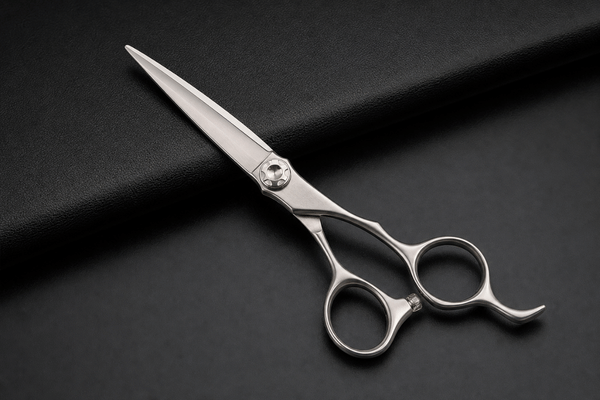
An ergonomic design does more than look modern: the goal is to minimize hand fatigue over a full shift by helping you arrange your grip so one finger anchors the thumb ring while the other hand feeds hair, rather than forcing the whole hand to fight the tool. Longer, heavier-bladed shears – the type designed for heavier bulk removal – are typically larger and suit sweeping technique, while a shorter, lighter-bladed model favors precision cutting and precise cuts near the hairline. None of this ergonomic detail is really about which blade is sharper; it’s about which implement lets you keep trimming, hour after hour, without your hand giving out – the same craft consideration that makes a widely used household pair a poor substitute once volume climbs.
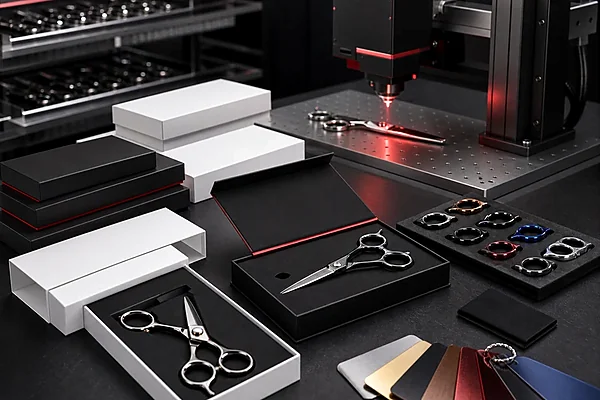
Once common scissors are out of consideration for a particular goal, the question become, which type of professional shear do you buy – a separate matter than “cutting shear vs. thinning shear” which is a task/technique comparison, not a scissor/shear vocabulary point.
| Type | Primary Use Case | Typical Edge | Best Fit For |
|---|---|---|---|
| Standard cutting shear (5.5–6″, about 140mm–150mm) | Everyday blunt/straight cutting | Convex or semi-convex | General salon stylists |
| Long-blade cutting shear (6.5–7″, about 165mm–180mm) | Bulk removal, sweeping strokes | Convex or beveled | Barbers, high-volume stylists |
| Slide-cutting shear | Wet or dry slide technique | Convex only | Texture-focused stylists |
| Point/detail shear (shorter blade) | Fine detail near hairline/face | Convex, fine tip | Precision finishing work |
| Left-handed shear | Left-hand dominant workflow | Any edge, mirrored handle | Left-handed stylists and barbers |
| Barber-specific shear | Scissor-over-comb, clipper pairing | Often beveled (durability) | Barbers |
| Salon precision shear | Fashion-forward, editorial cutting | Convex | Salon and session stylists |
| Training/beginner shear | Fundamentals, skill-building | Beveled (low maintenance) | Cosmetology students |
| Thinning/texturizing shear | Controlled bulk removal, blending | Notched blade | Any stylist needing texture control |
| Ordinary/general-purpose scissors | Household or office material | Flat bevel, thick stock | Not a substitute — baseline only |
Note how thinning/texturizing shears have their own category row instead of being lumped with “cutting shear”; this is because they answer a different type of question, specifically blending, as opposed to a standard-cutting type. Treating them as the same is a common buying mistake. See thinning shears for more on those specifically, and this professional hair cutting scissors guide for a broader walk-through of matching shear type to technique.
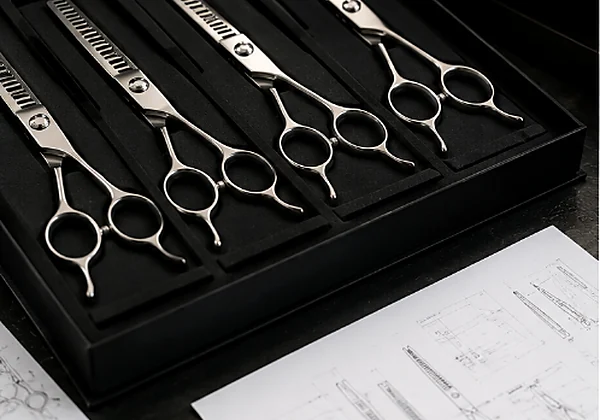
Verifying a professional hair shear before payment means checking documentation, not marketing language. Steel type, hardness grade, certification, and warranty terms should each trace back to a source the seller can name, rather than a general claim of quality. Blade length and edge type are part of that same verification, since neither one is universally “better” without matching it to your own technique and hand size.
Choosing the right tool ultimately comes down to matching these key differences – steel, edge type, blade length, and handle fit – against your own technique, so you can make an informed decision instead of relying on a seller’s word.
Longer blades are great for broad strokes or large volume-removal jobs. “Better” solely depends on your work style, hand size, goals, and control needs near the face and for finer detail work. Consider blade length relative to handle fit, balance, and work technique rather than trying to determine length represents an objective measure of “better.” You should confirm longer blades are right for your specific technique through brand documentation or other professional guidance rather than assuming longer is better.
Request and review documentation before buying ANY professional hair shear – instead of buying based solely on assertions by the seller. Steel type, origin, hardness grade, certification, and warranty are all numeric details that differentiate marketing puffery from reliable fact. Any claimed specifications should be backed by an independently verifiable source (such as an official certificate, a certification body, or recognized standards) before you factor that information into your purchasing decision. As a rough market reference guide only (there’s no official list), some market references show professional convex-edge shears running $200-$2,000 and up, semi-convex from about $150-$800, with standard beveled models priced $50 to $600. Price range alone shouldn’t determine the value for your specific needs without the additional data you should be obtaining.
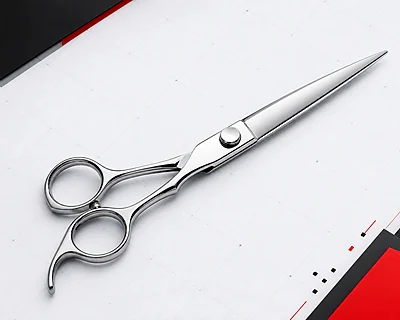
Before opening your wallet, confirm the shear steel type, check how its hardness grade is independently verified, and get estimates for annual maintenance (sharpening and service). Maintenance cost figures from trade publications indicate routine sharpening prices can be anywhere from $50-$170 for convex-edged shears, $35-$130 for semi-convex, and $50-$150 for beveled-again, consider these a ballpark range, as pricing varies by maker and service provider. Any shear you end up purchasing that offers all three elements with verifiable proof is of a substantively higher value than one that simply uses flattering buzzwords.
For those who want to explore the steel details of the purchasing decision, the steels guide and the guide to Japanese steel hair shears can explain in greater detail what steel claims actually mean; there’s even a hair shear steel guide that can help narrow down the right grade to match your typical technique once you receive documentation.
Hygiene documentation also needs to show up here. California’s Board of Barbering and Cosmetology, for instance, details a specific multi-step process of shear disinfecting in professional use: brush out visible waste, clean with soap/detergent and water, then rinse, and spray or wipe down with a California-approved, EPA-registered disinfectant according to the manufacturer’s use instructions. That’s regulatory info it’s worth knowing no matter what shear you eventually choose, and it’s useful also as a reminder that professional tool decisions aren’t made in a tech vacuum.
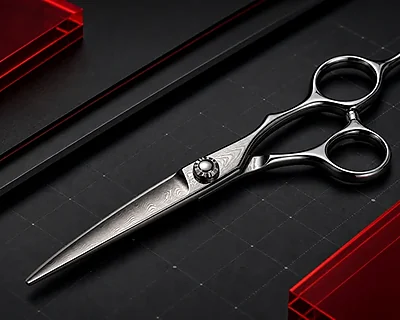
If you’re planning to buy a shear in 2026, the only credible place to start the process is with the technique fit checklist detailed in this article — task, edge type, handle fit, and handedness, each confirmed against the manufacturer’s own paperwork rather than a sales pitch. Reports from hair-scissors industry publications do offer some specific revenue or growth data for 2025-26, but readily available public reports vary wildly from each other as to market size or growth, an indicator they used different, unverified count methodologies. Before trusting any of those figures, verify the source: ask for the market-research firm behind the number, request the underlying test data or certificate rather than a marketing summary, and treat any claim without a named source as decoration, not evidence. Treat any such figures as broad market context, at best; the reason to choose one shear category over another must go beyond such numbers.
What’s verifiable is that the regulatory cycle for the California board on barber/cosmetology tool practice will remain active through 2025-26, and what the professional technique guidance on edge types and handle fit suggests continues to hold: convex edges trade wear durability for slide-cutting agility, and the fit between your chosen shear and handle system defines whether your edge choice works economically through out the working day. If buying today, be more interested in a shear that can clearly describe its edge type, steel composition, and handle fit; ignore any which simply brandish a trend headline.
The FAQs below address the specific questions readers ask most often about hair shears versus regular scissors.
Our firm MATSUOPRO sells professional shears for hairdressing and pet grooming, so this decision has some direct commercial relevance to us. With that said we’ve consciously tried not to confuse what mechanical function entails (edge geometry, handle fit, technique compatibility) with what we claim about our own product performance. In any instance here wherein information we’ve stated pertains directly to our own manufacturing and performance, it’s our stated data, and not independently verified. Technical review for the Mackay Hair scissors
MATSUOPRO is the Mackay Hair Scissors manufacturing brand for professional hairdressing shears, barber scissors, thinning shears, and pet-grooming scissors. We support salons, distributors, academies, grooming brands, and private-label buyers that need factory-direct production with practical material guidance.
Our buying guides are written to help purchasers compare steel grades, handle styles, blade geometry, surface finishes, logo options, packaging, MOQ, and sample validation before placing an OEM or wholesale order. The goal is to make each scissors specification easier to discuss with a real production team.
Factory-direct supply since 2014, with product lines covering professional cutting shears, barber shears, thinning scissors, texturizing scissors, left-handed models, and pet grooming scissors for international B2B customers.
We focus on Japanese 440C, VG10, and ATS-314 steel choices, convex and bevel edge geometry, ergonomic handle balance, tension systems, logo engraving, private-label packaging, and sample-based OEM confirmation.