Get in Touch with Mackayhairscissors Company
We use submitted details to respond to your quote request. Read our Privacy Policy.

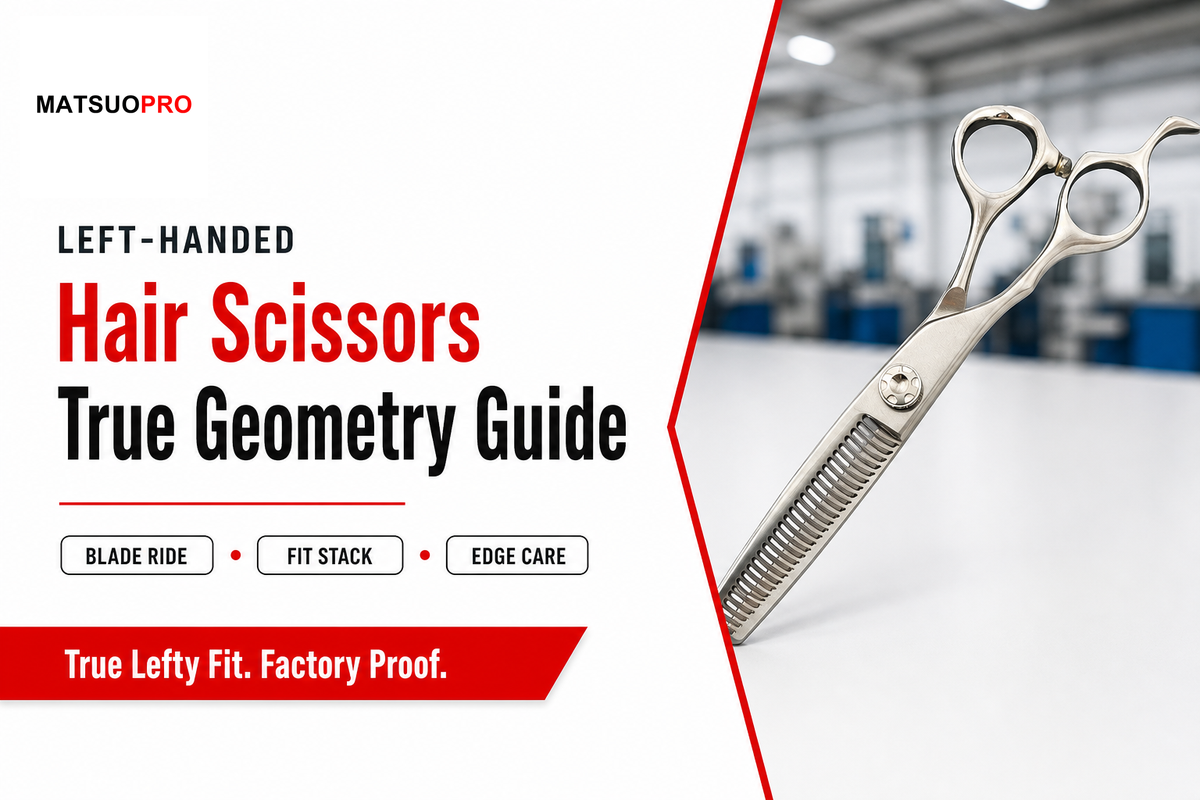
Left-handed hair scissors are professional hair shears built so blade ride, edge face, and thumb action close correctly in the left hand. A true lefty pair should support line-of-sight cutting, but neutral wrist position, tension, service mix, and handle fit still need checking.
Searchers use related wordings: left handed hair shears, left-handed shears, and hair cutting scissors. United States keyword data used for this article showed 50 monthly searches for the exact phrase Left-Handed Hair Scissors, 390 for left handed hair shears, 590 for left handed shears, and 2,400 for professional hair shears. That’s why this page is written as a guide, not as another product collection.
Data snapshot: CPC $2.08 exact, $1.73 left handed hair shears, $2.15 left handed shears, $3.15 professional hair shears; conversions 5.0 inch/12.7 cm, 5.5 inch/14.0 cm, 6.0 inch/15.2 cm, 6.5 inch/16.5 cm, 7.0 inch/17.8 cm. BLS lists 651,200 U.S. barber/hairstylist/cosmetologist jobs in 2024; population research puts left-handedness near 10%, but cutting hand still needs testing.
For a factory-direct range, see Mackay’s page for professional left-handed hair scissors from Mackay. This guide covers fit, geometry, steel, care, and buying checks to avoid competing with that solution page. Selection risk matters because true lefty performance is built around blade ride, line of sight, and real salon application, not the label alone.
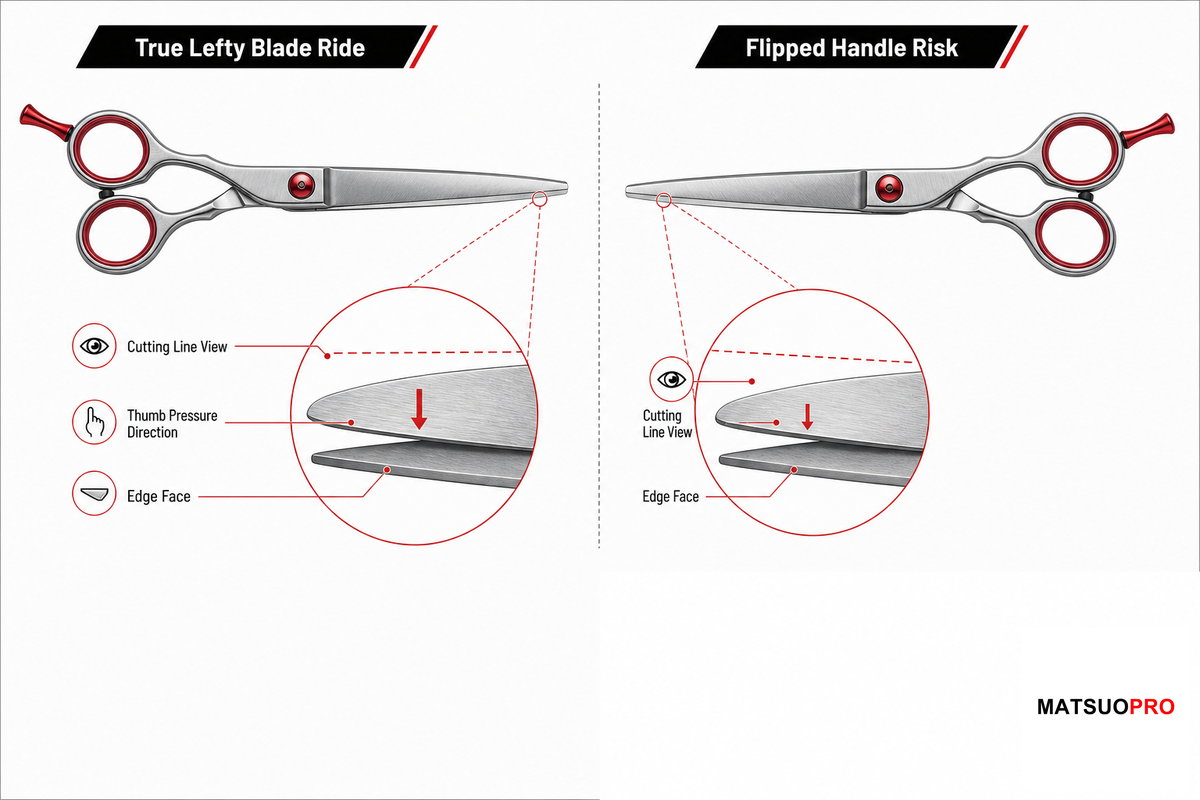
True left-handed hair scissors reverse more than the grip. Blade overlap, ride, edge face, thumb-blade relationship, and handle action all need to suit the hand that actually close the shear. If those pieces don’t line up, the scissor can still look left-handed while the hair shears act like right-handed tools under pressure.
Try a simple check: hold the shear in the left hand, screw facing you, and close it slowly. The cutting blade should let you see the cutting line while the left thumb push the blades together instead of pulling them apart. Handedness can be personal habit; left-handed shear design is still an engineering problem, not only a comfort label. This risk exists because professional cutting is built around a 5.5 in (14.0 cm) application check and a supplier sample that proves blade ride, not handle copy. A 10% handedness estimate is a population cue, not a shortcut for choosing a cutting hand.
Source context: Google Patents US5860215A shows reversed handle orientation as an engineering topic; occupational-therapy scissors research keeps cutting hand and handedness separate.
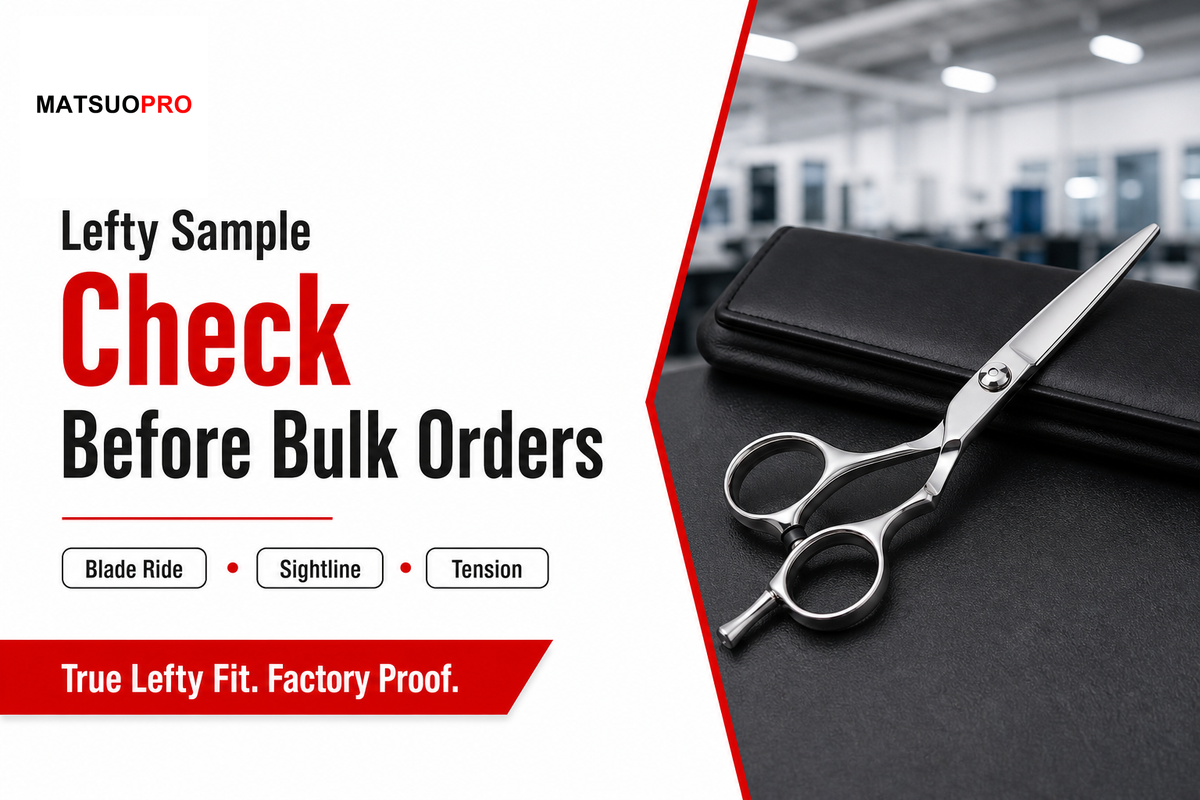
One common buying trap is assuming any lefty label means true lefty grind. Some low-cost hair cutting shears are right-handed patterns with a left-style handle. Others are ambidextrous in name, but the blade pressure still favors one hand. Use the Lefty Sample Check for supplier questions and sample testing. Do not flip a product photo and assume the edge is true-lefty. Sample testing works because left-handed control is built around 5.5 in (14.0 cm) salon application checks, not a mirrored handle photo. It isn’t a lab model or binary mirror-image rule.
| Check | True left-handed shears | Flipped or mismatched shears | What to verify |
|---|---|---|---|
| Blade overlap | Reversed for left-hand closure | Often keeps right-hand blade relationship | Hair can fold before the edge bites |
| Cutting-line visibility | Left hand can see the line | Blade can block the section | Uneven detail work |
| Thumb action | Thumb pushes naturally through the cut | Thumb may pull the blades apart | Extra pressure and drag |
| Ride and tension | Hand-tensioned for the lefty closing path | Tension feels tight, loose, or inconsistent | Chatter or folded hair |
| Slide cutting | Convex edge tracks with less resistance | Edge angle may fight the motion | Snagging on dry work |
| Scissor-over-comb | Line of sight can be checked | Comb and blade may crowd the view | Potential extra compensation |
| Sharpening | Lefty grind must be preserved | Sharpener may reset a wrong bias | Permanent geometry loss |
| Thinning action | Teeth and blade close in the intended direction | Teeth may feel grabby | Patchy texturizing |
| Long-day use | Wrist and shoulder can stay closer to neutral | User compensates with angle changes | Fatigue may build faster |
Source context: this is a first-party shop-floor checklist. US5860215A shows handedness engineering, while a 2015 J-STAGE study provides a general-scissor limitation example.
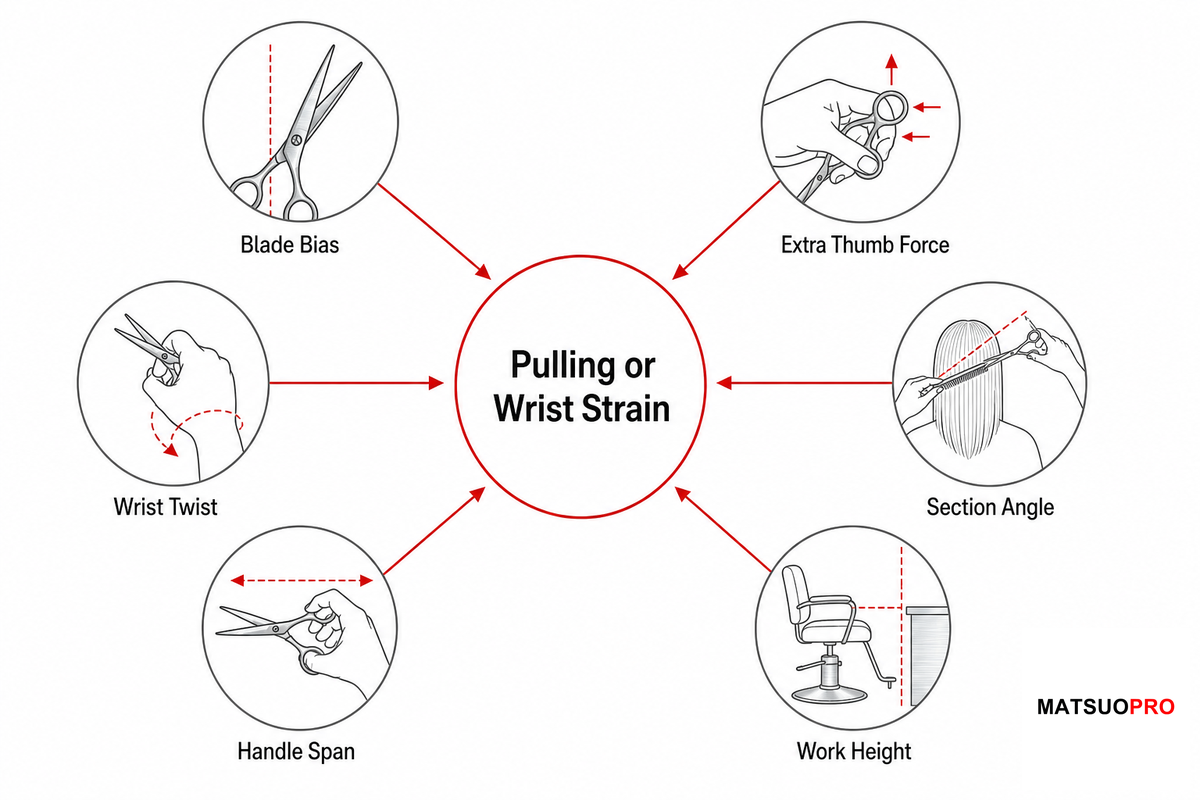
Pulling and folding usually start before the hair reaches the edge. If blade pressure doesn’t match the left hand, the stylist may add force, twist the wrist, or tilt the section to make the cut behave during detailed salon work.
For left-handed stylists and barbers, a comfortable shear is only part of the answer; blade orientation and tension still decide how the cut tracks. That risk shows up because a 6.0 in (15.2 cm) barber application is built around sightline control as much as edge sharpness. That can make a sharp scissor feel dull, especially during dry cutting, blunt work, or fast barber sections.
This guide doesn’t claim that a specific shear prevents injury. Hairdresser evidence points to elevated arms, repeated movement, force, awkward posture, workload, standing, overtime, distress, inadequate breaks, support-hand cuts, dermatitis, and task-specific wrist load. The shear is one variable inside that workload. A 2015 J-STAGE general-scissor study suggests scissor type can affect wrist posture, but it shouldn’t be stretched into salon shear accuracy proof. OSHA also adds maintenance, sharpening, and task rotation.
Source context: the 2019 hairdressing scoping review is the main boundary source. Safety Science and DermNet support support-hand injury context; Chen et al. supports task-level wrist exposure. OSHA, Springer, and J-STAGE keep the article from reducing strain to one tool variable.
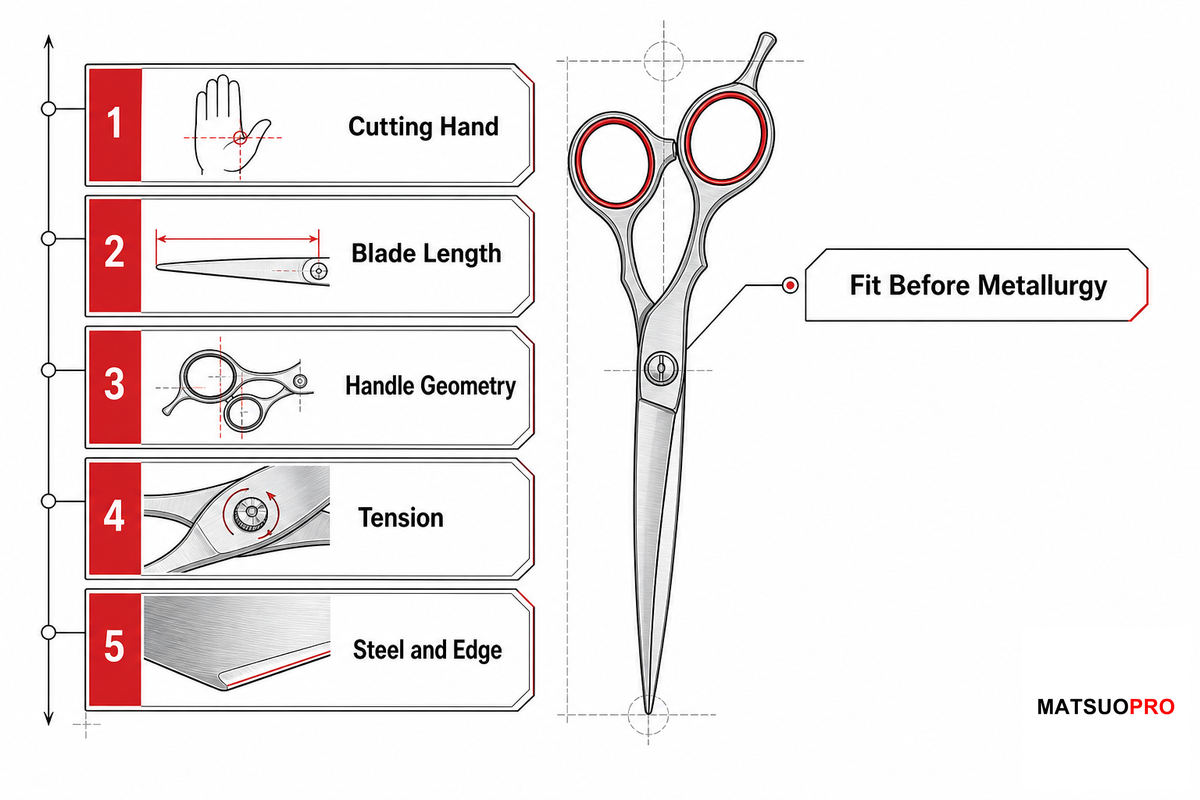
Use the Lefty Fit Stack as a practical order: confirm the actual cutting hand, then choose blade length, handle geometry, steel, and edge. The cutting-hand check is only the routing step; it doesn’t outrank wrist neutrality or handle fit. If the user is switching from a right-trained habit or a new handle, allow practice time before judging productivity or smoothness. This application order matters because the system is built around fit before metallurgy. In daily cutting, 60-62 HRC steel can’t rescue a shear that’s the wrong size or handle.
Source context: OSHA scissor-work guidance treats grip, force, wrist posture, and work height as connected ergonomic variables. That is why this fit stack starts with motion and handle control before steel grade.
| Layer | What to decide | Left-handed buying question | Common range |
|---|---|---|---|
| 1. Cutting hand and length | Left-hand, right-adapted, or mixed scissor use | Which hand closes the shear during paid services? | 5.0-6.5 inch after hand check |
| 2. Handle geometry | Offset, crane, straight, or swivel | Does my thumb move without pushing the shoulder up? | Offset and swivel are common lefty choices |
| 3. Tension | Screw feel and closing pressure | Does the scissor close cleanly without extra thumb force? | Hand-tensioned pairs should feel smooth |
| 4. Steel and edge | Hardness, grind, corrosion resistance | Will this edge hold for my service mix? | 440C, VG10, ATS-314, cobalt |
| 5. Supplier proof | Reports, warranty, sample policy | Can the seller verify steel, HRC, and lefty grind? | Batch reports and sample orders help |
Source context: American Salon lists left-handed barber shears in 2026. Hand-use context is checked against the Scissors Skills and Hand Preference pilot study. A 2025 Applied Ergonomics hairdresser study supports allowing adaptation time after a tool change.
Field rule: confirm the cutting hand, blade ride, and tension before rating steel; a 5.5 in (14.0 cm) shear that hides the line is the wrong tool for that application.
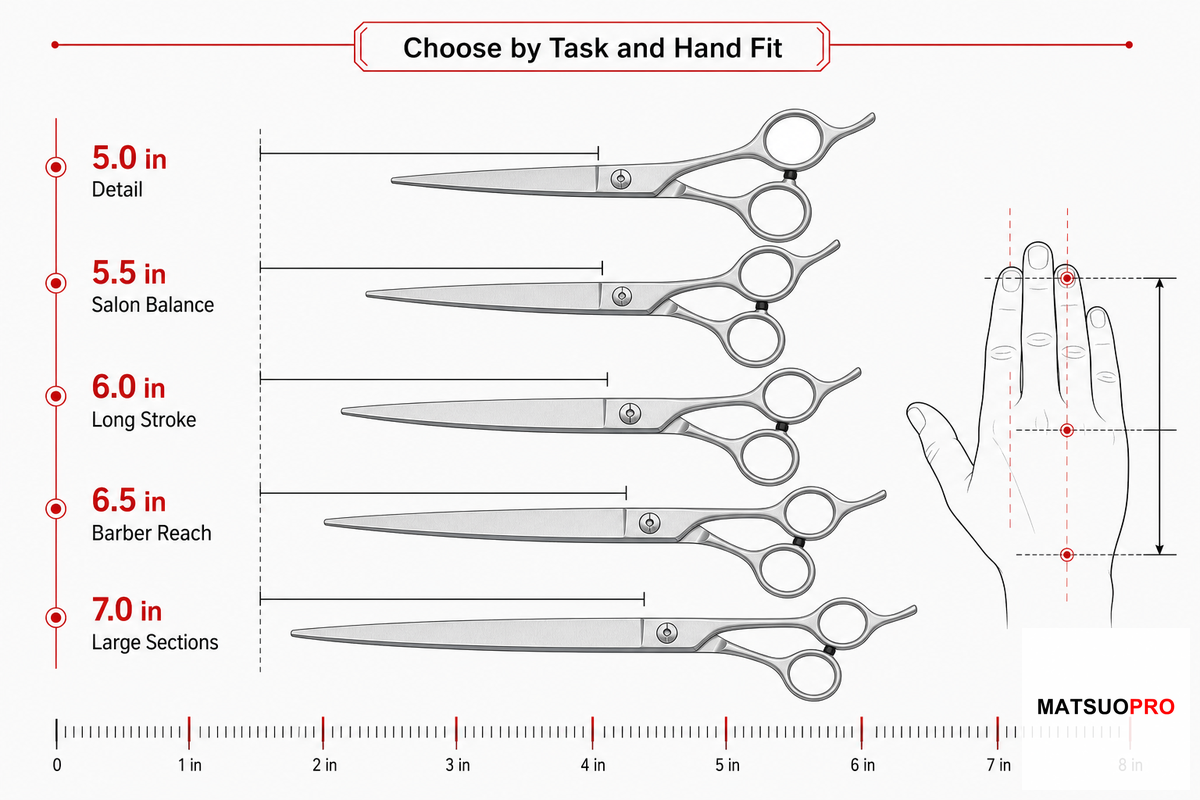
Size isn’t a rank from beginner to expert. It’s a fit and technique decision. Detail work and smaller hands often pair well with 5.0 inch. General salon cutting often centers on 5.5 inch. Longer strokes for blunt lines and scissor-over-comb usually start around 6.0 inch. Broader sections, larger hands, or clipper-over-comb finishing often push buyers to test 6.5 inch or 7.0 inch left-handed barber scissors. Size mistakes happen because each application is built around reach, section width, and hand control rather than a universal upgrade path.
Competitor collections show why size clarity matters. Public lefty product pages list 5.0, 5.5, 6.0, 6.5, and 7.0 inch options; price examples include about $147, $299, $555, and above $900 USD. Don’t read price alone as proof; test cutting-line visibility, tension, and edge behavior on real sections.
Source context: price and size figures here are public retail examples from competitor pages, not authority evidence. Search-demand data comes from keyword research for this article. Handedness orientation in this section references US5860215A.
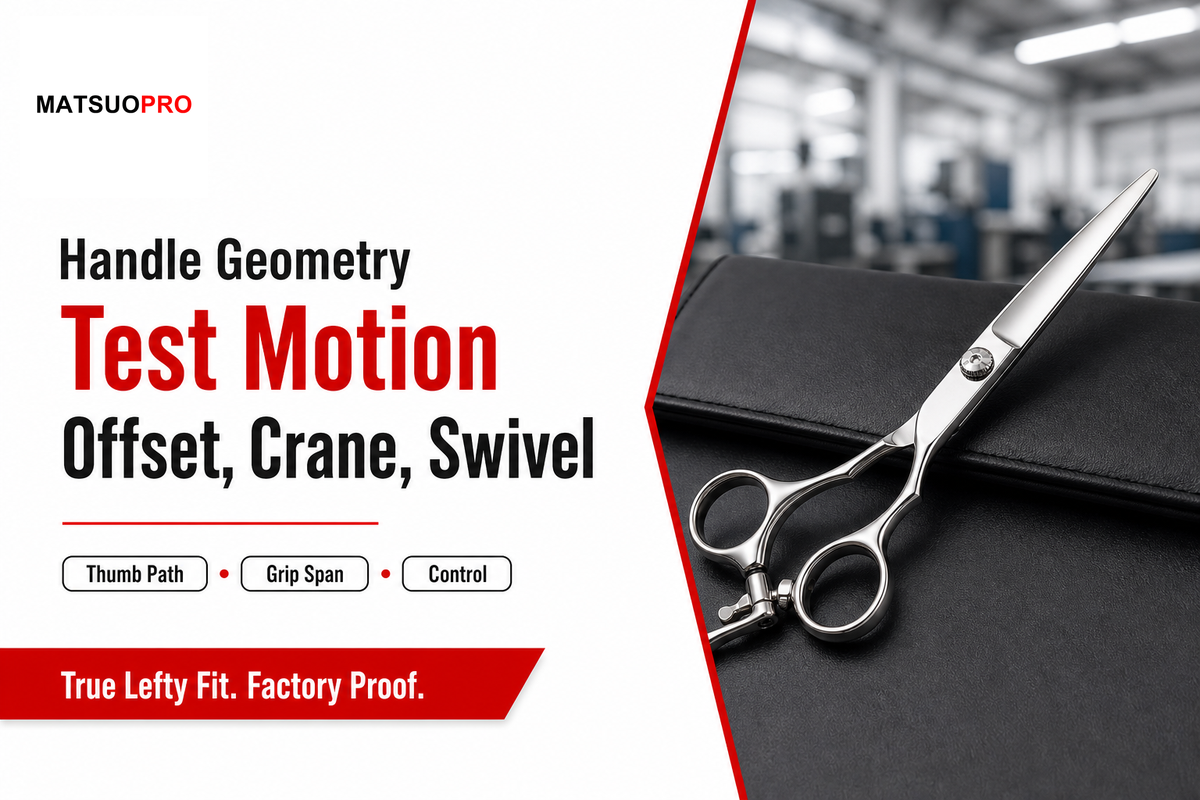
Handle fit decides how the shear sit between thumb and ring finger. Offset handles shorten thumb reach. Crane handles can lower elbow lift for some cutters. Swivel thumbs let the thumb rotate through awkward sections, which is why many high-volume lefty hair stylists test them for comfort. Direct hairdressing-scissor ergonomics evidence is stronger for handle/tool design, wrist neutrality, perceived pain, and grip strength than for left-handed grind alone. Handle risk appears because the application is built around thumb path, span, and 45-65 mm grip research, not a single handle label.
Choose a handle that keep the blade stable while the wrist stays quiet. Also check ring fit, grip span, contact pressure, thumb path, and whether finger discomfort appears before the cut is finished. In this article, ergonomic means reducing awkward compensation for the user, not proving one handle shape fit every left-handed stylist. Ask whether the handle is built around a true lefty blade, not whether the handle alone is left-shaped.
Source context: Boyles et al. 2003 tested ergonomic hairdressing scissors with 44 subjects. Dianat 2019 found thumb motion and finger discomfort could matter more than wrist posture in redesigned sewing scissors. Lee et al. 2009 tested 45-65 mm spans; small/medium hands preferred 50-55 mm and large hands 55-60 mm in general two-handle tools.
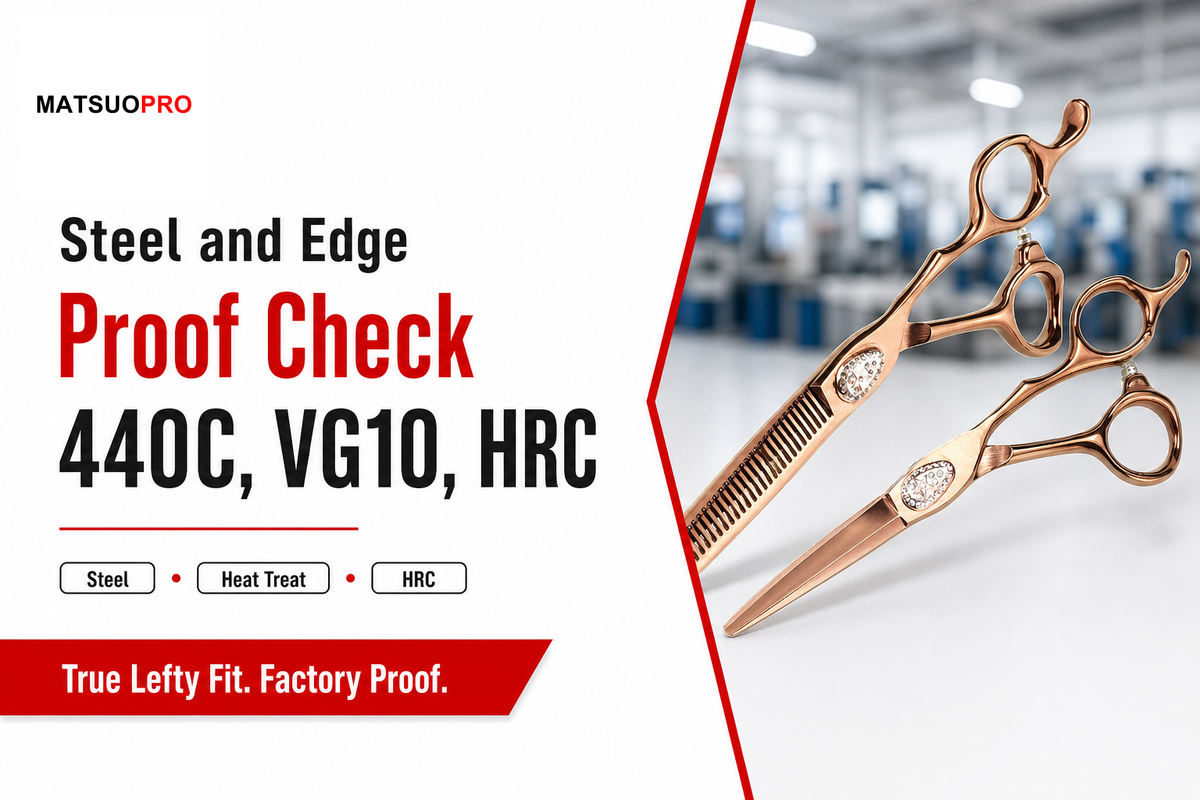
Steel matters after the shear fit the hand. Mackay states it uses Japanese 440C, VG10, ATS-314, and cobalt alloys across premium lines, with ATS-314 plate sourced from Japan’s Hitachi Group. If a sample is crafted from Japanese 440C or another stainless steel, compare it with Mackay’s hair-shear steel guide and still ask for the heat-treatment and hardness record. Premium pairs are vacuum heat-treated and cryogenically tempered to 60-62 HRC, with cobalt flagship lines reaching up to 64 HRC. Each blade is CNC-cut, then hand-honed to a Japanese convex edge with mirror polish and hand tension. The application risk is over-reading steel because the edge is built around heat treat, grind, and tension together.
HRC is a method-dependent hardness reading, not a full quality score, steel ranking, or direct performance proof. NIST describes Rockwell hardness as deformation measured under applied force. Higher hardness may matter in edge-life discussions, but only with the right heat treatment, grind, tension, and service habits. ASTM E18 explains testing, not which shear steel is best. Skin sensitivity is separate from edge quality: a U.S. barbershop study found nickel release in 10 of 192 metal tools, including 1 of 57 scissors. Wet work and salon chemicals are separate dermatitis risks. Sensitive users can ask about coating, nickel/cobalt release testing, or glove policy.
Source context: ASTM E18-25 and NIST support the hardness boundary. Peterson 2022, Chan 2023, Bieck 2025, and occupational hand dermatitis research supply skin-risk context.
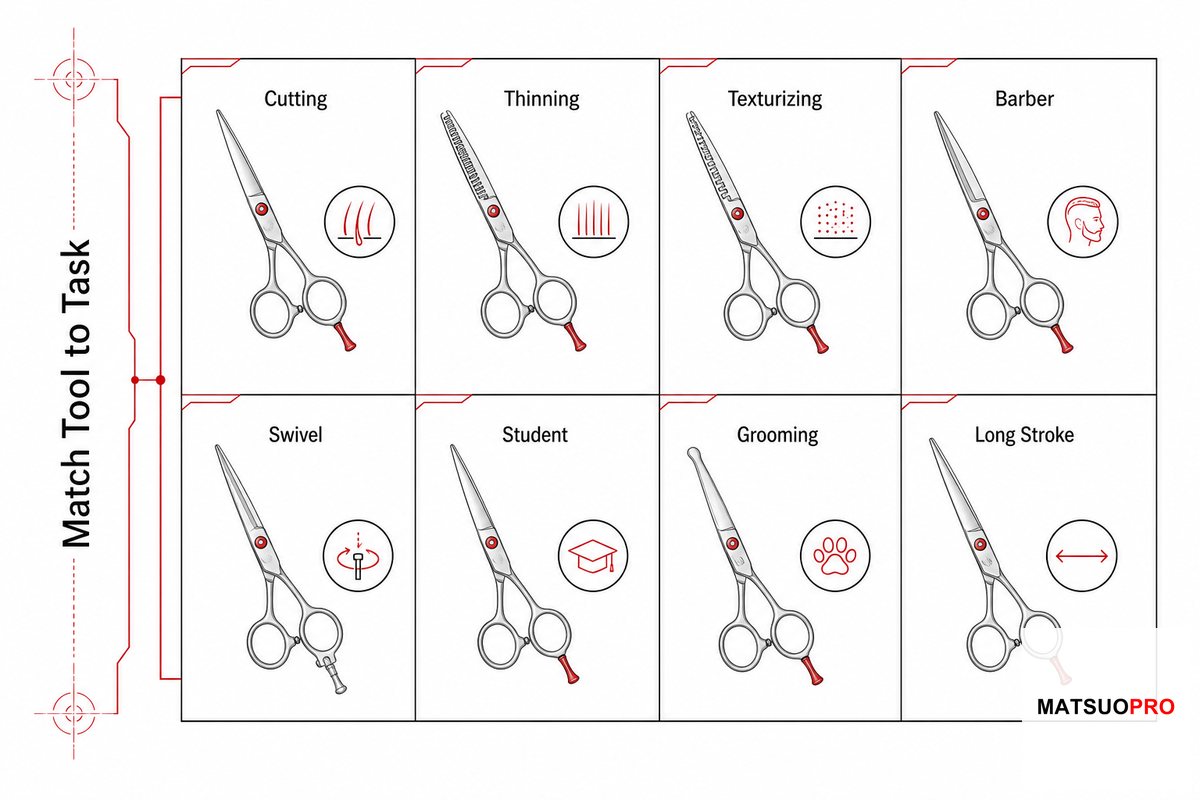
Left-handed hair cutting shears aren’t one tool. Blade shape, tooth count, length, and edge finish change the haircutting job. On thin hair, tooth entry and release can matter more than raw blade length. A professional hair cutting shears supplier should be able to separate left-handed cutting scissors from thinning scissors, texturizing shears, barber scissors, and grooming scissors without forcing the buyer into one generic lefty model. Variant risk exists because each use case is built around a different application, from 30-40 tooth thinning scissors to 7.0 inch barber reach. Specific model comparison belongs on the Mackay solution page, not inside this guide.
| Type | Typical left-handed use | Fit point to check | Specification note |
|---|---|---|---|
| Precision cutting shear | Detail lines, fringe, point cutting | 5.0 or 5.5 inch control | Convex edge feels clean on dry hair |
| General salon shear | Daily wet and dry cutting | 5.5 inch balance | 440C or VG10 can be suitable |
| Long-stroke cutting shear | One-length lines and longer sections | 6.0 inch stroke | Check blade weight before buying |
| Barber shear | Scissor-over-comb and larger sections | 6.0 to 7.0 inch reach | Line of sight matters more than size alone |
| Thinning scissors | Weight removal | Tooth entry from the left hand | 30-40 teeth are common examples |
| Texturizing shears | Movement and blending | Clean release with no grab | Test on dry and damp samples |
| Swivel lefty shear | High-volume or awkward angles | Thumb rotation without blade wobble | Pair with stable tension |
| Student lefty shear | Training and early salon practice | Durable edge and simple tension | Avoid vague ambidextrous claims |
| Left-handed grooming scissors | Pet-grooming coats and shaping | Hand fit plus coat resistance | Do not assume salon and grooming loads match |
Source context: product type classifications are market observations from competitor websites and Mackay manufacturing notes. The patent orientation record supports handedness as a blade-orientation topic, not a proof that one product family fit every cutter.
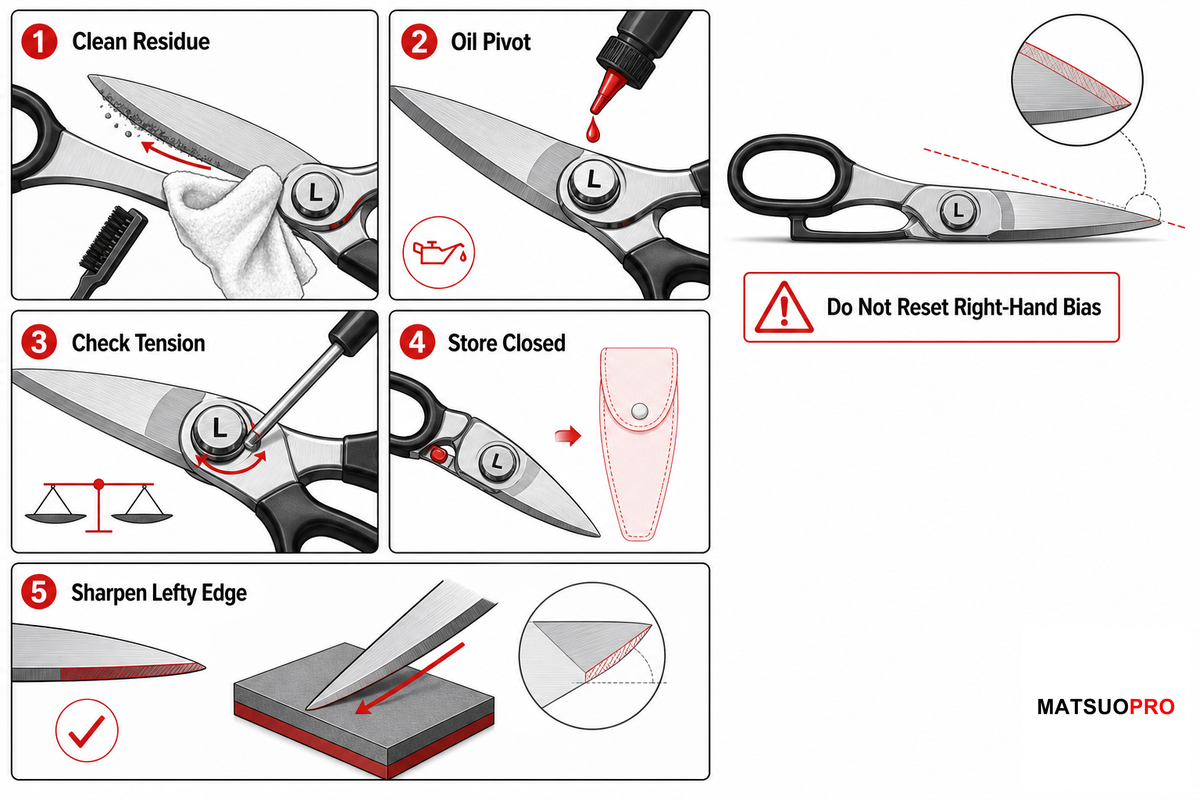
For the Left-Handed Edge Care Rule, protect the reversed geometry before chasing sharpness. Clean residue after use, add scissor oil at the pivot, check tension before the first client, and store the shear closed in a case. Salon sanitation is separate, and state rules don’t all treat shears the same way. California separates shears from immersion-only non-electrical tools and allows clean-then-spray-or-wipe disinfection; Georgia‘s official rule and Virginia‘s code use saturation or immersion language for multi-use implements that include scissors or shears. Care risk matters because a 60-62 HRC convex edge is built around tension and side-specific sharpening, not generic metal cleaning. OSHA adds contaminated-cut and UV-storage cautions: UV boxes store clean disinfected metal tools, not disinfect them. Follow your state board, the EPA product-label contact time, and disinfectant material guidance before changing a care routine.
A convex lefty shear needs a sharpener who understands which side carries the working edge and how the shear close. If a right-hand bias is introduced during sharpening, it can cancel the reason a left-handed professional bought that shear in the first place.
Source context: reversed orientation is checked against US5860215A. Infection-control examples include Connecticut, California, Georgia, Virginia, EPA, OSHA salon guidance, OSHA 1904.8, and CDC chemical-disinfectant guidance.

When buying, include both the cutter and the purchasing team. A solo user may only need to confirm that the left hand close cleanly without hiding the cutting line. A salon group or distributor should add steel traceability, batch consistency, reports, customization, and repeat-supply checks. The checklist should screen fit and proof; product range, sample requests, and quotes belong on Mackay’s left-handed solution page.
Mackay Hair Scissors manufactures premium shears through 80+ production steps, including CNC machining, vacuum-and-cryogenic heat treatment, PVD coating, laser engraving, and hand-honing stations. Factory information lists ISO 9001, BSCI/SGS audits, a 2,000+ square-meter facility, 100+ employees, OEM/ODM private-label service, 50-piece custom orders, and 1-piece in-stock orders. Here, craft means hand finishing around an industrial process. Treat these points as scope checks, not material validation: batch reports or third-party certificates more directly demonstrate steel and HRC claims.
Source context: The information regarding Mackay’s first-party data reflects its own manufacturing claims. The amfori group addresses BSCI through social auditing, and ISO clarifies certification details. The FTC and CBP set standards for import labeling and origin claims.
These answers keep the same risk boundary because left-handed selection is built around a 5.5 in (14.0 cm) application check, blade orientation, and tension rather than a product title alone.
Yes. True left-handed hair scissors are built for left-hand closure, not only finger placement. True lefty pairs also reverse the working blade relationship so the stylist can see the section while closing without forcing a right-hand thumb motion. When choosing left-handed shears, compare blade overlap, screw-facing view, thumb action, and tension before buying by product title alone.
Left-handed professionals who cut with the left hand should test true left-handed shears because hair cutting depends on blade visibility, edge pressure, and thumb direction. If you were trained on right-handed shears or use mixed-hand technique, compare before switching. Then fit size, handle style, tension, and steel to the way you cut.
Blade orientation is the main difference. True left-handed scissors reverse the working blade position, edge face, and ride for left-hand closure. That lets the thumb push the blades together with less resistance. Handle comfort alone does not prove true handedness.
Some hair cutting scissors are sold as ambidextrous, but professional hair cutting usually benefits from hand-specific blade configuration. If the shear still closes with a right-hand blade relationship, a left-handed stylist may lose line of sight and add thumb pressure. Ambidextrous tools can still be useful for light home trimming or training, but salon work should be judged by blade ride, tension, sample cuts, section visibility, and whether the thumb pushes or pulls through the closing path every single time.
Many stylists start around 5.5 inch for general salon work, then go shorter for detail cutting or longer for scissor-over-comb and barber work. Hand size, section size, cutting style, and handle geometry should decide the final choice. Even 6-inch may feel right for one lefty but too large for another. Test on wet and dry sections before ordering multiples for a team, especially if several cutters use different thumb paths or section widths during daily salon work.
No. Sharpening can rebuild a dulled edge, but it can’t reconstruct hand-specific blade geometry. A sharpener may adjust tension and edge finish, yet the blade ride, overlap, and handle relationship remain right-handed if the original shear was built that way.
Use this guide to inspect geometry and fit. Use the Mackay solution page when you need model range, steel options, OEM/ODM details, sample ordering, engraving, finishes, packaging, or a quote for left-handed hair cutting shears.
MATSUOPRO is the Mackay Hair Scissors manufacturing brand for professional hairdressing shears, barber scissors, thinning shears, and pet-grooming scissors. We support salons, distributors, academies, grooming brands, and private-label buyers that need factory-direct production with practical material guidance.
Our buying guides are written to help purchasers compare steel grades, handle styles, blade geometry, surface finishes, logo options, packaging, MOQ, and sample validation before placing an OEM or wholesale order. The goal is to make each scissors specification easier to discuss with a real production team.
Factory-direct supply since 2014, with product lines covering professional cutting shears, barber shears, thinning scissors, texturizing scissors, left-handed models, and pet grooming scissors for international B2B customers.
We focus on Japanese 440C, VG10, and ATS-314 steel choices, convex and bevel edge geometry, ergonomic handle balance, tension systems, logo engraving, private-label packaging, and sample-based OEM confirmation.