Get in Touch with Mackayhairscissors Company
We use submitted details to respond to your quote request. Read our Privacy Policy.
Updated July 2026 · Reviewed by the Mackay technical team
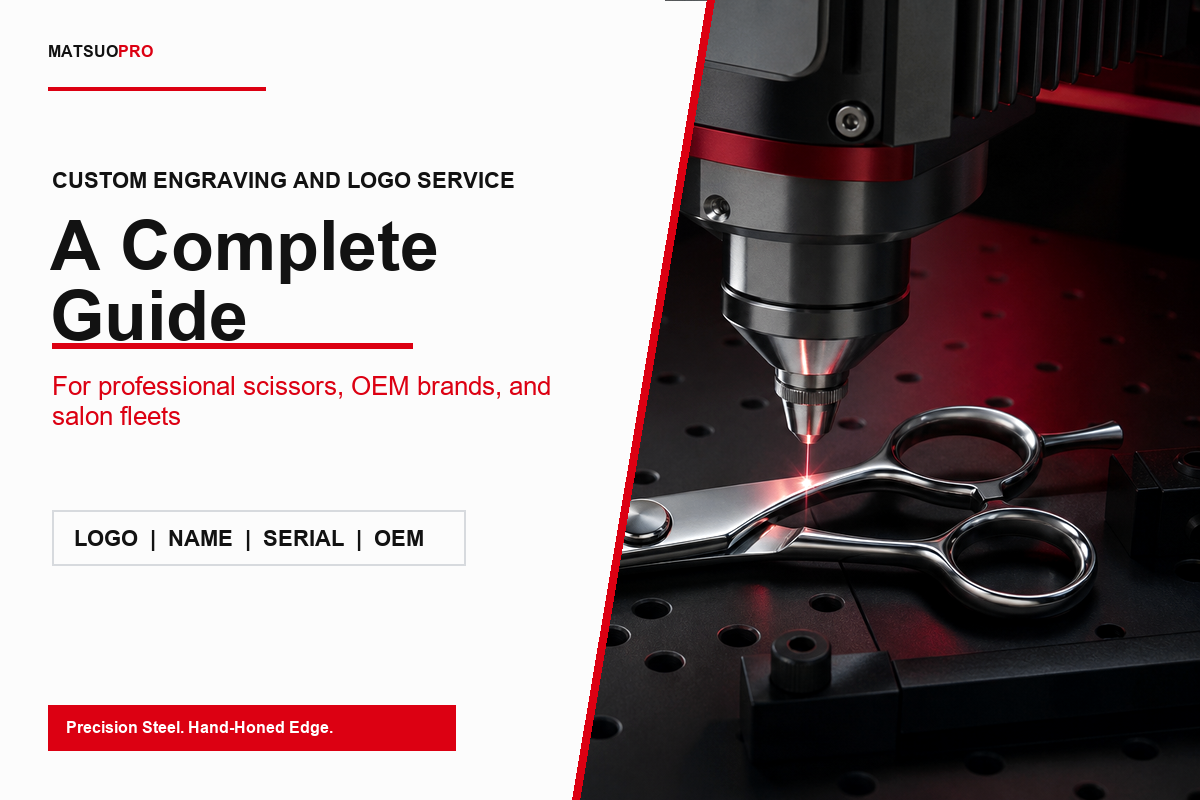
Custom Engraving & Logo Service is a controlled marking process that adds a permanent logo, name, or tracking number to professional scissors without redesigning the tool itself. For salons, barbershops, and OEM buyers, it is usually the fastest way to put a name on equipment that already performs the way you need it to. This guide compares laser and rotary engraving, explains the effect on hardened blade steel, lists artwork requirements, outlines typical costs, and shows how to vet a supplier. For OEM and private-label programs, minimum order quantity and certifications matter as much as the mark itself.
| Engraving methods | Fiber laser (primary); rotary/diamond-drag (select use cases) |
| Compatible steels | 440C, VG10, ATS-314 (Hitachi Japan), cobalt alloys |
| Hardness range | 60–62 HRC standard; up to 64 HRC on the cobalt flagship line |
| Accepted file formats | AI, EPS, SVG (vector); high-contrast grayscale for photo-based marks |
| Custom engraving MOQ | 50 pieces per SKU |
| In-stock engraving MOQ | 1 piece |
| Certifications | BSCI, SGS, ISO 9001, 3rd-party hardness/material reports |
| Typical applications | Salon/barber branding, corporate gifting, OEM/private label, serial-number traceability |
Custom Engraving & Logo Service adds a permanent laser-marked logo, name, or serial number to professional scissors; kept shallow and away from the cutting edge, it doesn’t meaningfully affect blade hardness, and Mackay offers it from 50 pieces custom or 1 piece in stock.
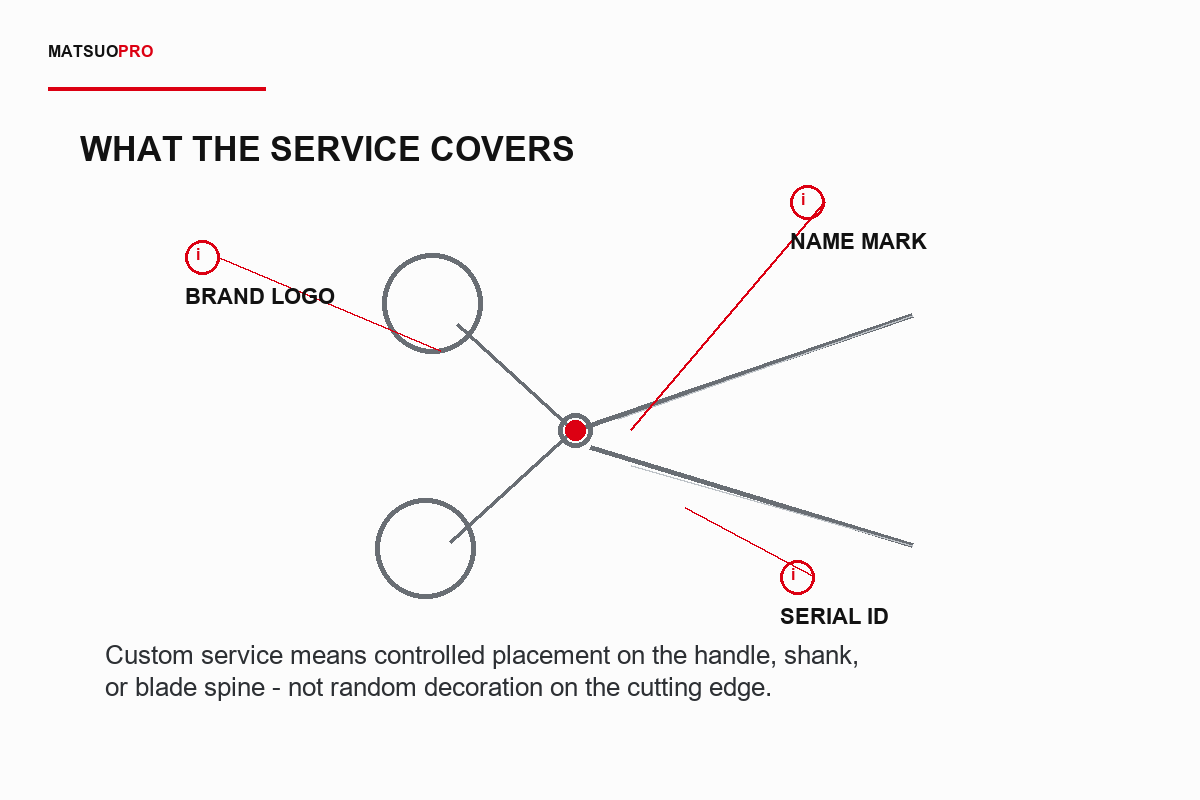
Custom engraving & logo service, for professional scissors, means permanently marking a blade, bolster, or handle with a business logo, a stylist’s name or initials, or a tracking number using a controlled industrial process. It is not the walk-in kiosk service that etches a name onto a keychain or a tumbler in five minutes. The distinction matters because scissor blades are hardened tool steel rated at 60+ HRC, not soft brass or glass.
The marking process has to account for that substrate. For the wider technical context, the ASME Journal of Manufacturing Science and Engineering documents laser direct-part marking on steel substrates.
Two buyer types make up most of the demand for this service: an individual salon or barbershop wanting its shop name or a stylist’s initials on a personal set, and a distributor or private-label buyer wanting a consistent logo throughout a bulk purchase intended for resale. The rest of this guide covers both, starting with how the marking process itself works.
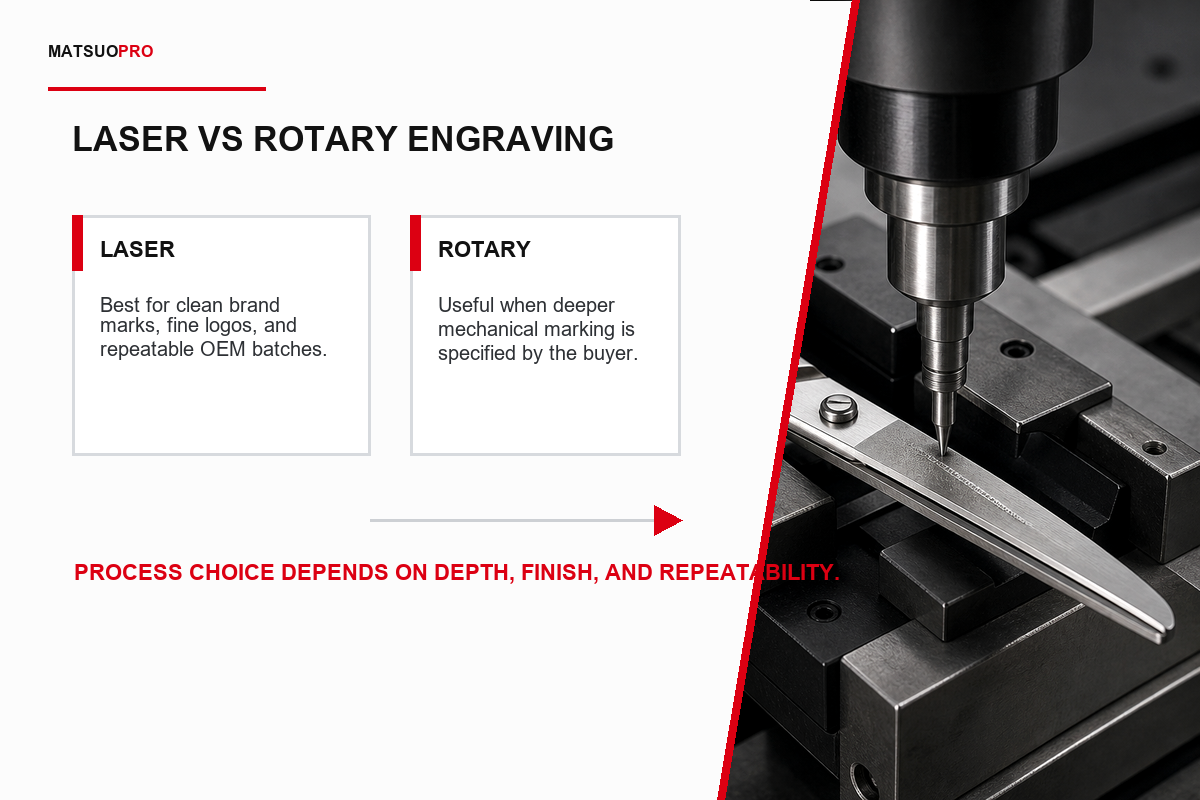
Laser engraving and rotary (diamond-drag) engraving differ mainly in how they mark hardened scissor steel. A fiber laser vaporizes a microscopically thin layer of material with a focused beam under digital control, while rotary engraving physically drags a diamond-tipped stylus over the surface under mechanical pressure.
On 60+ HRC steel, that difference in mechanism is why fiber laser has become the default method at industrial scale. Production-grade custom laser engravers can be calibrated for continuous, repeatable runs in a way a one-off retail kiosk machine cannot.
| Dimension | Fiber laser engraving | Rotary / diamond-drag engraving |
|---|---|---|
| Depth control | Programmable and repeatable per pass | Depends on stylus pressure and operator control; less repeatable |
| Best-suited materials | Hardened stainless and cobalt-alloy steel (60+ HRC) | Softer metals; less predictable on very hard steel |
| Setup per piece | Minimal — the digital file loads directly | Requires a height/fixture reset for each piece |
| Typical use at volume | OEM/bulk runs, fine-detail logos, serial numbers | One-off pieces, deep or 3-D relief marks |
The values below are reference starting points from GWEIKE W-series production tests on stainless steel, not Mackay production settings and not a recipe to copy onto a finished blade. GWEIKE states that alloy grade, coating, and surface finish shift the usable window, so a scissor supplier should validate its settings on the actual steel and finish before production. Use the table to ask whether a vendor controls and records the variables that determine mark depth and appearance.
| Reference case | Published starting point | What the buyer should verify |
|---|---|---|
| W-series operating window | Up to 2000 mm/s speed, 100% rated power, 250 kHz frequency, and 0.25 mm fill spacing | The supplier records the chosen values by steel grade, finish, and mark effect. |
| Black surface mark | 100–200 mm/s, 40% power, 80 kHz, 0.01 mm single-direction fill | A sample shows an even dark mark without edge-adjacent heat damage. |
| White surface mark | 1000 mm/s, 65% power, 35 kHz, 0.05 mm cross-hatch fill | The supplier confirms whether the finish needs a different speed or power window. |
| Standard deep-black reference | 200 mm/s, 40% power, 80 kHz, 0.01 mm single-direction fill | The requested appearance does not require unnecessary material removal. |
| Heavy deep-black reference | 500 mm/s, 80% power, 20 kHz, 0.05 mm single-direction fill | Any deeper setting is justified and kept away from the cutting edge and other high-stress regions. |
| Fine brushed reference | 1000 mm/s, 70% power, 35 kHz, 0.09 mm single-direction fill | The visible line density matches the approved artwork proof. |
| Medium brushed reference | 1000 mm/s, 70% power, 35 kHz, 0.12 mm single-direction fill | The finish stays consistent from the first sample through the production batch. |
| Coarse brushed reference | 1000 mm/s, 70% power, 35 kHz, 0.25 mm single-direction fill | Coarser scan lines remain legible at the actual logo size. |
| Machine-power transfer | When moving from a 20 W to a 30 W system, the source recommends starting with 25–30% less power | Settings are requalified after a machine change rather than copied unchanged. |
| Test-step control | A 0.5 mm fixture-height variation can shift results; the troubleshooting sequence changes speed by 20% before adjusting power in 10% increments | The supplier changes one variable at a time and records the approved sample settings. |
The depth-control advantage is not just a vendor claim. A peer-reviewed evaluation published in the ASME Journal of Manufacturing Science and Engineering assessed laser direct-part marking quality on steel substrates against the ISO/IEC 16022 Data Matrix specification. It confirmed that laser marking parameters can be controlled and verified to a defined standard rather than left to operator feel. Machinists working stainless by hand report a related, practical version of the same point: on the Practical Machinist forum, professionals recommend multiple low-power laser passes rather than one deep pass for a clean result on stainless steel. They also note that rotary engraving becomes less practical at volume because it needs a fixture reset for every piece, a real labor-cost reason laser has become the industrial default rather than merely a marketing preference.
Reputable engraving providers mark a scissor blade before its final honing pass, not after, so any minor surface disturbance near the mark gets addressed in the same finishing step that sharpens the edge. This sequencing matters because engraving and honing both touch the blade surface. Doing them in the wrong order either locks in a rough edge past the point where it is easy to fix or risks re-honing over a mark and blurring it. Engraving first, then honing last, keeps the two processes from working against each other. Depth and placement—not merely whether the blade was engraved—help determine whether a marked blade performs identically to an unmarked one, a distinction the next section covers in detail.
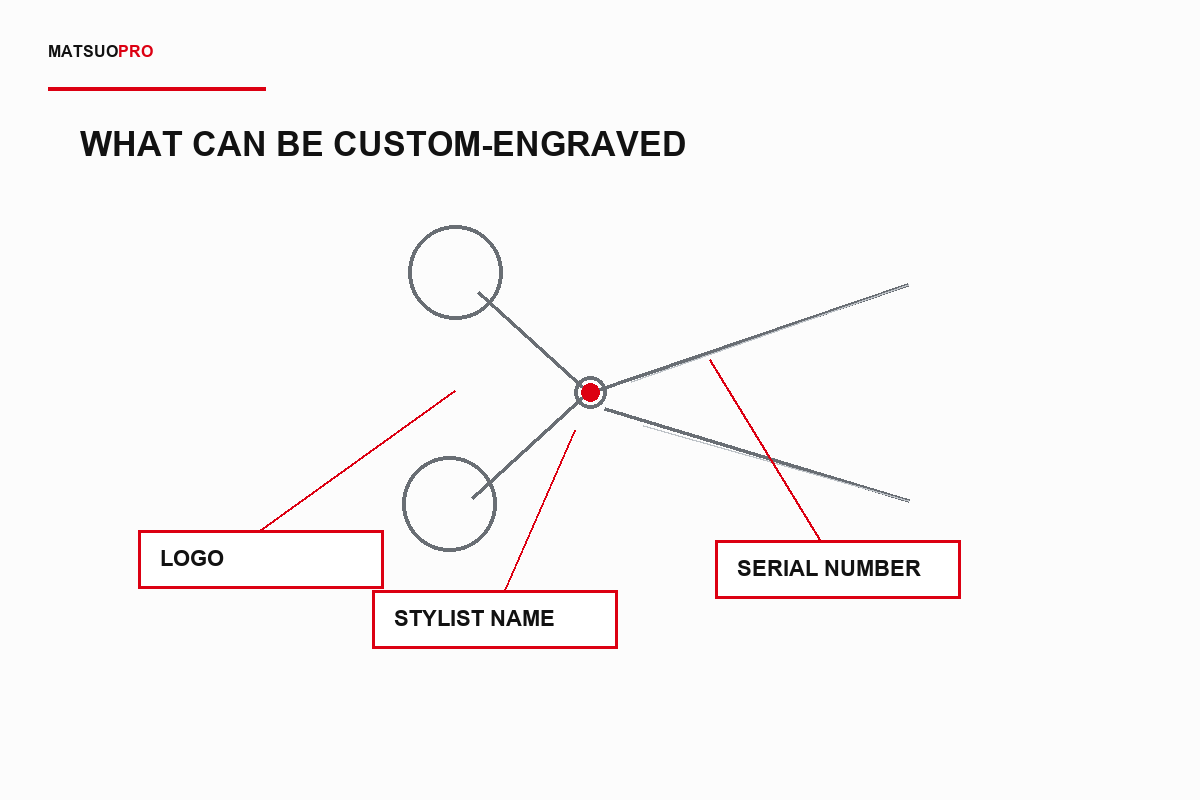
Three categories of markings cover almost every custom engraving request for professional scissors: brand logos for OEM and private-label resale, personal names or salon initials for individual buyers, and serial or lot numbers for warranty and inventory tracking. A single order can combine more than one without adding a separate production step.
Logo engraving on metal blades uses the same fiber-laser process for all three categories below, calibrated to the specific steel grade being marked. If your catalog also uses custom engraving plates, quote those separate nameplates or plaques as a different component; this guide concerns marks applied directly to scissors, not add-on plates.
Mackay’s engraving service is available throughout its full range, including our Japanese steel scissors line, where VG10 and ATS-314 blades are marked using the same fiber-laser process described above, calibrated to each grade’s hardness.
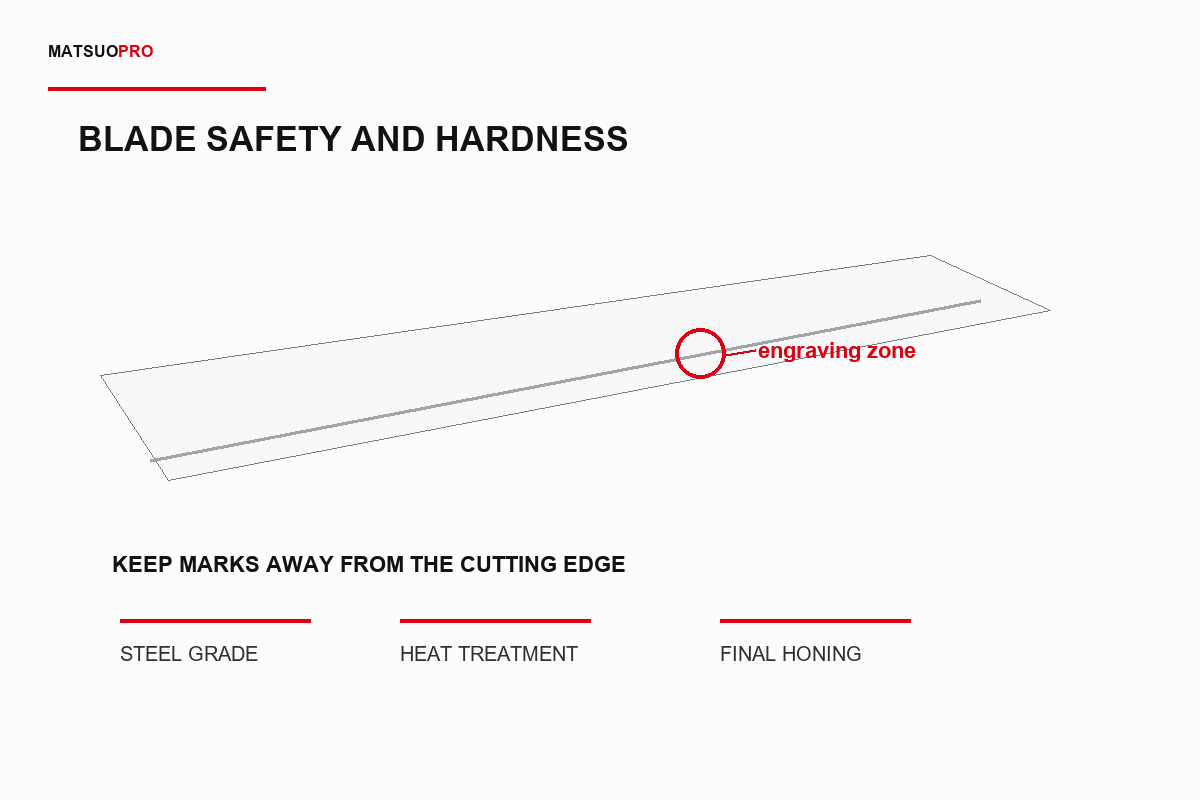
If a scissors engraving stays shallow, sits away from the cutting edge, and is applied with calibrated laser parameters, it won’t meaningfully reduce blade hardness or edge retention, but a blanket claim that engraving “never” affects hardness doesn’t hold up against independent research, and it’s a fair question to put to any supplier rather than take on faith.
Mackay’s scissors run on 440C, VG10, ATS-314 (Hitachi Japan), and specialty cobalt-alloy steels, hardened to 60–62 HRC standard and up to 64 HRC on the cobalt flagship line. That’s meaningfully harder than common 420 cutlery-grade stainless: an Atlas Steels Grade 420 data sheet lists a maximum hardness of 50 HRC. Steel-hardness classification work also remains active ISO 3506-3:2025, published in 2025, sets mechanical and hardness classes for corrosion-resistant stainless fasteners in the same family of standards.
Independent research on laser marking and hardened metal is where the unqualified “never affects hardness” claim breaks down. A study in Materials Science and Engineering A on laser-processed AISI 4340 steel found no adverse fatigue effect under its specific tested conditions, but explicitly noted that heat-affected-zone microstructural changes from laser processing “can be difficult to control and potentially detrimental.” Separately, a peer-reviewed engineering study on laser-marked metal components found that mark position is “highly critical” to fatigue performance and measured a significant fatigue-life reduction when a mark was deliberately placed in a high-stress region, a finding echoed, without specific figures, in a University of Staffordshire research record confirming that laser marking can reduce a component’s fatigue life. One practitioner on a metalworking forum separately reported a severe loss of strength after laser engraving a hardened knife blade steel, not proof that engraving always causes damage, but a real-world data point consistent with the same depth-and-placement variables the academic sources identify.
“We treat blade edge integrity as non-negotiable, so any engraving on our scissors goes on the shank or bolster, calibrated to the grade being marked, 440C, VG10, ATS-314, or our cobalt alloys, never the cutting edge itself. If a buyer asks how deep a mark goes or where it sits relative to the edge, that’s exactly the right question to ask any engraving supplier, including us.”
Our engineering team at Mackay
This is also why the two variables matter more than the material grade itself: engraving location and engraving depth. For background on how the steels compare, see our 440C vs VG10 steel comparison, and for the measurement behind the hardness numbers themselves, see how HRC hardness is measured.
Engraving placement is also a hygiene consideration in a professional setting, not just a mechanical one. Shears used in salons and barbershops have to be cleaned and disinfected between clients OSHA guidance on salon biological hazards calls for tools to be cleaned and soaked in an EPA-registered disinfectant after each client, and a mark positioned away from the pivot and cutting face is simply easier to keep debris-free through that routine than a deep groove sitting where the blades meet.
Blade-hardness risk from engraving comes from depth, placement, and laser parameters — not from engraving itself; a shallow, off-edge mark applied with calibrated equipment does not meaningfully affect hardness or edge retention.
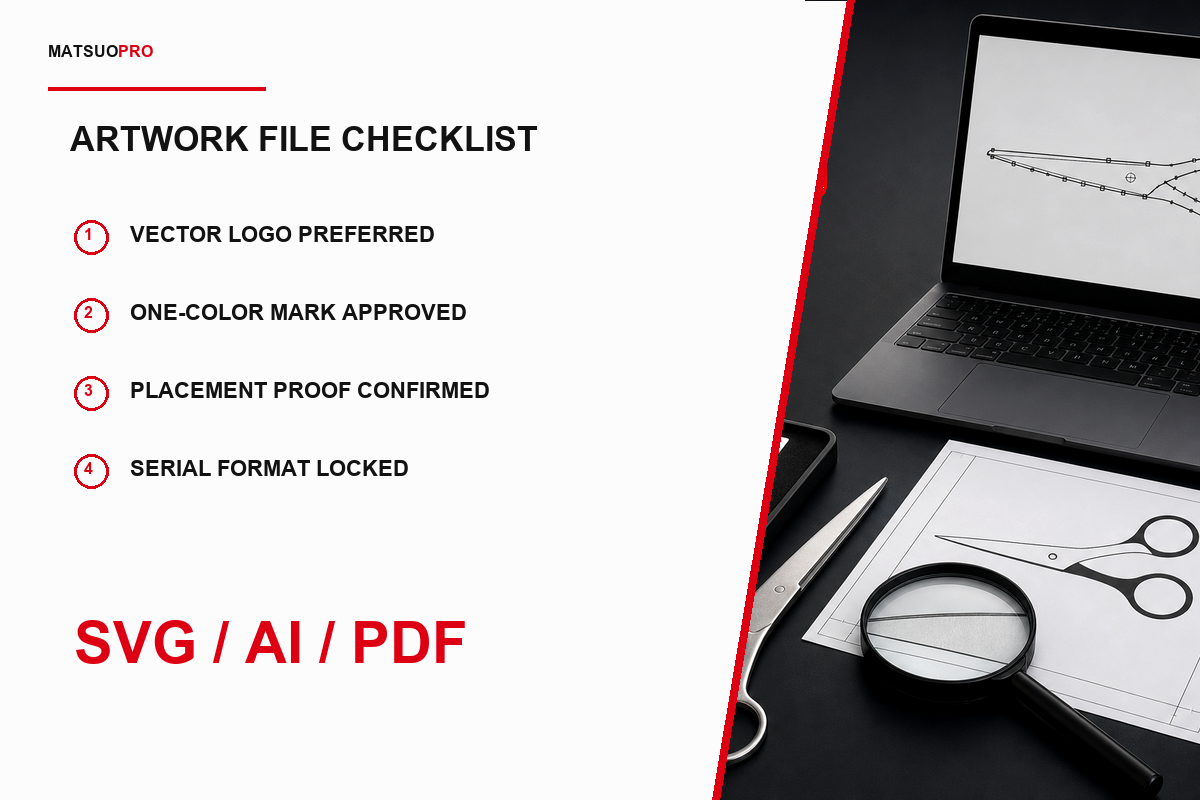
A custom logo engraving order needs four things before it can move to production without delay: vector artwork in AI, EPS, or SVG format, text converted to outlines, a high-contrast black-and-white or grayscale version of the design, and the file exported in the format your provider actually requests rather than whatever your design software defaults to.
Professional engraving shops consistently flag the same handful of file problems: low-resolution raster art under 300 DPI that turns pixelated at engraving size, text left as live fonts instead of outlines (which can be substituted or dropped if the engraving system does not have that font installed), open vector paths that confuse the laser’s toolpath, and files exported in an unsupported format. Several providers also use a color convention, commonly red for cut lines and black for engrave lines, and mixing that up sends the wrong instruction to the machine.
File checklist — confirm these before you submit artwork:
| Parameter | Recommended range | Why it matters | How to verify |
|---|---|---|---|
| File format | Vector: AI, EPS, or SVG | Raster files can’t be rescaled or re-edited without quality loss | Open the file and confirm it isn’t a flattened raster embed |
| Text | Converted to outlines | Fonts not installed on the engraving system will substitute or drop | Request an outlined proof before final approval |
| Color mode | High-contrast black & white or grayscale | Laser engraving reads contrast, not color, to set the mark | Preview the file in grayscale before submitting |
| Line convention | Cut vs. engrave lines clearly separated (commonly red/black) | Mixed conventions send the wrong instruction to the laser | Confirm your provider’s specific color-code convention |
| Engraving area | Fits the quoted mark area for your scissors model | Oversized artwork gets cropped or rejected | Request the exact engravable dimensions for your model |
| Raster resolution (if used) | 300+ DPI at final print size | Below 300 DPI prints pixelated or blurry | Zoom to 100% and check edges for jagged pixels |
One more thing to confirm before you submit anything: the logo or artwork has to be something you actually own or have rights to use. Trademark protection applies to logos in the same way it applies to other branded artwork. As explained in USPTO guidance on trademark basics, a registered mark has to be maintained by its owner. A supplier engraving a file you send is not a substitute for confirming your rights beforehand.
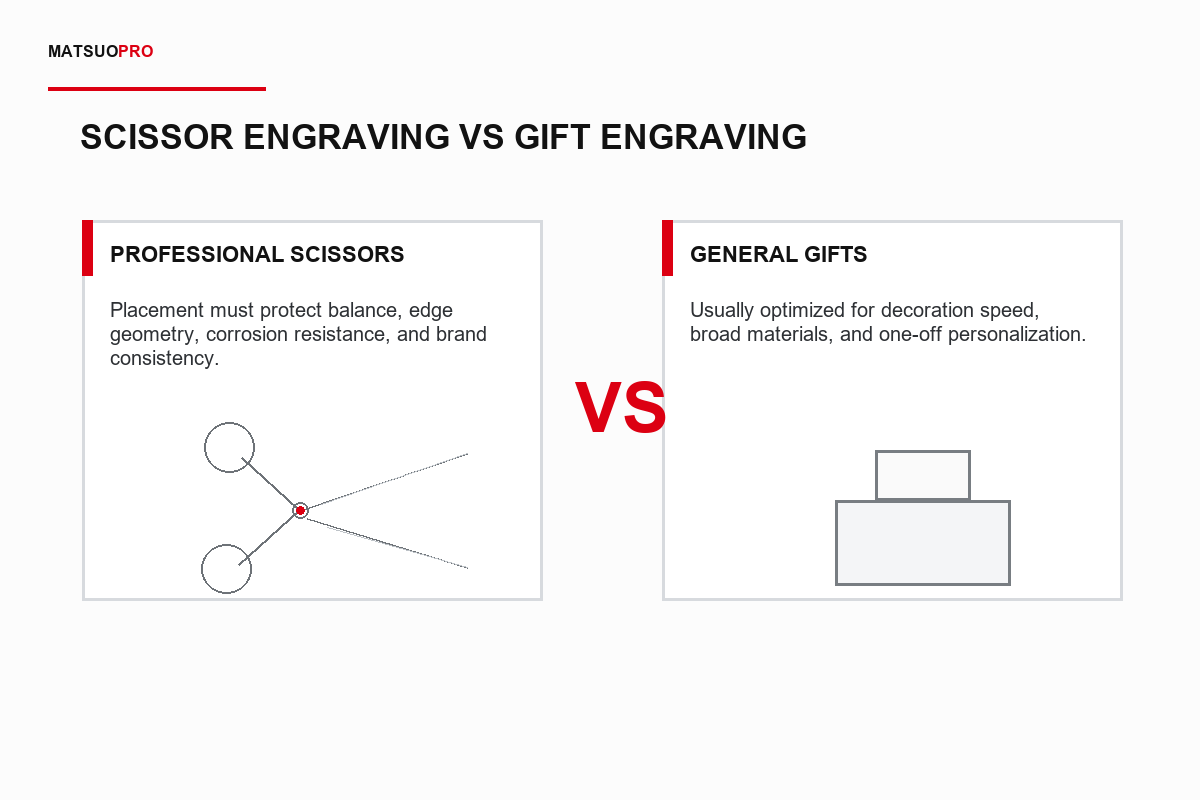
Search results for engraving services mix industrial direct-part marking with consumer personalization, awards, and signage. Use this scope matrix before requesting a quote so the supplier evaluates the right material, machinery, and compliance needs instead of assuming that anything can be engraved with the same process.
| Request category | How it relates to this service | What to confirm |
|---|---|---|
| Professional scissors | Direct scope: precision, highly detailed marks on hardened steel, with permanence tied to controlled depth and placement. | Ask which engraving machine is used and whether the engraving process, proofing, and quality control are handled in-house. |
| OEM and branded products | Direct scope for private-label scissors and a bulk corporate order; broader branded merchandise may require a separate production line. | Confirm SKU-level MOQ, packaging, and whether a nationwide campaign or export program changes fulfillment. |
| Personal and recognition gifts | A scissor can be a custom gift, one of several personalized gifts, or an engraved gift used to honor a stylist with a name, date, or motto. | Keep the personal touch legible at blade size; a keepsake should still function as a professional tool and make a lasting impression through use. |
| Drinkware | Tumblers, a flask, and other drinkware are outside this scissor-specific service scope. | Use a provider set up for cylindrical fixtures and food-contact products. |
| Wood products | Cutting boards and picture frames use different material settings and are outside this scope. | Ask a wood-engraving specialist about finish, scorching, and usable mark area. |
| Acrylic, crystal, and awards | Acrylic plaques, crystal pieces, and engraved awards are not hardened-steel blade work. | Request a separate proof from an awards specialist; edge lighting and subsurface marking require different equipment. |
| Small promotional items | A tag, name badges, a pen, and other small items may be possible elsewhere but are not part of the scissor quote. | Separate promotional-item quantities from the tool order so pricing and fixtures are not mixed. |
| Signage and accessibility | General signage, braille signs, and ADA compliant sign systems are a separate technical and regulatory category. | Use a signage specialist who can verify the applicable accessibility requirements. |
| Mixed-material engraving projects | The phrase “anything can be engraved” is too broad: each substrate responds differently to heat, pressure, and tooling. | List every material and finish in the RFQ; do not assume one machine setting covers the full project. |
| Service and support | Customer service matters when artwork, proofs, and repeat orders pass between teams. | Ask who owns proof approval, revision control, and post-delivery issue handling. |
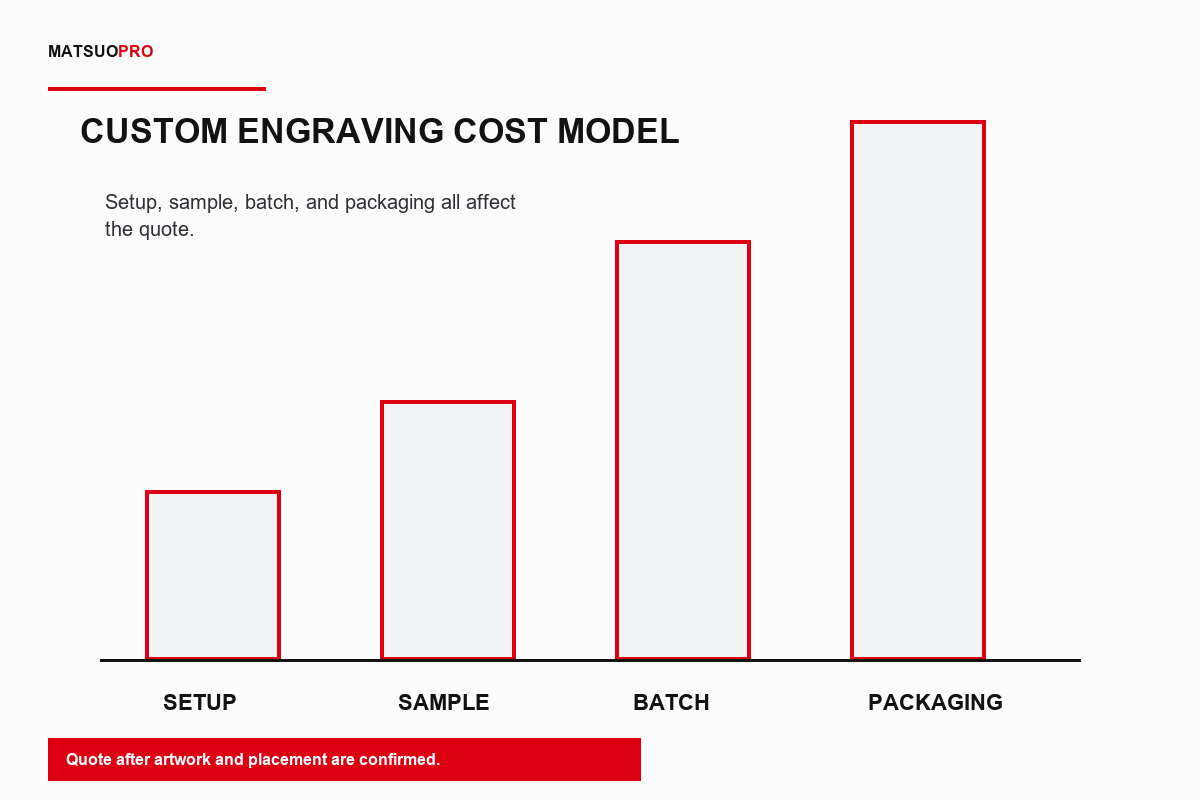
Buyers searching for custom engraving & logo service cost should expect a one-time setup fee plus a per-piece or per-size charge for the engraving itself, a pattern that holds throughout the personalization and engraving industry. Exact numbers vary by provider, mark size, and order volume. Setup fees commonly cover the time needed to load and calibrate a file for a specific machine and material, and that charge is usually assessed once per design rather than once per piece.
Volume changes the math. On small orders, the setup fee is a larger share of the total; on OEM and private-label runs, many suppliers fold the setup cost into a blended per-unit rate once an order clears a set quantity threshold, which is one reason bulk pricing looks meaningfully different from a one-off quote. Rush-turnaround surcharges are common industry-wide too, and they tend to scale up steeply as the requested timeline shrinks rather than rising in a straight line.
The most common budgeting mistake is treating the per-unit engraving rate as the whole cost. Ask for an itemized quote that separates the setup charge, the per-unit engraving fee, any charge for multi-color or larger-format logos, and the rush-fee schedule if you need a faster turnaround. That is the only way to compare two suppliers on the same basis instead of relying on a single headline number that may not include everything. This total-cost comparison also follows NIST’s supplier-selection guidance, which tells manufacturers to look beyond the quoted purchase price when evaluating a supplier.
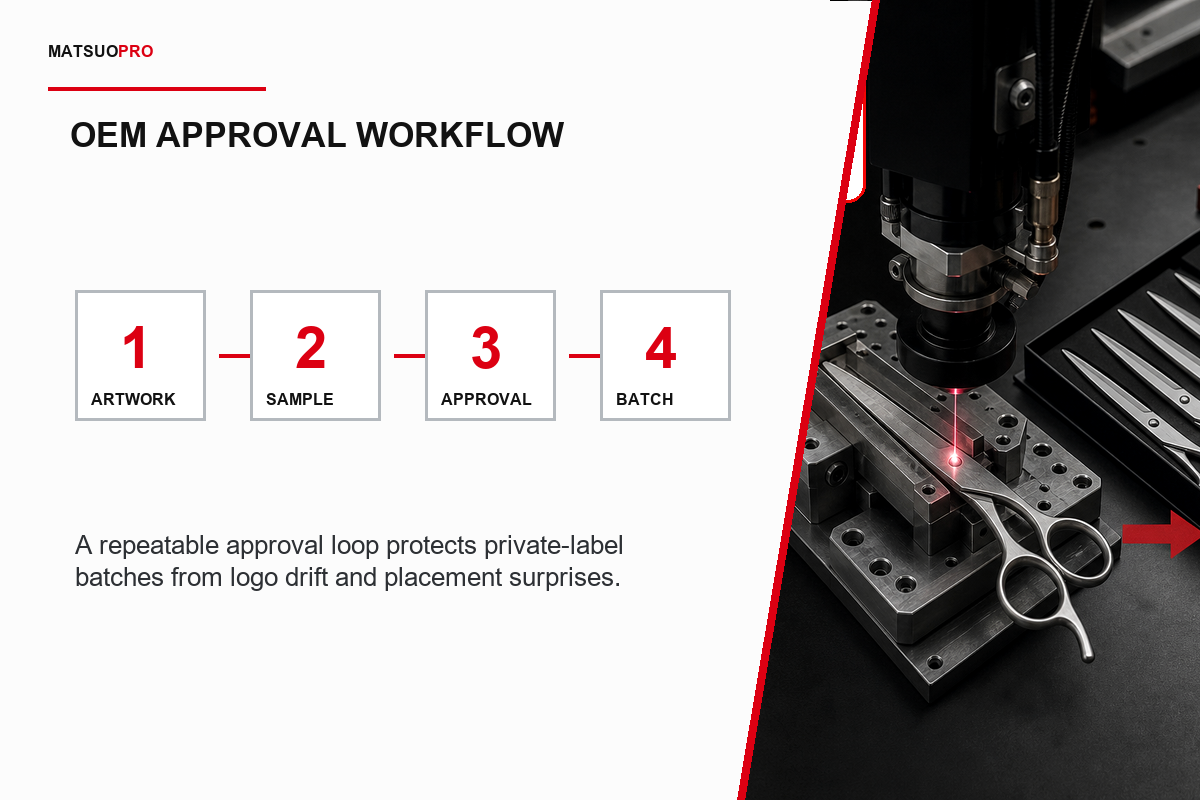
Minimum order quantity is usually the deciding factor for OEM and private-label buyers weighing whether custom engraving is worth pursuing at all, and it splits into two tracks: Mackay’s program opens custom engraving at 50 pieces per SKU, while in-stock scissors can be engraved from a single piece. That split gives a buyer a practical way to test a logo or a private-label design before committing to a full custom production run, rather than guessing from a spec sheet alone.
Certifications matter here as much as MOQ because they are what an OEM buyer’s own customers or auditors will eventually ask about. Mackay’s manufacturing is certified to BSCI, SGS, and ISO 9001 and is checked through a national tools-and-hardware inspection center. Third-party hardness and material reports are available on request, giving an OEM reseller documentation it can pass along rather than having to generate independently. You can read more about our OEM and private label engraving program and our manufacturing background directly.
One compliance detail private-label buyers often overlook is that engraving a logo onto a pair of scissors and making a country-of-origin claim about the finished product are separate, independently regulated matters. A brand name or logo alone does not establish where a product was made. According to FTC guidance, an unqualified “Made in USA” claim on packaging or marketing requires the product to be “all or virtually all” US-made. Check that requirement before finalizing packaging copy on a private-label run, regardless of where the engraving itself happens.
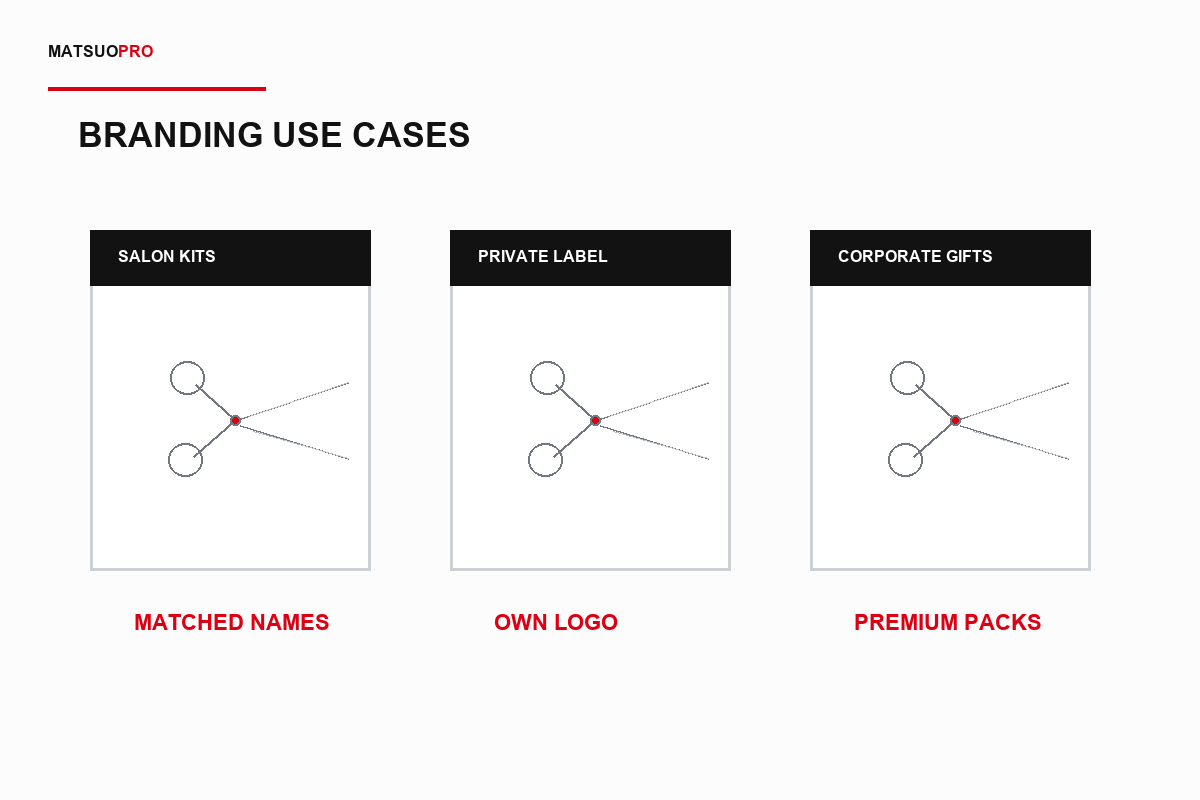
Corporate gifting and branded-tool programs use custom engraving to turn a functional, everyday-use purchase into a lasting brand touchpoint. A stylist who receives a shop-engraved pair of shears uses it on every client and every shift, unlike printed custom promotional products that get set on a shelf or thrown out once the novelty wears off. It is a different category from disposable promotional merchandise entirely: durability, not print-run size, is the value proposition.
That durability is the core of the appeal. An engraved mark on hardened steel does not fade, peel, or wash off the way printed or embroidered branding does on soft goods, and a tool used daily in front of clients puts the brand in view far more often than a one-time gift would. Corporate gifting programs lean on the same logic for milestone awards or incentive programs: an engraved scissors set for a work anniversary carries more weight than a generic trophy. Private-label resellers also use engraving as a merchandising tactic to build recognition for a wholesale line without redesigning the tool itself. When a program uses a protected logo, confirm ownership and permitted use against USPTO trademark guidance before production. Broader research on personalization and corporate gifting points toward sustained growth in this category, a pattern this guide returns to in the outlook section below.
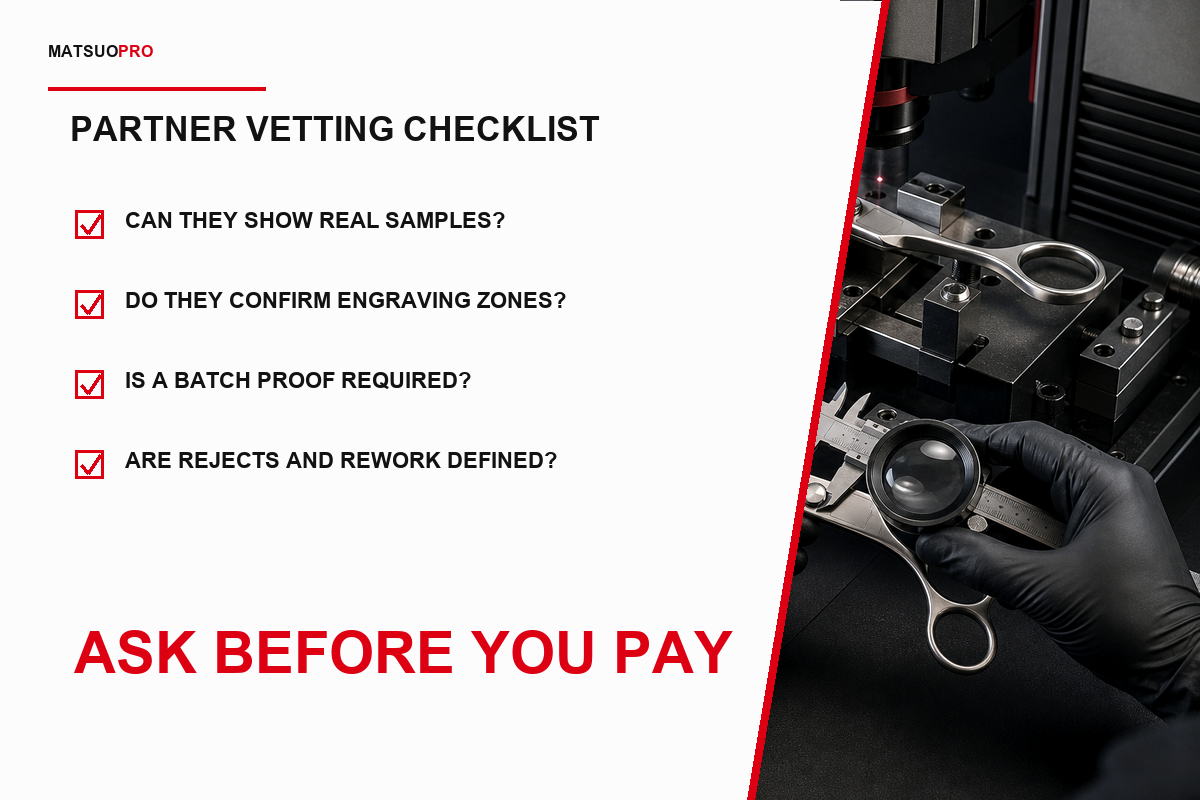
A dependable custom engraving and logo partner, sometimes simply called an engraver, scores consistently on six criteria: certification proof, sample turnaround, MOQ flexibility, durability testing, private-label experience, and file support. Price alone does not predict whether an order ships on time and matches the file you sent.
None of this needs to be invented from scratch. Independent supplier-vetting guidance already exists from standards and quality organizations: NIST’s manufacturing-extension guidance points to documented quality systems, production capacity in a healthy range, and periodic site audits as core vetting criteria, and ASQ’s supplier-quality resources add past performance, financial stability, and validated testing to the list. The scorecard below adapts that general manufacturing-vetting guidance into six criteria specific to custom engraving and logo services for professional scissors.
A six-criterion, 0–2 scoring rubric turns supplier vetting for custom engraving and logo services into a single comparable number. Score each criterion 0 (red flag), 1 (partial), or 2 (strong), for a maximum of 12 points: 10–12 signals a strong partner ready for a sample order, 6–9 means proceed but negotiate or verify the weak criteria first, and below 6 means keep evaluating other suppliers.
| Criterion | Strong (score 2) | Red flag (score 0) |
|---|---|---|
| 1. Certification proof | ISO 9001 / BSCI / SGS or equivalent, documents provided unprompted | No documentation, or claims made without paperwork |
| 2. Sample turnaround | Firm date given at quote stage; sample matches the file sent | No firm date; sample deviates from spec without explanation |
| 3. MOQ flexibility | Clear custom-vs-in-stock MOQ tiers, quoted separately | One rigid MOQ regardless of order type |
| 4. Durability testing | Engraving depth/placement tested against blade hardness, results shared | No testing data offered; vague reassurance only |
| 5. Private-label experience | Documented OEM/private-label projects, references available | No prior private-label work; unclear on packaging/compliance |
| 6. File support | Written file-spec checklist provided before quoting; reviews artwork pre-production | No file guidance; problems surface only after production starts |
Here’s the scorecard applied to a hypothetical supplier, call it Supplier X, evaluated against the six criteria above:
“We built this scorecard around the same checks our own QC team runs before approving an engraving order, sample proof, a depth check against the blade’s hardness spec, and a documented MOQ and turnaround commitment before production starts. We’d rather a buyer use it to compare us against other suppliers than take our word for it.”
Our engineering team at Mackay
Run this same scorecard against any supplier you’re evaluating, including us. The point is a comparable process between quotes, not a sales pitch dressed up as one.
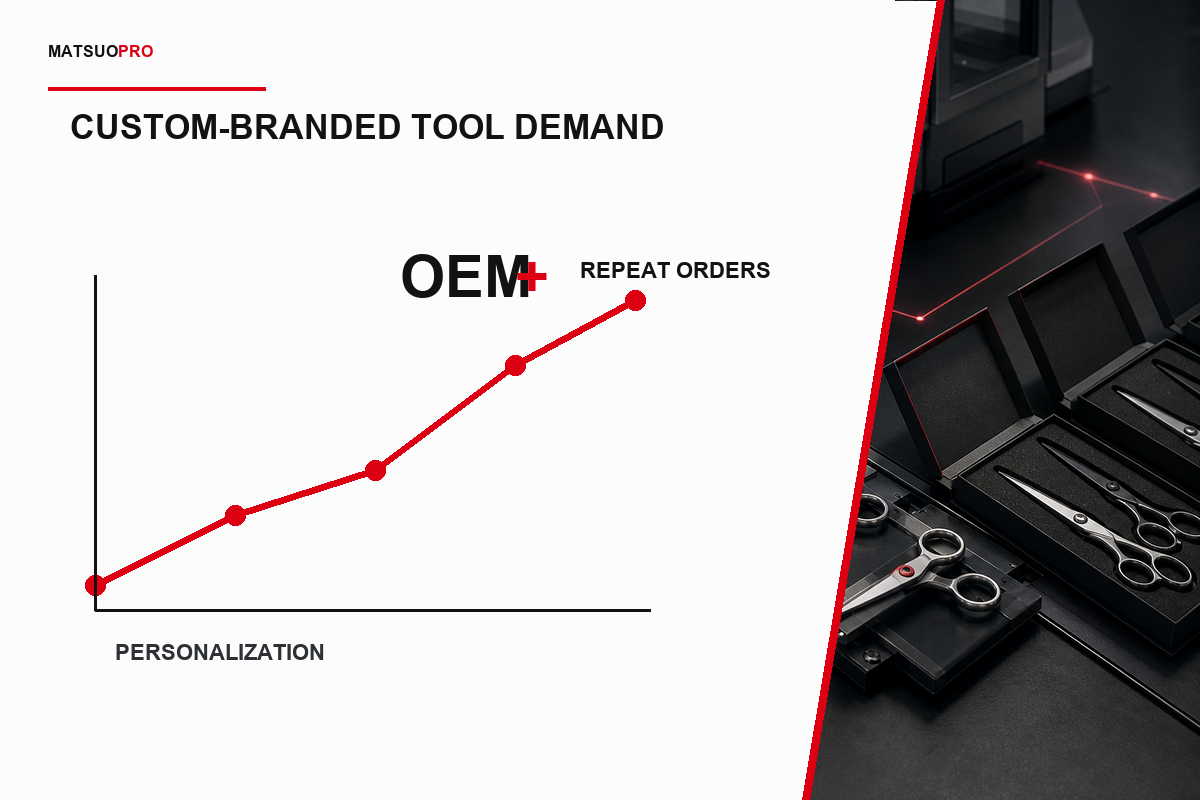
If a business still treats custom engraving as a decorative add-on rather than a standard line item on an OEM or private-label order, it’s behind where B2B purchasing for professional tools is heading, because procurement decisions increasingly weigh brand-asset value, a tool that carries a logo into daily, client-facing use, alongside pure function. That shift in buyer priorities is the structural driver behind rising demand for engraving and logo services on professional equipment, not a seasonal marketing trend.
The technology is moving in a direction that reinforces this shift rather than complicating it. UV laser systems, which became commercially accessible for smaller-scale operations during 2025, mark with less thermal stress than older laser types. That is a real technical improvement directly relevant to the hardness question covered earlier in this guide, though adoption still varies by shop size and equipment budget. As that technology becomes more common, the depth-and-placement discipline this guide recommends gets easier to deliver consistently, not harder.
The demand signal behind this shift is practical rather than speculative. As a manufacturer shipping to more than 40 countries, we’re seeing more OEM and private-label buyers ask about engraving and logo options at the RFQ stage rather than as an afterthought, treating branding as a spec, not a special request. If you’re planning a 2026 OEM order or a private-label launch, price engraving into the RFQ from the start; it’s simpler to negotiate MOQ and turnaround together than to retrofit branding after tooling and packaging are already locked.
From a single engraved set for your shop to a full OEM/private-label run starting at 50 pieces per SKU, our team can walk through steel grade, file requirements, proof approval, mark placement, and turnaround before you commit to your specific order.
Get a Custom Engraving Quote →Mackay’s research for this guide combines its steel, hardness, and MOQ data with independent engineering and standards-body sources, including peer-reviewed laser-marking fatigue studies and a current ISO stainless-hardness standard. Where the evidence on engraving and blade hardness was mixed, we used the qualified, defensible conclusion rather than a simpler unqualified claim. Reviewed by the Mackay technical team.
MATSUOPRO is the Mackay Hair Scissors manufacturing brand for professional hairdressing shears, barber scissors, thinning shears, and pet-grooming scissors. We support salons, distributors, academies, grooming brands, and private-label buyers that need factory-direct production with practical material guidance.
Our buying guides are written to help purchasers compare steel grades, handle styles, blade geometry, surface finishes, logo options, packaging, MOQ, and sample validation before placing an OEM or wholesale order. The goal is to make each scissors specification easier to discuss with a real production team.
Factory-direct supply since 2014, with product lines covering professional cutting shears, barber shears, thinning scissors, texturizing scissors, left-handed models, and pet grooming scissors for international B2B customers.
We focus on Japanese 440C, VG10, and ATS-314 steel choices, convex and bevel edge geometry, ergonomic handle balance, tension systems, logo engraving, private-label packaging, and sample-based OEM confirmation.