Get in Touch with Mackayhairscissors Company
We use submitted details to respond to your quote request. Read our Privacy Policy.

Updated August 2026
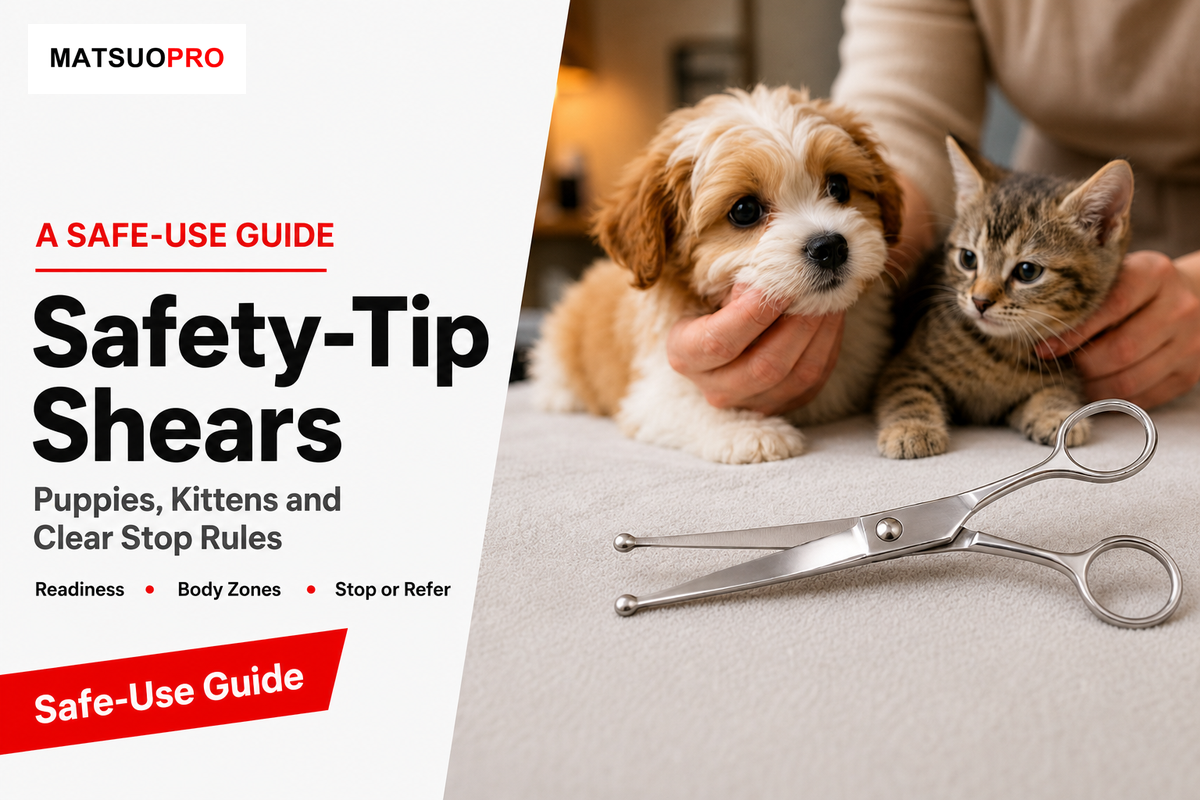
Safety-Tip Shears for Puppies & Kittens are rounded-end grooming scissors made for small, controlled trims, but the name does not make the tool injury-proof. Rounded ends change the tip geometry; they do not remove the cutting blades, prevent sudden movement, or make mats safe to cut.
Direct answer: Use safety-tip grooming shears only when the animal is calm, the target hair is fully visible, and you can keep skin, folds, eyes, and moving limbs out of the blade path. Stop for mats, distress, uncertain anatomy, or any skin or eye problem.
This guide is intentionally different from Mackay Hair Scissors’ commercial safety-tip grooming shears solution page. That page covers product families, materials, sizes, customization, samples, and sourcing. This article covers the use boundary: when a small home trim is reasonable, when to pause, and when a groomer or veterinarian should take over.
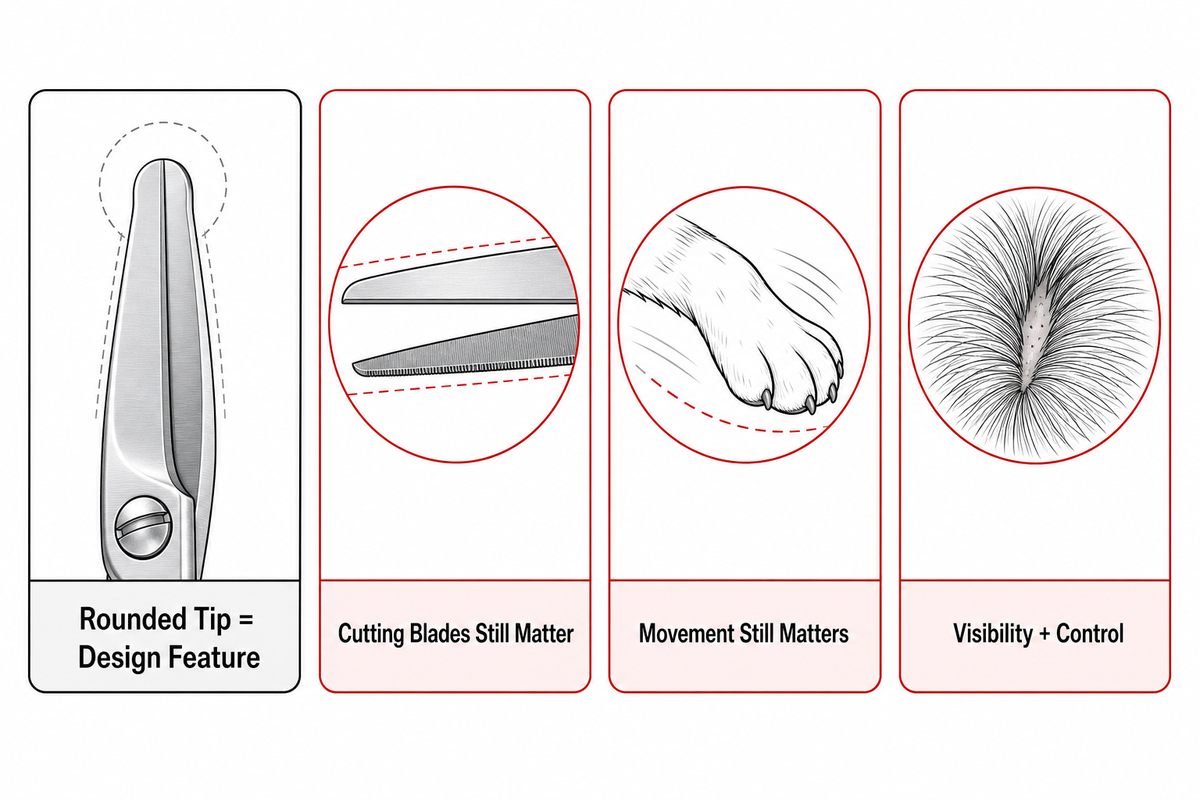
Safety-tip grooming shears replace an exposed pointed corner with a rounded or blunted end, but no veterinary source reviewed for this guide supports treating that feature as a complete safety system. Blade sharpness, hand position, animal movement, hidden skin, and the body area being trimmed still control the real risk.
Tip shape and cutting edges solve different problems. Rounded ends may make the tool feel less needle-like during careful positioning, yet the blades still have to be sharp enough to cut hair. If skin enters the blade path, the word safety on the product category cannot protect it.
Use one deliberately conservative rule: treat the rounded tip as a small part of a safe grooming process, never as the reason to proceed. Those limits apply to dog grooming shears, curved scissors, trimming scissors, and any tool sold as safety scissors. Precision comes from visibility and control, not from a stainless steel blade or the curve of the shear.
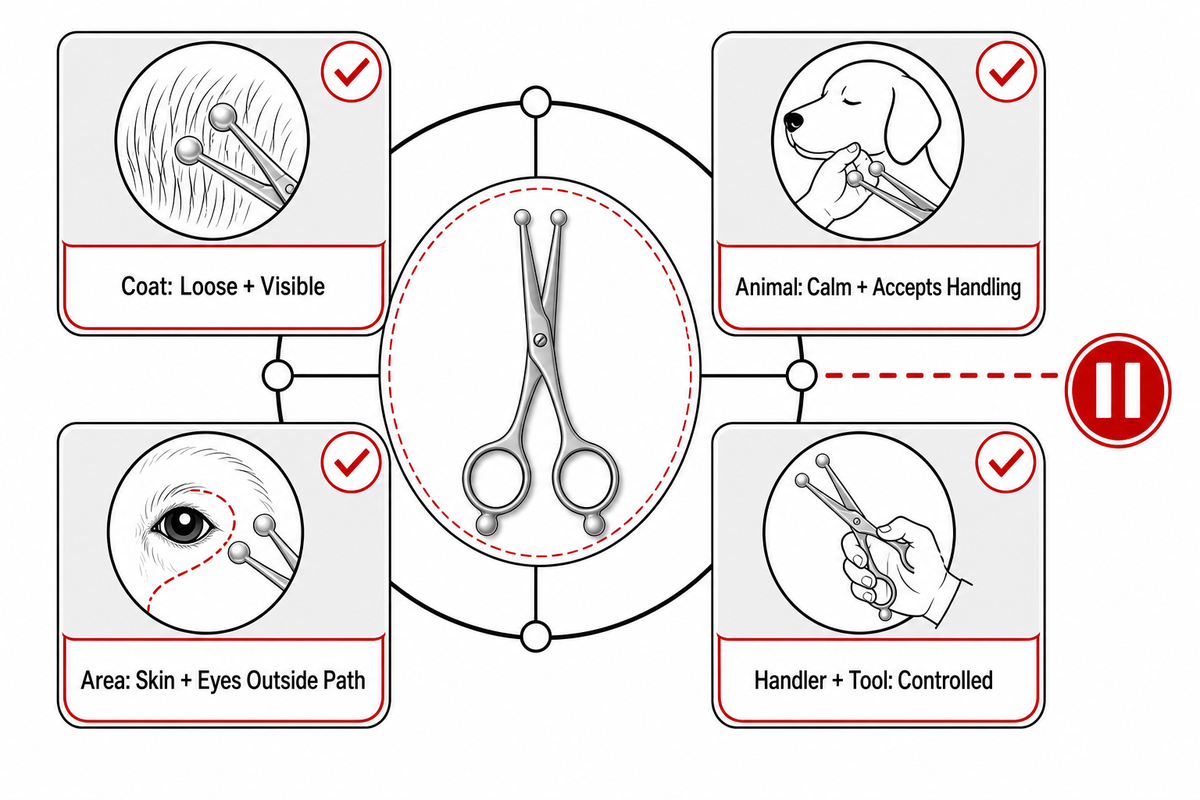
The Four-Part Readiness Check asks about the coat, the animal, the body area, and the person holding the tool. Proceed at home only when all four checks are clear. One uncertain answer means pause; a mat, injury risk, pain sign, eye problem, or abnormal skin means refer.
| Check | Proceed only when | Pause when | Refer when |
|---|---|---|---|
| Coat | Hair is clean enough to separate, loose, and fully visible. | Hair cannot be isolated from the coat or skin. | A mat is tight, severe, painful, or cannot be brushed out. |
| Animal | The puppy or kitten is calm and accepts gentle handling. | The animal turns toward the tool, pulls away, freezes, or repeatedly shifts. | There is persistent distress, aggression, pain, or injury potential. |
| Area | The hair end is visible and skin, folds, eyes, and moving joints are outside the path. | You cannot confirm what sits beneath or beside the hair. | The target is beside an eye, inside a fold, on irritated skin, or in a delicate sanitary area. |
| Handler and tool | The tool fits the task, opens smoothly, and can be controlled without awkward wrist or finger positions. | You need a second person to force the animal still or cannot keep the blade path visible. | You have not been shown the technique for a sensitive area or the pet cannot be handled safely. |
Coat condition is a hard boundary, not a preference. The ASPCA’s matting guidance says never to cut mats out with scissors because a pet can move unexpectedly, causing a severe laceration or puncture. Unbrushable mats belong with a groomer or veterinarian.
Run the four checks again whenever the animal changes position. Readiness is not a one-time permission slip. Even a reasonable starting point becomes unsafe the moment the target hair disappears, the puppy twists, or the kitten becomes agitated.
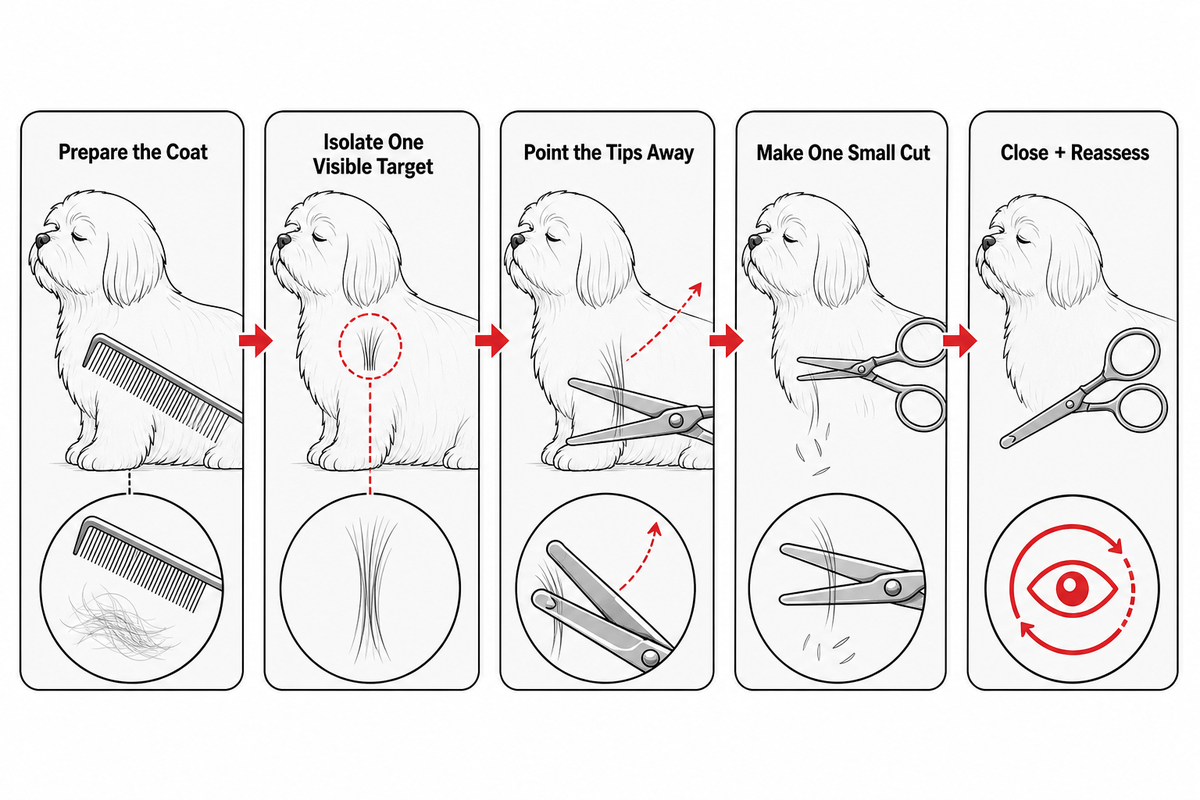
A controlled micro-trim removes only a small amount of fully visible hair while the animal remains calm. Work intentionally slowly: prepare the coat, isolate the target, place skin and eyes outside the blade path, make one small cut, close the shears, and reassess before doing anything else.
Grooming is not a test of obedience. If the animal moves, stop moving the shears. Close them before repositioning. Never chase a paw, muzzle, tail, or ear with open blades, and never ask another person to pin down a struggling animal so you can finish.
Calm grooming begins before the scissors appear: use a familiar surface, allow gentle handling of the area, and keep the first attempts shorter than the animal’s tolerance. One calm helper may support the body without forcing it. If the animal freezes, tries to escape, growls, hisses, snaps, or repeatedly turns toward the tool, end the session.
For cats, the ASPCA’s grooming guidance is explicit: do not attempt clipping when a cat is agitated, and contact a professional groomer or veterinarian when resistance creates injury potential. That principle matters more than completing a tidy line.
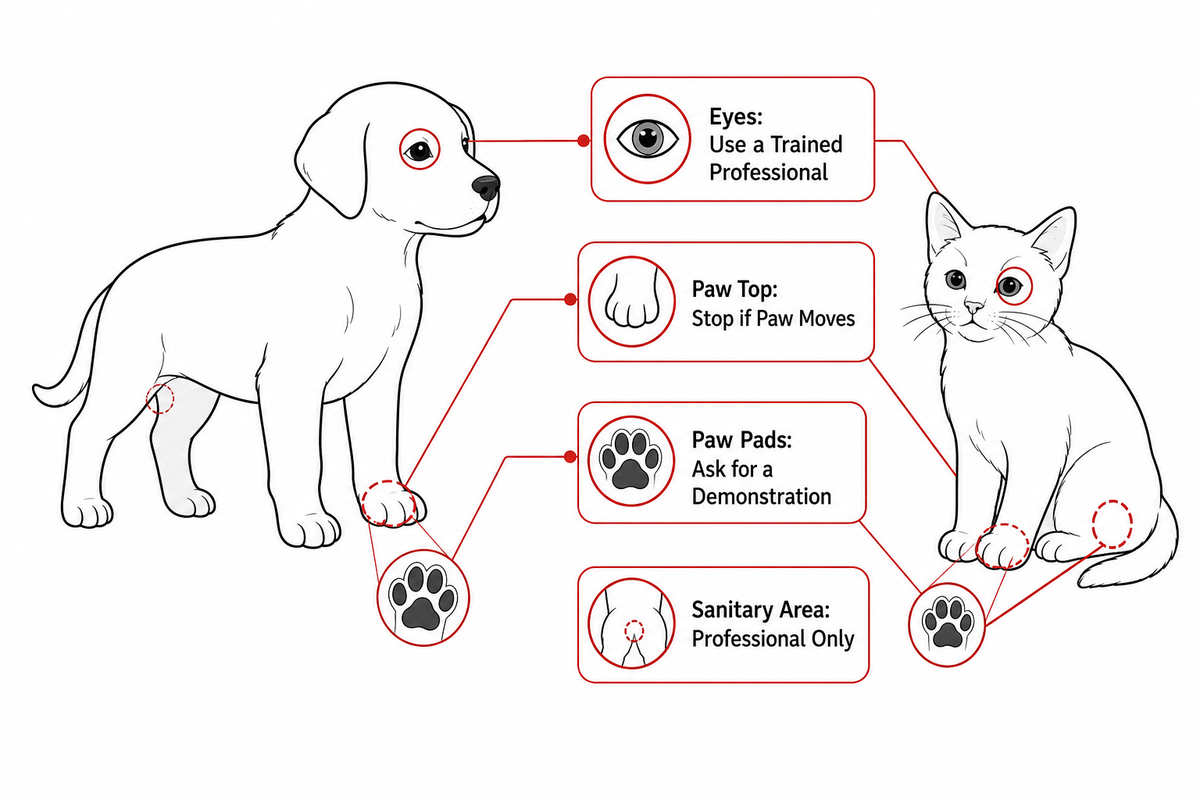
Body areas do not share one safety rule. Paw hair can hide skin between pads; facial hair sits beside eyes, whiskers, lips, and sudden head movement; tail and sanitary hair can cover folds and delicate tissue. Use the table as a boundary map, not as permission to trim every listed area.
| Area | Possible home target | Hidden risk | Safer boundary |
|---|---|---|---|
| Top of a paw | A few isolated hair ends well above visible skin. | Toes flex and the paw can withdraw without warning. | Stop if the paw will not rest naturally. |
| Between paw pads | Only hair clearly protruding beyond the pads after professional guidance. | Skin, webs, and folds sit beneath the hair. | Ask a groomer, breeder, or veterinary professional to demonstrate first. |
| Around the eyes | No beginner scissor target is recommended in this guide. | Head movement can place the eye in the blade path instantly. | Use a trained groomer or veterinary-supervised technique. |
| Muzzle and chin | A fully visible hair end only when the mouth is still and closed. | Whiskers, lips, tongue, and rapid head turns. | Refer if the pet mouths the tool or will not hold a neutral head position. |
| Tail fringe | Loose visible ends away from skin. | Tail movement, thin skin, and hidden mats. | Never hold a resisting tail rigid to make a cut. |
| Outer ear fringe | Loose hair extending beyond a fully visible outer ear edge. | Thin ear tissue, folds, and sudden ear flicks. | Stop unless the ear edge and the full blade path remain visible. |
| Chest or belly fringe | A few combed-out ends clearly separated from the body. | Loose skin, nipples, folds, and sudden crouching. | Refer when skin landmarks cannot be seen and kept outside the blade path. |
| Sanitary area | No beginner scissor target is recommended in this guide. | Delicate skin, folds, moisture, and poor visibility. | Use a professional groomer; involve a veterinarian for irritation, pain, swelling, or discharge. |
For paw pads, the American Kennel Club’s grooming guidance says small blunt-edge scissors or a narrow clipper blade should be used only after speaking with a groomer, breeder, or veterinary staff.
There is one narrow cat-specific example worth preserving accurately: ASPCA says irritating hair between a cat’s toes may be trimmed gently with a small pair of rounded scissors. That does not justify copying the same advice to a puppy, pushing the blades between pads, or cutting where skin is hidden.
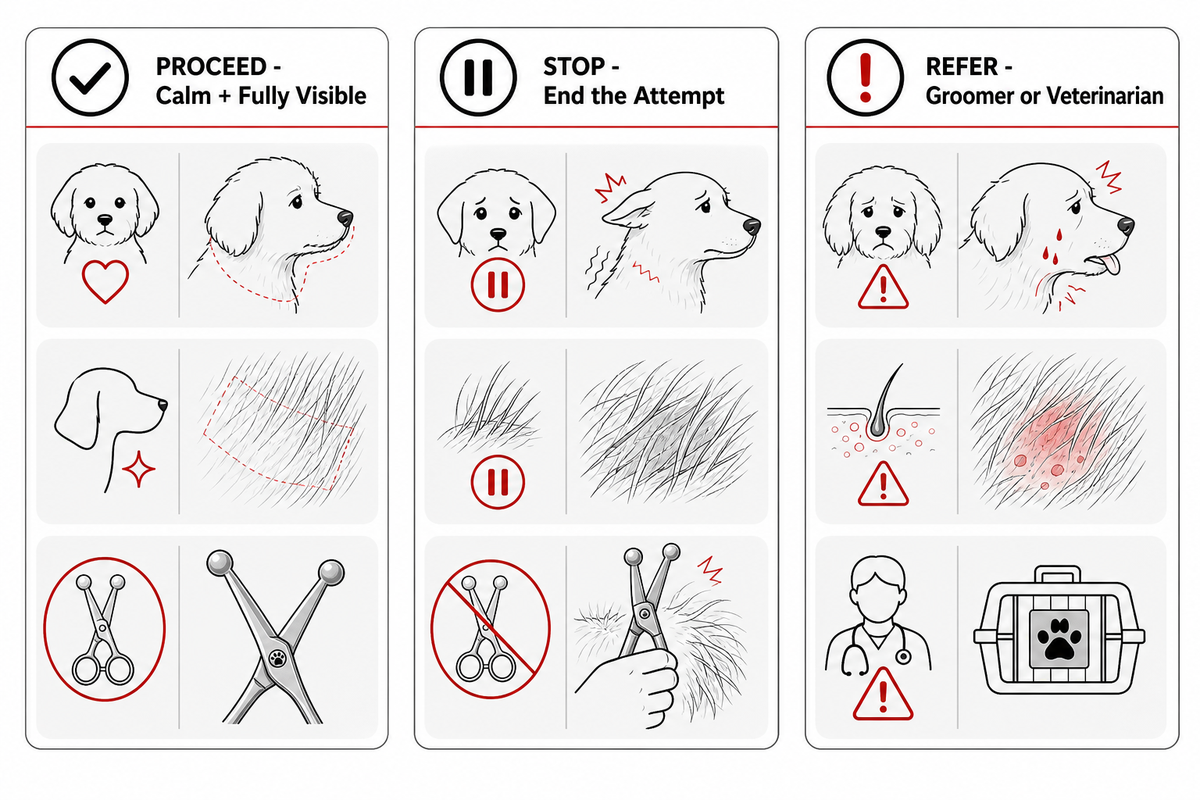
The Stop / Proceed / Refer Matrix turns grooming red flags into an immediate action. “Proceed” applies only to calm behavior and fully visible surface hair. “Stop” ends the current attempt. “Refer” means the problem belongs with a groomer or veterinarian, not with a different pair of scissors.
| What you see | Decision | Why | Next owner of the task |
|---|---|---|---|
| Loose, isolated hair; calm animal; skin and eyes visible and outside the blade path | Proceed | The target and movement are controlled. | Home caregiver, one micro-trim at a time |
| Animal turns toward the tool or shifts repeatedly | Stop | The blade path is no longer predictable. | End the attempt; retry only after calm acclimation |
| Growling, hissing, snapping, biting, or active escape attempts | Refer | Forcing the session raises injury risk for the animal and handler. | Professional groomer or veterinarian |
| Tight mat with no clear space between coat and skin | Refer | Skin can be pulled into the mat and cut with it. | Professional groomer; veterinarian if severe or painful |
| Hair near an eye, but the head will not remain neutral | Refer | A small head movement can put the eye in the blade path. | Trained groomer or veterinarian |
| Redness, open sore, swelling, discharge, bald patch, or broken skin | Refer | This may be a health problem, not excess hair. | Veterinarian |
| The animal flinches or shows pain when the area is touched | Refer | Pain changes movement and may signal an underlying problem. | Veterinarian |
| Hair is visible, but skin position beneath a fold is uncertain | Stop | The target cannot be separated from delicate tissue. | Professional groomer if trimming is needed |
| You need to restrain the animal forcefully to finish | Stop | Completion is less important than avoiding fear and injury. | Rebuild handling tolerance or consult a professional |
| A cut, bleeding, or possible eye contact has already occurred | Refer now | The priority has changed from grooming to medical assessment. | Veterinarian or emergency veterinary service as appropriate |
Matting guidance is consistent across species-oriented sources. VCA’s cat coat-care guidance separates gentle brushing of small tangles from mat removal and warns against scissors because skin can be pulled into the mat. Switching tools is not the first decision; professional assessment is.
Skin and behavior also change the owner of the task. ASPCA’s dog grooming guidance advises veterinary attention for abnormal skin, sores, bald spots, and persistent scratching or licking. Those signs should not be covered up by trimming the coat shorter.
Safety-tip shears belong only in the green zone: calm animal, loose visible hair, known skin position, and a controlled blade path. Any red flag changes the task from trimming to referral.
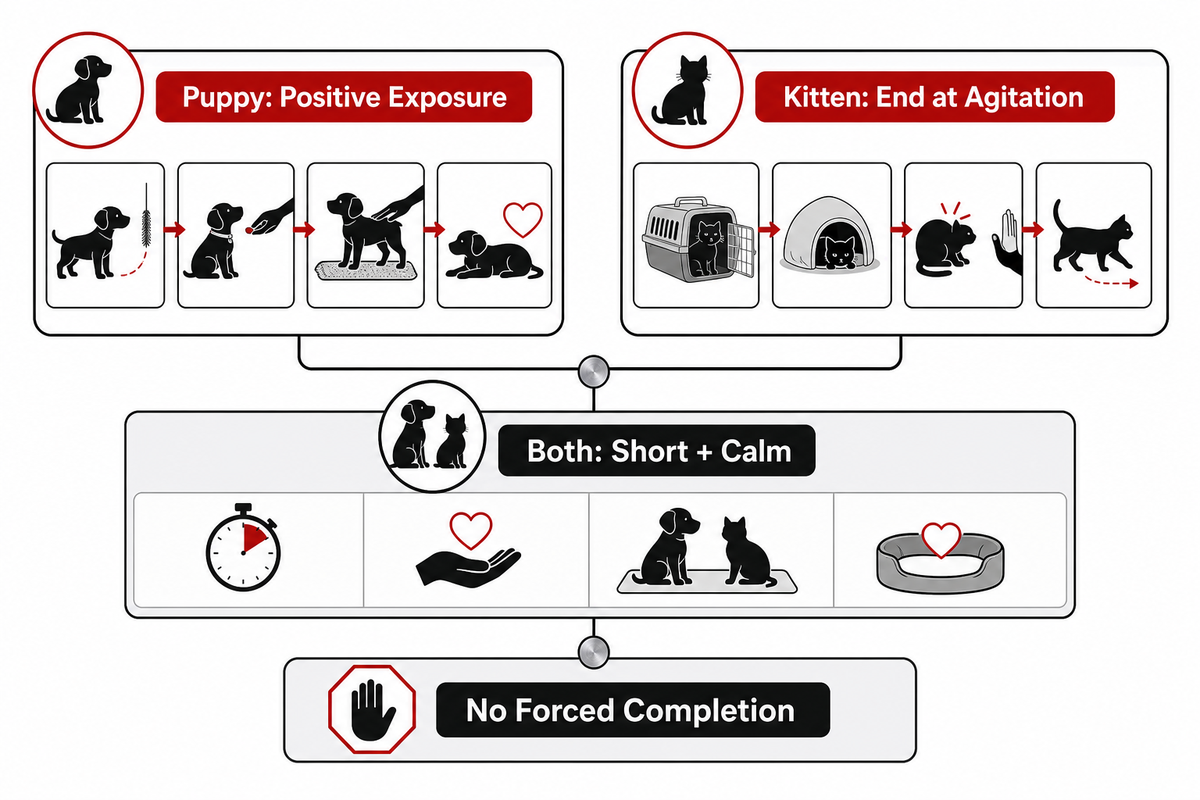
Puppies and kittens share the same no-force, full-visibility rule, but they do not share identical handling evidence. During puppy grooming or kitten grooming, delicate areas and rapid movement demand separate judgment. Dog and cat advice should stay species-specific instead of being copied across animals, especially with a small pet.
Gentle handling, touching the paws, showing a comb, and pairing a calm interaction with a reward can begin before a scissor trim is needed. PetMD’s veterinary-reviewed guide recommends early positive exposure and ties the timing of a professional grooming visit to booster status. Ask your veterinarian and chosen groomer about their vaccination and appointment requirements rather than relying on one universal age.
Some kittens accept brushing but reject a paw being held, or tolerate one small task and then become overstimulated. Do not interpret stillness as consent if the body is rigid, the ears flatten, the tail lashes, or the kitten begins turning toward the hand or tool. End while the interaction is still manageable.
Across both species, the most defensible lesson is modest: short, calm exposure is useful; forced completion is not. Home grooming should keep grooming tasks smaller than the animal’s tolerance. When a puppy or kitten cannot remain comfortable enough for a visible micro-trim, choose a shorter session, more acclimation, or professional help.
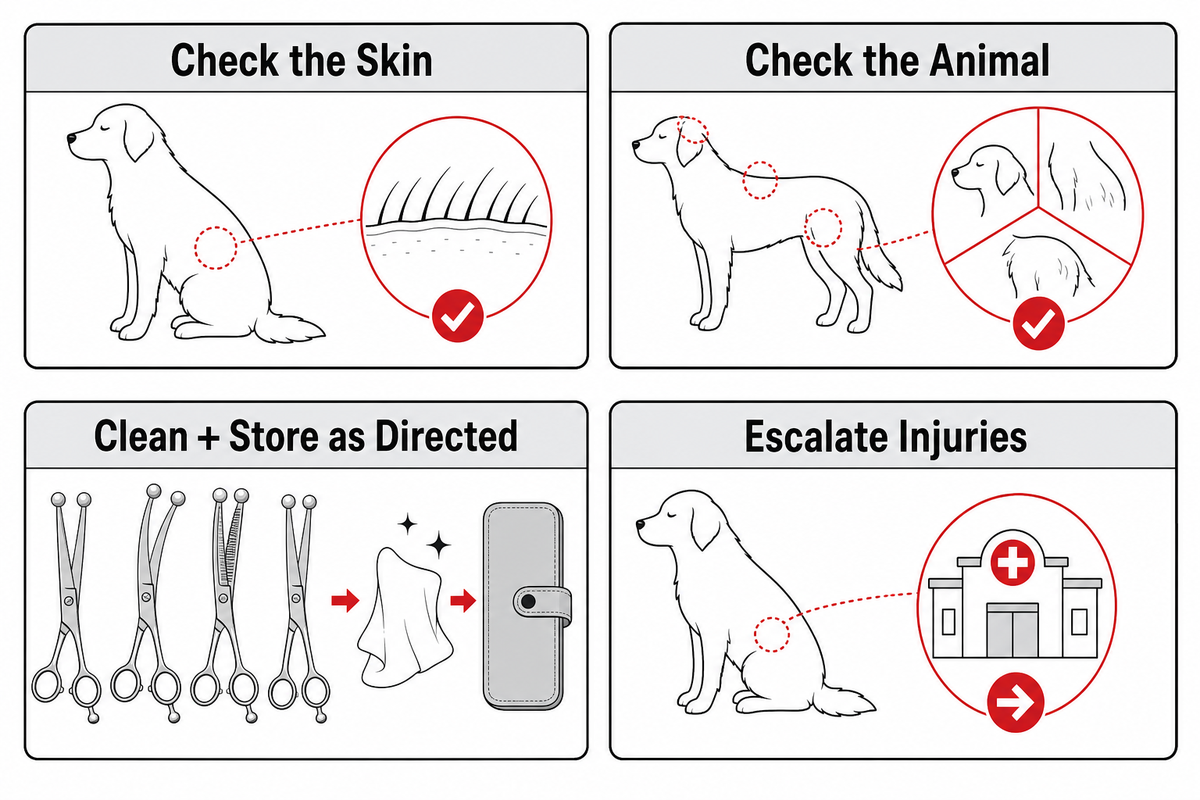
After a micro-trim, inspect the area in good light before putting the tool away. Look for redness, a nick, swelling, discharge, a new pain response, or behavior that did not appear before grooming. Then clean, dry, lubricate, and store the shears only as the manufacturer instructs.
For readers comparing shear types after understanding these limits, the pet grooming scissors collection explains the broader product families. If the task is coat blending rather than a sensitive-area micro-trim, the guide to thinning shears for dogs addresses that separate use case.
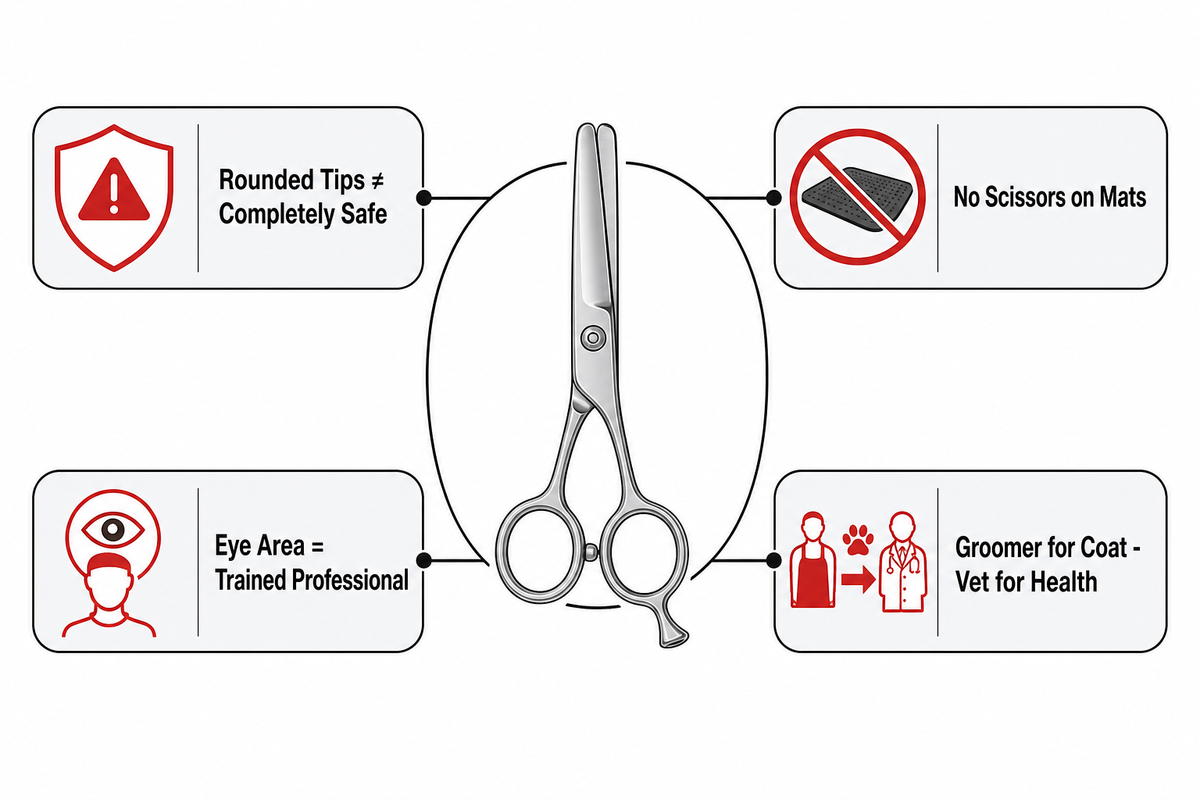
If the animal is calm, the hair target is visible, and the area is appropriate for a small trim, compare Mackay’s safety-tip options on the existing solution page. For mats, distress, pain, eye work, or uncertain anatomy, stop and use the right professional instead.
Mackay Hair Scissors makes professional hairdressing and pet grooming shears. This article separates that commercial role from its safety guidance: product details stay on the solution page, while the use boundaries above are grounded in animal-welfare, kennel-club, and veterinary sources. Learn more about the company on the Mackay Hair Scissors about page.
MATSUOPRO is the Mackay Hair Scissors manufacturing brand for professional hairdressing shears, barber scissors, thinning shears, and pet-grooming scissors. We support salons, distributors, academies, grooming brands, and private-label buyers that need factory-direct production with practical material guidance.
Our buying guides are written to help purchasers compare steel grades, handle styles, blade geometry, surface finishes, logo options, packaging, MOQ, and sample validation before placing an OEM or wholesale order. The goal is to make each scissors specification easier to discuss with a real production team.
Factory-direct supply since 2014, with product lines covering professional cutting shears, barber shears, thinning scissors, texturizing scissors, left-handed models, and pet grooming scissors for international B2B customers.
We focus on Japanese 440C, VG10, and ATS-314 steel choices, convex and bevel edge geometry, ergonomic handle balance, tension systems, logo engraving, private-label packaging, and sample-based OEM confirmation.