Get in Touch with Mackayhairscissors Company
We use submitted details to respond to your quote request. Read our Privacy Policy.

Updated October 2026
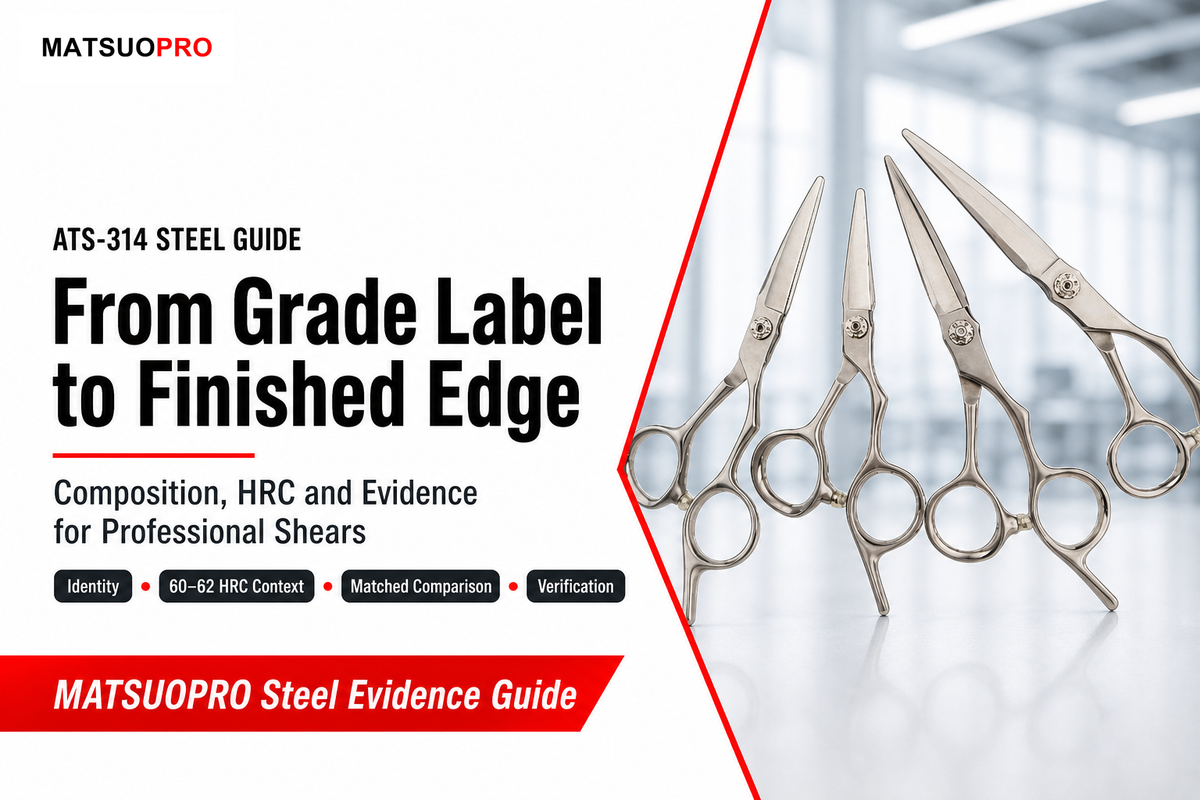
ATS-314 steel, also searched as ATS 314 steel, is a stainless cobalt-alloy material developed for professional hair scissors. ATS 314 steel refers to the same hyphenated designation in this guide. Yamamura Manufacturing says it specified the material and Proterial, formerly Hitachi Metals, produced it. This establishes a traceable identity. It doesn’t mean that all shears produced with that material have the same hardness, edge geometry, heat treatment, assembly quality, or service life.
The useful question isn’t simply, “Is ATS-314 good?” It’s, “What evidence connects this label to the finished pair of shears I’m evaluating?” This guide follows that chain from material identity to blade hardness, geometry, pivot condition, inspection records, and real service support.
ATS-314 has a more specific history than most seller pages reveal. Yamamura’s material account describes ATS-314 as a stainless cobalt alloy made by Proterial to Yamamura’s specified composition. Its company history dates the joint development for beauty scissors to December 1998.
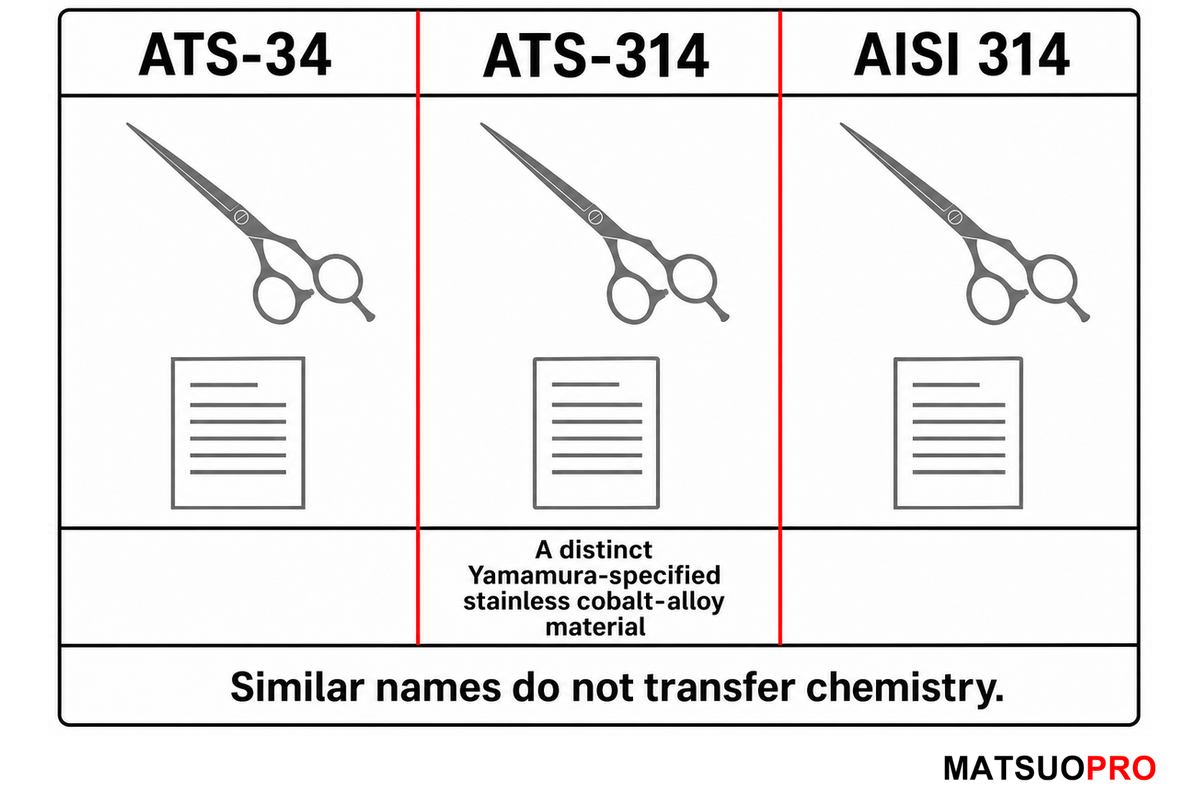
That history also corrects a common naming error. Yamamura says the ATS-314 name was derived from ATS-34, but the contents are different. Thus, ATS-314 isn’t ATS-34 with an extra digit, and an ATS-34 composition table can’t be labeled as ATS-314. AISI 314 is another separate designation. Characters in a name don’t always mean the same thing in chemistry.
Names get shortened to ATS314, but the missing hyphen doesn’t create a different grade. The traceable account comes from a scissor manufacturer in Japan and describes a stainless steel developed for beauty scissors. That’s stronger identity evidence than a vague statement such as “a traditional Japanese scissor steel,” yet it still doesn’t provide evidence of a finished commercial product.
| Label or statement | Supported meaning | Unsupported inference |
|---|---|---|
| ATS-314 | A distinct Yamamura-specified stainless cobalt-alloy material produced by Proterial | One universal hardness, edge life, or quality tier for every finished shear |
| ATS-34 | A separate material whose name influenced ATS-314 naming | A chemistry table that can be transferred to ATS-314 |
| AISI 314 | A separate generic steel designation | A synonym for the proprietary ATS-314 scissor material |
A maker-level page from Yasaka also uses ATS-314 as a hair-scissor material designation. That confirms market use by a scissor maker, but comparative phrases such as “higher grade” remain maker claims unless a controlled finished-shear test defines the basis of comparison.
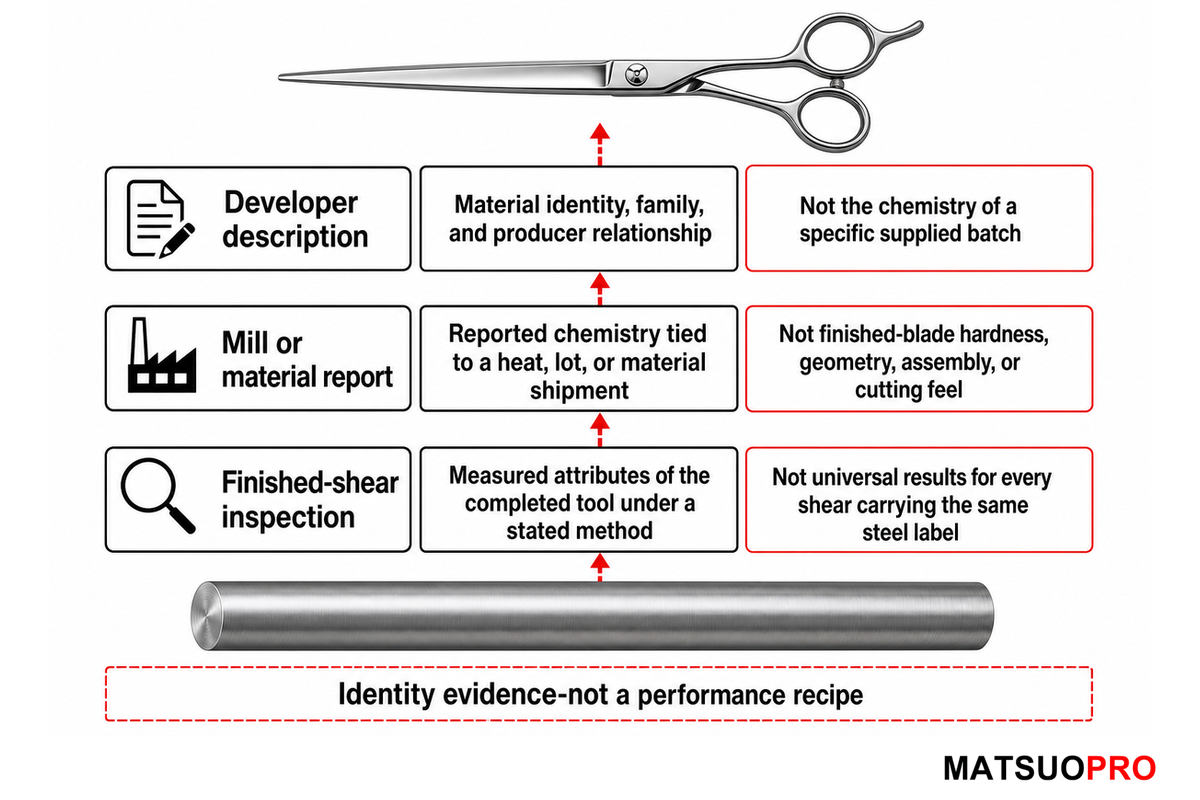
The reviewed developer page doesn’t publish a complete ATS-314 percentage table. It identifies a stainless cobalt-alloy family and a producer relationship, but it does not provide a public recipe supporting the exact carbon, chromium, molybdenum, or cobalt percentages repeated across seller pages. Those percentages should remain open unless the supplier provides batch-linked material evidence.
Even a verified chemistry report would answer only one part of the performance question. NIST gives a useful materials-design example: two steel samples with the same exact composition can develop very different properties when their cooling histories differ. One becomes strong; another becomes brittle and weak. That example isn’t an ATS-314 test, but it shows why composition can’t substitute for processing history.
| Evidence layer | What it can establish | What it cannot establish |
|---|---|---|
| Developer description | Material identity, family, and producer relationship | The chemistry of a specific supplied batch |
| Mill or material report | Reported chemistry tied to a heat, lot, or material shipment | Finished-blade hardness, geometry, assembly, or cutting feel |
| Finished-shear inspection | Measured attributes of the completed tool under a stated method | Universal results for every shear carrying the same steel label |
For a stylist buying one pair, ask the maker to confirm the exact material designation and finished specification for that model. For an OEM or private-label order, add the material or heat reference to the purchase specification and connect it to the sample, production lot, and final inspection record.
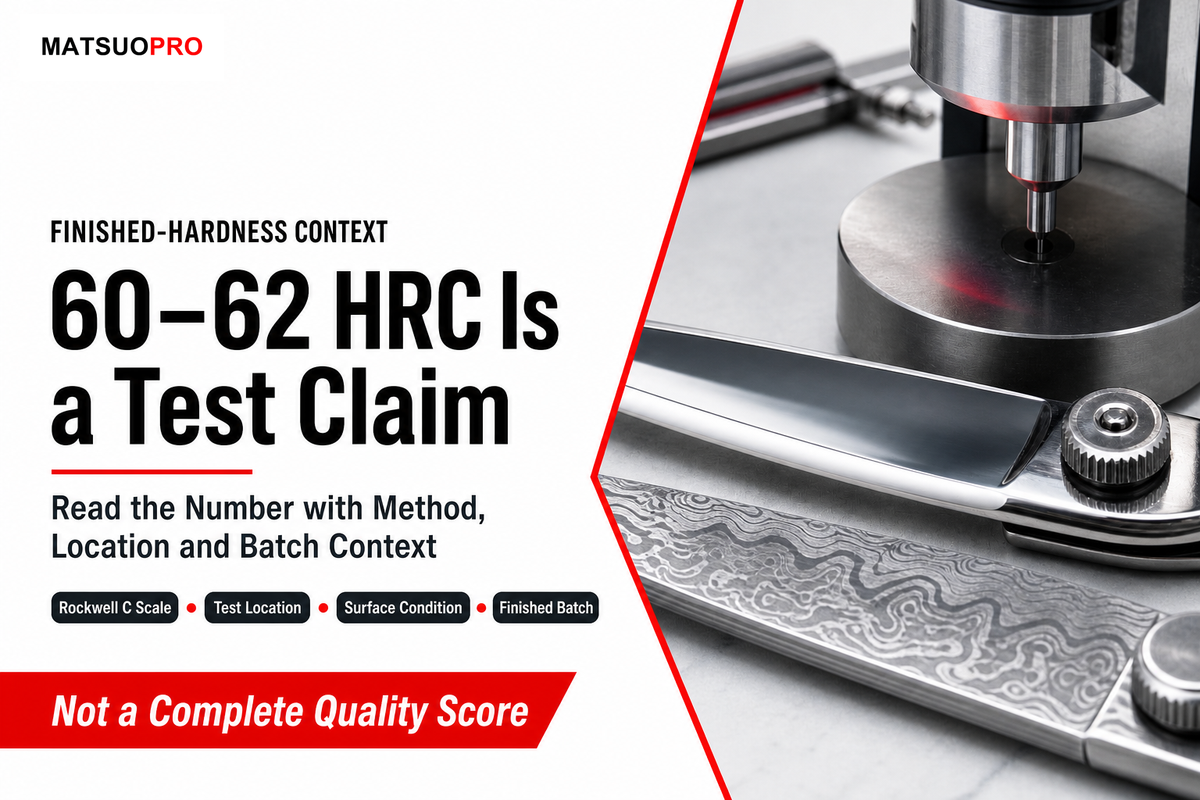
HRC is a Rockwell C hardness result, not a complete quality score. Mackay publishes HRC in the low 60s for professional shears and says hardness reports are available upon request. Read 60-62 HRC as an attributed finished-product claim that still needs a valid test record, not as an invariant property of the ATS-314 name.
The current ASTM E18-25 page is also pertinent. It provides minimum thicknesses and gives guidance for correction of convex cylindrical surfaces. It also states that a test result from one location may not represent the entire part or end product. A thin, tapered, curved shear blade is not necessarily a simple flat test coupon.
Evidence boundary: a hardness result from one test location may not represent the entire part or end product.
Compare two HRC values only after accounting for Rockwell scale, test location, blade thickness, support, surface condition, and whether curvature correction has been taken into account. Consider also whether the number is a target, a typical value, a range, or the actual value for the finished batch. Check Mackay’s document HRC hardness testing and interpretation for the wider scissor context.
Mackay’s published use-case matrix lists ATS-314 at 60–62 HRC with a 5.5–6.0 in size range; the same page shows comparison examples at 58–60 HRC, 60–61 HRC, and up to 64 HRC. Those are Mackay’s stated model and range examples, not universal properties of the grades.
This affects how you view minor distinctions. An entry listing 61 HRC isn’t always more specific than an entry listing 60-62 HRC. One value could represent a target, an average, or a result from a single test point; a range could represent a production tolerance or a broad statement in a catalog. Ask for the record behind each number before assuming a one-point gap represents a performance advantage. If the blade geometry didn’t allow for a valid direct reading, the maker should explain the specimen, preparation or alternative verification method used.
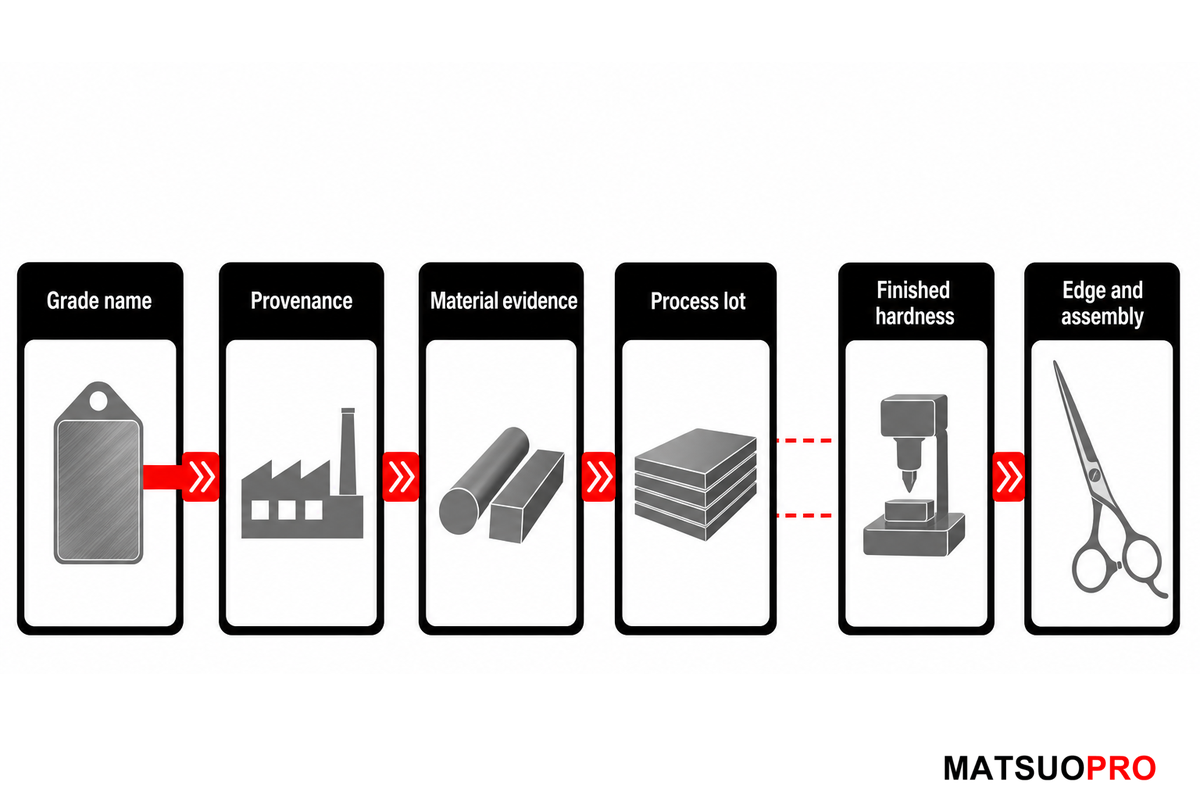
The Label-to-Edge Evidence Chain prevents one familiar material name from carrying more weight than the finished product deserves. Each link of the chain answers a different question, and a missing link should remain “unknown” and not be filled in with a seller’s general statement.
One link may be false and the rest valid. A seller may correctly name ATS-314 but reuse a generic HRC value with no test location. One batch may have evidence of the material with inconsistent pivot tension or edge finishing. Inconsistent finishing doesn’t mean the steel identity is false. It means the finished-shear conclusion is incomplete.
The kind of evidence you need depends on the decision. A stylist choosing one model may stop after written model-level provenance, a final finished specification, a fit trial, and a clear warranty and service route. An OEM buyer exposing a brand to hundreds of units should go further, connecting the approved sample to the material heat or shipment, the production lot, hardness and inspection plan, nonconformance rules, and records supplied at shipment. The same steps apply to both buyers, but the acceptable stopping point changes with quantity and risk.
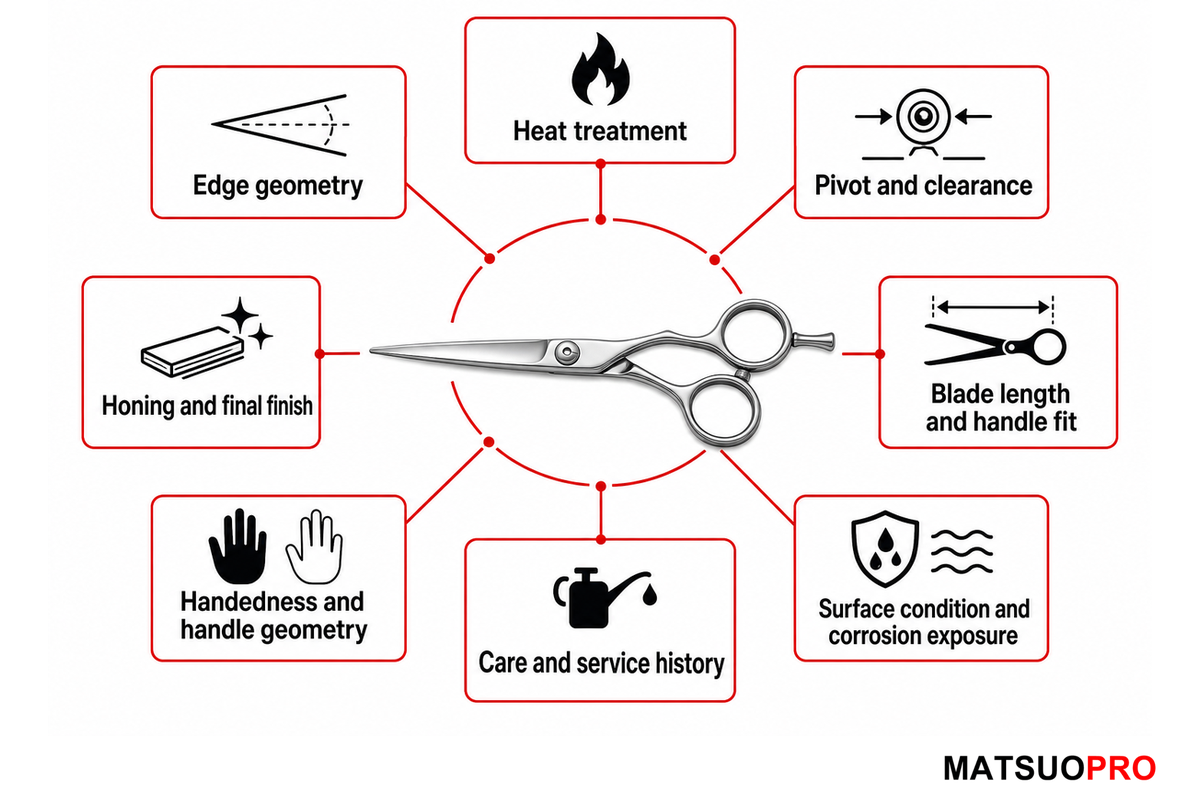
Heat treatment hardens the tool steel and affects the microstructure. Grinding and honing create the cutting profile. Blade thickness, convexity, hollowing, tip shape, surface finish, and edge angle change how the blades enter and release hair. These variables interact, so two shears with the same material label can behave differently without either label being wrong.
Assembly is just as important. A study titled “Presumption of Fiber Cutting Load by Hair-Cutting Scissors” tested hair scissors using nylon string. It identified screw tightness, edge angle, and edge-tip sharpness as variables affecting cutting load. When the screw was loosened, blade clearance and cutting load increased. The study doesn’t test ATS-314, but it directly shows why a steel label can’t diagnose drag or pushing by itself.
| Variable | Possible effect | Evidence to request |
|---|---|---|
| Heat treatment | Hardness, toughness, and structure of the finished blade | Lot identity and finished hardness record, not a universal recipe |
| Edge geometry | Entry force, glide, stability, and sharpening response | Named profile, intended technique, and authorized service method |
| Pivot and clearance | Blade contact, alignment, and cutting load | Piece-level tension and alignment inspection |
| Honing and final finish | Burr removal, initial feel, and edge consistency | Finished-edge inspection and qualified sharpening route |
| Blade length and handle fit | Reach, balance, wrist posture, and technique fit | Model drawing, stated size, and physical sample |
| Handedness and handle geometry | Blade presentation, grip, and control | Exact handedness, handle type, and user trial |
| Surface condition and corrosion exposure | Finish integrity and cleaning response | Finish criteria, exposure record, and compatible care method |
| Care and service history | Edge condition, pivot feel, and repeatability over time | Cleaning, impact, adjustment, and sharpening record |
MACKAY describes vacuum and cryogenic processing, precision grinding, and hand honing as aspects of its in-house manufacturing. These are first-party process claims. They can be useful to a buyer only if they specify the particular model, sample, production lot, and final inspection. Otherwise, they serve only as prestige words.
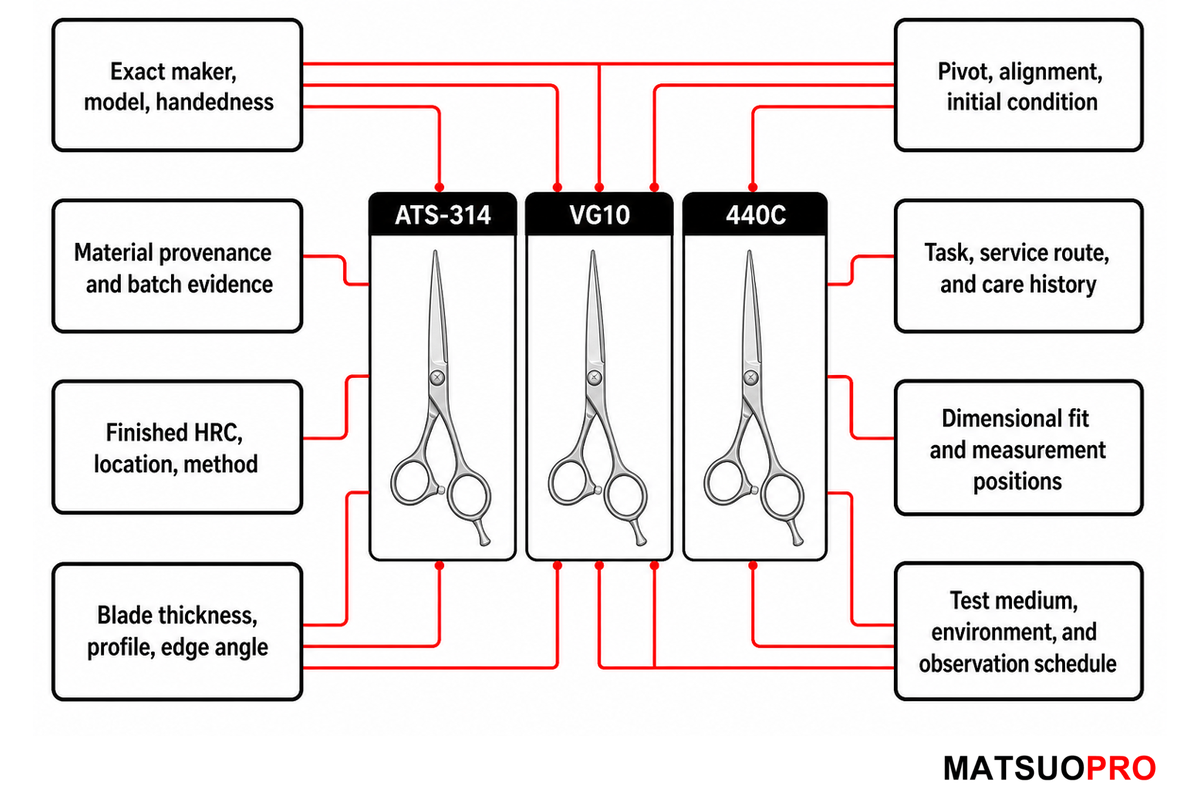
There’s no defensible universal winner among ATS-314, VG10, and 440C based on the grade names alone. The current research found no completed studies of finished hair-cutting shears that held geometry, heat treatment, assembly, task, care, and test method constant. Each finished shear is a cutting tool, and the state thereof is part of the comparison.
A 2026 peer-reviewed CATRA knife study provides insight into why these variables must be controlled. Across other steels and included edge angles of 18, 24, and 30 degrees, initial cutting performance was dominated by the edge angle. However, total cutting performance involved the interaction of carbide features and matrix hardness. ATS-314, VG10, and 440C weren’t tested, and knives aren’t scissors. The focus is on test design and not ranking.
| Comparison category | ATS-314 candidate | VG10 candidate | 440C candidate |
|---|---|---|---|
| Exact maker, model, handedness | Record | Record | Record |
| Material provenance and batch evidence | Verify | Verify | Verify |
| Finished HRC, location, method | Match | Match | Match |
| Blade thickness, profile, edge angle | Match | Match | Match |
| Pivot, alignment, initial condition | Inspect | Inspect | Inspect |
| Task, service route, and care history | Match | Match | Match |
| Dimensional fit and measurement positions | Measure | Measure | Measure |
| Test medium, environment, and observation schedule | Control | Control | Control |
Example measurement-sheet format: overall length 152 mm; cutting length 65 mm; pivot-to-thumb-rest reach 75 mm; thumb opening 22 × 18 mm; finger opening 21 × 17 mm; blade thickness 2.5 mm at the pivot, 1.8 mm at mid-blade, and 0.6 mm at a point 10 mm from the tip; balance point 8 mm behind the pivot; trial angles 18°, 24°, and 30° if those are the chosen conditions; test-medium diameter 0.5 mm; and observations after 30 min, 1 hr, 8 hr, and 7 days if the protocol calls for those intervals. Replace every number with actual measured data. These figures show a record format only; they aren’t ATS-314 product specifications or acceptance limits.
If those items aren’t aligned, describe the differences rather than declare a steel winner. For more information about named materials in professional shear selection, refer to the guide to Japanese shear steels. This ATS-314 page stays focused on evidence for one designation.
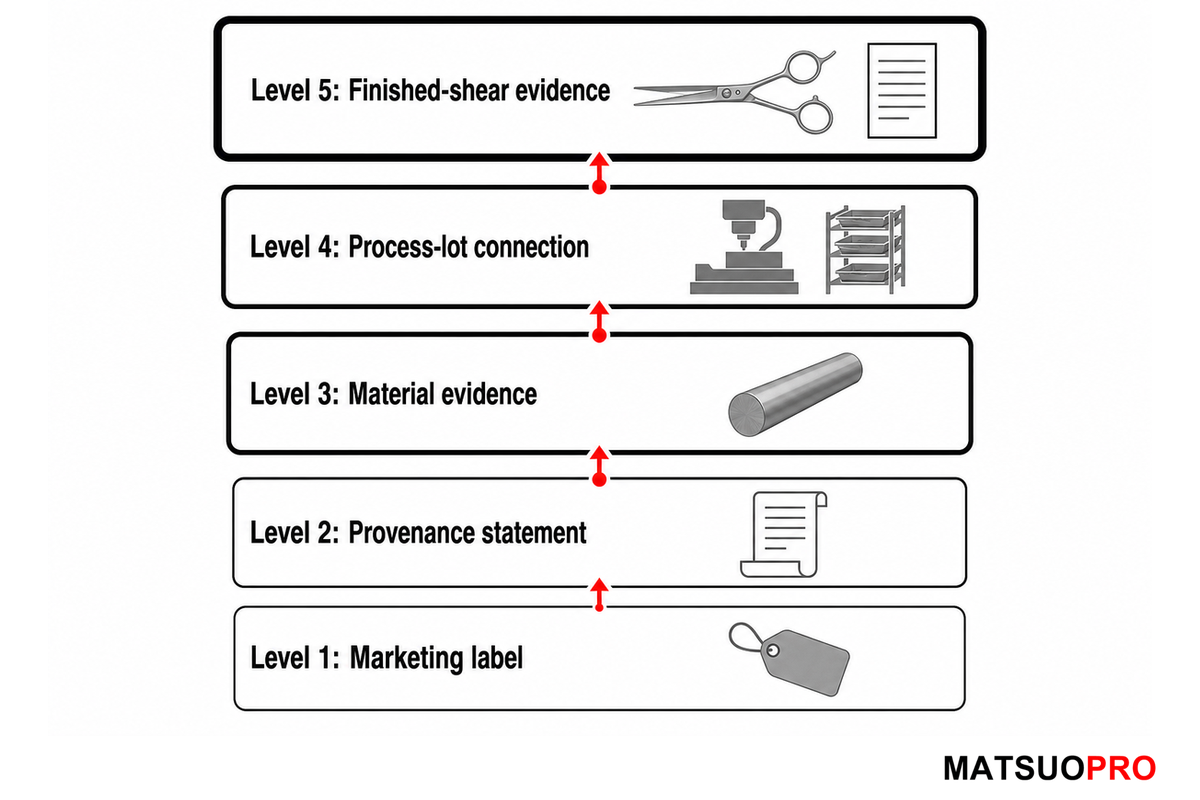
The ATS-314 Claim Verification Ladder ranks evidence by how closely it connects the material name to the product in your hand or the lot you’re buying. Climb the Ladder only as high as your documents permit. A lower rung doesn’t mean fraud; rather, it refines the conclusion.
In the case of a private-label order, package the following three types of evidence as “The Three-Point Finished-shear Evidence Pack”:
Mackay says material-composition, Rockwell hardness, and salt-spray reports can be made available on request, and that piece-level QC covers sharpness, balance, tension, and finish. Tension is also evaluated. Treat those as stated first-party capabilities and specify which documents must accompany your own order. To better establish the origin of materials, see the japanese-steel provenance test.
Stainless doesn’t mean maintenance-free. Clean away hair and compatible salon residues, dry the shear before storage, lubricate the pivot as the maker directs, and protect the edge from drops and blade-to-blade impacts. Don’t infer a universal sharpening interval from the ATS-314 name.
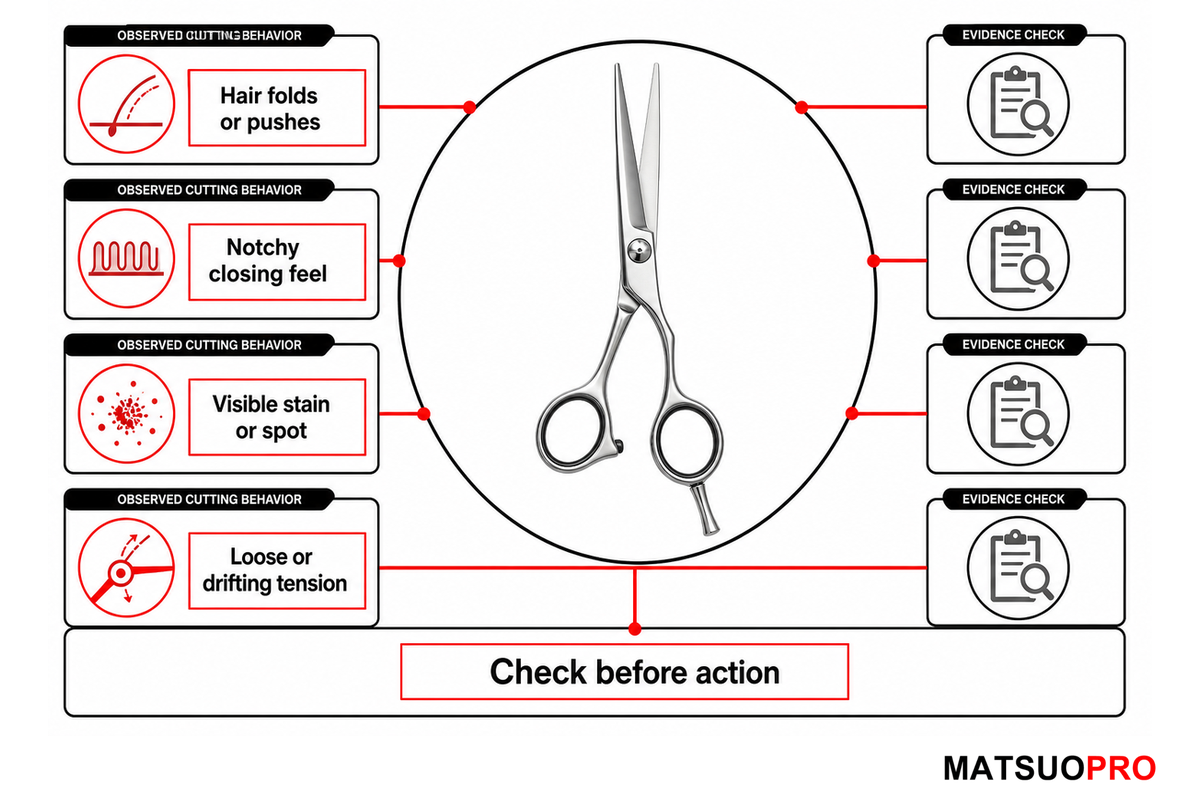
When cutting feel changes, record the cutting behavior before authorizing sharpening. A dull or damaged edge is only one possibility. Pivot movement and blade clearance, alignment, residue, and prior service can create different observations that need different corrections.
A useful service record is short: date, model, handedness, dominant technique, cutting behavior, location along the blade, drop or collision history, pivot changes, cleaning chemistry, and the last sharpener’s work. Ask the technician what was done and if the edge profile was changed. This prevents the next service visit from starting with guesswork and helps separate recurring assembly problems from ordinary edge wear.
| Cutting behavior | Possible axis | Check before action |
|---|---|---|
| Hair folds or pushes | Edge condition, clearance, alignment, or technique fit | Clean tool, inspect full blade contact, record task and location of failure |
| Notchy closing feel | Impact damage, nick, alignment, or excessive tension | Isolate after a drop; do not force the blades closed |
| Visible stain or spot | Residue, moisture, chemical exposure, or finish damage | Document exposure and follow maker-compatible cleaning guidance |
| Loose or drifting tension | Pivot setting, washer, screw, or assembly wear | Check the model’s adjustment procedure or qualified service route |
Keep all evidence that supports the use case for ATS-314 with the service request, and name the model and serial number. That record is more useful than saying only, “These are ATS-314 and feel dull.”
ATS-314 can be a credible premium material choice when the complete shear and evidence package fit the work. Its value depends on authentic provenance, verified finished hardness, convex edge geometry, edge retention under the intended task, and serviceable assembly; the grade name alone cannot establish durability. It isn’t premium just because it’s on a blade or listing.
When selecting hair cutting shears, stylists and barbers should evaluate technique, blade profile, size, handle fit, wrist posture, and grip comfort. Additional factors include pivot feel, access to a qualified sharpener, return terms, and the maker’s service route. A verified alloy doesn’t improve a handle design that strains your hand or an edge profile that isn’t suited to your dominant technique.
For an OEM or private-label buyer, define the evidence before approving a sample. Check the designation and provenance statement, material or lot documentation, finished-hardness evidence, geometry, pivot and alignment, and finish criteria. Other evidence may include packing identity and records that must travel with the production lot. Mackay’s stated in-house process and documentation capabilities are useful only when converted into your own acceptance requirements.
| Buyer | Evidence of value | Reason to pause |
|---|---|---|
| Stylist | Exact-model specification, comfortable fit trial, task-appropriate geometry, qualified service access | Premium rests on steel name while fit, return terms, and service route remain vague |
| OEM buyer | Approved sample and lot-linked identity, condition, and inspection evidence | Supplier offers a certificate image that is not tied to the material or production lot |
Pay for ATS-314 when the seller can connect the grade to the finished shear, the geometry and handle fit suit your work, and the service pathway protects the edge. If the premium is only for the badge, request an evidence pack.
Request an ATS-314 Evidence Pack for Your OEM Shear Brief
Mackay manufactures professional hair and grooming shears and describes an in-house process that includes material intake, heat treatment, precision grinding, finishing, assembly, and inspection. This guide separates those first-party process statements from independent standards and research, and it leaves unverified ATS-314 chemistry or performance claims open instead of repeating them. Reviewed for source scope, test-method boundaries, and finished-shear relevance.
MATSUOPRO is the Mackay Hair Scissors manufacturing brand for professional hairdressing shears, barber scissors, thinning shears, and pet-grooming scissors. We support salons, distributors, academies, grooming brands, and private-label buyers that need factory-direct production with practical material guidance.
Our buying guides are written to help purchasers compare steel grades, handle styles, blade geometry, surface finishes, logo options, packaging, MOQ, and sample validation before placing an OEM or wholesale order. The goal is to make each scissors specification easier to discuss with a real production team.
Factory-direct supply since 2014, with product lines covering professional cutting shears, barber shears, thinning scissors, texturizing scissors, left-handed models, and pet grooming scissors for international B2B customers.
We focus on Japanese 440C, VG10, and ATS-314 steel choices, convex and bevel edge geometry, ergonomic handle balance, tension systems, logo engraving, private-label packaging, and sample-based OEM confirmation.