Get in Touch with Mackayhairscissors Company
We use submitted details to respond to your quote request. Read our Privacy Policy.

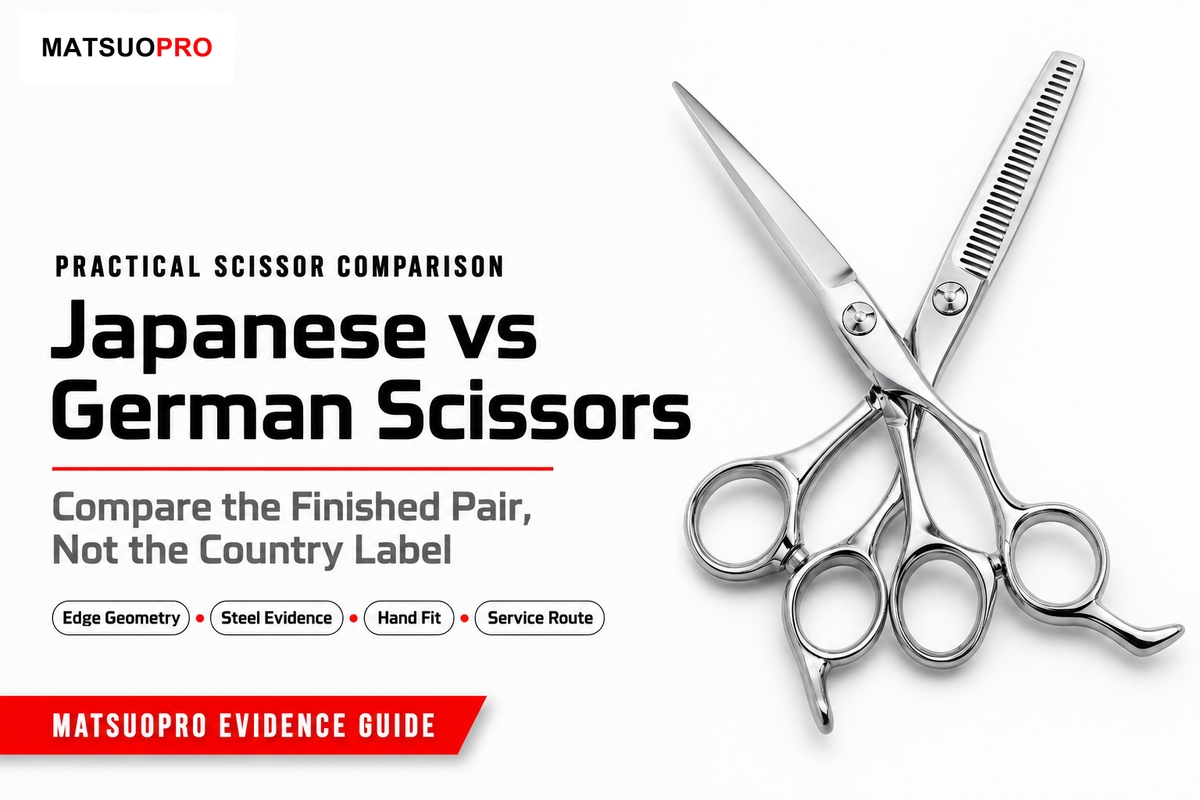
Japanese vs German scissors terminology refers to comparing finished shears, not choosing an automatic winner. The useful comparison is between two finished pairs: their exact steel, achieved hardness, edge geometry, alignment, hand fit, cutting task, and service route. “Japanese” or “German” can describe the source of steel, country of manufacture, brand history or design. None of the above can fully describe edge cutting performance.
This guide gives professional stylists and barbers, professional hairdressers, salon hairstylists, distributors, and private-label buyers a way to compare evidence rather than flags. It also explains where familiar style patterns can help, where they become stereotypes, and what to check before paying for a premium professional shear.
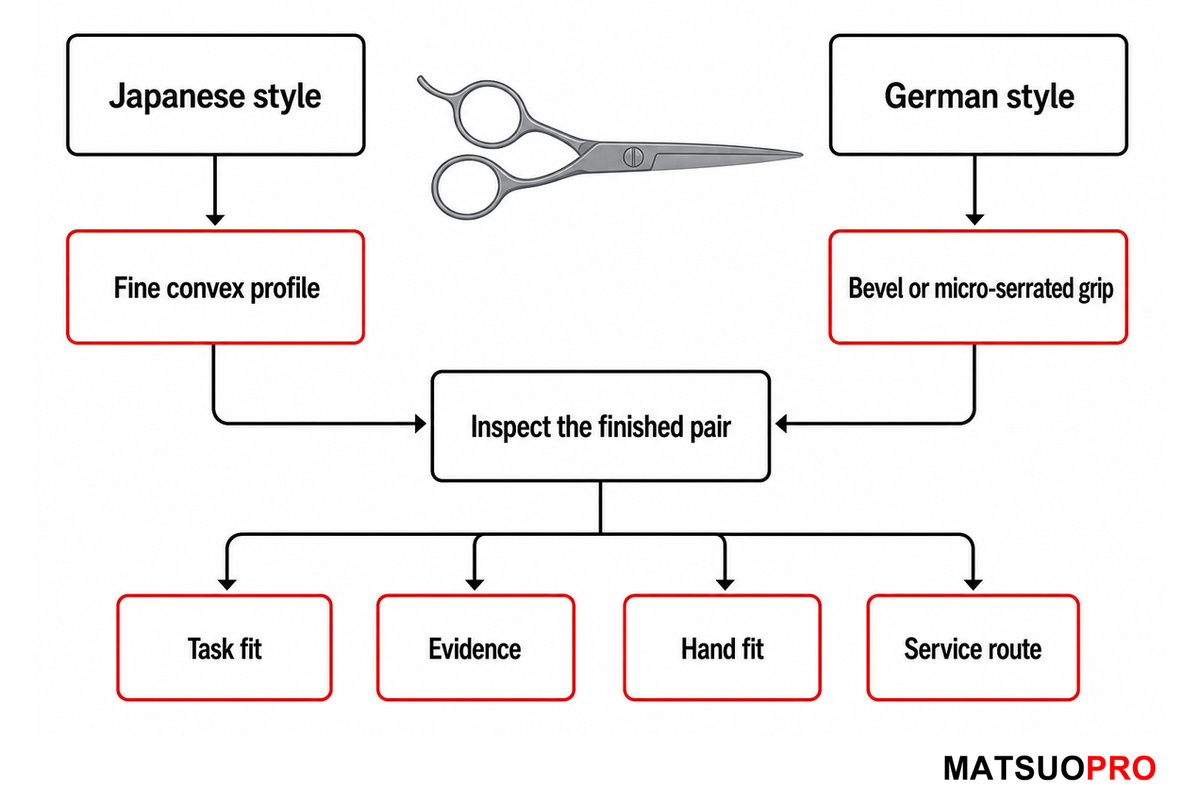
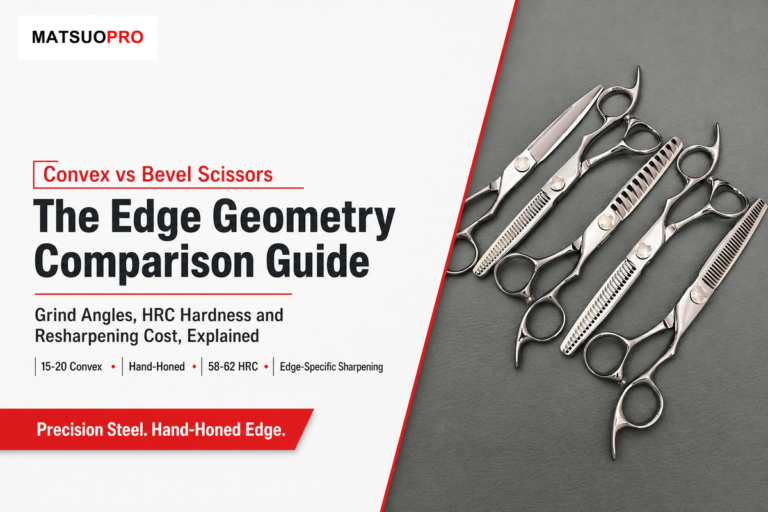
Japanese-style hairdressing scissors are typically associated with a thin convex edge. German-style scissors are often associated with a bevel or micro-serrated edge that gives a positive grip on the hair. Both descriptions, if anything, just give a general idea of the edge shape and are by no means absolute. JAGUAR, a brand associated with Solingen, describes bevel, convex, and micro-serrated options in its own technical glossary. That reference catalog evidence also shows why the national style label can’t fully describe the edge of a given model; it also doesn’t establish the factory of origin of the models listed.
Use five axes to make the decision:
A country label can prompt better questions. It shouldn’t provide the answers.
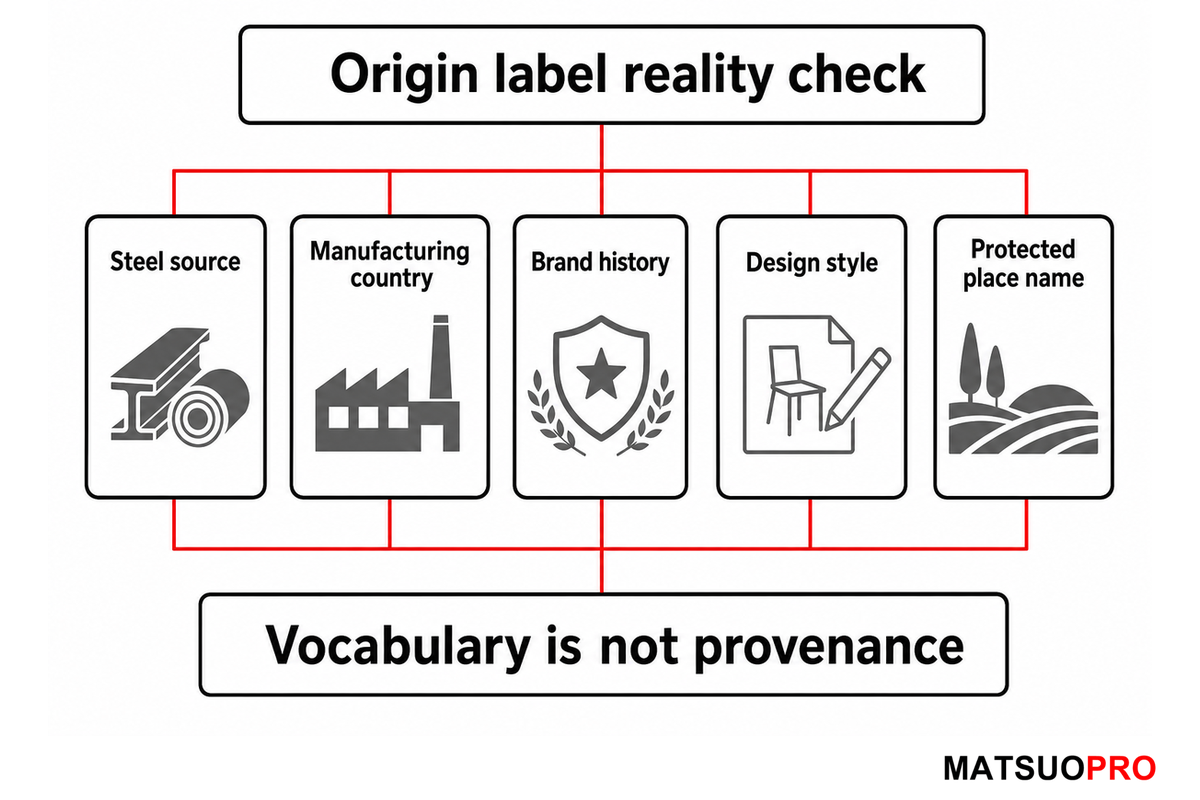
Origin Label Reality Check: separate the label into five claims before comparing Japanese vs German scissors. Under the U.S. marking framework, 19 CFR Part 134 defines country of origin around where the article was manufactured, produced, or grown, with further processing assessed under applicable origin rules. That’s different from saying where the steel was melted or where a brand began.
| Claim on a listing | What it may establish | What it does not establish |
|---|---|---|
| Japanese steel | A stated material source or grade family, if documented | That the finished scissors were made in Japan |
| Made in Japan | A finished-product origin claim under the applicable rules | That every component or all steel came from Japan |
| Japanese-style | A design description, often involving a fine convex profile | Legal origin, metallurgy, or proven superiority |
| German steel | A stated material source or grade, if traceable | That the complete shear was made in Germany |
| Solingen | A specific geographical claim with its own legal history and conditions | A universal performance grade for every pair |
Special treatment is warranted for Solingen. The current official text of Germany’s Solingen ordinance includes scissors and connects use of the name to defined manufacturing conditions. The text also contains a 2026 transition or cessation provision whose activation is not resolved in this article. The safe conclusion is narrow: a protected geographical name can carry more specific meaning than a loose “German-style” label, but it still does not prove that one model cuts better than another.
As first-party context, MATSUOPRO describes its material and manufacturing process as Japanese steel finished in China through more than 80 production steps. That is an example of split-origin wording, not independent proof of an outcome. The buyer still needs finished-pair evidence.
Vocabulary isn’t provenance. Search results mix “japan scissors,” Japanese hairdressing scissors, hair cutting scissors, hair shears, steel shears, kitchen scissors, and tools for home users. These are different products and audiences. Japan’s craftsman traditions don’t classify all scissors and shears. Brand names like Yasaka or Kasho, or phrases like “Japanese craftsmanship,” still require a model-level claim. Even the awkward retail phrase “hairdressing scissor leather” is keyword noise, not evidence about scissors made in a particular country.
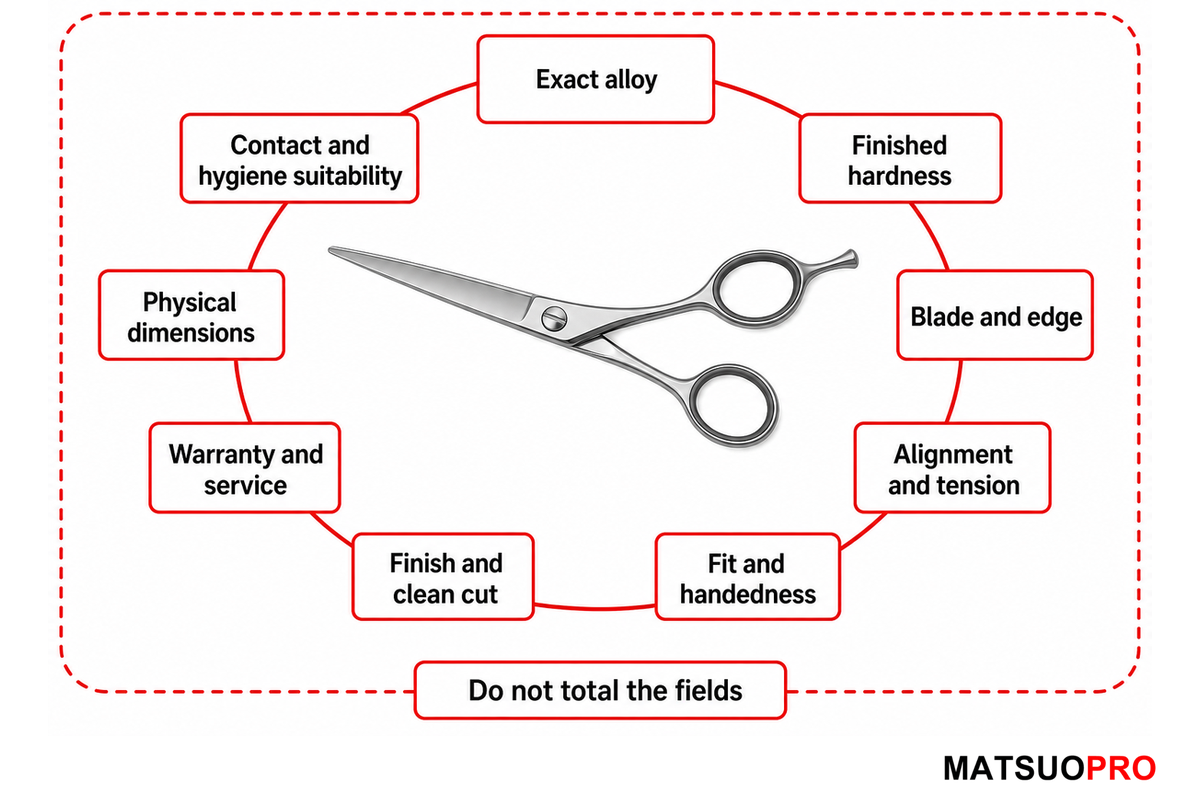
Finished-shear Evidence Scorecard: don’t add the following fields into a fake total score. Treat them as nine separate checks, as a strong outcome in one area can’t compensate for a weak outcome in another. For example, high hardness cannot rescue poor blade alignment, and an impressive origin story cannot make an uncomfortable handle fit your hand.
| Evidence category | Useful proof | Red flag | Decision effect |
|---|---|---|---|
| Exact alloy | Named grade plus source or purchase documentation | Only “premium Japanese steel” or “German steel” | Clarifies what material claim can be checked |
| Finished hardness | HRC result with scale, test context, and lot/model link | A bare number used as a quality rank | Shows resistance to indentation under the stated test |
| Blade and edge | Convex, flat bevel, micro-serrated, hollow, or other profile stated | “Razor-sharp” with no geometry | Connects the shear to a cutting method and service skill |
| Alignment and tension | Smooth travel, stable adjustment, correct tip meeting, clean closure | Binding, drifting tension, visible gap, or folded hair | Bad finished mechanics can override material claims |
| Fit and handedness | True left/right blade orientation, size, handle geometry, balance | A mirrored handle sold as a true left-handed tool | Controls comfort and the cutting view in daily use |
| Finish and clean cut | Even surface, no burrs, clean test on the intended hair/work | Snagging, pushing, scratching, or inconsistent contact | Tests the delivered pair rather than the brochure |
| Warranty and service | Named service route and geometry-capable technician | Generic grinding with no profile identification | Protects the cutting edge after normal wear or damage |
| Physical dimensions | Overall size, cutting length, weight, ring dimensions, and measured sample | One nominal size with no fit or blade-length detail | Turns hand fit and task reach into comparable fields |
| Contact and hygiene suitability | Material/finish disclosure plus compatible cleaning and disinfection instructions | No surface-care limits or contact-material information | Checks whether the delivered pair can stay suitable for professional use |
Format example, not acceptance targets: a comparison sheet could list available sizes as 5.0 in (127 mm), 5.5 in (140 mm), 6.0 in (152 mm), and 6.5 in (165 mm); cutting lengths as 55 mm, 62 mm, 68 mm, and 75 mm; and sample weights as 45 g, 50 g, 55 g, and 60 g. It could also record 18 mm and 20 mm finger-ring diameters, 1 mm and 2 mm insert walls, 3.0 mm spine thickness, 1.0 mm tip thickness, and inspection positions 10 mm, 30 mm, and 50 mm from a defined reference. Another sample log might contain 130 mm, 145 mm, and 160 mm overall lengths; 48 g, 52 g, 58 g, and 65 g weights; plus 58 mm, 66 mm, 80 mm, and 90 mm cutting lengths. These numbers illustrate a repeatable record format. The supplier and buyer must set the actual model tolerances.
For a deeper explanation of the measurement boundary, see how Rockwell hardness applies to a finished shear. The official ISO 6508-1:2023 listing describes Rockwell as a test method. It does not turn HRC into a complete verdict on edge retention, toughness, corrosion, comfort, or craftsmanship.
Finished-pair suitability can include less obvious checks too. A study published in 2025, based on occupational tools sampled in Germany in 2024, reported nickel release from 2 of 32 tested scissors within a 141-tool sample. The study shows that skin-contact suitability may apply. It, however, doesn’t set a rate for German scissors, because the tools’ place of use may not be their place of manufacture.
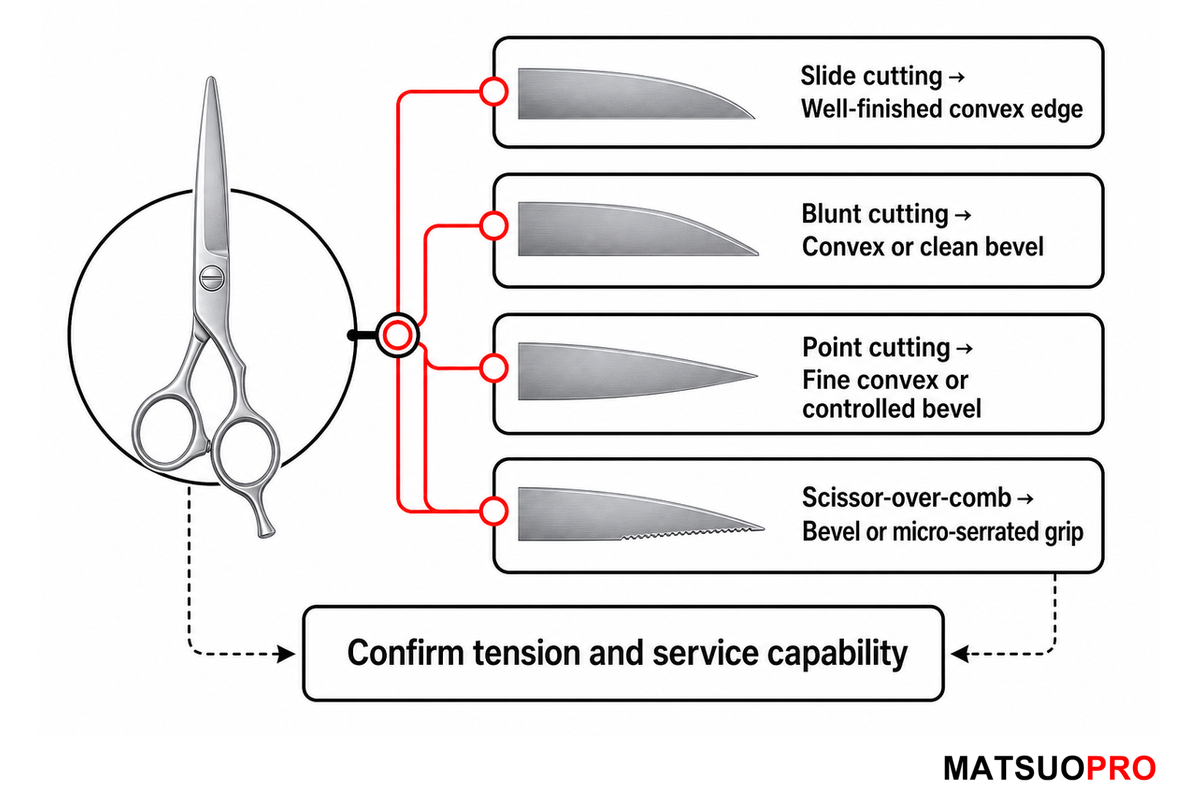
Task-to-Edge Selection Table: This should be used as manufacturer-specification guidance and not as an independent head-to-head trial. Joewell’s blade guide shows convex and flat single-bevel designs as a trade-off. The table translates that type of model information into questions for a stylist or barber.
| Cutting task | Useful starting geometry | Why it may fit | Limitation and service caution |
|---|---|---|---|
| Slide cutting | Well-finished convex edge | A fine, smooth profile can let hair travel along the blade with less interruption | Requires correct tension and a sharpener who can preserve the convex surface and inside work |
| Blunt cutting | Convex or clean bevel, depending on feel | Both can produce a clean line when the pair is aligned and suited to the section | Do not choose by flag; compare the actual bite, blade shape, and closure |
| Point cutting | Fine convex or controlled bevel | Tip profile, balance, and visibility can matter as much as the edge family | A highly acute edge is not automatically the safest or most controllable option |
| Scissor-over-comb | Bevel or micro-serrated for grip; polished edge for a different feel | Micro-serration can help hold moving hair, while polished edges may feel freer | Micro-serration needs a service route that restores the teeth rather than grinding them away |
Different factors can change how well a tool performs. Hair type, wet or dry work, blade length, tension, technique, and personal preference all change the result. A 5.5-inch cutting shear can feel precise in detail work yet be inefficient for another user or task. “Best Japanese shears” and “best German scissors” lists often hide those conditions behind a single national label.
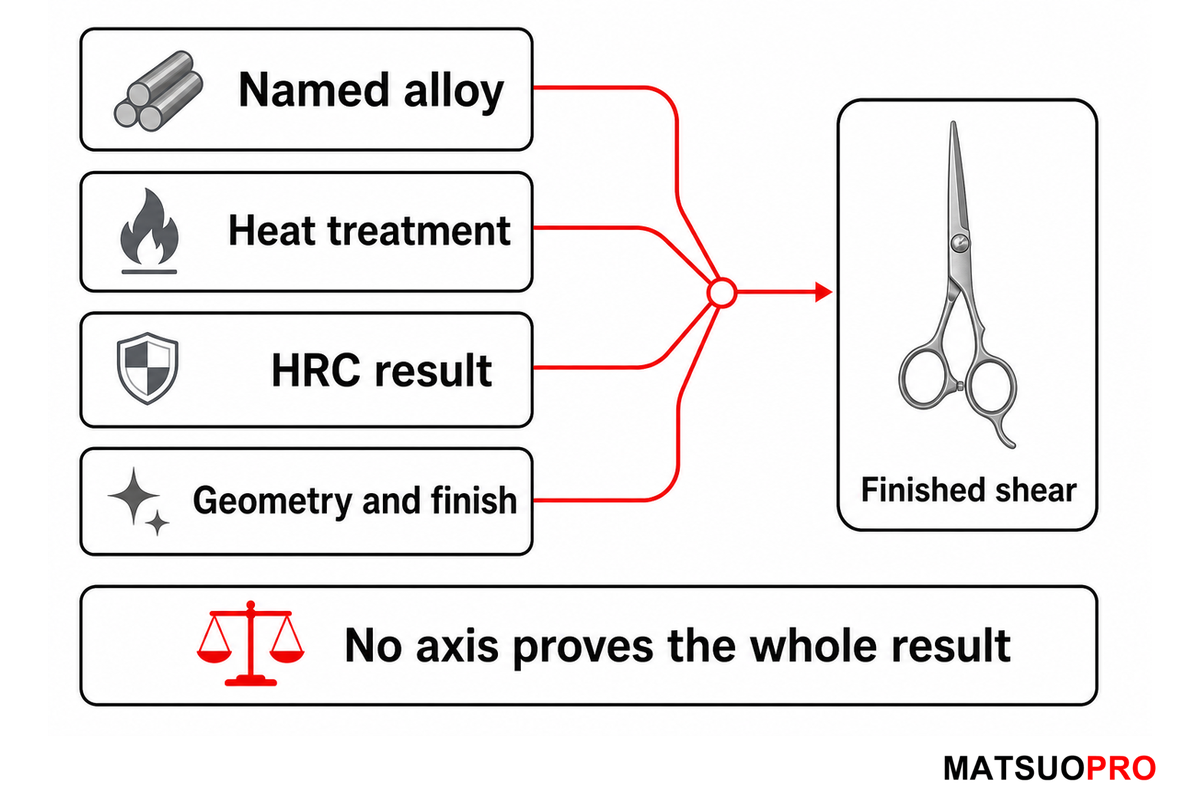
Exact alloy identities can be more useful than the terms “German steel” and “Japanese steel.” Even an identified alloy is only one factor. Nominal chemistry, heat treatment, achieved hardness, toughness, corrosion behavior, blade thickness, edge finish, and final alignment all contribute to the finished tool. Stainless grades such as 440C, cobalt-bearing alloys, and other quality steel options can be processed into noticeably different scissors.
| Axis | What it can affect | Useful proof | What it cannot prove alone |
|---|---|---|---|
| Named alloy | Available chemistry and heat-treatment window | Grade, supplier, heat or lot record where available | Final sharpness, alignment, or edge life |
| Heat treatment | Achieved hardness, microstructure, and consistency | Process control plus finished-blade test | Comfort, geometry, or workmanship |
| HRC result | Resistance to indentation at the tested location | Scale, method, surface, location, and lot context | Whole-blade toughness or universal service interval |
| Geometry and finish | Cut feel, hair grip, friction, and service method | Exact edge/profile specification and sample check | Material provenance |
ASTM E18-25 and ISO 6508 describe how Rockwell measurements are made and controlled. They do not declare one HRC range “Japanese,” another “German,” or the hardest blade the highest quality. MATSUOPRO publishes 60 to 62 HRC for certain lines and up to 64 HRC for a cobalt line. Treat those as attributed product claims to verify for the exact model, not as universal professional-scissor thresholds.
This is why saying “Japanese steels provide effortless cutting” is inaccurate. A steel label cannot reveal whether the blades meet correctly, whether tension remains stable, whether the cutting edge suits the technique, or whether the pair survived poor sharpening.
Discussion about alloys can include carbon steel, stainless steel, cobalt, and vanadium. Other elements such as handle ergonomics, blade thickness, and a documented heat-treat cycle can be addressed independently. For example, the “ergonomic” handle, thin blade and documented heat-treat cycle don’t need to be consolidated into a single material argument. Scissors should never be ranked by collapsing these independent axes.
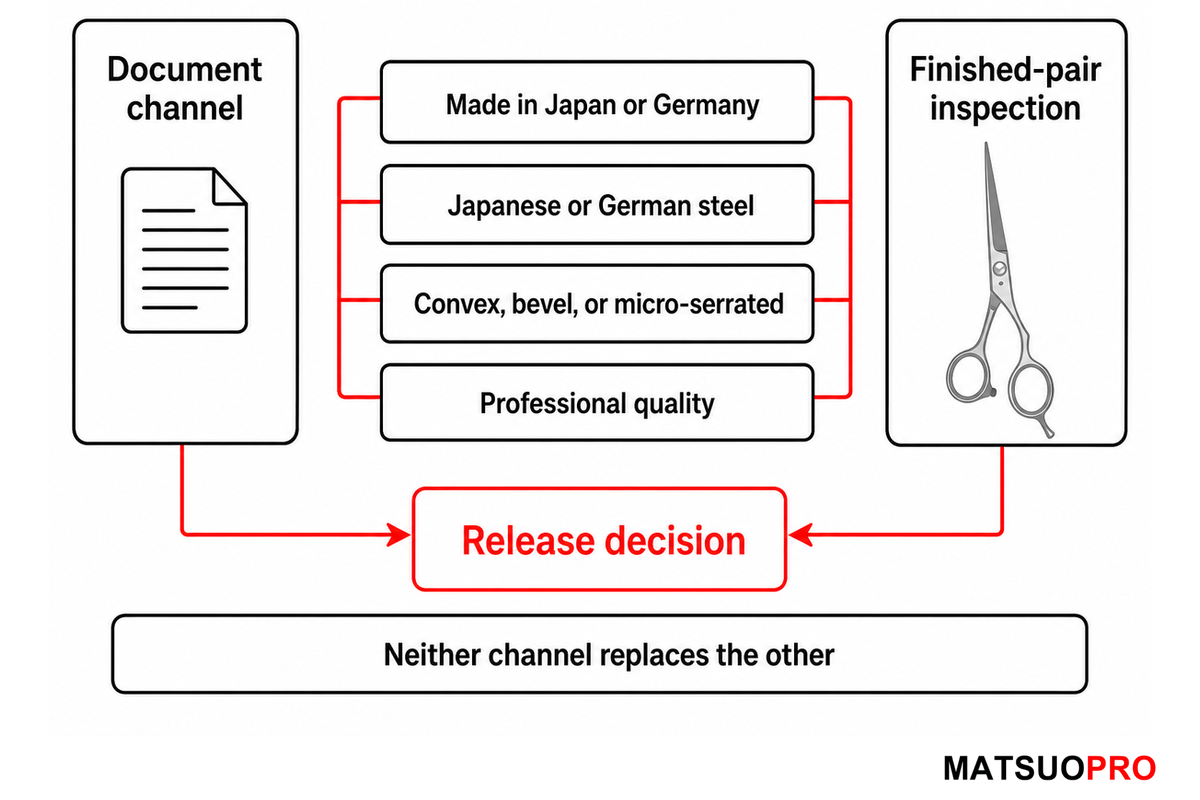
Country-Claim Evidence Card: Run two evidence channels in parallel. Documents support a claim about origin or material. A physical inspection supports a claim about the delivered pair. Neither channel replaces the other.
| Listing claim | Proof to request | Finished-pair check | What remains unproven |
|---|---|---|---|
| Made in Japan or Germany | Supplier origin statement and applicable manufacturing records | Alignment, travel, tip meeting, clean cut, comfort | Steel-mill origin and comparative superiority |
| Japanese or German steel | Exact grade, purchase record, and lot link where contractually required | Hardness context, finish, edge profile, corrosion condition | Finished-product country of origin |
| Convex, bevel, or micro-serrated | Model drawing, specification, or clear blade description | Inspect the actual profile and cutting behavior | That the geometry suits every user or hair type |
| Professional quality | Replace the phrase with measurable acceptance points | Sample inspection under intended work | A universal grade or guaranteed lifespan |
Before paying, open and close the shear slowly, check that travel is smooth, confirm that the tips meet as designed, observe whether tension changes, inspect the surface, and test a clean cut on the intended material. Do not rely on a universal “blade-drop” stopping point; follow the model’s guidance and judge the actual cutting action. Measurement guidance such as the NIST Rockwell guide is valuable precisely because it explains why context and procedure matter.
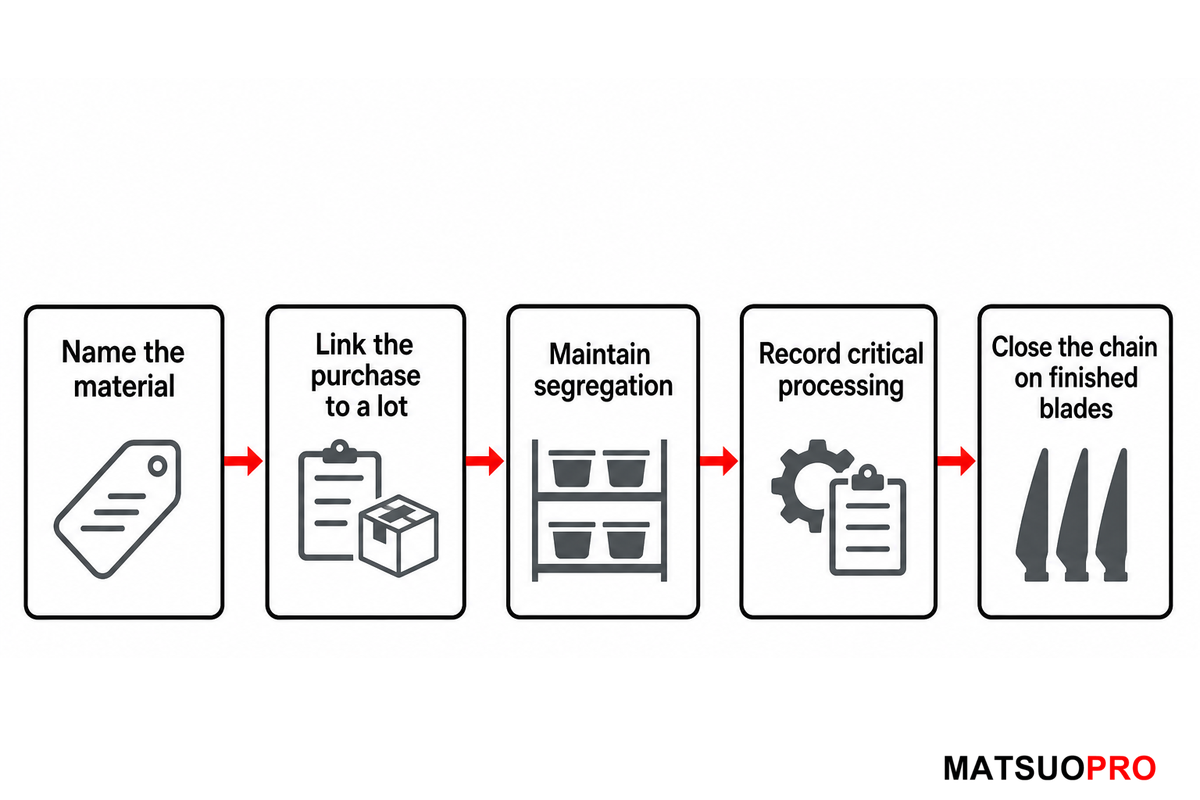
Five-Link Split-Origin Claim Chain: A material claim is more useful if it remains connected to the finished lot produced. Exact paperwork varies by supplier, market, material and contract. Therefore, don’t demand one certificate name universally.
Then state your case truthfully. It’s clearer to say “Made in [actual manufacturing country] using identified Japanese steel” than to word it in a way that would lead the consumer to believe the finished pair was made in Japan. U.S. Commerce guidance on substantial transformation and rules of origin explains why it’s necessary to treat products made in multiple countries on a case-by-case basis rather than using a catchphrase.
MATSUOPRO says it uses Japanese steel and performs China-based CNC machining, vacuum and cryogenic heat treatment, precision grinding, and hand honing. That process statement can be the basis for a document request. It does not replace batch evidence or finished-scissor inspection. A distributor should specify the claim wording, required records, sample protocol, batch acceptance, and what happens if the delivered lot differs.
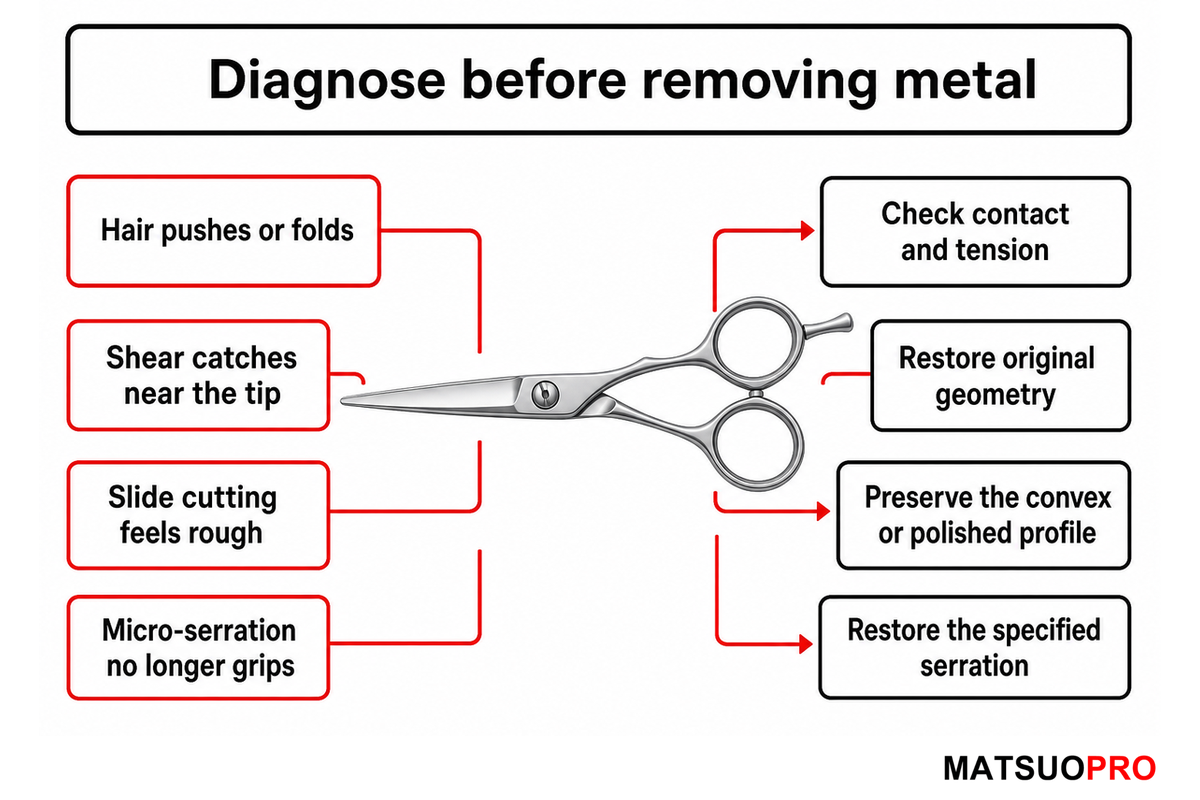
Geometry-First Service Brief: tell the technician what the edge is, what happened to it, and what the result must be in order to restore it. “Japanese scissors” isn’t a sharpening specification. A convex face, a flat bevel, a hollow inner surface, and micro-serration involve different equipment, skill, and inspection.
| Symptom | Possible axis | Document before service | Question for the technician |
|---|---|---|---|
| Hair pushes or folds | Dull edge, alignment, tension, or residue | Where it occurs, hair condition, current tension | Will you diagnose contact and tension before removing metal? |
| Shear catches near the tip | Tip damage, set, alignment, or uneven prior grind | Visible damage and prior service history | How will you restore the original geometry and tip meeting? |
| Slide cutting feels rough | Edge finish, burr, tension, contamination | Exact model, profile, and when the feel changed | Can your process preserve this convex or polished profile? |
| Micro-serration no longer grips | Worn or ground-away teeth | Tooth condition and any previous sharpening | Can you restore the specified serration rather than convert it? |
JAGUAR advises removing hair and residue, drying thoroughly, adding pivot oil as directed, and seeking professional maintenance when cleaning, oiling, and correct tension do not restore a clean cut. Its care guidance supports a condition-based trigger rather than a universal three- or six-month calendar. TONDEO also states that a factory service restores the original grind and angle appropriate to the model.
Cleaning and disinfection are separate from sharpening. Use the product compatible with the equipment and abide by the local directives and manufacturer instructions. For one jurisdictional example, California’s barbering and cosmetology regulations prescribe removal of visible debris, cleaning, approved disinfection, and protected storage. That rule is not global, but it shows why a sharp pair can still be unfit for the next client.
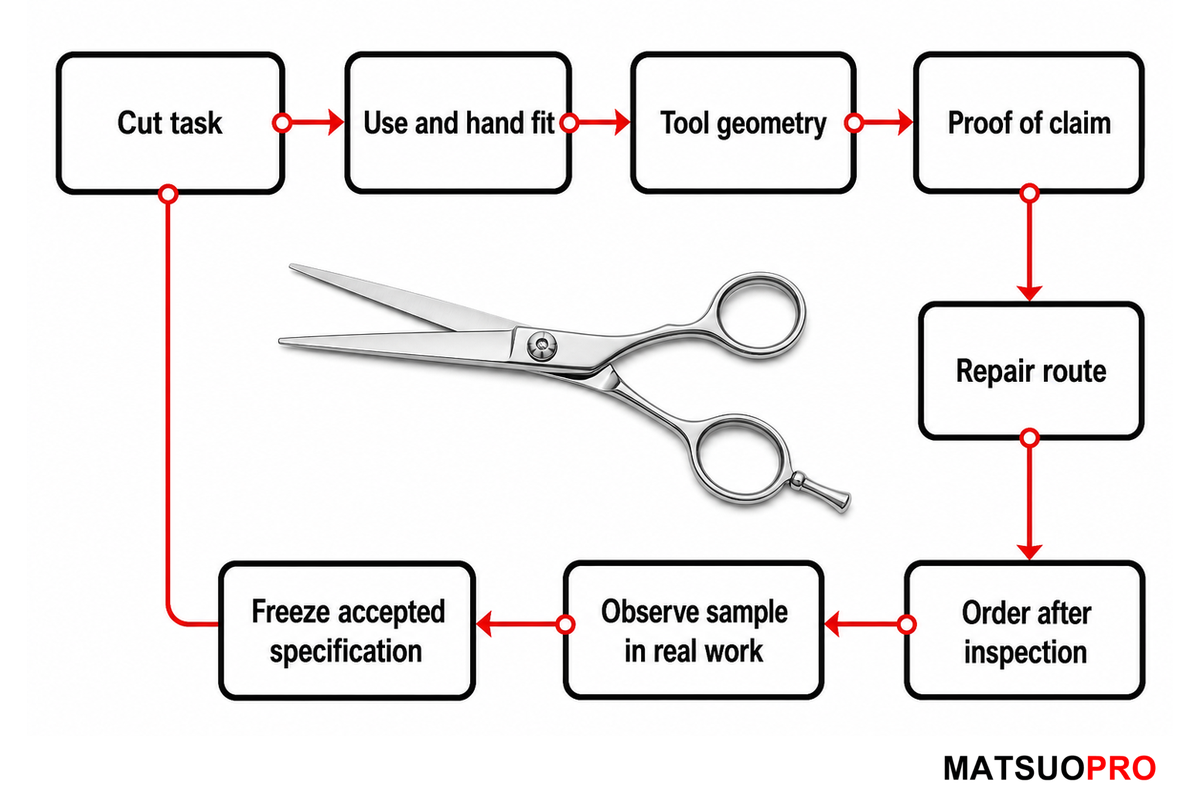
Use the CUT-PROOF sequence: cut task, use and hand fit, tool geometry, proof of claim, repair route, order only after inspection, observe sample in real work, and freeze accepted specification for repeat orders.
| Buyer | Prioritize | Do not accept as a substitute | Release decision |
|---|---|---|---|
| Stylist | Technique fit, comfort, clean cutting, dependable service | Country prestige without model details | Trial the exact pair in representative work |
| Barber | Control, blade length, grip or glide, tension stability | A “German” or “Japanese” shortcut | Confirm edge and service capability |
| Distributor | Claim wording, documents, sample inspection, after-sales route | One certificate presented as total quality proof | Approve against a written evidence card |
| OEM/private label | Lot traceability, process controls, batch acceptance, repeatability | Unbound test results or generic quality language | Freeze the accepted sample and specification |
Following style practice may be a good place to start. A stylist who relies on slide cutting may begin with a convex model. A barber who wants a positive bite during scissor-over-comb may start with a bevel or micro-serrated model. In both cases, confirm the actual geometry, mechanics, fit, and sharpening route. Official origin rules and test standards set boundaries of evidence; they don’t select the winner.
None of the claims about “top-of-the-line,” “superior quality,” “unmatched,” “unparalleled,” or an “affordable price” proves performance. The evidence card must translate claims about professionalism, artistry, or commitment to quality into product specifications, sample requirements, or service obligations.
When comparing a professional model or preparing an OEM evidence brief, discuss your requirements with MATSUOPRO for the intended task, edge, size, wording of the claim, documentation requirements, sample check and service requirements. This should help define the specification without guaranteeing a result has been demonstrated.
Not always. A country label may be given to a material, origin of manufacture, history of a brand or a design tradition, and these are different claims. Compare the exact finished pair for alloy identity, hardness with test context, edge geometry, alignment, tension, hand fit, serviceability, and behavior in your own work. Quality craftsmanship and precision exist in both countries, and poor finished mechanisms can detract from an expensive origin story.
Japanese-style hair scissors are often associated with a fine convex edge and smooth slicing, while German-style hairdressing shears are often associated with a bevel or micro-serrated edge that gives a more positive bite. These are design patterns, not legal origin assurances. Today’s manufacturers offer various geometries, so identify the actual blade, cutting edge, tension system, handle and the technique or purpose for which it’s designed, in the actual model.
No, “Japanese steel” and “German steel” refer to different alloys, conditions, and hardness. Hardness is an achieved test result on a particular specimen or finished blade, and the result depends on heat treatment, thickness, surface preparation, test location, and process control. Ask for the exact alloy and HRC context, then consider toughness, corrosion care, geometry, edge retention evidence, and whether a qualified technician can sharpen that design.
A well-finished convex edge is usually a logical first option because its fine profile can support a smooth glide. The outcome can still depend on other factors like blade shape, tension, sharpness, state of the hair, user skill, and upkeep. A pair with a Japanese label can still have a flat edge. A convex edge on a shear can still be misaligned.
Yes. There are different places where different processes occur. A defensible supplier should name the grade or source, preserve batch traceability, disclose where major processing and final manufacture occurred, and avoid wording that implies the scissors were made in Japan. It’s still the responsibility of the consumer to verify the finished tool. Just because the steel is of good quality doesn’t mean the finished scissors have proper sharpening, alignment, durability, or a clean cut.
There are several different edge profile geometries, including micro-serrated, hollow-ground, convex, and flat-bevel edges. The edge type determines the service type, restoration methods, and any adjustments required. There are also issues related to previous damage and/or an incorrect service that must be addressed. Give the technician the exact model and edge profile, ask how the original shape will be preserved, and require a finished alignment, tension, and cutting check.
MATSUOPRO is the Mackay Hair Scissors manufacturing brand for professional hairdressing shears, barber scissors, thinning shears, and pet-grooming scissors. We support salons, distributors, academies, grooming brands, and private-label buyers that need factory-direct production with practical material guidance.
Our buying guides are written to help purchasers compare steel grades, handle styles, blade geometry, surface finishes, logo options, packaging, MOQ, and sample validation before placing an OEM or wholesale order. The goal is to make each scissors specification easier to discuss with a real production team.
Factory-direct supply since 2014, with product lines covering professional cutting shears, barber shears, thinning scissors, texturizing scissors, left-handed models, and pet grooming scissors for international B2B customers.
We focus on Japanese 440C, VG10, and ATS-314 steel choices, convex and bevel edge geometry, ergonomic handle balance, tension systems, logo engraving, private-label packaging, and sample-based OEM confirmation.