Get in Touch with Mackayhairscissors Company
We use submitted details to respond to your quote request. Read our Privacy Policy.

Four common handle labels. Three work positions to compare. Two separate choices: fixed geometry and thumb movement.
A pair can look right in a product photograph and feel awkward as soon as you follow a comb. Compare the fixed shape first, then decide whether an independently moving thumb would help your normal cutting technique.
Hairdressing scissors handle types commonly include straight, offset, crane and swivel. Straight, offset and crane describe geometry; swivel adds a rotating thumb ring. Choose by ring fit and control in your usual cutting positions.
Updated October 2026
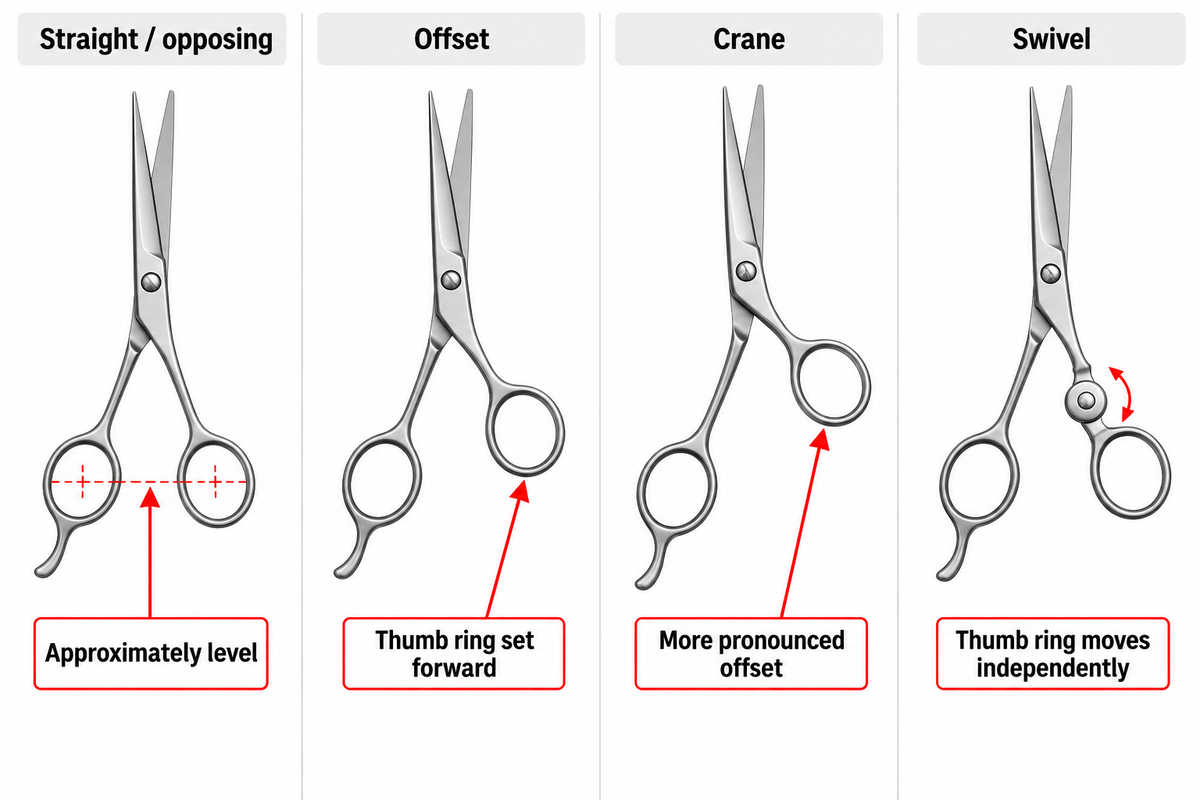
Straight handles place the rings approximately opposite one another. Offset handles move the thumb ring forward; crane designs carry that offset or angle further. Swivel shears add a moving thumb ring. The actual ring position and joint tell you more than a model name.
A classic handle is also referred to as being level, even or opposite. Ichiro’s handle descriptions distinguish these layouts from an independently rotating thumb. An actual combined design is Sam Villa’s Signature Series Swivel Shear with an ergonomic crane handle and swivel thumb.
| Comparison point | Straight / opposing | Offset | Crane | Swivel |
|---|---|---|---|---|
| Ring alignment | Approximately level | Thumb ring set forward | More pronounced offset/angled layout | Underlying geometry can be offset or crane |
| Thumb ring attachment | Fixed | Fixed | Fixed | Articulated |
| Main design change | Symmetric ring placement | Shorter thumb reach relative to opposing geometry | Different relationship between hand and blade line | Thumb ring moves independently |
| What stays predictable | Fixed thumb position | Fixed thumb position | Fixed thumb position | Blade pivot remains separate from thumb joint |
| First comparison | Familiar grip against alternatives | Thumb opening and closing reach | Blade line at normal working height | Steering while thumb ring changes angle |
| Horizontal line work | Observe wrist and blade alignment | Observe wrist and blade alignment | Check how the changed angle meets the section | Check fixed-blade control during movement |
| Scissor-over-comb | Compare access along the comb | Compare access along the comb | Compare elbow position without forcing it down | Check ring clearance and control |
| Detail and point work | Compare access to the section | Compare access to the section | Compare fingertip approach angle | Compare thumb movement with blade-tip control |
| Care difference | Follow pivot and blade instructions | Follow pivot and blade instructions | Follow pivot and blade instructions | Additional joint; follow model-specific care |
| Buying decision | Keep it if it fits the task well | Useful fixed-handle starting comparison | Try when a deeper offset matches your working position | Choose when added movement remains controlled |
Use the chart to focus on a key structure rather than a basic-to-advanced ranking. Our professional hair cutting shears include different types of hair scissors for cutting and texturizing. Cutting shears, thinning scissors and texturizing scissors describe the blade’s job. Each still requires a handle that fits the user.
A useful shortlist: compare a fixed handle that’s familiar to you with one alternative in the same nominal size, such as 5.5 inches. Check the actual length and balance. A rotating thumb and a deeper offset solve different movement questions, so buying both features together should be a deliberate choice.
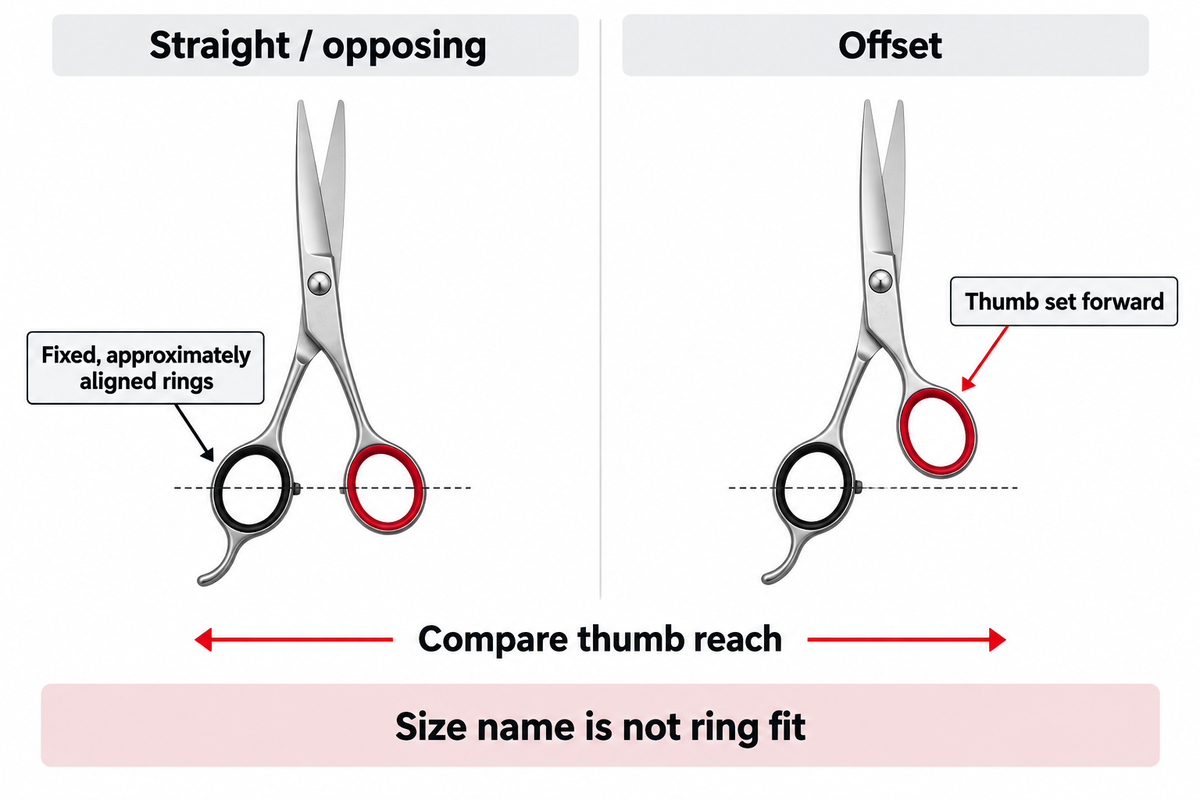
An offset hair scissor has a shorter thumb handle relative to the finger side, so the thumb ring sits forward of the opposing layout. A practical comparison is the reach needed to open and close the blades. A fixed thumb remains predictable in either shape; the relationship between the rings changes.
For a hairdresser accustomed to a straight pair, the familiar blade line may matter during blunt cuts. An offset design may be worth a try when the grip requires the thumb to stretch to open/close the blade. Compare the two when using the finger-supported steady blade. Don’t use a tighter whole-hand grip to provide a more secure feeling when the ring is too large.
Fixed, approximately aligned rings. Compare the familiar grip and cutting line against the reach your thumb needs.
Fixed rings with the thumb set forward. Compare the opening movement without changing your usual grip to force a fit.
Care needs to be taken when dealing with size. For Sam Villa’s swivel model, separate measurements are given for nominal size, overall length, and pivot to blade tip. Even when dealing with a fixed handle, a size name isn’t a ring-fit measurement.
| Published field | 5.5-inch model | 6-inch model |
|---|---|---|
| Overall length | 6.20 inches | 6.81 inches |
| Pivot to blade tip | 2.32 inches | 2.91 inches |
| Weight | 2.2 oz | 2.4 oz |
| Handle specification | Crane with swivel thumb | Crane with swivel thumb |
Source: Sam Villa Signature Series Swivel Shear, Technical Specs. These measurements describe samples from that series and may not represent a universal sizing convention.
For a fair comparison, keep size, blade condition and tension as close as practical. The 5.5 inch and 6 inch examples differ in measured reach and weight. A preference attributed to the handle may be due to a longer blade or different balance point.
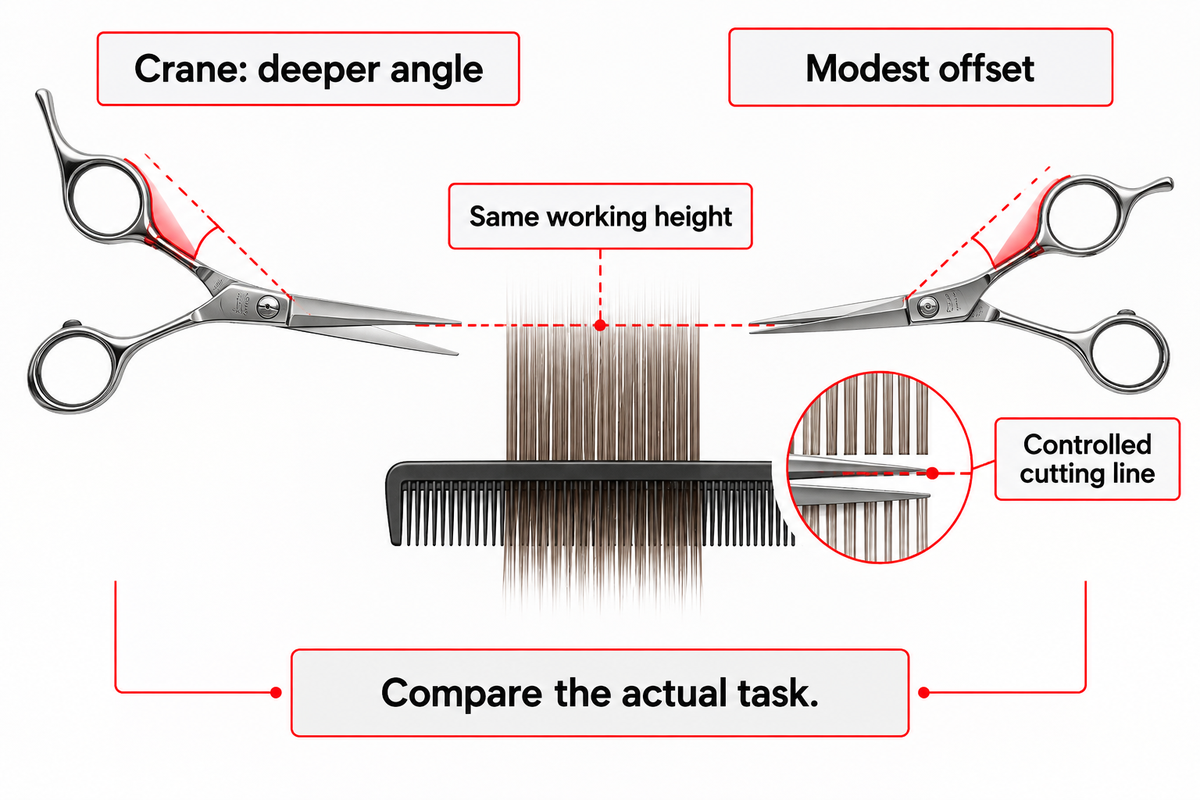
A crane handle changes the angle and position of the rings more than a small offset. Experiment with it if you feel awkward in your regular work position with the hand to blade relationship. The result is bringing a controlled cutting line into play, as opposed to trying to get the lowest elbow position possible.
During the scissor-over-comb, be mindful of the blade and the access around the head. During graduation or layering be mindful of the angle of the handle. This may allow you to meet the section to be finished cleanly. Keep the client or mannequin at an appropriate working height; a handle isn’t going to help you with all of the positioning problems.
The Canadian Centre for Occupational Health and Safety’s tool-design guidance mentions straight and angled handles in relation to the direction of the work. Its warning against indiscriminate use of bent handles is a useful reason to compare the actual task. Ergonomic scissors still need to fit the working task. Crane is a shape to try, not a comfort level above offset.
If the deeper angle makes your normal line harder to control, a moderate offset may stay the better tool. Precision cutting benefits from a predictable blade, and some users prefer a fixed thumb even for advanced cutting techniques.
Keep the comparison specific: A 6-inch crane and a 6-inch offset aren’t mechanically identical tools. Record their measured length, weight and ring fit. Prefer the version that gives you control without having to take an extra twist or grip it tighter.
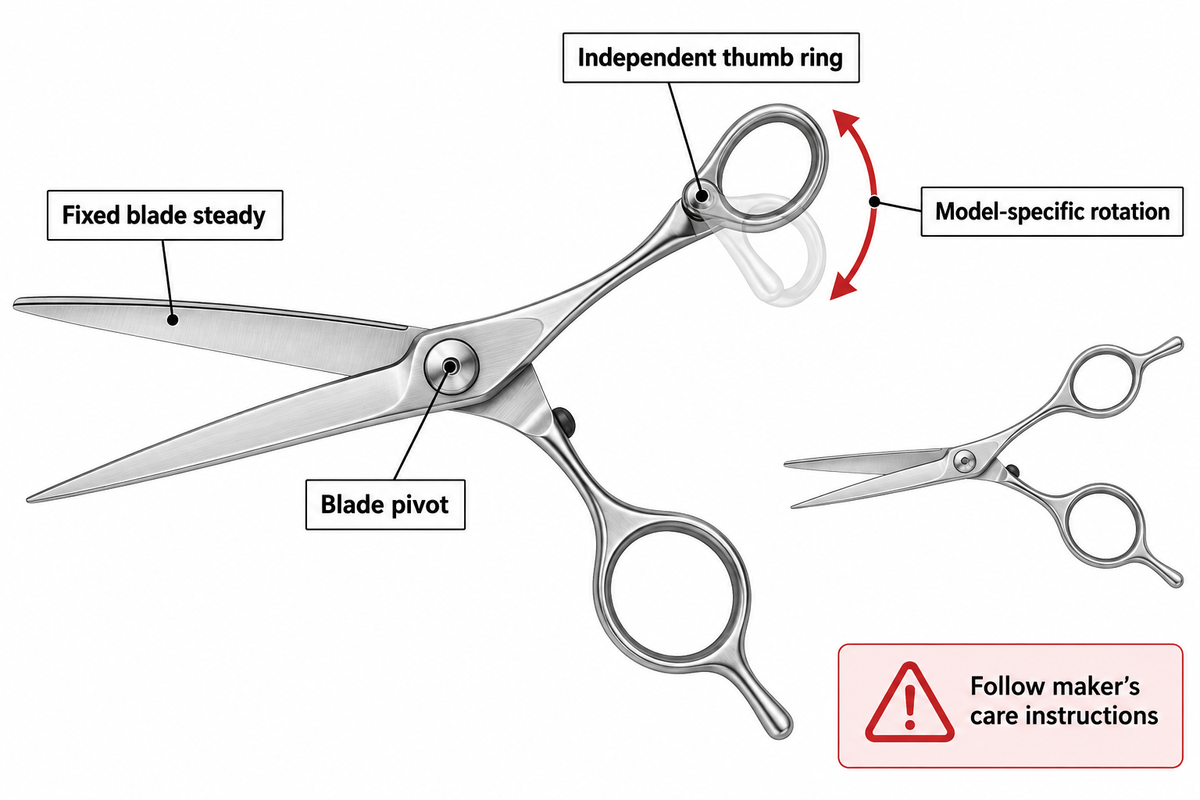
A swivel handle has a thumb ring that’s free to rotate independently from the main handle. That extra movement can help the thumb follow a change of angle during point cutting, slide cutting or detailed dry work. Because this changes the tool’s feel, it’s important to match the free movement with a dependable control of the blade tip.
Single and double swivel describe different joint arrangements. Rotation range, resistance and care instructions belong to the particular model. Sam Villa mentions 360-degree rotation for its cited swivel shear; the figure should remain with that product. A moving ring on another pair may have a different range, or an adjustment system.
Start with a controlled practice task before using an unfamiliar cutting tool in a service. Keep the fixed blade steady as you move the thumb through the angles you actually use. Added movement is beneficial only as the blade follows your intended line. There is no reason to pursue the largest rotation number if a smaller movement does the job.
The extra joint also adds a care point. You need the maker’s instructions to adjust and lubricate; don’t turn an unfamiliar joint as if it was the blade-tension screw. A well-maintained fixed pair can be a more practical choice for someone who values the same thumb position throughout a haircut.
Choose a swivel for working movement: Compare it with a fixed 5.5- or 6-inch pair for the same detail task. Note the changes at the thumb and blade tip, separately. Initially, unfamiliarity deserves practice. However, persistent loss of control over a tool warrants a different sample or fit adjustment.
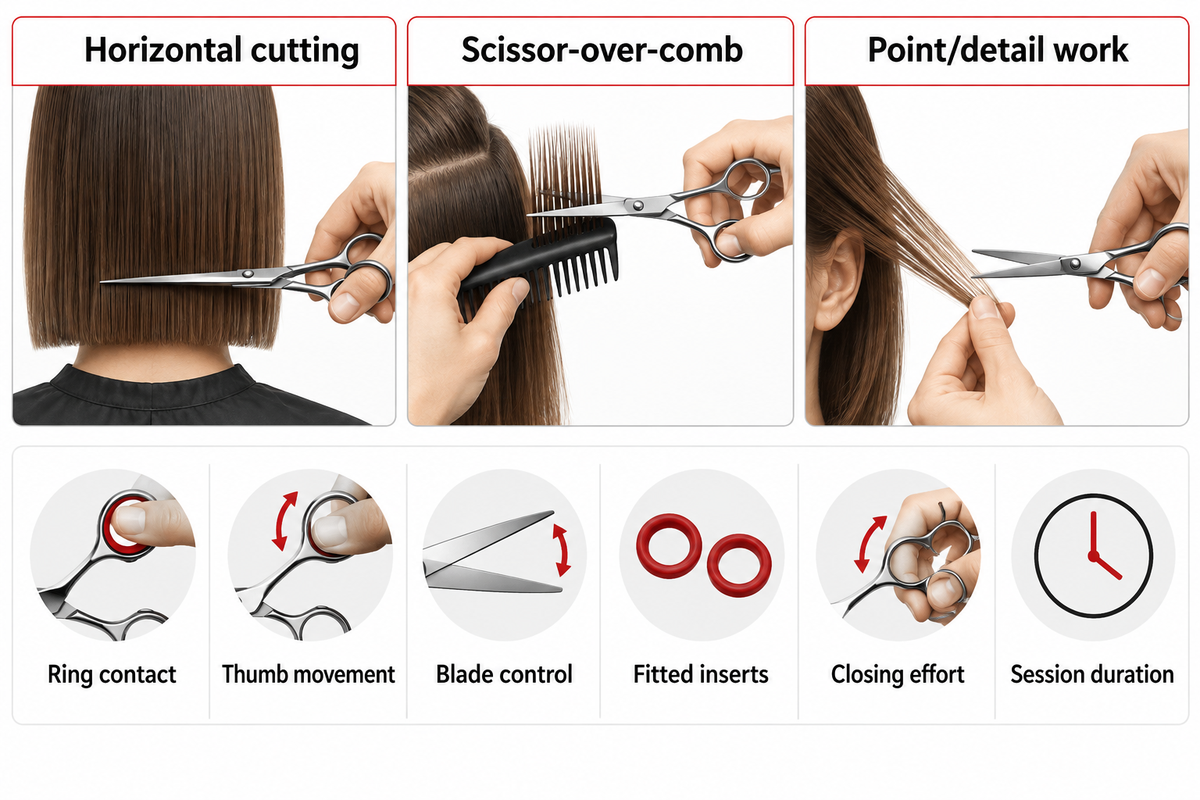
The 3-Position Handle Trial assesses ring fit, thumb movement, and blade control during horizontal cutting, scissor-over-comb, and point or detail work. Each sample follows the same sequence, so you can distinguish ring contact, opening movement, and control of the cutting line.
Use the same task sequence for each sample and keep the work height about the same. Record the nominal size and measured length, fitted inserts, blade condition and tension setting. Note the duration of the session, how often the tool is used, and the effort needed to close it. A quick opening and closing check is helpful, but this is just a starting point.
The NIOSH and Cal/OSHA hand tool selection guide begins with the user and the job. NIOSH identifies the factors of intensity, frequency and duration of the work task. The record below applies that task-first thinking to comparing shears; it does not turn a short fitting into a prediction of a full working day.
Place the ring finger in the finger ring, let the little finger rest on the tang, and let the index and middle fingers guide the shank. Keep the thumb tip lightly in the thumb ring to operate the moving blade. The other fingers hold the tool rather than squeeze the handles through the cut.
Educator Jesse Linares of the Sam Villa ArTeam discusses this in American Salon’s shear-fitting lesson. He says that the shear should be kept towards the fingertips and the finger ring shouldn’t be allowed to go past the second knuckle of the ring finger. Spacers can be used to achieve the desired spacing.
“The thumb’s job is to merely move the blade up and down, not to hold or push it.”
| Working position | Check | What to observe | Decision |
|---|---|---|---|
| Horizontal cutting | Ring contact | Notice where the thumb or finger ring presses. | Change ring fit before blaming the entire handle family. |
| Horizontal cutting | Thumb movement | Open and close while keeping the finger-supported blade steady. | Compare reach at the same opening; avoid a whole-hand squeeze. |
| Horizontal cutting | Blade line | Follow a clean line without lifting the wrist to compensate. | Keep the model that meets the section with controlled alignment. |
| Scissor-over-comb | Ring contact | Check whether the thumb catches as the tool follows the comb. | Compare ring shape and thumb clearance. |
| Scissor-over-comb | Thumb movement | Move through the same section with each sample. | Separate unfamiliar swivel movement from poor blade control. |
| Scissor-over-comb | Working position | Observe hand, elbow and access beside the head. | Adjust the working height before changing tools. |
| Point/detail work | Ring contact | Notice pressure as the blade approaches the section. | Compare inserts and thumb-ring position. |
| Point/detail work | Thumb movement | Keep blade-tip movement deliberate as the angle changes. | Prefer useful movement over the largest advertised rotation. |
| Point/detail work | Control | Repeat the same detail task at your normal pace. | Retain the sample that stays predictable without extra gripping. |
Keep a short note for each pair and user instead of awarding a made-up ergonomic score. Compare the first impression to subsequent use under similar conditions; overall end-of-day fatigue is also an indicator, but reflects other services and tasks performed, and shouldn’t be attributed solely to one handle.
A repeatable purchase record names the 5.5-inch or 6-inch sample, its actual dimensions and the task used. Pair that record with a note about contact and blade control in each position. The result is a reasoned shortlist that a salon owner can discuss with each stylist.
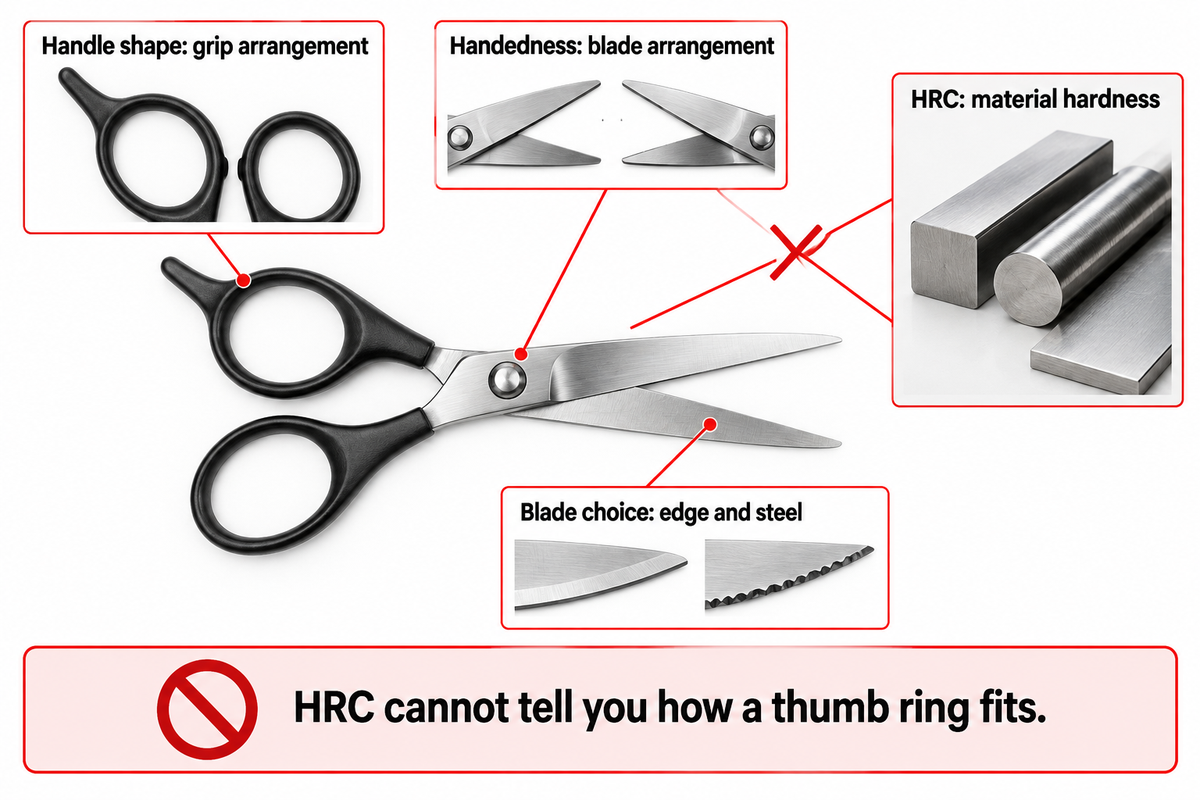
Grip arrangement defines handle shape. The cutting blade, steel, tension and handedness define the other aspects of the tool. A comfortable handle cannot correct an unsuitable edge or reversed blade geometry. When comparing different types of hairdressing scissors, keep all other specifications of the tool visible, rather than letting the ergonomic handle label stand for the rest.
True left-handed shears reverse blade arrangement for left hand use. A symmetric outer handle won’t change right handed blades to left handed blades. Select the desired blade arrangement first, then compare ring fit and view of the cutting edge with a model designed for left hand use.
Our left handed shear range includes offset, crane and swivel descriptions. This separates the hand of use from the handle arrangement. Right handed and left-handed versions should be identified clearly in a sample request, even if their photographs look similar.
The type of blade is another choice: a convex blade and a bevelled edge have different cutting actions. The blade choice is addressed in the convex versus bevel scissors guide. Thinning shears and other texturizing tools bring another variable: tooth design changes how hair is removed, while the handle still needs the same fit check.
HRC measures hardness on the Rockwell C scale, which is a property of a material. Variability in hardness testing and measurement is covered in NIST’s Rockwell hardness measurement guide. The quality of the steel and its treatment belong to the blade decision; HRC cannot tell you how a thumb ring fits. Please refer to our HRC hardness explanation for the material side.
Separate the purchase into fields: a 5.5-inch label, a steel grade, and a swivel description answer different questions. Compare fit with the sample in hand, cutting performance with an appropriate sample cut, and material specifications with the named model. High-end hair scissors still need all three checks.
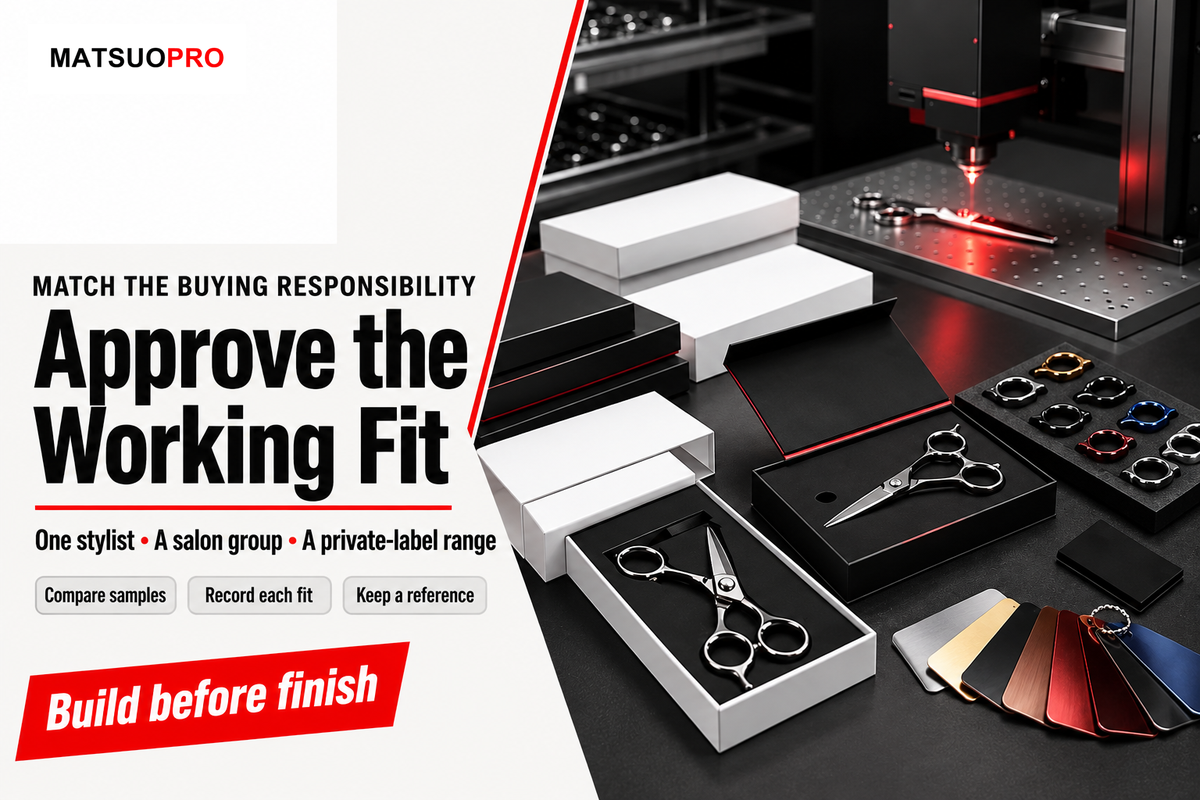
A stylist purchases a tool for individual use. A salon owner purchases a mix for multiple users. A private-label brand also needs repeatable specifications for future supply. Although these buyers begin with the same four handle names, these different responsibilities change their sample decision.
For an individual stylist, use the current sample as a reference, and change one feature at a time if possible. A user satisfied with a fixed thumb control may compare a modest offset to a crane before considering a moving thumb control. Different types of hair and hair techniques can alter the task, but don’t impose a handle.
For a salon group: let intended users compare a small selection. For ordering convenience, a salon group may try to standardize a single model, but this may not preserve each user’s fit. Record who approved which model and explain the rationale. Our salon-series hair scissors provide model options for this purpose.
For a private-label buyer: approve the working build before choosing decorative finishes or packaging. A picture of a black handle doesn’t show swivel resistance, weight, or dimensions. Keep a reference sample to check procurement and quality.
These are illustrative buying situations, rather than reported customer projects. A lower unit price is useful only if the chosen quality scissors remain usable for the intended people. A sample-selection cost and a batch replacement cost belong in the same purchase decision; no universal saving percentage is needed to see the tradeoff.
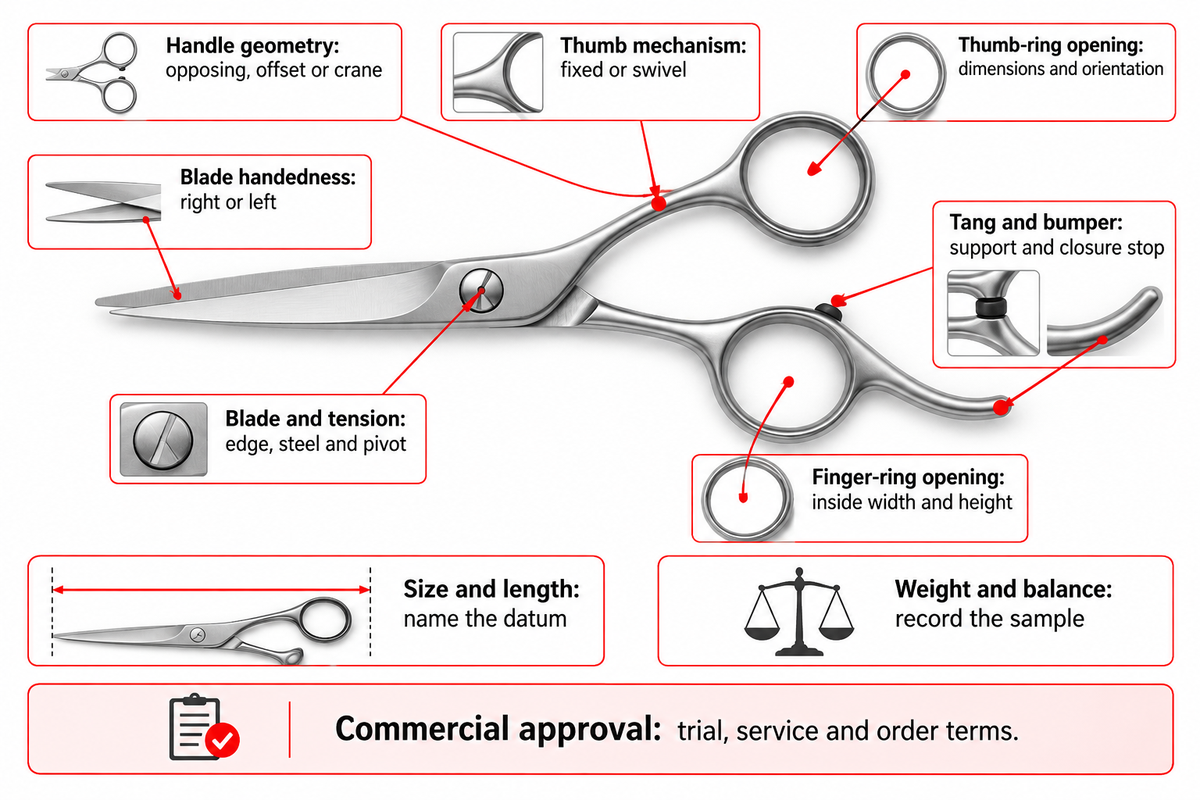
A sample request should specify the geometry of the handle, the thumb mechanism, the blade handedness and length, ring dimensions, and fitted inserts. Since MATSUOPRO offers handle customization through our private-label program, a model reference plus changes is a better starting point compared to requesting an ergonomic pair.
Copy the fields below into an inquiry for OEM and private label scissors. Confirm the actual model configuration and the commercial trial conditions together. A request for 5.5-inch and 6-inch samples should identify what those labels measure and which handle features stay the same between them.
| Field | What to specify | Approval record |
|---|---|---|
| Handle geometry | Opposing, offset or crane; identify the model. | Side/profile photographs show ring placement and blade alignment. |
| Thumb mechanism | Fixed, single swivel or double swivel; rotation range in degrees. | Movement demonstrated through its actual travel; no loose joint. |
| Blade handedness | Right or left, independently of the outer handle shape. | Correct blade overlap and a clear cutting line in the intended hand. |
| Finger-ring opening | Inside width and height in mm; insert type and installed size. | Fit remains secure with the stated insert, without burying fingers. |
| Thumb-ring opening | Inside dimensions in mm and ring orientation. | Thumb tip operates the moving blade without being trapped. |
| Size and length datum | Nominal size in inches; overall and pivot-to-tip lengths in inches or mm. | Each quoted length uses a named start/end point. |
| Weight and balance | Weight in g or oz with fitted inserts. | Actual sample weight recorded; balance judged in the same task. |
| Blade and tension | Edge type, steel grade, pivot/tension system. | Clean sample cuts and controlled closure at the maker’s setting. |
| Tang and bumper | Fixed/removable finger rest; bumper position and replacement. | Finger support and closure stop suit the selected grip. |
| Commercial approval | Sample charge, trial/return terms, service, batch quantity and lead time. | Approved sample/model reference linked to the order and repeat supply. |
Bring the sample result back to the intended cutting style. Keep the fixed design when it gives the control you want; select crane when its angle fits the work; choose a swivel when its movement is useful and stays controlled. For a group purchase, preserve all fits approved by the sample test instead of averaging people’s observations.
Compare 4 handle labels through 3 working positions, then approve a named sample. Ring fit, controlled thumb movement and the correct blade hand make a more useful buying record than an ergonomic label alone.
For hairdressing handles, four common labels are straight or opposing, offset, crane and swivel. The first three describe ring placement and handle geometry; swivel describes a moving thumb ring. A crane-swivel model can carry both descriptions. If you mean different types of scissors by cutting function, cutting, thinning and texturizing scissors form a different classification. Keep those two classifications separate when comparing products.
Start with a well-fitted offset cutting shear as a fixed-handle comparison, then try crane or swivel when the working position calls for it. The best hairdressing scissors for one professional may feel awkward to another. Match handedness, edge and length to the task, and compare thumb control before paying for a premium finish. Price and an ergonomic label can’t choose the fit for you.
Yes, hair-cutting shears marked 5.5 inches can cut hair; the size label doesn’t restrict them to barbers. Suitability still rests on reach, control, handedness and the intended technique. A shorter tool can be useful for detail work, while broad scissor-over-comb work may call for a different length. Choose proper hair shears and keep their edges maintained rather than substituting household scissors.
The projection behind the finger ring is usually the tang or finger rest. It supports the little finger and helps balance the tool. Some are removable; a swivel thumb ring is a different part.
Buy through a specialist manufacturer, authorized distributor or professional shear supplier that identifies the exact model and provides service terms. For a stylist, access to a fitting or a clear trial policy may be more useful than a large discount. For a salon group, order a small selection of handle configurations for the people who will use them before choosing the purchase mix. Private-label buyers should work from an agreed sample specification, not a generic photograph of an ergonomic handle. MATSUOPRO offers professional hair cutting scissors and private-label handle options through our product and customization ranges. Include your intended hand, usual cutting tasks, current size and preferred fixed or moving thumb in the inquiry. Sample pricing, return conditions, spare parts and sharpening arrangements belong in the same discussion as the purchase price.
Tell us your working hand, current shear size and usual cutting tasks. We can discuss fixed and swivel options for a professional hairdressing kit or a private-label range.
MATSUOPRO provides professional hairdressing scissors and customization options for hairdressers and barbers, salons, and brands. Learn about MATSUOPRO and use the sample specification to request a quotation.
Our editorial comparison method and means for organizing a sample decision is the 3-Position Handle Trial, based on fitted tool selection and task-based assessment. It isn’t a medical assessment. Measurements given for the sample are for the model tool described.
MATSUOPRO is the Mackay Hair Scissors manufacturing brand for professional hairdressing shears, barber scissors, thinning shears, and pet-grooming scissors. We support salons, distributors, academies, grooming brands, and private-label buyers that need factory-direct production with practical material guidance.
Our buying guides are written to help purchasers compare steel grades, handle styles, blade geometry, surface finishes, logo options, packaging, MOQ, and sample validation before placing an OEM or wholesale order. The goal is to make each scissors specification easier to discuss with a real production team.
Factory-direct supply since 2014, with product lines covering professional cutting shears, barber shears, thinning scissors, texturizing scissors, left-handed models, and pet grooming scissors for international B2B customers.
We focus on Japanese 440C, VG10, and ATS-314 steel choices, convex and bevel edge geometry, ergonomic handle balance, tension systems, logo engraving, private-label packaging, and sample-based OEM confirmation.