Get in Touch with Mackayhairscissors Company
We use submitted details to respond to your quote request. Read our Privacy Policy.

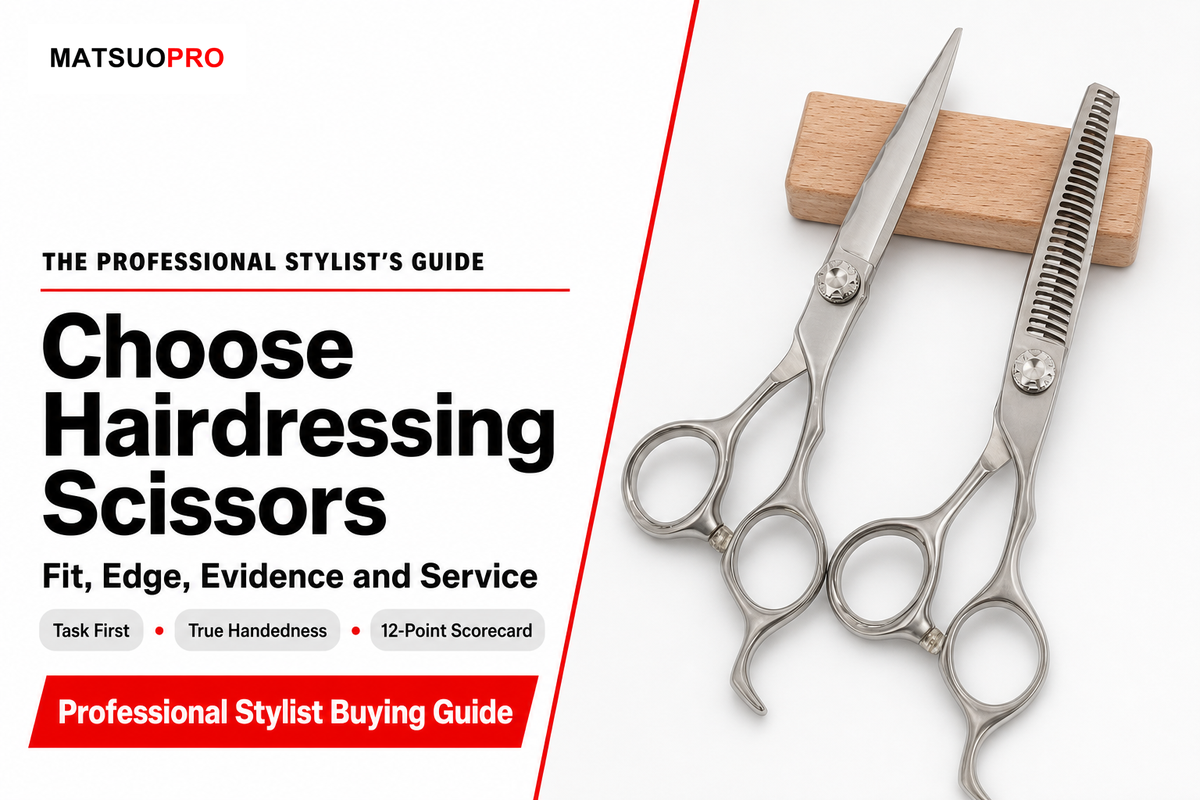
Professional Stylist Buying Guide · Fit, Proof & Service
How to choose hairdressing scissors is a practical sequence: start with the cutting tasks you perform most, then compare blade length, true handedness, handle shape, edge type, material evidence, tension, balance, return terms, and service access. The right pair is the one you can control, verify, and maintain for your work—not the one with the loudest steel claim or the highest price.
Updated August 31, 2026 · Educational guidance for salon stylists, hairdressers, barbers, students, and educators
CUT defines the job. HAND checks handedness, handle, and control. PROOF tests the seller’s specifications, return policy, warranty, and service path. Follow that order before comparing brand prestige.
Build a shortlist of two or three candidates, try them under the same conditions, and record the result. Your own explainable decision is more useful than a universal “best hair scissors” list.
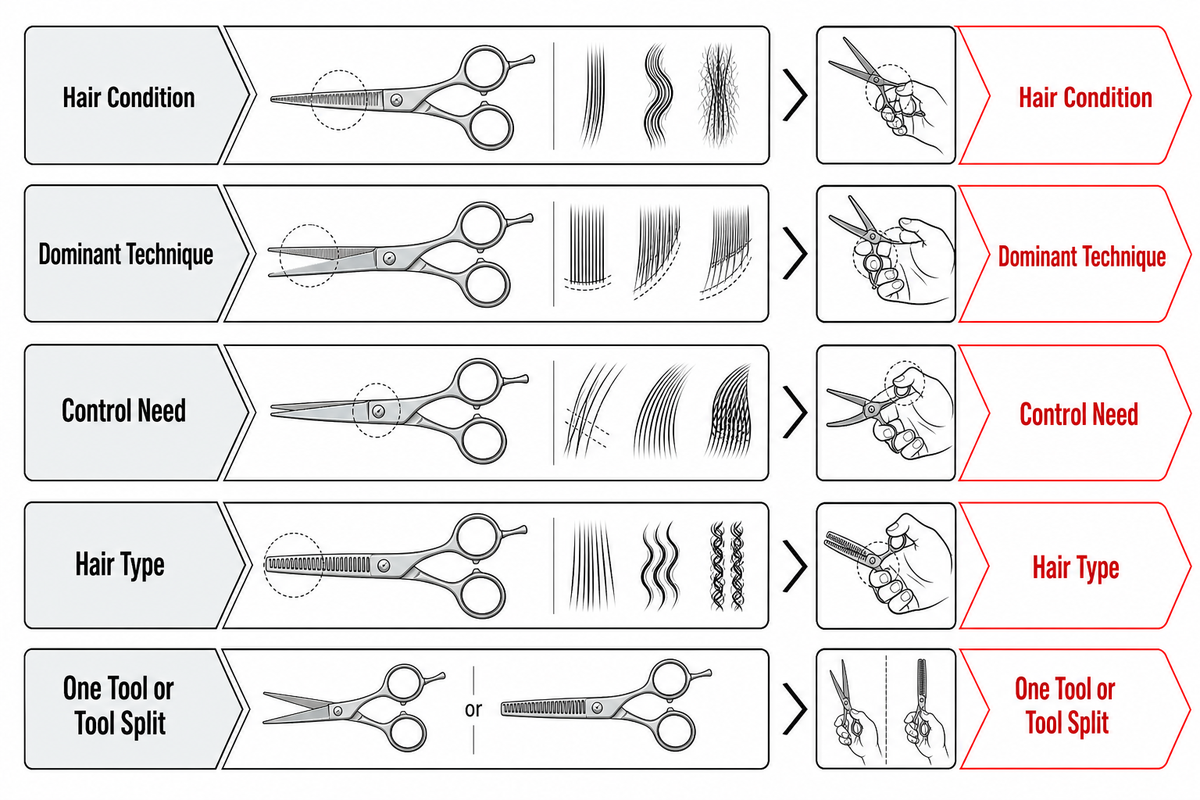
The first step is to write down what the scissors must do. Stylists who spend most of the day on precision bobs need a different trial set from barbers doing long scissor-over-comb passes or curl specialists refining dry hair. Brand, steel, and price cannot repair a task mismatch.
Use a 5-line task brief before opening a product page:
This brief prevents a common buying mistake: selecting a premium professional shear first and inventing a use for it later. It also gives a seller something specific to answer. “Which model supports controlled point cutting and dry refinement?” is a better question than “What is your best hair cutting scissor?”
When you cut hair through a full haircut, the same hair shear may move from close detail to broader sections. Record where that transition feels controlled and where it becomes a compromise; that observation belongs in the shortlist.
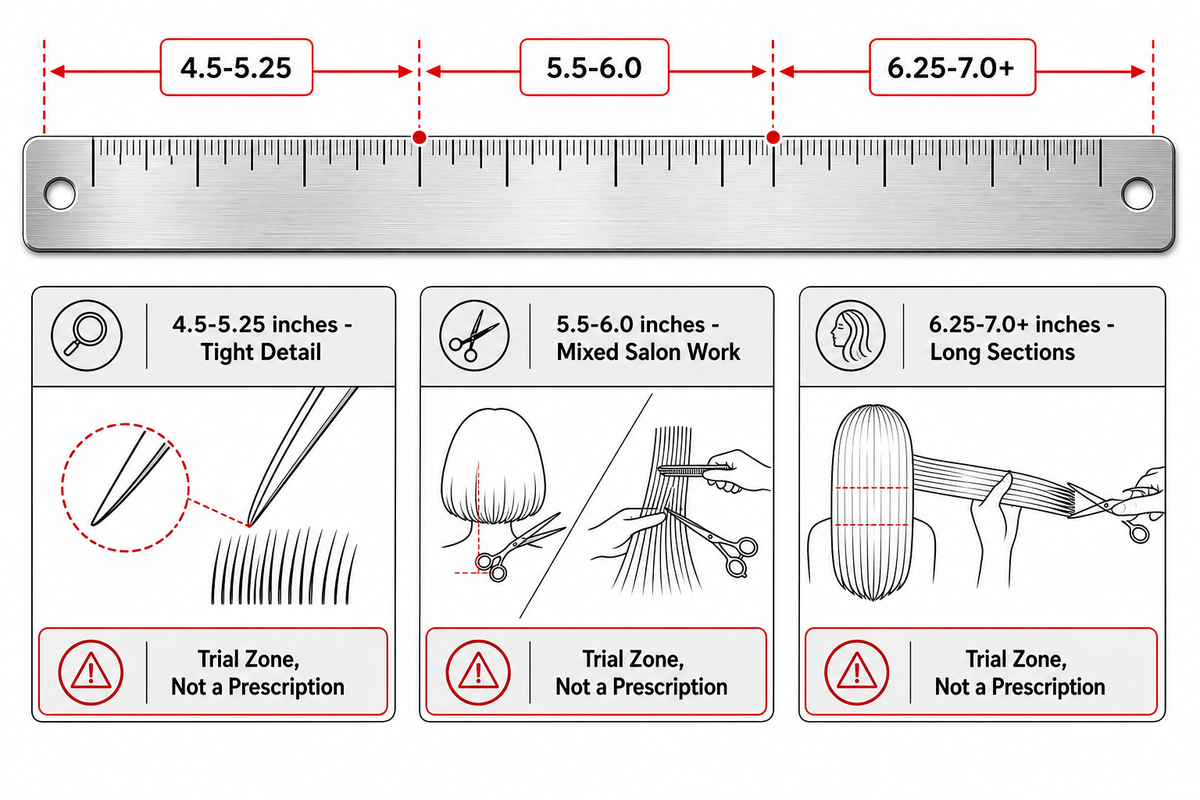
For this guide, blade length follows the working stroke and cutting style rather than a universal hand-size formula. Palm measurements can define a starting range, but they cannot tell you how a particular pair balances, where its tip sits, or whether you can control the full blade through your dominant cutting techniques.
The mismatch matters because an uncontrolled length creates extra openings, hidden tip movement, or needless grip tension during a normal haircut.
| Starting trial range | Often useful for | Check before keeping |
|---|---|---|
| 4.5–5.25 inches | Tight detail, close tip work, smaller controlled sections | Does the shorter stroke create extra openings on long lines? |
| 5.5–6.0 inches | Mixed salon work, precision cutting techniques, point cutting | Can you see and control the tip without over-gripping? |
| 6.25–7.0+ inches | Long sections, broad lines, scissor-over-comb, some barber work | Does the blade stay balanced through its full usable stroke? |
Treat these as trial zones, not rules. Two 6-inch hair scissors can feel completely different because handle length, finger position, blade mass, pivot location, and finger rest all affect balance. Compare the actual models with the same grip and the same motion.
The 5.5-inch pair usually places the tip closer to the hand and may feel easier to place in detailed work. Moving to 6 inches gives roughly half an inch more overall reach and may cover longer sections with fewer openings. That difference is useful only if you can control it. Try both on a blunt line, a point-cutting motion, and your normal elevation. Keep the size that asks for fewer compensations.
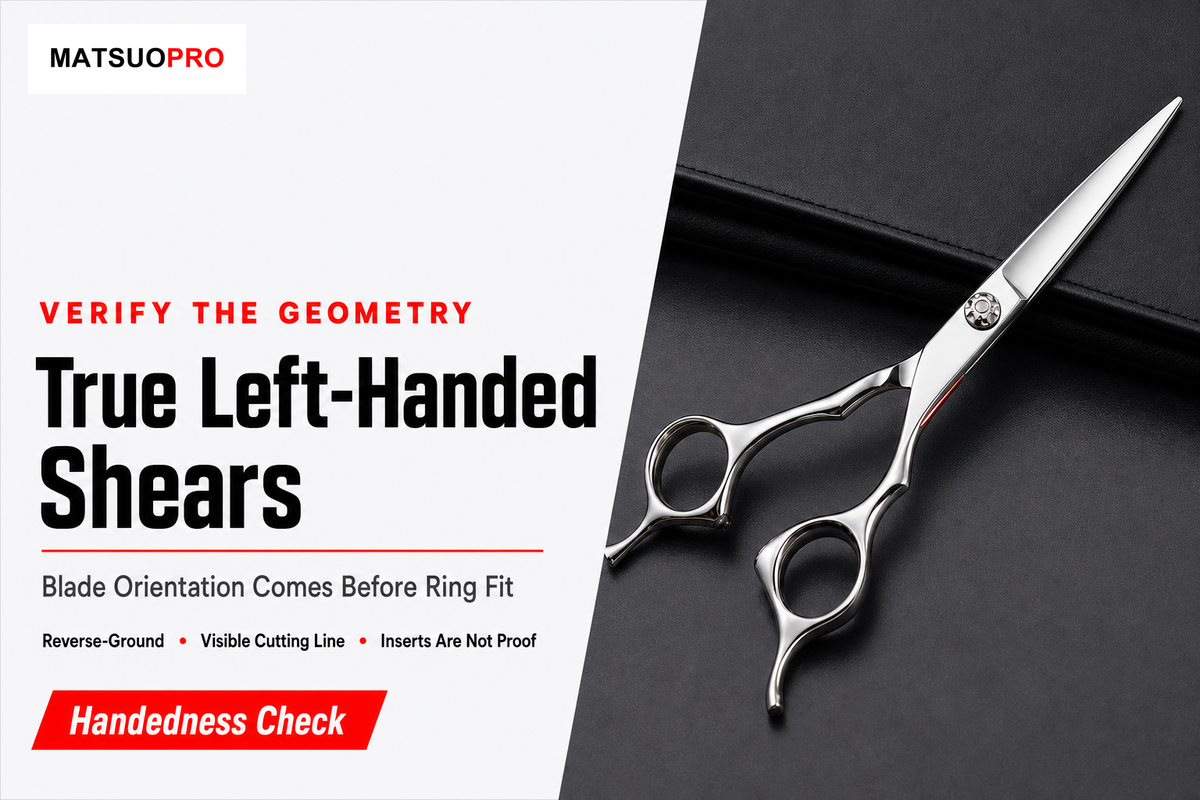
True left-handed shears reverse the blade orientation so a left-handed stylist can see the cutting line and apply natural thumb pressure. Ring inserts can make a finger hole smaller, but they cannot turn a right-handed blade set into left-handed scissors.
Wrong blade orientation is a control risk because natural left-thumb pressure can push the cutting edges apart instead of together.
Look at the scissors in the working hand. The moving blade should sit in the orientation intended for that hand, with the cutting line visible rather than hidden behind the upper blade. Ask the seller to state “true left-handed” or “reverse-ground left-handed blades” in writing, then compare that statement with the construction shown in the left-handed hair cutting shears collection. “Suitable for either hand” often describes a symmetric handle, not the blade geometry.
Check three things: reversed blade orientation, a left-hand-specific product description, and a working view that lets the stylist see the line while closing naturally. Do not use removable inserts as proof. Mackay describes its true-left models as using reverse-ground blades, and independent professional guidance makes the same blade-orientation distinction. If a listing shows only handle photos, ask for a blade-side image before buying.
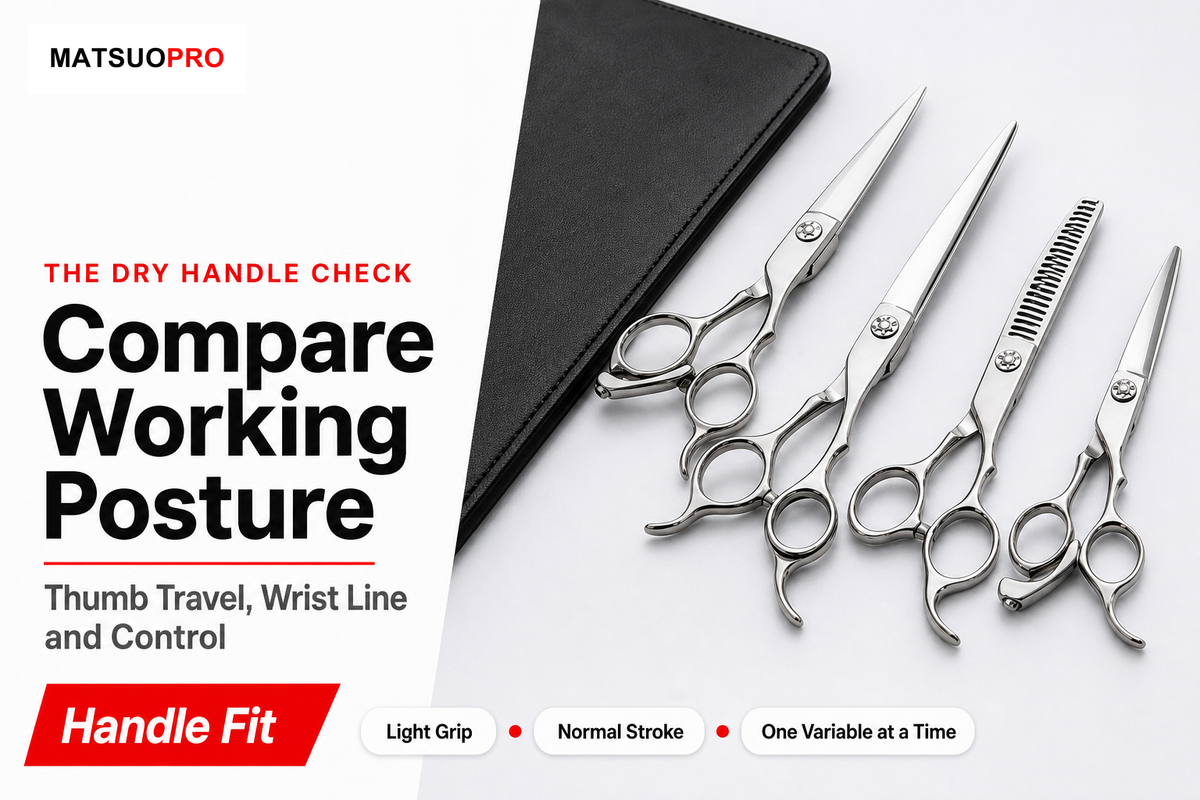
Choose a handle by comparing thumb travel, elbow position, wrist correction, and control during your real working stroke. Opposing, offset, crane, and swivel handles change how the hand meets the blade, but no ergonomic handle guarantees injury prevention.
Opposing handles keep the finger and thumb rings more level and may suit stylists trained on a classic grip. Offset handles shorten the thumb reach. Crane handles add more angle between the handle and blade. Swivel handles let the thumb rotate but introduce a learning curve and more moving parts. The “most ergonomic scissors” are therefore personal: a design is useful only if it reduces correction without weakening control.
The peer-reviewed scoping review found that hairdressing exposure involves repetition, force, elevated arms, awkward posture, workload, and workstation conditions. A 2023 workplace study of cosmetologists also identified awkward posture, psychological demand, experience, and specific tasks among pain predictors. Handle shape is one tool choice within that wider system. If you have persistent pain or numbness, buying advice is not a substitute for qualified professional assessment.
Trial note: Compare one variable at a time. If blade length changes with the handle, you won’t know which change reduced the correction or created the new tension.
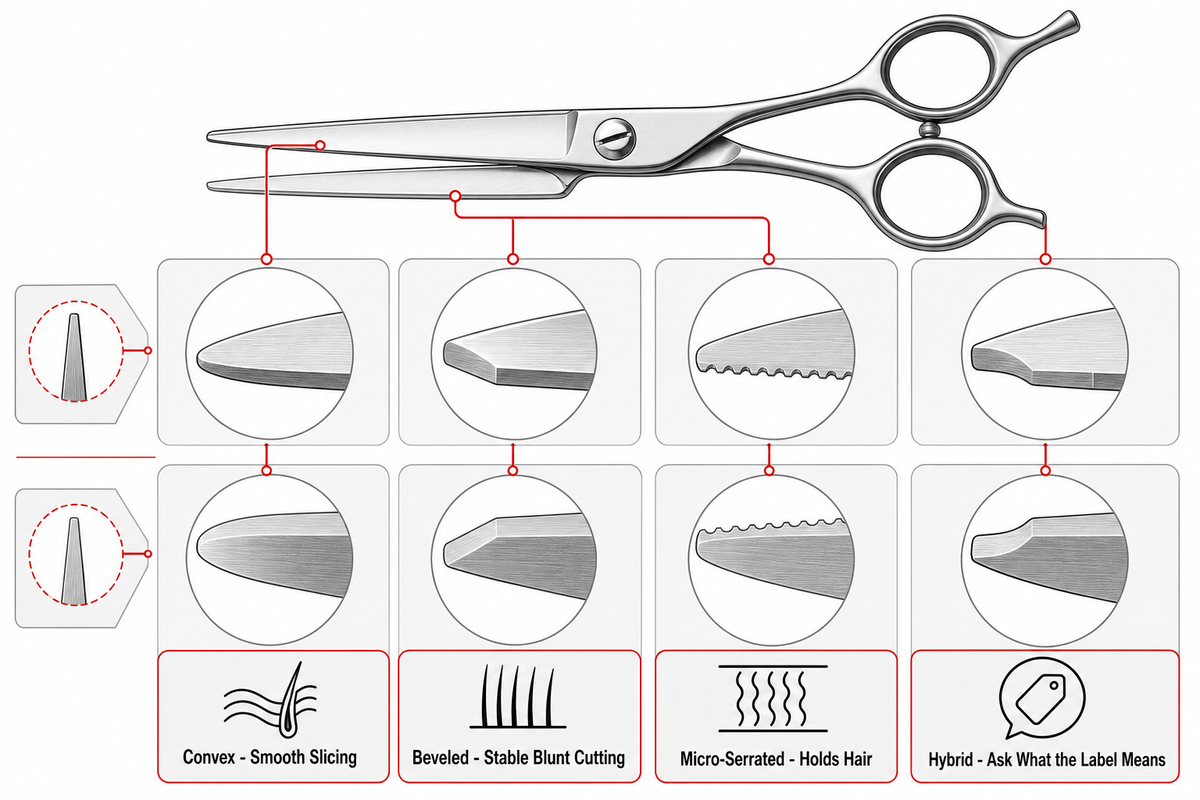
The type of blade edge affects how hair enters, stays on, and leaves the cutting shear. Choose edge geometry for the technique you actually use, then confirm that local sharpening support can service it. “Sharper” is not a complete buying specification.
The edge should also match the hair type and maintenance route. Stylists doing frequent dry refinement may value smooth travel, while students building reliable blunt lines may value a more stable bite. Do not buy an edge your local service provider cannot identify and restore.
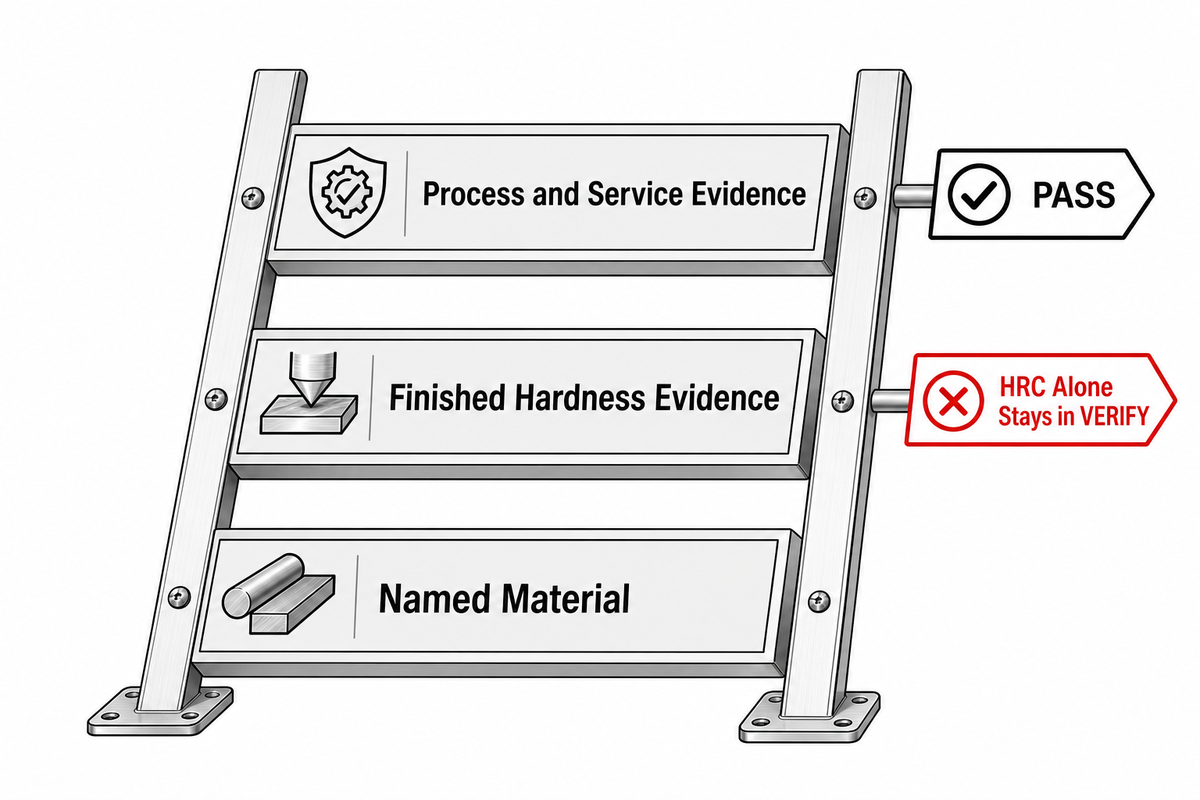
Steel grade and HRC can support a buying decision, but neither is a finished-shear quality score. Rockwell C results measure indentation hardness under a defined test; they do not directly measure edge geometry, toughness, grind accuracy, balance, surface finish, or how well the pair was assembled.
Use the 3-Spec Evidence Ladder:
ASTM E18 notes that a Rockwell reading at one location may not represent the whole part or end product. That is why HRC alone cannot move a candidate to PASS. Mackay’s first-party manufacturing guidance similarly separates material, hardness, thermal processing, grinding, honing, and quality control. Read the linked explanation of how HRC hardness is measured and interpreted before comparing supplier claims.
No. Higher measured hardness may support edge stability in a suitable steel and thermal process, but it can also change toughness and service requirements. More importantly, the number says nothing by itself about blade geometry, finish, alignment, tension, or fit. Compare HRC only after the task, handedness, handle, edge, and evidence source are clear.
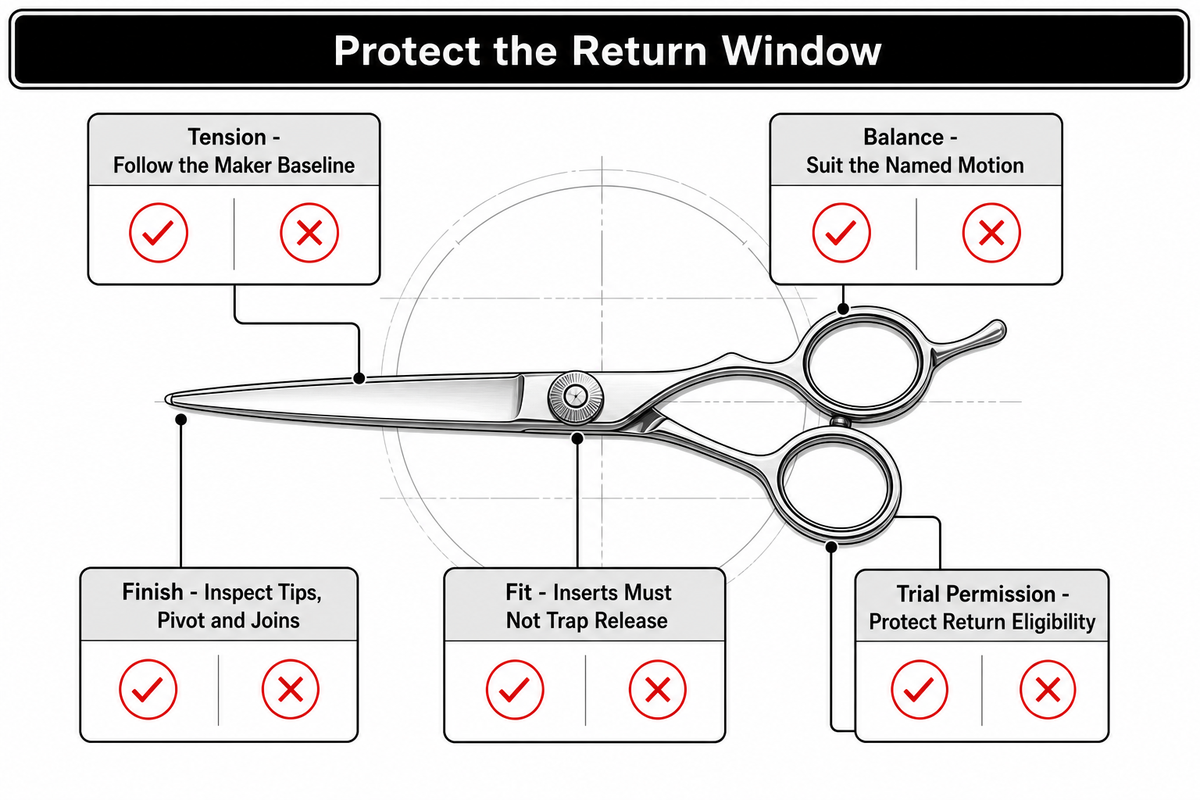
Inspect the actual pair before the return window closes. Model descriptions cannot prove that the delivered scissors are aligned, balanced for your hand, cleanly finished, or free from pivot play. Keep the test reversible and within the seller’s written trial rules.
Hygiene rules matter here because some sellers will not accept a used or contaminated tool. Confirm the return condition before a hair test, and follow the current salon disinfection rule where you work. This guide does not set a universal chemical or care method; local rules, the disinfectant label, and the exact shear instructions must agree.
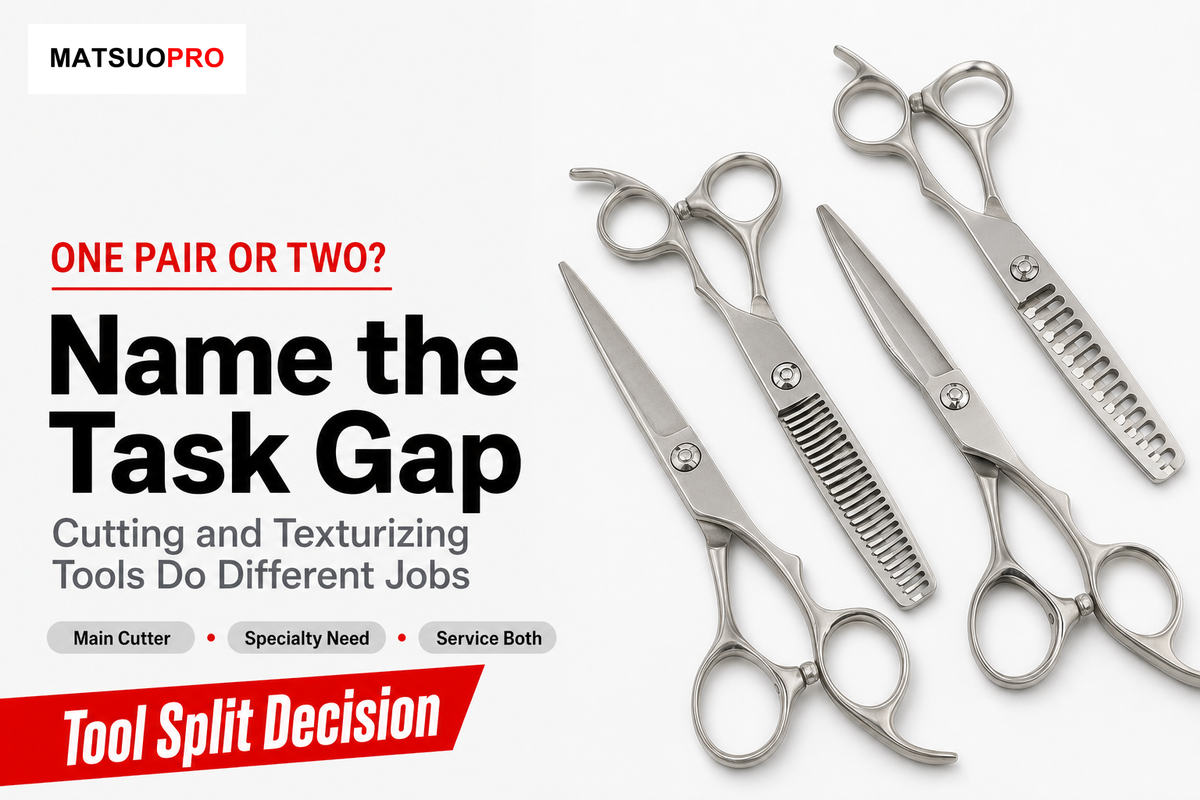
Straight-blade hair cutting shears and thinning and texturizing shears solve different jobs. One versatile cutting pair may cover a new stylist’s core work, but it cannot become texturizing scissors simply because the technique changes.
The common trap is a tool mismatch because one tooth-count label is asked to stand in for section size, geometry, tension, and technique.
Start with one reliable cutting shear if most services require clean lines, section work, point cutting, or general shape building. Add a second tool only when the task brief identifies a repeatable gap; use the available hairdressing scissors sets and kits to compare combinations, not to skip the task check. For example, a stylist may pair a 5.5-inch cutting shear for precision with longer shears for broad scissor-over-comb work, or pair a main cutter with thinning scissors for controlled blending.
Do not select specialty shears from tooth count alone. Tooth geometry, spacing, edge treatment, channel width, tension, hair type, section size, and technique all affect removal behavior. The “30-tooth” label is a starting fact, not a guaranteed removal percentage. Ask for intended use and test conservatively under the seller’s rules.
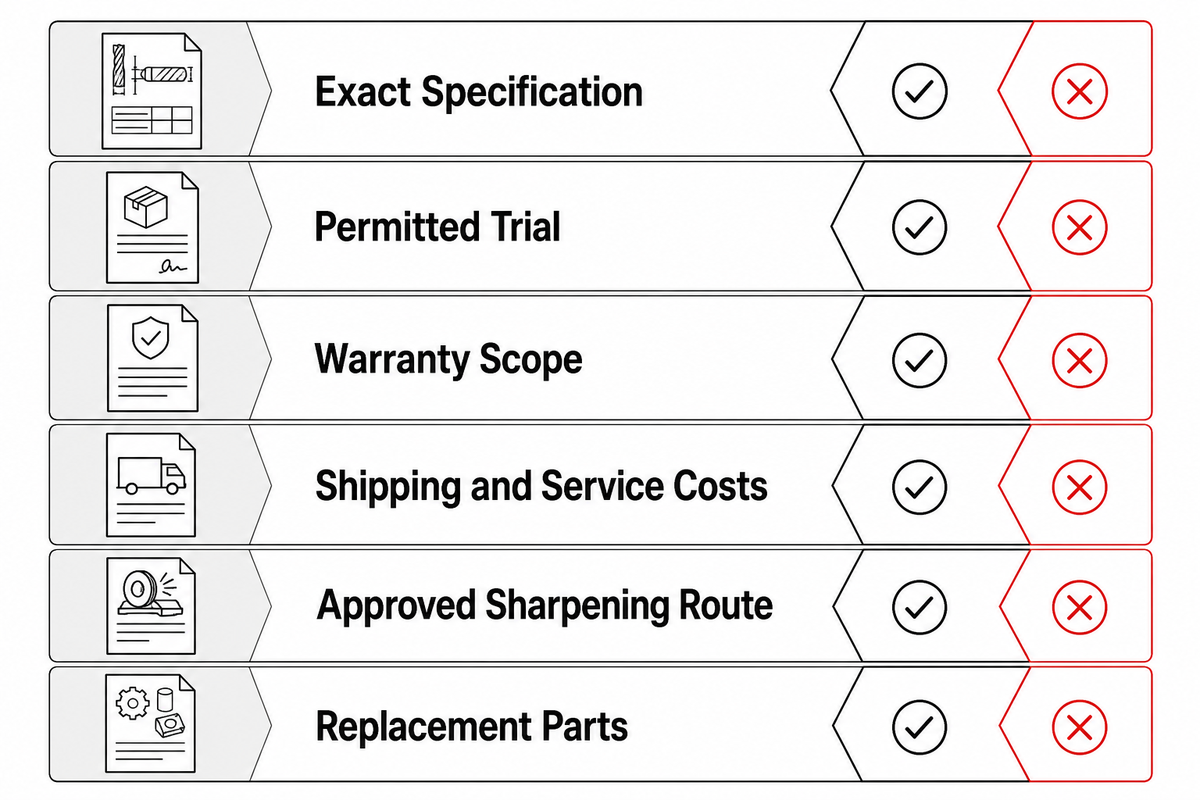
Strong sellers make important terms easy to verify before payment. Look for exact specifications, a readable return window, warranty inclusions and exclusions, shipping responsibility, replacement-parts availability, and a sharpening route that matches the edge and tension system.
Ask these six questions in writing:
Current seller terms show why this step matters: “lifetime warranty” may apply only to manufacturing defects, while drops, misuse, shipping, or routine sharpening remain the buyer’s responsibility. Treat every warranty as a contract with exclusions, not as a quality adjective. Save the version you relied on at purchase because terms can change.
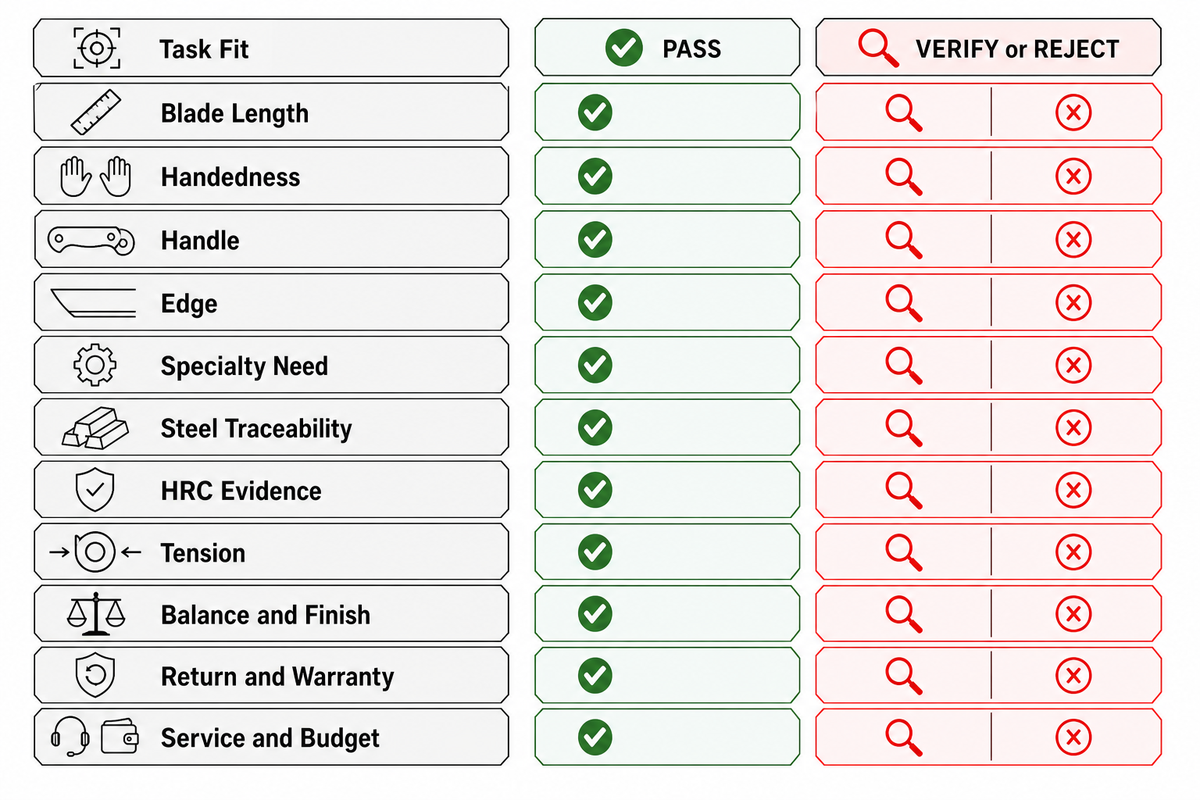
The 12-point scorecard turns a personal trial into a traceable decision. It does not rank all professional hairdressing scissors for every stylist. It records whether a candidate fits your tasks and whether the supporting evidence is complete.
| # | Decision type | PASS | VERIFY or REJECT |
|---|---|---|---|
| 1 | Task fit | Solves a named cutting task | Use is vague or invented after selection |
| 2 | Blade length | Controlled through working stroke | Chosen from a universal size rule |
| 3 | Handedness | Blade orientation confirmed | Only ring fit or “ambidextrous” claim |
| 4 | Handle | Thumb travels without forced correction | Injury-prevention promise or awkward dry fit |
| 5 | Edge | Matches technique and service route | “Sharpest” without geometry |
| 6 | Specialty need | Second tool solves a named gap | Tooth count used as full specification |
| 7 | Steel traceability | Named material or clear source | Premium adjective only |
| 8 | HRC evidence | Range and context disclosed | One number treated as quality score |
| 9 | Tension | Maker baseline and stable motion | Forced, loose, or unexplained adjustment |
| 10 | Balance and finish | Actual pair inspected | Visible damage or uncontrolled feel |
| 11 | Return and warranty | Trial, exclusions, and costs clear | Terms missing or contradictory |
| 12 | Service and budget | Qualified support is accessible | No suitable sharpener or total-cost answer |
Mark each row PASS, VERIFY, or REJECT. Candidates with one unresolved critical item—wrong handedness, missing return terms, or no suitable service path—do not become safer because they win on price or HRC. Compare finalists side by side and record why one fits your chair work better.
If you want to review professional hair cutting shears after defining your requirements, visit Mackay’s hair cutting shears page. For model, material, left-hand, or service questions, Ask Mackay about your shortlist.
Professional hairdressers use cutting shears selected for their dominant techniques, preferred blade length, true handedness, handle, and edge, then add thinning or texturizing scissors when a separate job requires them. There is no single professional hair cutting shear used by everyone. The 5.5- or 6-inch convex cutting shear is common in mixed salon work, while shorter or longer shears may suit different cutting tasks. Fit, service access, and verifiable specifications matter more than a brand label alone.
Look for a clear task fit, controllable length, correct blade orientation, comfortable thumb travel, an edge suited to your technique, traceable steel and hardness evidence, stable tension, balanced finish, and written return, warranty, and sharpening terms. Inspect the actual pair during the permitted trial window. Treat vague phrases such as “best steel” or “ergonomic scissors” as questions, not proof. The 12-point scorecard above turns those checks into PASS, VERIFY, or REJECT decisions.
A 5.5-inch shear often brings the tip closer to the hand for detail and precision, while a 6-inch shear adds about half an inch of reach for mixed work and longer sections. The practical difference also depends on handle length, pivot position, blade mass, and balance. Test both through the same blunt line, point-cutting motion, and working elevation. Choose the pair that stays controlled without over-gripping or changing wrist position.
No. Price may reflect material, finishing, distribution, warranty, support, packaging, or brand position, but it does not prove fit or cutting performance for your hand and work. Lower-priced pairs with correct handedness, clear specifications, reliable finish, and local service can be the lower-risk choice. Compare the actual evidence and trial result rather than assuming cost closes a specification gap.
Straight-blade cutting shears can create texture through point cutting, channel work, or other techniques, but they do not duplicate the controlled removal pattern of thinning or texturizing scissors. Start with one dependable cutter, then add a specialty tool when your task brief identifies a repeated need. Any second pair should solve a named problem: softening a perimeter, blending a transition, reducing weight in a specific hair type, or covering long sections with fewer openings. Compare tooth geometry, spacing, edge treatment, section size, and intended removal behavior rather than tooth count alone. Test conservatively because two tools with the same tooth count may remove hair differently. The main cutter and specialty pair should also be easy to distinguish at the chair so the wrong tool is not picked up during a service. Record which tool owns each job, how the seller describes its removal behavior, and which sharpener can service that geometry. If those answers are unclear, keep the specialty purchase in VERIFY and continue using controlled cutting techniques with the main pair.
Good hairdressing scissors are not chosen by one number. Define the work, trial the length, confirm true handedness, compare the handle and edge, then test the 3-Spec Evidence Ladder and the seller’s terms. Use the 12-point scorecard to make your own trade-offs visible.
The expensive mistake is assuming one strong specification closes every gap, because fit, evidence, return rights, and service access can fail independently.
The final question is simple: can you explain why this pair suits your technique, hand, evidence standard, return risk, and service access? If the answer is yes and the actual tool passes inspection, you have a defensible shortlist. If a critical answer is missing, keep it in VERIFY rather than letting price, steel language, or brand prestige decide for you.
MATSUOPRO is the Mackay Hair Scissors manufacturing brand for professional hairdressing shears, barber scissors, thinning shears, and pet-grooming scissors. We support salons, distributors, academies, grooming brands, and private-label buyers that need factory-direct production with practical material guidance.
Our buying guides are written to help purchasers compare steel grades, handle styles, blade geometry, surface finishes, logo options, packaging, MOQ, and sample validation before placing an OEM or wholesale order. The goal is to make each scissors specification easier to discuss with a real production team.
Factory-direct supply since 2014, with product lines covering professional cutting shears, barber shears, thinning scissors, texturizing scissors, left-handed models, and pet grooming scissors for international B2B customers.
We focus on Japanese 440C, VG10, and ATS-314 steel choices, convex and bevel edge geometry, ergonomic handle balance, tension systems, logo engraving, private-label packaging, and sample-based OEM confirmation.