Get in Touch with Mackayhairscissors Company
We use submitted details to respond to your quote request. Read our Privacy Policy.

Updated September 2026
Convex vs bevel scissors is a comparison between two blade-edge geometries: convex edge scissors are made with a slightly curved, single-facet, flat-free surface sharpened at a very thin angle, while bevel edge scissors are sharpened at a noticeable flat step before the cutting line. This single difference is what separates how a shear feels in your hand, how often it must be resharpened, and how expensive it is to own over its first five years. Both edges show up on identical-looking pairs of professional shears, and most marketing copy refers to either as “razor sharp” without ever saying which one you’re actually buying.
This guide gives the numbers competitor pages skip: the grind-angle range behind a convex edge, why a Rockwell hardness number is a separate spec from edge geometry, and how the resharpening cost structure differs between the two edge types.
People search for this comparison under different names — convex vs beveled edge shears, convex vs beveled, or simply which edge type cuts better — and the vocabulary shifts by shop and region. A hair shear, a cutting shear, hair cutting shears, hair cutting scissors, and a plain pair of scissors all mean the same object here; a thinning shear is a different tool covered in our other guides. Every scissor blade on the market is convex, semi-convex, bevel (also written beveled shears), or serrated, and that single spec is what this guide is about, not the label on the box.
| Convex edge grind angle (Mackay pet-grooming line) | 15-20 degrees, hand-honed, no flat facet |
| General industrial-scissor edge angle (not bevel-specific) | 35 degrees measured from the inside edge is a commonly cited general figure; no manufacturer publishes a bevel-only or convex-only angle range for comparison |
| Best for | Convex: slide, point and dry cutting. Bevel: blunt cutting and heavy daily use. |
| Resharpening pattern | Convex: fewer total visits over its service life, but each visit costs more and needs edge-specific specialist equipment. Bevel: more frequent visits, but cheaper and easier to find. |
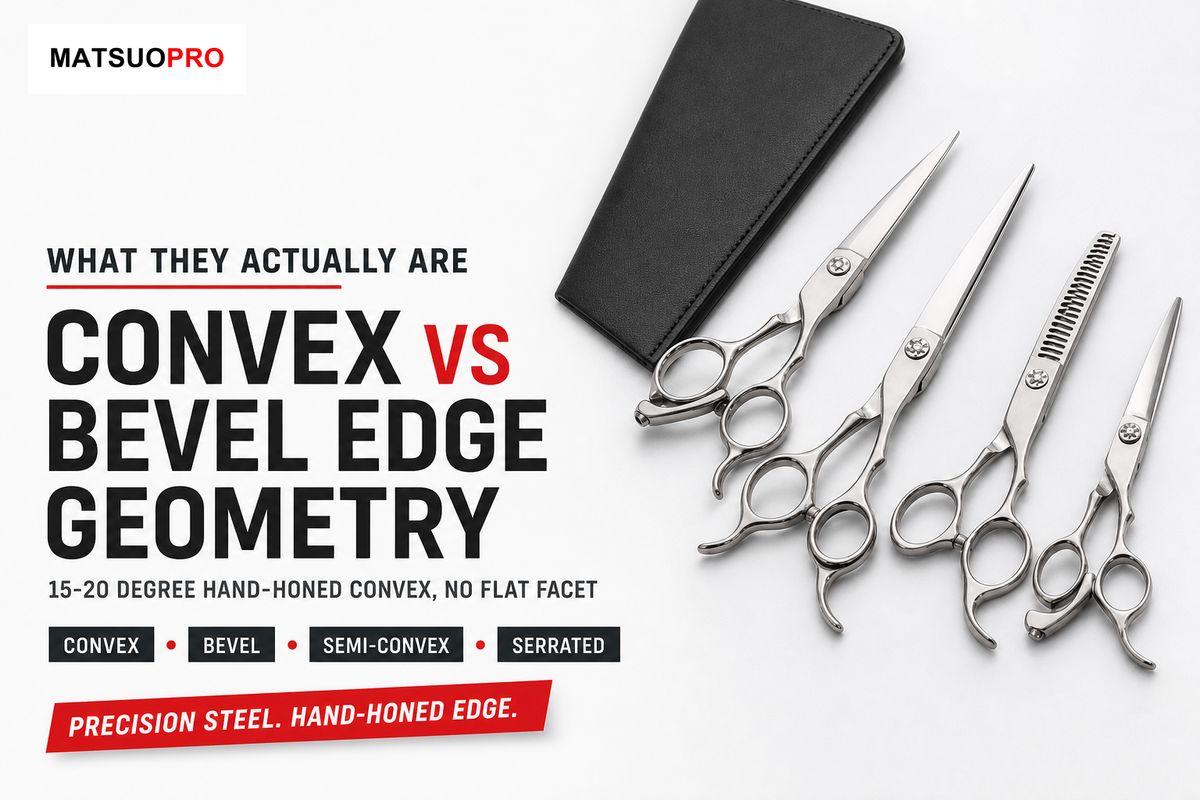
A convex blade is a curved edge blade ground down to a single fine point, with no flat step anywhere along the cutting line. Bevel edges — sometimes called German edges — carry a distinct flat facet ground into the blade before they meet the cutting edge. This flat facet is the entire difference: it adds edge-holding durability at the cost of a slightly less clean glide through hair.
Mackay’s own hand-honed convex edge, published for its pet-grooming line, is ground at 15-20 degrees with a mirror polish and no flat facet. This is a product-line-specific figure, not a universal industry number — Mackay’s hairdressing line is ground to the same convex family but isn’t separately published at this exact angle, so treat 15-20 degrees as a real, verifiable example of what “hand-honed convex” means in practice rather than a claim about every convex shear on the market.
Bevel angles are harder to pin to one number because manufacturers measure them differently, and no maker publishes a bevel-only or convex-only figure for direct comparison. Wolff Industries, an industrial scissor and sharpening-equipment maker, publishes 35 degrees as the common edge angle for its industrial scissors generally — not specifically for bevel edges — measured from the inside of the blade; the same edge measured from the outside face reads roughly 55 degrees. Treat 35 degrees as a general industrial-scissor reference point, not a like-for-like bevel-vs-convex comparison with Mackay’s 15-20 degree convex figure above.
“The most consistent and reliable reference will always be from the inside of the shear because the face of the blade may be sloped…and not parallel to the inside of the blade.”
– Wolff Industries, sharpening-angle technical guidance
This measurement-convention gap is exactly why a bare angle number on a listing, without saying which face it was measured from, tells you less than it looks like it does.
Convex edges cut with less resistance because there’s no flat facet catching the hair; bevel edges trade some of that glide for a facet that resists chipping and holds its line through rougher daily use.
There’s a physical reason a fine, flat-free edge interacts with hair differently, and it isn’t unique to scissors. Researchers Roscioli, Taheri-Mousavi and Tasan published a 2020 Science study on razor-blade dulling — a different cutting mechanism than scissors’ shearing action — and found that bending hair generates a shear force perpendicular to the cutting edge, with steel blades more than 50 times harder than human hair. The study doesn’t extend this to scissor geometry; the facet-area reasoning below is our own inference from that mechanism, not a finding of the paper: flatter facets plausibly give that shear force more surface to act against, while finer, flat-free edges give it less.
Semi-convex is convex geometry ground at a coarser angle than full convex, trading some of the glide for more edge durability — it sits between full convex and bevel rather than being its own separate category. Stylists reach for it when a full convex edge feels too delicate for their daily volume but a bevel edge feels like it’s pushing hair instead of cutting it.
Serrated edges are a fourth, less-discussed option: small teeth ground into one or both blades, usually paired with a bevel edge or lower-cost steel to stop hair from slipping out from between the blades. A serrated edge can’t slide-cut cleanly — the teeth catch and jam hair during a sliding motion — which is why it shows up almost exclusively on blunt-cutting and texturizing tools rather than finishing shears. None of these four edge-grind categories are covered by ASTM E18-25 or ISO 6508-1:2023 — those standards test hardness alone, not grind geometry, which is exactly why a spec sheet can list a Rockwell number and still say nothing about which of these four edges you’re getting.
Open the shears fully and look at the inside face of one blade under a strong light. Finding a visible hone line — a slightly polished secondary line running just behind the cutting edge — means convex or semi-convex. No hone line and a flat, uniform facet you can see edge-on means bevel. Run a fingernail lightly along the inside face: a convex edge feels like one continuous curve, a bevel edge has a perceptible step where the flat facet meets the blade body. Figuring out your hair shear’s blade type starts with this test; once you can tell hair shear blade design and beveled edge blade design apart by feel, the rest of this guide is about matching that design to your technique.
Slide cutting and point cutting are both advanced cutting techniques that depend on the blade moving through hair with minimal resistance, which is why convex edges dominate this work; a blunt cut depends instead on a clean, repeatable straight-line pass where a bevel edge’s extra durability matters more than glide. Our hairdressing scissors buying guide touches edge type briefly as one factor among many in a full shortlist; this section is the deeper technique-by-technique breakdown.
The Technique Exclusion Grid below flags which edge type each core cutting technique rules out, not just which one it favors — use it to check your own dominant technique against the edge you currently own before you shop.
Scissor over comb cutting — working the blade directly against a comb held close to the scalp — rewards a fully convex or true convex edge because the blade needs to glide through larger sections without snagging mid-pass; beveled edges grip the hair rather than gliding, and when that grip catches mid-pass, hair jams against the pivot. Whether you’re wet or dry cutting, techniques such as slide cutting and slice cutting both depend on smooth and sharp cutting action across the whole pass, not just at the tip. Stylists and barbers who mix cutting or dry cutting styles in the same day often keep both a convex and a semi-convex pair on hand — convex and semi-convex together cover most of what a single cutting style can’t.
| Technique | Best-Fit Edge | Why | Not Suitable For |
|---|---|---|---|
| Slide cutting | Convex | Minimal facet contact lets the blade slide along hair without catching | Serrated edges (teeth jam mid-slide) |
| Point cutting | Convex | Fine tip control needs a flat-free edge for clean texture entry | Heavily worn bevel edges (rounded tip loses precision) |
| Dry cutting | Convex or semi-convex | Dry hair offers more resistance; a finer edge needs less force to compensate | Serrated (designed for wet, higher-friction sections) |
| Blunt / club cutting | Bevel | Straight-line force benefits from the facet’s edge-holding durability, not glide | Not a hard exclusion for convex, but the durability trade-off is wasted on this technique |
A working stylist who mixes slide cutting into an otherwise blunt-heavy day doesn’t automatically need two pairs of shears — most convex edges handle occasional blunt sections fine. The reverse is the real limitation: a bevel edge used heavily for slide or point work will feel like it’s pushing hair rather than cutting it, because that’s exactly what the flat facet is doing.
Edge geometry and steel hardness are two independent purchase variables, not one combined “quality” score — a shear can carry a high Rockwell hardness number and still be ground with either a convex or a bevel edge, and neither number tells you the other. Blade length is a third, separate spec again — our buying guide covers length selection in full; this guide stays focused on the edge-geometry variable.
Rockwell C hardness results are localized empirical indentation measurements, defined by ASTM E18-25 Standard Test Methods for Rockwell Hardness of Metallic Materials, and by ISO 6508-1:2023 internationally; simply knowing a Rockwell hardness number cannot certify the overall quality of a finished shear, because it does not speak to how the edge was ground, honed, or finished. Measurement traceability itself depends on calibrated reference blocks, a discipline NIST documents as metrological traceability: a steel-origin label or a bare hardness number does not, on its own, establish fitness for purpose.
Mackay publishes two different HRC ranges for its hairdressing line depending on which page you read: the HRC hardness breakdown states 58-62 HRC as the optimal professional range, with cobalt variants reaching 64 HRC, while the company’s about page states 60-62 HRC as standard. Both describe the same manufacturer’s same product family from two different pages — one technical, one a general overview — and the honest read is that Mackay’s hairdressing shears sit in the high-50s to low-60s HRC band, with the exact number depending on which page and which specific model you compare.
The top-ranking pages we reviewed for this comparison don’t put a number on edge-grind angle or connect it back to steel hardness as a separate variable — they describe convex and bevel qualitatively and stop there. That gap is why a spec sheet listing “440C, 60 HRC, convex edge” is really giving you three separate claims to verify, not one combined quality score.
Convex edges are simultaneously described as “more durable” and “more fragile” across different sources, and both claims are correct because they describe two different kinds of durability: edge-holding durability under normal cutting versus impact resistance if the shears are dropped or used to cut something other than hair. ASTM E18-25‘s Rockwell test measures resistance to indentation, not impact toughness — harder steels generally give up some impact toughness for wear resistance, which is part of why a higher-hardness convex edge’s fragility trade-off exists at all; the hardness number from the previous section and the durability trade-off here are two readings of the same underlying material property, not two unrelated specs.
To be specific: a convex edge’s single fine facet holds a cutting line longer under ordinary use than a bevel edge does, which is the “more durable” claim. That same thin geometry leaves less material behind the edge to absorb a drop or an accidental cut into a bobby pin or foil, which is the “more fragile” claim. Bevel edges make the opposite trade: the flat facet gives up some glide for more material mass behind the cutting line, so it tolerates rough handling better but dulls its glide-quality edge faster under heavy slide-cutting use.
| Failure Mode | Convex | Bevel | Not Suitable For / Limitations |
|---|---|---|---|
| Drop-impact chipping | Higher risk | Lower risk | Neither edge is drop-proof; both chip on tile or concrete impact |
| Glide-quality dulling under slide cutting | Slower dulling | Faster dulling | Not applicable if slide cutting is rare in your daily work |
| Accidental non-hair cutting (foil, pins) | Higher chip risk | Lower chip risk | Both edges should be reserved for hair only regardless of type |
| Resale / long-term edge value | Holds value if well maintained | More forgiving of inconsistent maintenance | Neither claim holds without documented service history |
Buyers reporting “convex shears feel fragile” on sharpening and grooming forums are commonly describing a drop or an off-label cut, not normal cutting wear — practitioners we reviewed generally describe the two failure modes as unrelated, which matches the mechanical explanation above rather than contradicting it.
A convex edge costs more to keep sharp over its lifetime because it needs a sharpener with edge-specific equipment and technique, while a bevel edge can be serviced by more general scissor-sharpening setups — the gap shows up in both price per visit and how far you can travel to find someone qualified to do it. Manufacturers make blade design and handle design decisions independently: the type of edge (convex, semi-convex, bevel or serrated) and the type of blade steel are chosen separately from how the handle itself is shaped. Having a sharp edge on day one doesn’t guarantee long edge retention — a dull convex edge usually means normal wear or a bad sharpening job, not a manufacturing defect.
Sharpening a convex edge wrong is a common way convex shears actually fail: pressing a convex edge against a flat sharpening wheel designed for bevel edges grinds a flat facet into what was a curved edge, permanently converting it toward a bevel geometry and losing the glide characteristic you paid for. That’s the practical reason “can any sharpener service convex shears” is one of the most common real questions buyers ask before switching to convex — a wrong answer doesn’t just dull the edge, it changes the edge type.
Over a five-year working life, a convex edge typically needs fewer total resharpening cycles than a bevel edge under the same slide/point-heavy technique mix — because it dulls its glide-quality edge more slowly — but each convex visit costs more and requires locating a convex-specific sharpener, while bevel visits are cheaper and more widely available but happen more often. The realistic payback case for convex is technique-driven (you actually do enough slide and point work to feel the glide difference), not durability-driven.
Mackay’s own edge-life and resharpen-cost estimator walks through this calculation with your own cutting volume and current edge type rather than a generic industry average, since the real payback point depends heavily on how much slide and point work you actually do.
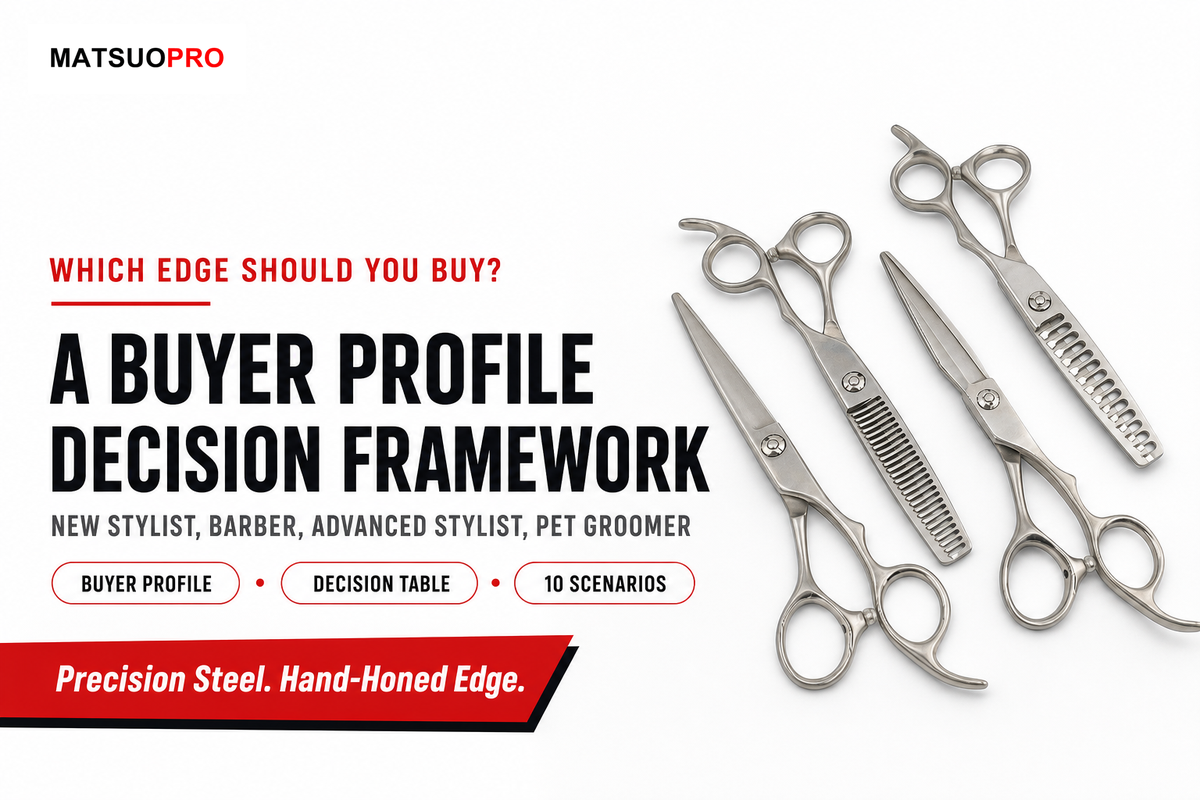
Match your dominant cutting technique and your realistic access to a qualified sharpener before you match your budget — buying convex without confirming either one first means paying a real premium for a glide advantage you cannot actually maintain or use in daily practice.
| Buyer Profile / Type | Recommended Edge Type | Why | Disqualifying Condition |
|---|---|---|---|
| New stylist, first year (professional shear range) | Bevel or semi-convex | Tolerates inconsistent handling and cheaper, more available sharpening while technique develops | If you already do heavy slide-cutting work in training, semi-convex may fit better than full bevel |
| Working barber, mostly blunt/club cuts (barber shear range) | Bevel | Durability matters more than glide for the dominant technique | Not disqualified by occasional slide work, only by regular advanced technique volume |
| Advanced stylist, slide/point/dry-cut heavy, or left-handed (true left-handed range) | Convex | Glide advantage is used daily enough to justify the sharpening cost and access requirement | Disqualified if no convex-capable sharpener is reachable within a reasonable service radius |
| Pet groomer, mixed coat types (pet-grooming range) | Semi-convex or bevel depending on coat density | Denser, coarser coats favor edge durability over glide | Full convex is not disqualified, but the maintenance overhead is harder to justify against fur versus human hair |
| Session or editorial stylist, heavy dry-cutting workload | Convex | Dry hair’s extra resistance rewards the finer, flat-free glide most directly | Disqualified on the same access/turnaround grounds as any other convex buyer |
| Salon owner buying a shared team set | Bevel | Lower per-pair sharpening cost and wider sharpener availability scale better across a multi-stylist team | Not disqualified if the team’s dominant work is advanced slide/point technique |
| Stylist switching from bevel toward convex mid-career | Semi-convex first | Semi-convex gives some glide without the full sharpening-access commitment while technique adapts | Skip straight to full convex only once a convex-capable sharpener is already confirmed |
| Stylist in a market with no convex-capable sharpener nearby | Bevel or semi-convex | Sharpening access is the hard constraint, independent of technique preference | Not disqualified by wanting convex eventually; revisit once access changes |
| High-volume barbershop, daily blunt/club work | Bevel | Edge-holding durability under heavy daily straight-line cutting outweighs glide | Not disqualified by occasional finishing work mixed into the day |
Delay a convex purchase when your sharpening turnaround runs longer than three to four weeks and you cut daily, when your current technique mix is mostly blunt cutting, or when the budget gap between convex and bevel would come out of an early-career training budget you need for other tools first.
A convex edge left unsharpened past its service window doesn’t fail gracefully the way a bevel edge does — it dulls its glide characteristic and starts pushing hair on slide work, which is the exact problem convex was supposed to solve. If your local market has no sharpener who explicitly services convex edges, the realistic cost isn’t just money, it’s shipping shears out and working without your primary pair during the wait. Newer stylists still building technique volume, and still deciding whether slide and point work will become a large share of the work week, get more practical value putting that budget toward a well-maintained bevel or semi-convex pair first and revisiting convex once the technique mix and the local sharpening access are both confirmed.
Mackay runs scissor manufacturing across facilities in Guangzhou and Zhangjiagang, China, putting each pair through 80-plus process steps. The convex-angle and HRC figures here are our own published specifications; the industrial edge-angle figure is Wolff Industries’ published number, credited as theirs. Rockwell references are to the ASTM/ISO test-method standards, not a claim they list scissor values. Reviewed by the MATSUOPRO / Mackay Hair Scissors technical team.
MATSUOPRO is the Mackay Hair Scissors manufacturing brand for professional hairdressing shears, barber scissors, thinning shears, and pet-grooming scissors. We support salons, distributors, academies, grooming brands, and private-label buyers that need factory-direct production with practical material guidance.
Our buying guides are written to help purchasers compare steel grades, handle styles, blade geometry, surface finishes, logo options, packaging, MOQ, and sample validation before placing an OEM or wholesale order. The goal is to make each scissors specification easier to discuss with a real production team.
Factory-direct supply since 2014, with product lines covering professional cutting shears, barber shears, thinning scissors, texturizing scissors, left-handed models, and pet grooming scissors for international B2B customers.
We focus on Japanese 440C, VG10, and ATS-314 steel choices, convex and bevel edge geometry, ergonomic handle balance, tension systems, logo engraving, private-label packaging, and sample-based OEM confirmation.